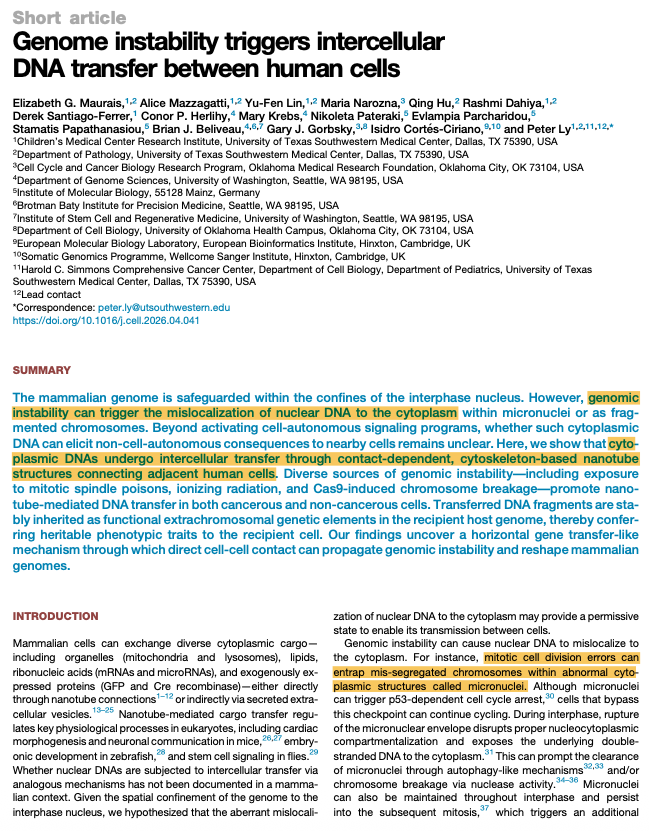
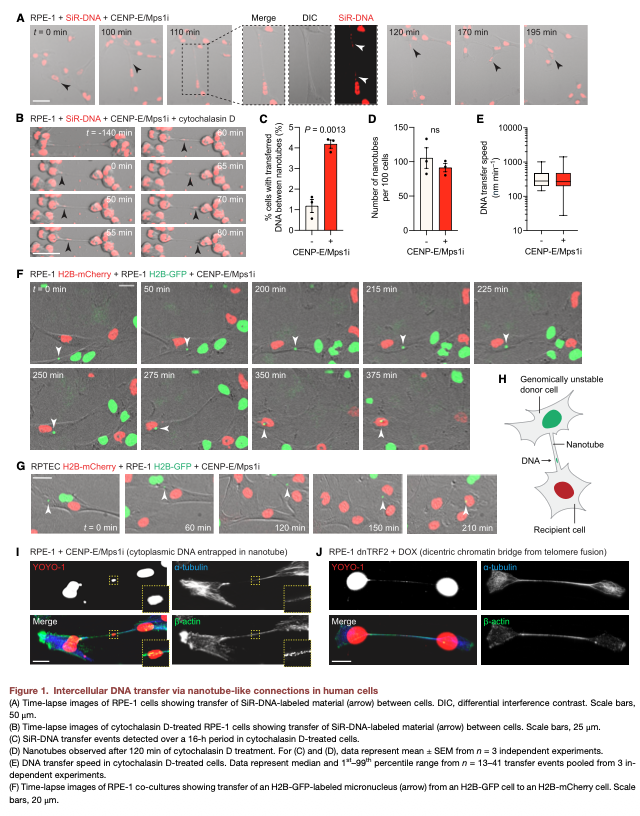
My favorite paper this week: Human cells with damaged genomes (from cancer, radiation, or even CRISPR editing) grow tube-like bridges to their neighbors and send them broken chromosomes. The transferred DNA sticks around in the receiving cell and remains functional.
This paper is really cool, and hints at *so many* interesting questions, but it’s important to caveat that it isn’t the first time people have seen DNA moving between human cells! There’s a 2013 paper (Jin Cai et al.) that shows extracellular vesicles (membrane-enclosed bubbles that bleb off cell membranes) can also carry DNA between cells. A similar thing happens with “apoptotic bodies.” Basically, when a cell dies, pieces of that cell will form into little spheres, some of which contain DNA. These “apoptotic bodies” are then engulfed by neighboring cells, which take up their DNA and (sometimes) incorporate the sequences into their own genomes. (See the Holmgren et al. paper from 1999.)
People had even shown that nanotubes can swap DNA between cells! They hadn’t seen this with nuclear DNA, though; mostly mitochondrial DNA and various RNAs. This paper, then, is extremely original and exciting, yet sits within a rich subfield of cell-cell DNA transfers.
The experiment was extremely simple. The researchers grew two types of human cells together in a dish. They tagged the histones in each cell type with a different fluorescent color; one green and the other red. Next, they exposed the cells to drugs that interfere with mitosis and recorded time-lapse videos. In one of these videos, they literally watched as DNA tagged with one color moved — through the thin nanotubes — into a cell with the other color. This happened not only with mitosis-blocking drugs, but also with CRISPR-induced chromosome breaks and radiation. The transferred DNA remained functional, too; they were transcribed into RNA and translated into protein.
(Sidebar: It seems like this whole discovery was an accident. The group behind this paper had previously studied what happens to nuclear DNA when chromosomes break using exactly the same techniques and drugs. But it seems like they never expected to see this transfer happen between cells. They write in the paper: “Surprisingly, using live-cell imaging to monitor cytoplasmic DNA labeled with a double-stranded DNA-specific fluorescent dye, we observed the apparent transfer of DNA from the cytoplasm of donor cells to neighboring recipient cells.”)
It’s not clear to me how important this might prove for, say, cancer. But the authors point at some intriguing ideas. Maybe the transfer of DNA between cells “mimics” some of the genome architectures we see in cancer cells, for example. Perhaps “DNA transfer could generate genomic alterations in recipient cells that resemble whole-chromosome gains or non-tandem duplications, challenging the assumption that these changes originate exclusively from cell-autonomous mitotic defects.”
The researchers also speculate that DNA transfers could “potentially enable genomically unstable cancer cells to disseminate oncogenic alleles, deleterious mutations, and/or regulatory elements to neighboring non-cancerous cells.” If this turns out to be true, nanotubes could be a useful target for cancer therapies.
Anyway, I love papers like this, where it feels like a whole swath of questions suddenly arises from beneath your feet. There is so much work to be done, and biology goes ever deeper.
Looking for researchers who share our vision of programming biology and building tangible products that impact everyday lives in the real world!
Lab website: https://t.co/zGw7EQv4ZR
Machine learning for biology postdoc: https://t.co/nkAAwNtpzL
Biological design postdoc: https://t.co/hOAWf5E1ZO
Molecular technology development scientist: https://t.co/X5c6ufpWuF
Biochemistry scientist: https://t.co/0XqhTGUZZJ
AI is cool and all... but a new paper in @ScienceMagazine kind of figured out the origin of life?
The paper reports the discovery of a simple 45-nucleotide RNA molecule that can perfectly copy itself.
Our updated manuscript with the late, great Charles Kirkpatrick, a force in Clin. Immunology for 60 yrs. We found that B cell immunodeficient patients of his had a hypomorph variant in EZH2 caused by a defect in allostery. https://t.co/0Y98PJbiMP
If you're a senior researcher (i.e., associate professor or more senior), and you'd consider moving to the University of Toronto to take up a Canada Impact+ Research Chair (1 million/year in funding), email me. Discretion guaranteed.
++Please share to help me spread the word!++
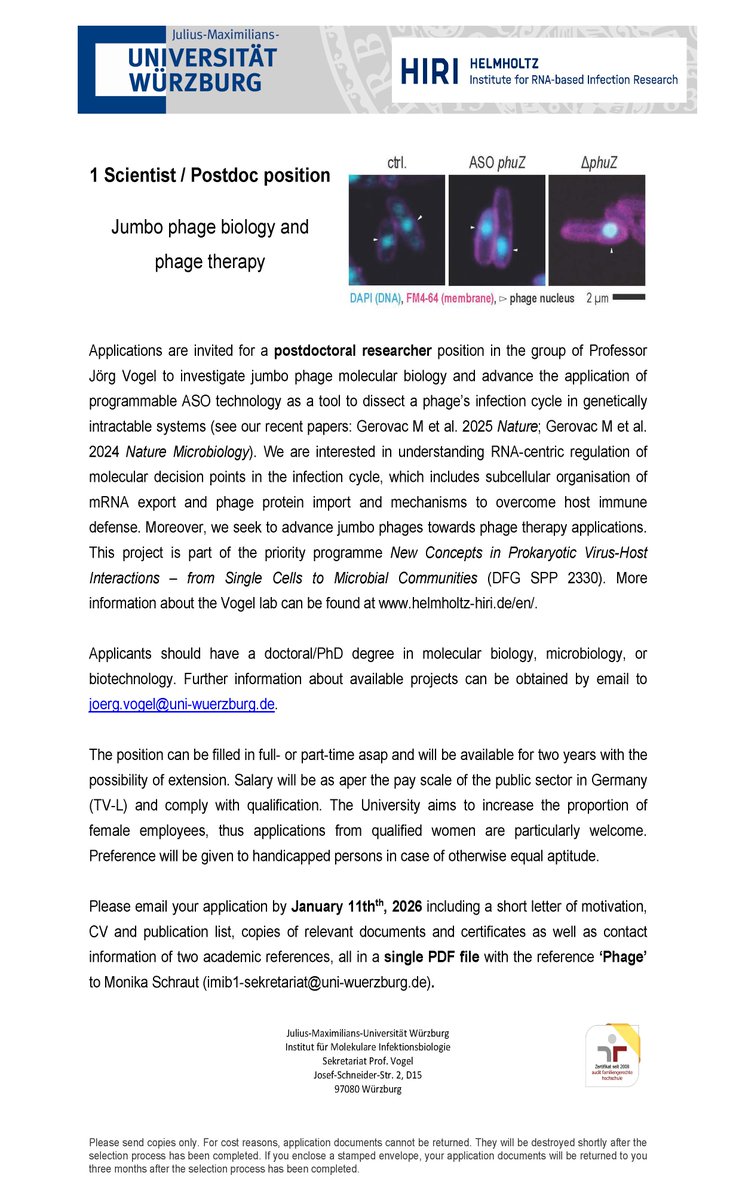
Looking for a POSTDOC to work on jumbo phages (those with large genomes and fascinating cell biology), using our latest ASO technology (Gerovac M et al. 2025 Nature) to define RNA export mechanisms as well as to help advance phage therapy. Here's the job ad.
@lpolgreen@MacaesBruno You may need to doze off after taking it. If you happen to be in Kashmir and wanna grab a cup of coffee in your free time. Let me know, would love to meet you.
Nature Research Briefings are a really cool idea. Here's one describing our antimicrobial ASO technology to study phages, to appear in this week's print version of Nature. Gives a bit of background how we got there.
https://t.co/WCTMq3besh
Does RNA inhibit PRC2?
This new preprint says yes, but it depends on the sequence!
Love following the ever-evolving PRC2–RNA saga.
https://t.co/agNsnYx9si
Online Now: VEL-dependent polymerization maintains the chromatin association of Polycomb proteins for the switch to epigenetic silencing https://t.co/tGYPX948D8