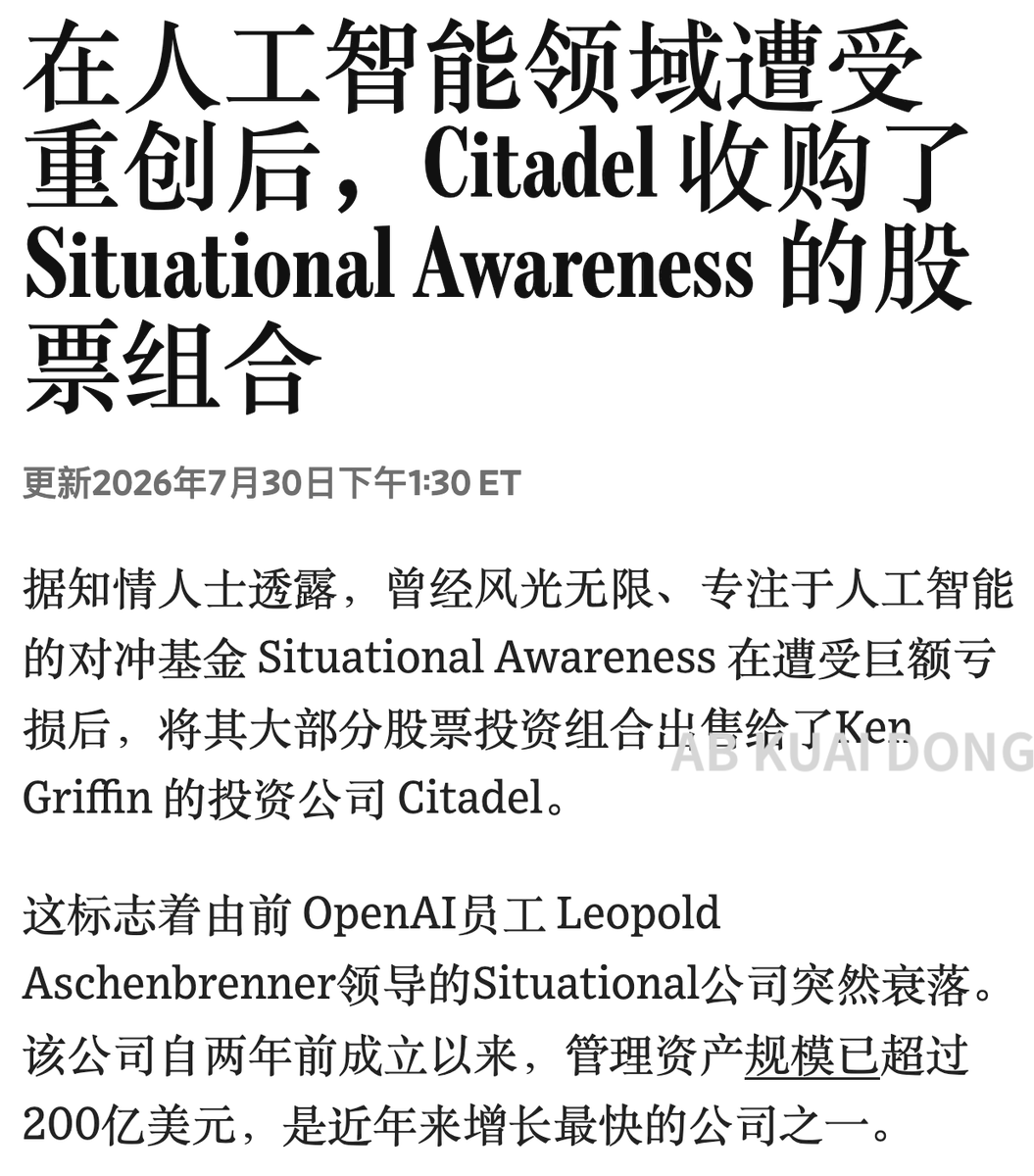
随着交易的完成,收购 AI 股神 Leopold 剩下股票持仓,捡到便宜筹码的,被曝是 Citadel 城堡对冲基金,它由华尔街老油条 Kenneth Griffin 率领。
戏剧性的是,城堡对冲基金曾发表,7 月美联储意外加息,给市场带来恐慌,间接加速 AI 股票下跌,迫使 Leopold 的 4 倍杠杆基金在低点平仓。
这也让 Citadel 城堡对冲基金,能低价买入 AI 股神 Leopold 基金的剩余持仓,此时它们的基金,已缩水至约 100 亿美元的水平。
2026 年最狠的资本市场故事,年轻的 AI 股神,被华尔街老油条狠狠干了。
There’s a reason for the saying that, when it comes to memory semiconductors, you shouldn’t trust anyone but Korean analysts, lol.
KIS is a veteran in this field.
Not only KIS, but veteran analysts at Citi, Meritz, and elsewhere all lowered their earnings estimates for SK hynix.
Warren Buffett: "If we can't make a decision in five minutes, we can't make it in five months."
In a Q&A, a shareholder from Munich, Germany asks Buffett a specific question: how large is the universe of companies whose intrinsic value he carries in his head — the ones he could act on within a day or two if the market offered an attractive price?
Buffett doesn't give a number. He reframes the question entirely.
Speed, he explains, doesn't come from knowing more. It comes from refusing to think about most things at all.
"Our immediate decision is whether we can figure out what's being offered to us or not. I mean, there's a go no-go signal."
That signal fires almost immediately:
"Charlie and I are often thought to be rude when we think we're just being polite and not wasting the other person's time. So, as they start mid-sentence in their first conversation with us, we just say, 'Forget it.'"
He continues:
"We know very, very, very early in the conversation whether somebody's talking about something that there's any chance is actionable by us, and we don't worry about the ones we miss."
The filter isn't about the quality of the opportunity. It's about whether Buffett is equipped to judge it:
"We want to make sure that we don't waste any time thinking about things that, when we got all through thinking about them, we're not going to know enough to make the decision on. So we just rule those out, and that rules a lot of things out."
What survives that filter gets decided on immediately:
"So we make decisions—we can make a decision in five minutes very easily. I mean, it just is not that complicated."
Then comes the line that explains the whole system:
"If we can't make a decision in five minutes, we can't make it in five months. You know, there's—we're not going to learn enough in the following five months to make up for the fact that we went in deficient in the first place."
Deliberation doesn't fix a knowledge deficit. If you weren't already competent to judge the thing, five months of study won't close the gap — it will only manufacture the confidence to act badly.
So when the input arrives — a phone call about a business for sale, or a price in a newspaper, a magazine, an annual report, a 10-K — the only thing Buffett is looking for is a "significant differential between price and value." If it's there, "we move right then."
"And Charlie and I don't need to talk to each other about it; I mean, we both think the same way and we have generally similar spheres of knowledge."
Charlie Munger then names the mechanism directly:
"The answer to your question is we can make a lot of decisions about a lot of things very fast and very easily, and we're unusual in that respect. And the reason we're able to do that is there's such an enormous other lot of things that we won't allow ourselves to think about at all. It's just that simple."
He gives his own example:
"I have a little phrase when people make pitches to me, and about halfway through the first sentence I say, 'We don't do startups; they don't exist.' Well, if you blot out startups, there's a whole layer of complexity that goes out of your life."
And he confirms this is a system, not a one-off:
"And we've got other little 'blotter out' systems, and using those we finally find out that what remains is still a pretty large territory that we can handle."
Buffett closes with the part most people get backwards:
"We waste—I would say we waste a lot of time, but we waste it on things we want to waste our time on. And then we're very selective about that, and then we're good at it."
The five-minute decision is not actually made in five minutes.
Source: 2008 Berkshire Hathaway Annual Meeting