Since the 1960s, the genetic code has been used to predict protein sequences from DNA and mRNA sequences. Our @Nature article demonstrates that these predictions miss thousands of protein sequences present in human tissues.
Across >1,000 human samples, we identified numerous abundant proteins whose amino acid sequences differ from those predicted by the genetic code.
These proteins are not rare translation byproducts. They accumulate to thousands of copies per cell. Some are more abundant than the proteins predicted by the genetic code from the same transcripts.
Their abundance reflects a combination of alternate RNA decoding mechanisms — including codon-anticodon mismatches, tRNA abundance, and RNA modifications — and selective stabilization of the resulting proteins. The last factor – protein stability – emerges as a major determinant of protein abundance across proteins, proteoforms and cell types: https://t.co/IzOfAZKnxT
Alternate RNA decoding is pervasive across functional groups of proteins, healthy and diseased tissues. It affects proteins playing key roles in neurodegeneration, and some alternately decoded proteins show strong enrichment in tumors compared to their surrounding tissues.
This discovery has been a long and exhilarating journey with Shira Tsour and the @slavovLab team. It started in 2019 and proceeded through many challenges and thrilling highs. A journey that has opened new perspectives that we long to explore!
1/
Excited to share our new preprint "Genetic code expansion enables plant-directed control of bacterial activity", a fantastic collaboration with @kunjapur lab!
https://t.co/JDQZfRkpzY
Apply to the Microbial Fuel Cells MudTronics competition: https://t.co/9NimkCyJ4P
MudTronics is a collaborative competition that brings together bio, tech, and art/design to explore what we can do with microbial fuel cells.
Deadline June 6th, 2026
1/ Excited to share our new paper in Science: “Toward life with a 19-amino acid alphabet through generative artificial intelligence design.” @ColumbiaSysBio@ColumbiaBME@Columbia
https://t.co/ZT3Ygw9tiG 🦠🧬🛠️🖥️💥
Excited to share our new paper in @NatureChemistry!
Building on our Rare Codon Recoding (RCR) work @ScienceMagazine, we developed a multi-rare-codon strategy enabling the simultaneous incorporation of up to 5 distinct ncAAs in mammalian cells!
https://t.co/tLp3wZTQ9U
Simultaneous in vitro expression of minimal 21 transfer RNAs by tRNA array method
by Miyachi, R., Masuda, K., Shimizu, Y., Ichihashi, N.
https://t.co/lO0PBPcRuz
If you are an highschool student and you are conducting research in a lab, you are a scientist.
If you are an undergraduate student and you are conducting research in a lab, you are a scientist.
Machine learning-guided evolution of pyrrolysyl-tRNA synthetase for improved incorporation efficiency of diverse noncanonical amino acids
https://t.co/WFOmxDhlsa
Michelle Chang of @PrincetonChem and colleagues publish in @NChemBio: “Terminal alkyne formation by a pyridoxal phosphate-dependent enzyme.”
Great work! https://t.co/DRkPaXNYyc
2 of 2: Instead of activating a water molecule for hydrolysis, as previously thought, release factors induce a structural change in the transfer RNA, enabling its own 2’OH group to attack and break the bond, a universal process in all organisms.
https://t.co/pnvjwTpz0V
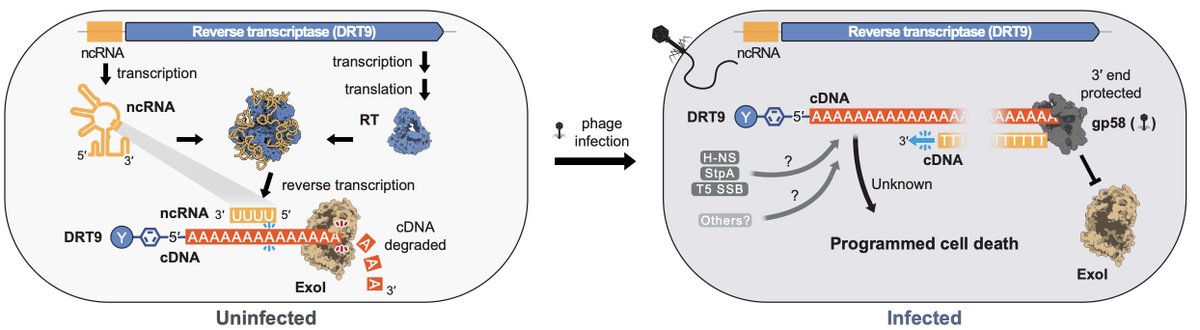
Excited to share our newest paper, online today @Nature! We report the discovery of a highly unusual mechanism of antiviral immunity through the synthesis of long, homopolymeric DNA.
https://t.co/0TV9jrPWrs
Happy to share the peer-reviewed and updated version of our work on OrthoRep-driven evolution of aaRSs for genetic code expansion with unnatural amino acids. Congrats to @yuichi_furuhata, a true master bioengineer, on leading this excellent work! https://t.co/2iYPAg0yq8