Solving boring (read:majority) problems from first principles; Recovering hard hitting developer who now values spending more cycles in the problem domain
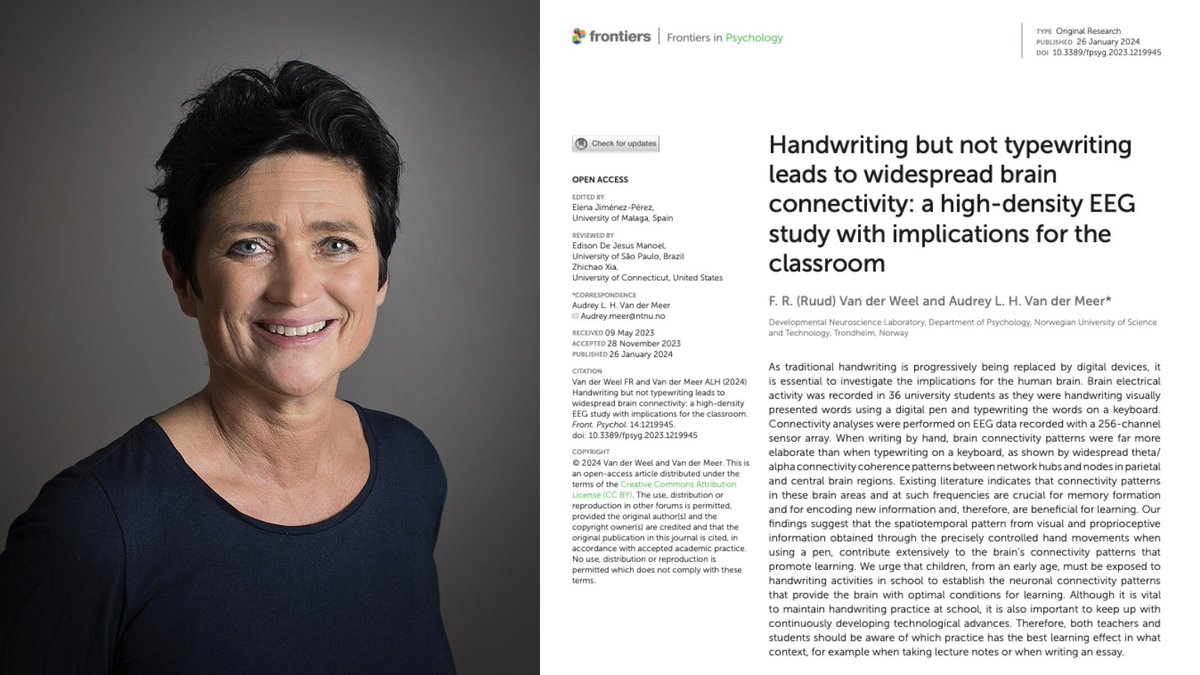
A Norwegian neuroscientist spent 20 years proving that the act of writing by hand changes the human brain in ways typing physically cannot, and almost nobody outside her field has read the paper.
Her name is Audrey van der Meer.
She runs a brain research lab in Trondheim, and the paper that closed the argument was published in 2024 in a journal called Frontiers in Psychology. The finding is brutal enough that it should have changed every classroom on Earth.
The experiment was simple. She recruited 36 university students and put each one in a cap with 256 sensors pressed against their scalp to record brain activity. Words flashed on a screen one at a time.
Sometimes the students wrote the word by hand on a touchscreen using a digital pen, and sometimes they typed the same word on a keyboard. Every neural response was recorded for the full five seconds the word stayed on screen.
Then her team looked at the part of the data most researchers had ignored for years, which is how different parts of the brain were communicating with each other during the task.
When the students wrote by hand, the brain lit up everywhere at once.
The regions responsible for memory, sensory integration, and the encoding of new information were all firing together in a coordinated pattern that spread across the entire cortex. The whole network was awake and connected.
When the same students typed the same word, that pattern collapsed almost completely.
Most of the brain went quiet, and the connections between regions that had been alive seconds earlier were nowhere to be found on the EEG.
Same word, same brain, same person, and two completely different neurological events.
The reason turned out to be something nobody had really paid attention to before her work. Writing by hand is not one motion but a sequence of thousands of tiny micro-movements coordinated with your eyes in real time, where each letter is a different shape that requires the brain to solve a slightly different spatial problem.
Your fingers, wrist, vision, and the parts of your brain that track position in space are all working together to produce one letter, then the next, then the next.
Typing throws all of that away. Every key on a keyboard requires the exact same finger motion regardless of which letter you are pressing, which means the brain has almost nothing to integrate and almost no problem to solve.
Van der Meer said it plainly in her interviews.
Pressing the same key with the same finger over and over does not stimulate the brain in any meaningful way, and she pointed out something that should scare every parent who handed their kid an iPad.
Children who learn to read and write on tablets often cannot tell letters like b and d apart, because they have never physically felt with their bodies what it takes to actually produce those letters on a page.
A decade before her, two researchers at Princeton ran the same fight using a completely different method and ended up at the same answer. Pam Mueller and Daniel Oppenheimer tested 327 students across three experiments, where half took notes on laptops with the internet disabled and half took notes by hand, before testing everyone on what they actually understood from the lectures they had watched.
The handwriting group won by a wide margin on every question that required real understanding rather than surface recall.
The reason was hiding in the transcripts of what the two groups had actually written down.
The laptop students typed almost word for word, capturing more total content but processing almost none of it as they went, while the handwriting students physically could not write fast enough to transcribe a lecture in real time, which forced them to listen carefully, decide what actually mattered, and put it in their own words on the page.
That single act of choosing what to keep was the learning itself, and the keyboard had quietly skipped the choosing and skipped the learning along with it.
Two studies. Two countries. Same answer.
Handwriting makes the brain work. Typing lets it coast.
Every note you have ever typed instead of written went into your brain through a thinner pipe. Every meeting, every book highlight, every idea you captured on your phone instead of on paper was processed at half depth.
You did not forget those things because your memory is bad. You forgot them because typing never woke the part of the brain that would have made them stick.
The fix is the thing your grandmother already knew.
Pick up a pen. Write the thing down. The slower road is the faster one.
Built rp1 as a lighter take on BMAD-style frameworks: less ceremony, but just as structured. It uses constitutional prompting, research-based epistemic checks, project context, and durable artifacts so AI coding produces better outputs with managed intent. https://t.co/WETaog1r1b
New @thepeelpod with @jimbelosic
Jim bootstrapped @sendcutsend to a $140 million revenue run rate in eight years.
We talk building a sheet metal manufacturing business in the US, creative ways he financed the company early on, using speed, trust, and software to compete with overseas competitors, lessons from restaurants, and why you can’t run factories from a spreadsheet.
Thank you to @Numeral, @FlexSuperApp, and @Amplitude_HQ for supporting this episode!
Timestamps:
0:16 Automating sheet metal manufacturing
5:59 Zero to $140 million ARR in 8 years
7:58 Acquiring a $750k laser with $0
13:38 Automating factories is like baking cookies
15:17 Being legible to capital
17:31 Unlocking custom, low order manufacturing with software
20:00 Building more factories instead of selling the software
24:50 Run your company like a lemonade stand
28:30 Raising an angel round in 2021 as a safety net
33:21 SendCutSend’s unique bottoms-up GTM
38:24 Fun coupons
40:12 Building a moat with speed and trust
45:55 How US factories can beat China
47:40 Gaslight product launches
52:05 Lessons from non-manufacturing businesses
55:19 You can’t run a factory from a spreadsheet
58:10 Using data in manufacturing
59:50 Lessons from Factorio
1:03:17 Unlocking a negative cash conversion cycle
1:06:14 You need to resist automating everything
1:13:51 Surviving COVID with six weeks of cash
1:15:47 Solving the US skilled labor shortage
1:26:17 Teaching kids about manufacturing
@rasmus1610 Agree. It’s fascinating when you build (or assemble) stuff from the ground up to learn how something is put together, you start to see how much complexity gets added by designing for crazy scale which 99% products don’t need.
@Dave_DotNet@ICooper When everything is public “by default”, it looses its meaning. I keep class & ctors internal by default, making them public only required. Or when a method’s domain has large valid inputs, I refactor it into a general purpose public utility function.
Want to know how we build products here @Cloudflare? Well, we build 'em on Workers.
We re-built Queues using a new sharded Durable Object architecture to reduce write latency, significantly improve per-queue throughput, and set us up for future scale: https://t.co/HZI4sMfUrb
“ Israel isn’t at war with Sinwar, or Hamas. Israel is at war with the Palestinian people”
This interview w Daniel Levy should
be aired on every TV channel in both the US & Europe.
This is not the right way to use AI for learning/growing as a programmer! You need to ask the AI:
1) What are other ways we could write this code? What are the pros and cons of those approaches?
2) Explain this code from the perspective of a <your language> programmer. What things are easier and what is harder?
3) Are there ways of refactoring this code to be more modular, readable, and robust?
4) What are common mistakes people make when writing code like this? Show examples
If you use AI lazily to just write the code then yeah it’s gonna impact your learning. However you can prompt the AI to actively tutor you and use it thoughtfully. This is for any area you are trying to learn, not just coding.
Today we’re excited to feature RAGApp v0.1 - which lets any user construct a multi-agent application 🎨🤖 without writing a single line of code 💫
Add any number of agents that you wish, and assign each agent a role, system prompt, and a set of tools.
In this example, use a researcher, analyst, and report generation agent to write a news article. This directly generates a full chat interface where you can ask questions and get back answers with full streaming and sources.
Huge shoutout to @MarcusSchiesser for working on this!
RAGApp: https://t.co/6QXEF8CBVZ
create-llama: https://t.co/xFsws3ku26
If you want finer control, you can define your own agentic workflows through code: https://t.co/EbUH0QJ1VN
This is amaaaazing! This must be the best way to get started with GPU programming now
Literally, as you type each char, it creates and runs GPU in real time, runs it, and reports the results.🤯
I didn't expect to see a FastHTML/gpu.cpp cross-over… let alone something so cool.