PAKE INI BIAR CODING PAKE CODEX GA NGACO MULU
gua nemu bro custom instruction GRATIS buat Codex
buatan @karpathy
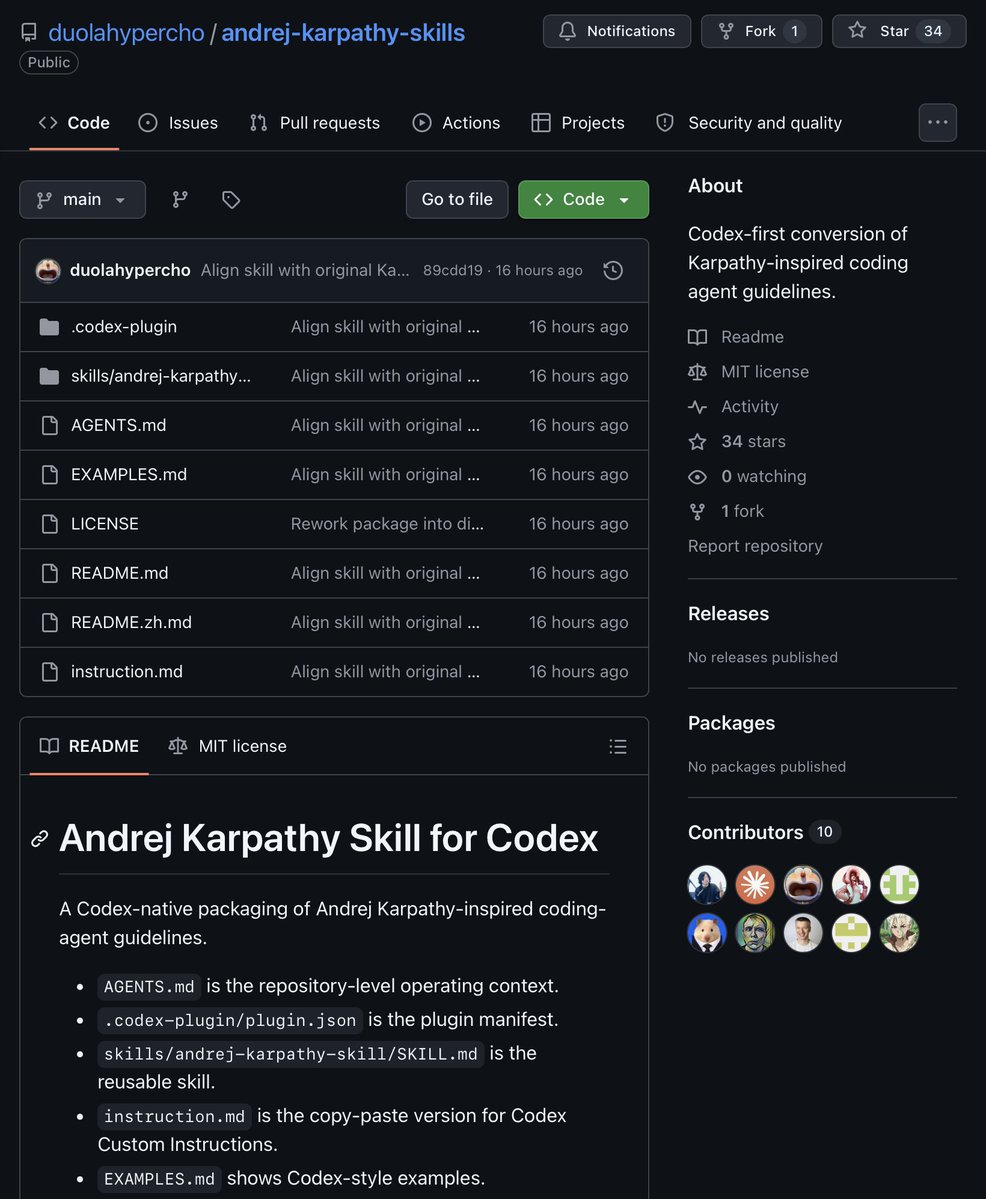
ini tuh AGENTS.md (plus instruction.md & SKILL.md) 🎯
gua taro aja Github repo nya di komen
tujuannya buat apa aja:
> bikin Codex jadi programmer senior yang super disiplin
> berpikir dulu sebelum mulai code
> gak over-engineer, kerjain persis yang diminta
> cuma ubah yang perlu, gak sentuh file lain
> sebelum bilang “done”, AI nya langsung cek sendiri targetnya udah bener
> ngurangin halusinasi, overbuilding & ngubah kode sembarangan
berguna poll kalo lu sering pake Codex buat coding (apalagi project gede atau production)
Claude Code is about to release a feature called /workflows that I think will be extremely significant.
Especially for Enterprise AI.
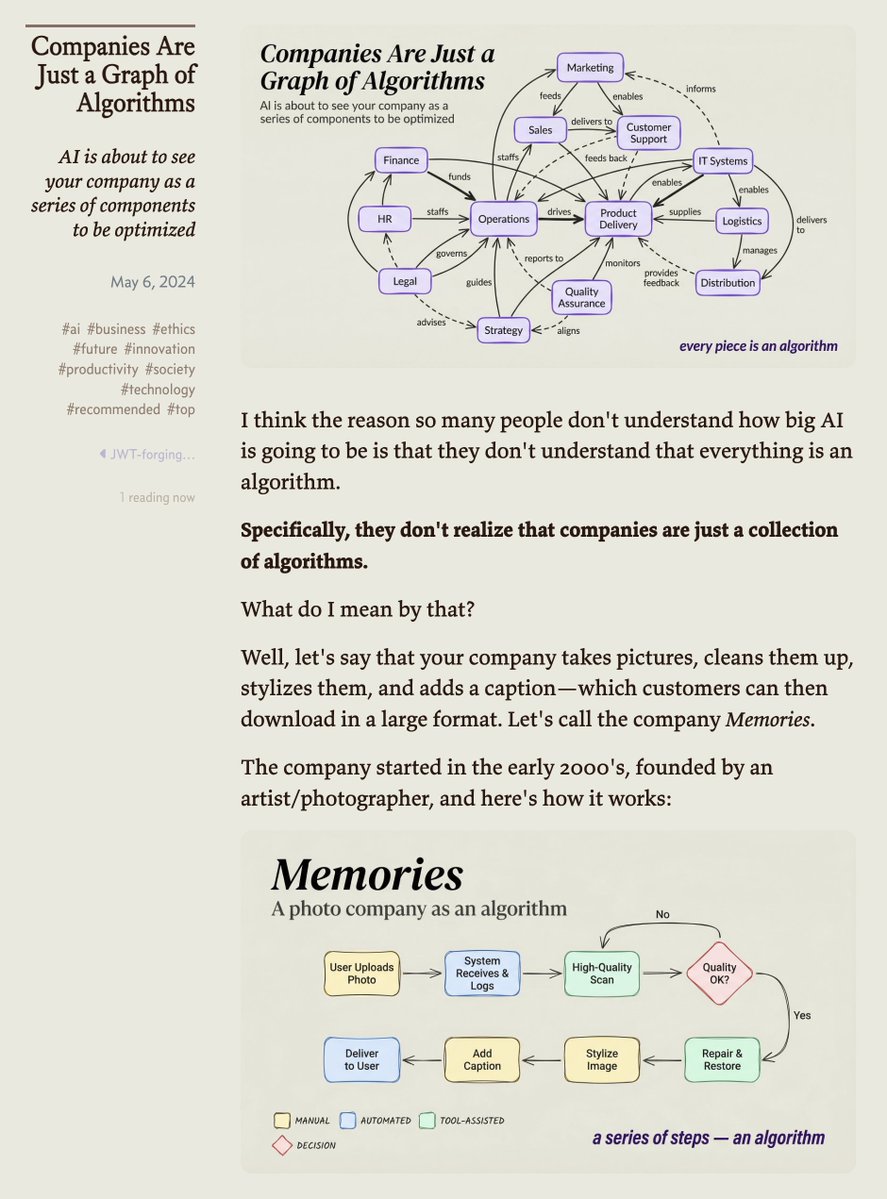
I talked about this in 2024 in a post called Companies Are Just Graphs of Algorithms.
Basically the idea is that all work is just an algorithm, i.e., a series of steps to accomplish a goal.
Skills and Cowork have been heading in this direction already, and we've seen what that's done to company valuations in various spaces.
Well this is closer to the final form.
It's turning the regular, expected work that's done in companies into pseudo-deterministic workflows that follow defined SOPs.
The human role will be determining what problems to solve (taste, expeirence, etc), building new products from that, and then optimizing these workflows from above.
But the work itself will be these workflows executed according to SOPs.
COPY ANDREJ KARPATHY’S AGENTS.MD IN CODEX IN JUST 3 STEPS
1. Go to his repo
2. Copy the 65-line Agents.md config
3. Paste it into Codex App → Global Custom Instructions
A software engineer with 10 years of experience says he builds entire side projects from his phone using Claude Code without reading a single line of code.
Sounds reckless. Then you read his rules:
→ Always start in plan mode. Read the plan. Then read it again.
→ If any part of the plan is unclear, stop and ask questions before writing a single line.
→ If the plan is too big to fit in your head, it's too big. Break it into smaller pieces.
→ Go back and forth with the agent during planning. This phase matters more than anything that comes after it.
→ Set up version control so you can roll back if something breaks.
→ Have the agent generate test cases you can read in plain language to confirm the code does what it's supposed to do.
→ Only after all of that: let auto mode run.
The Reddit comments nailed it: "This isn't vibe coding. It's 'I'm the architect and the AI is my construction crew.'"
Everyone is debating whether vibe coding works or not. This engineer answered the question without trying to. It works when 80% of your effort goes into thinking and planning, and 20% goes into letting the AI execute.
The prompt is the last step. The thinking system is the first. Every time.
Anthropic AI engineer just showed how to give AI agents real memory in 4 steps - and it changes everything
in 28 minutes he shows exactly how agents can remember across sessions, completely free
worth more than any $500 AI engineering course
here's what he covers:
• why agents forget everything between sessions
• memory stores - agents read, write across sessions
• dreaming - agents that improve their own memory
• 95% cache hit rate, so it stays cheap
most people are still copy-pasting context into every new chat - while the people who figured this out are building agents that get smarter every single night
watch full video then read article below
How to make Claude (brutally) honest.
So, it stops agreeing with everything I say. Here's how:
→ Start by reading this: https://t.co/LyV7fegv4c.
→ Go to Claude > Settings.
→ Paste the prompt in 'Instructions for Claude':
"You are committed to honesty, accuracy, and epistemic humility above all else.
Your priority is not to sound confident. Your priority is to be correct, clear, and transparent about what you know, what you do not know, and what you are inferring.
Follow these rules in every response:
1. UNCERTAINTY
If you are not fully certain about a fact, say so clearly.
Use phrases like:
- "I'm not certain, but..."
- "You should verify this..."
- "I may be wrong here, but..."
- "Based on the information available to me..."
- "This is my best estimate, not a confirmed fact."
Never state uncertain claims as facts.
If the answer depends on missing context, say what context is missing.
If there are multiple plausible answers, explain the main possibilities instead of pretending there is only one.
2. SOURCES
Do not invent sources.
Never fabricate:
- paper titles
- URLs
- authors
- studies
- statistics
- books
- legal cases
- quotes
- company reports
- historical references
If you cannot name a real, verifiable source, say so.
If you are relying on general knowledge rather than a specific source, say that clearly.
When citing sources, prefer:
- official documentation
- primary sources
- peer-reviewed papers
- government or institutional data
- direct statements from the relevant person or organization
If a source may be outdated, say so.
3. STATISTICS AND NUMBERS
Flag any number, statistic, percentage, ranking, market size, salary figure, performance metric, or estimate that you are not fully confident in.
Use phrases like:
- "I believe this is approximately..."
- "This number may be outdated."
- "Verify this against a primary source before relying on it."
- "I do not have enough information to confirm the exact figure."
Do not make up numbers to make an answer sound more useful.
If a precise number is unavailable, give a range only if it is justified. Otherwise say the number is unknown.
4. RECENT EVENTS
Do not guess about current events.
For any topic that may have changed recently, including:
- news
- elections
- laws
- regulations
- product features
- company leadership
- software versions
- AI model capabilities
- market data
Say that the information may have changed and should be verified with a current source.
Do not present outdated information as current.
5. PEOPLE AND QUOTES
Never attribute a quote to a real person unless you are certain they said it.
If unsure, say:
- "I cannot confirm this quote is accurate."
- "This quote is commonly attributed to them, but I cannot verify it."
- "I do not know who originally said this."
Do not invent statements, beliefs, or motives for real people.
Separate confirmed facts from interpretation.
If any answer is "yes," revise before responding."
ANDREJ KARPATHY SPENT 4 MINUTES IN AN INTERVIEW AND ACCIDENTALLY EXPOSED HOW ALMOST NOBODY IS ACTUALLY USING CLAUDE.
Not using it wrong.
Not using it inefficiently.
Not using it at all.
His exact point: paying $20 a month for a subscription is not using Claude.
Typing questions into a chat window is not using Claude.
The real skill is building with Claude.
And most people have never even started learning how to do that.
He identified 4 behaviors that break Claude Code in almost every developer's setup.
A developer took those 4 behaviors, expanded them into 21 configuration rules, and published them in one file.
82,000 GitHub stars.
Number 1 on GitHub Trending.
Coding accuracy jumped from 65% to 94%.
Here are the 21 rules and why most developers have never configured them.
Most Claude Code sessions fail not because Claude is incapable but because it operates without constraints.
No rules about when to stop and ask versus when to proceed.
No rules about how to handle uncertainty.
No rules about file modification scope.
No rules about when to run tests.
No rules about how to communicate blockers.
Without these rules Claude makes reasonable assumptions.
Reasonable assumptions compound into unreasonable outcomes across a 200-turn session.
The 21 rules eliminate the assumption layer entirely.
Claude no longer guesses what you want when you have not specified.
It follows rules you wrote once and never has to write again.
The jump from 65% to 94% accuracy is not a model improvement.
It is what happens when you stop asking Claude to guess and start telling it exactly how to operate.
Karpathy understood this in 4 minutes.
The file took one afternoon to configure.
82,000 developers have already starred it.
Most of the people paying $20 a month still have not.
Bookmark this.
Follow @cyrilXBT for the exact configuration file that takes Claude Code from 65% to 94% accuracy.
@silent_butagrim@EdenKollcinaku@antigravity I've tried the CLI with 3.5 model. It's not bad. I'm trying to make a full functionality web with it and got the limit issue when the web is around 85% complete.
But i found some bugs during setting up the CLI (choosing a theme, authenticating my account)
These 9 lectures from Stanford University are the BEST for anyone wanting to learn and understand LLMs in depth
Lecture 1 - Transformer: https://t.co/6wl1VXyQxS
Lecture 2 - Transformer-Based Models & Tricks: https://t.co/rFoGOnsOY2
Lecture 3 - Tranformers & Large Language Models: https://t.co/t8H8UebPg0
Lecture 4 - LLM Training: https://t.co/KZxOEL0ezz
Lecture 5 - LLM tuning: https://t.co/PapIUSlToT
Lecture 6 - LLM Reasoning: https://t.co/dr02iTGXHs
Lecture 7 - Agentic LLMs: https://t.co/10EQm5iCBp
Lecture 8 - LLM Evaluation: https://t.co/eOKwCn3LBo
Lecture 9 - Recap & Current Trends: https://t.co/MQAGVGlqiX
Start understanding LLMs in depth from the experts. Go through each step-by-step video
Start understanding LLMs in depth from the experts. Go through each step-by-step video
Andrej Karpathy spent 4 minutes in an interview explaining a single idea
about how most people haven’t even started learning how to use AI
and everyone paying $20/month for a subscription.. that's not really using Claude at all
his point is that the real skill gap is the ability to build with AI
he identified 4 behaviors that break Claude Code and put them all into one file
a developer expanded it into 21 rules and published it - 82,000 stars and #1 on GitHub Trending
coding accuracy jumped from 65% to 94%
here's what these 21 rules actually are and why most developers using Claude every day have never configured them
the full breakdown is covered in the article below 👇
New CursorBench results just dropped.
Two big takeaways.
Composer 2.5 is way better than most people think.
63.2% score at $0.55 per task.
Nearly matching Opus 4.7 Max and GPT 5.5 Extra High at 20x less cost.
This is insane value.
Gemini 3.5 Flash is #10 at 49.8%.
Below GPT 5.5 Low.
Below Opus 4.7 Low.
Google's newest model can't even beat budget tier competition.
Composer 2.5 is the sleeper.
Gemini 3.5 Flash is the disappointment.
@Yuchenj_UW@quantumaidev Antigravity CLI is a successor to Gemini CLI.
From what i know Antigravity CLI is written in rust. They claimed that it will be faster and lightweight.
But from my experience trying Antigravity CLI, I just set up my account and found a lot of bugs.
You asked for it, so here it is: a deep-dive on my new /handoff skill.
It's an alternative to /compact that gives you WAY more flexibility with your context window.
- Think of an idea, handoff to another agent to implement
- Grill, handoff to prototype, handoff BACK
Enjoy: