To make an LLM a strong dense retriever, you often need training…
But what if you only have a few-examples 🥩🥦 and no training budget?
Just add RICE 🍚, a simple way to turn your LLM into an effective dense retriever that requires zero training 👨🍳
📄 https://t.co/A1dQGj4ShG
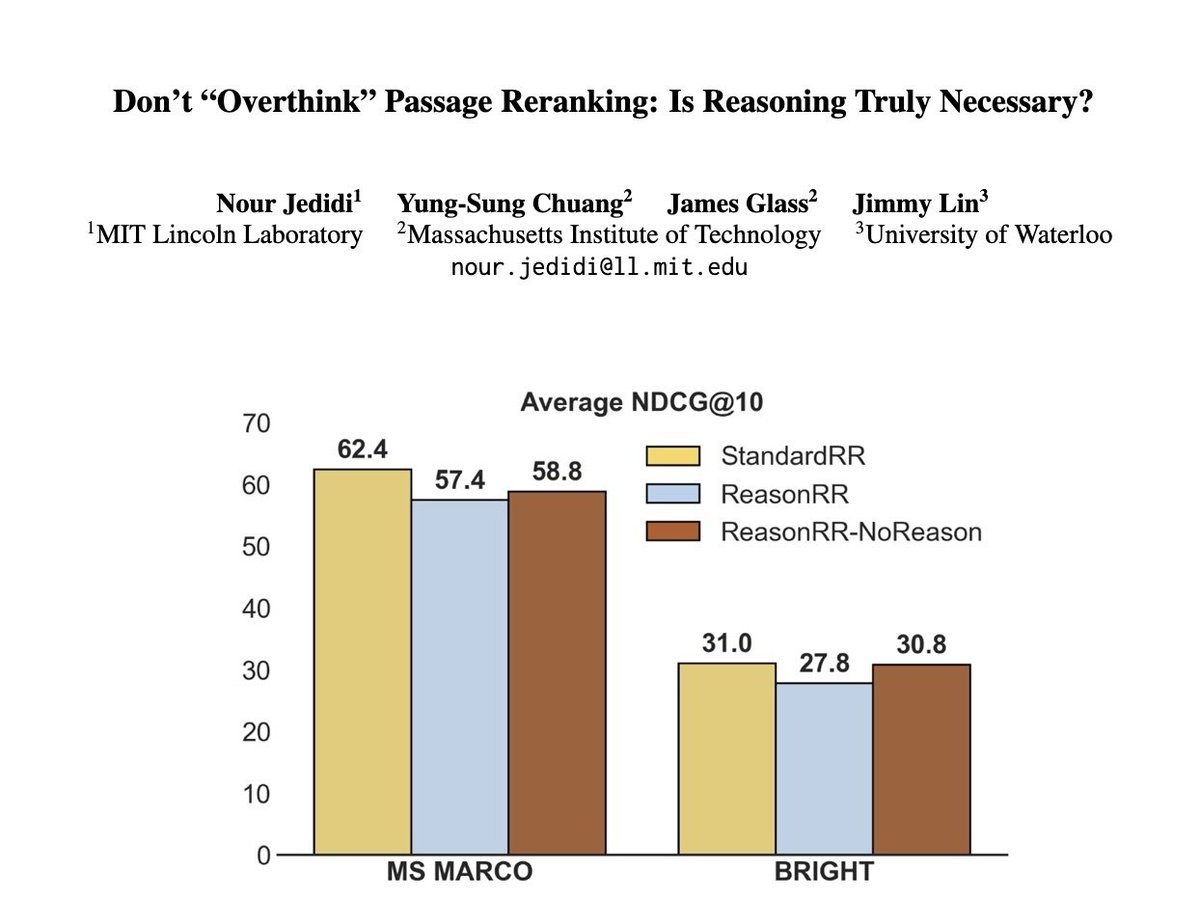
The official version of our paper “Don’t ‘Overthink’ Pointwise Reranking: Is Reasoning Truly Necessary?” is out! 🎉
📄 https://t.co/wPioDrMACN
See the 🧵 below for details! 👇
Excited to share that our paper was accepted to EMNLP Findings 🎉
We ask a simple question: Does reasoning improve pointwise rerankers?
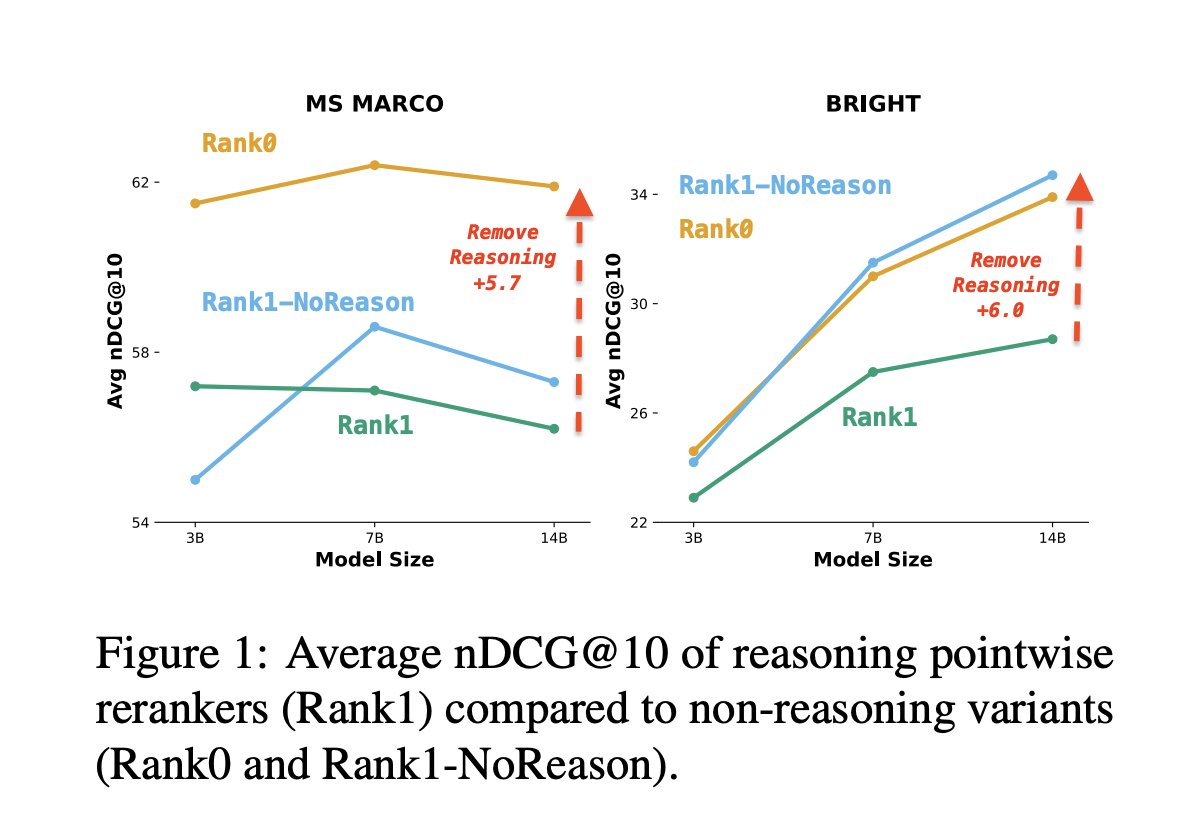
The answer? It can actually hurt... even for Rank1, a reranker trained to reason-then-answer 😱
📄 https://t.co/ZyL7fYghDL
What are we up to? 🏡 Project Greenhouse: Progress Toward Fully Open and Sovereign Agentic Search w/ @Sahel_Sharify@Lingwei_Gu@nour_jedidi https://t.co/QQgZ2rjwx0
@sivareddyg@sivareddyg thanks for the kind words!
This is an interesting idea! In-context examples could further refine the output-centric embeddings by steering it toward the kinds of outputs we want for retrieval - this may even work out of the box since LLM2Vec-Gen keeps LLM frozen too
To make an LLM a strong dense retriever, you often need training…
But what if you only have a few-examples 🥩🥦 and no training budget?
Just add RICE 🍚, a simple way to turn your LLM into an effective dense retriever that requires zero training 👨🍳
📄 https://t.co/A1dQGj4ShG
Excited to share that our paper was accepted to EMNLP Findings 🎉
We ask a simple question: Does reasoning improve pointwise rerankers?
The answer? It can actually hurt... even for Rank1, a reranker trained to reason-then-answer 😱
📄 https://t.co/ZyL7fYghDL
So, can reasoning still help pointwise rerankers? 🧐
We tried self-consistency, inverse training (answer-then-reason), and graded relevance labels, but none outperformed Rank0...
Our takeaway? For pointwise reranking, reasoning doesn’t give enough bang for the buck 💸
So, if you want dense embeddings and have an LLM but no training budget…don’t forget to add RICE 🍚👨🍳
This work was done with @abdbasitali, @hanglics, and @lintool!
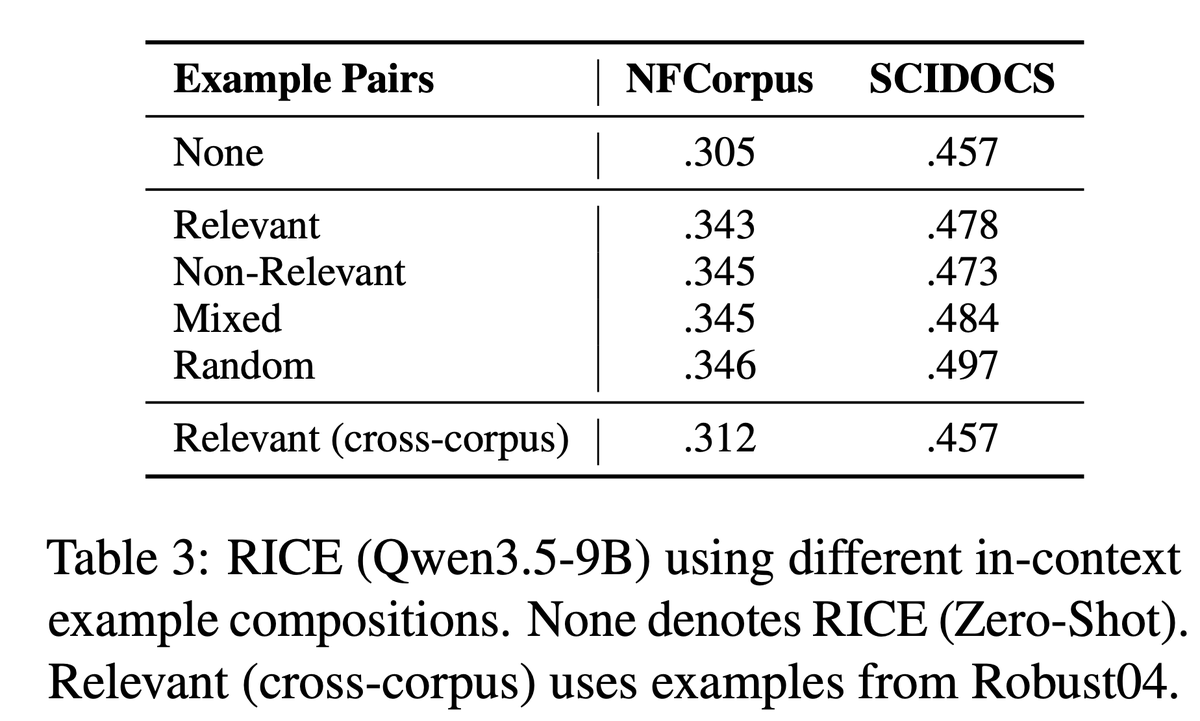
👉 Interestingly, correct query–document pairings isn’t the key ingredient 🤔
In our ablations, non-relevant and random pairs from the same corpus outperform relevant cross-corpus examples, suggesting the domain language matters more than the accuracy of the examples…
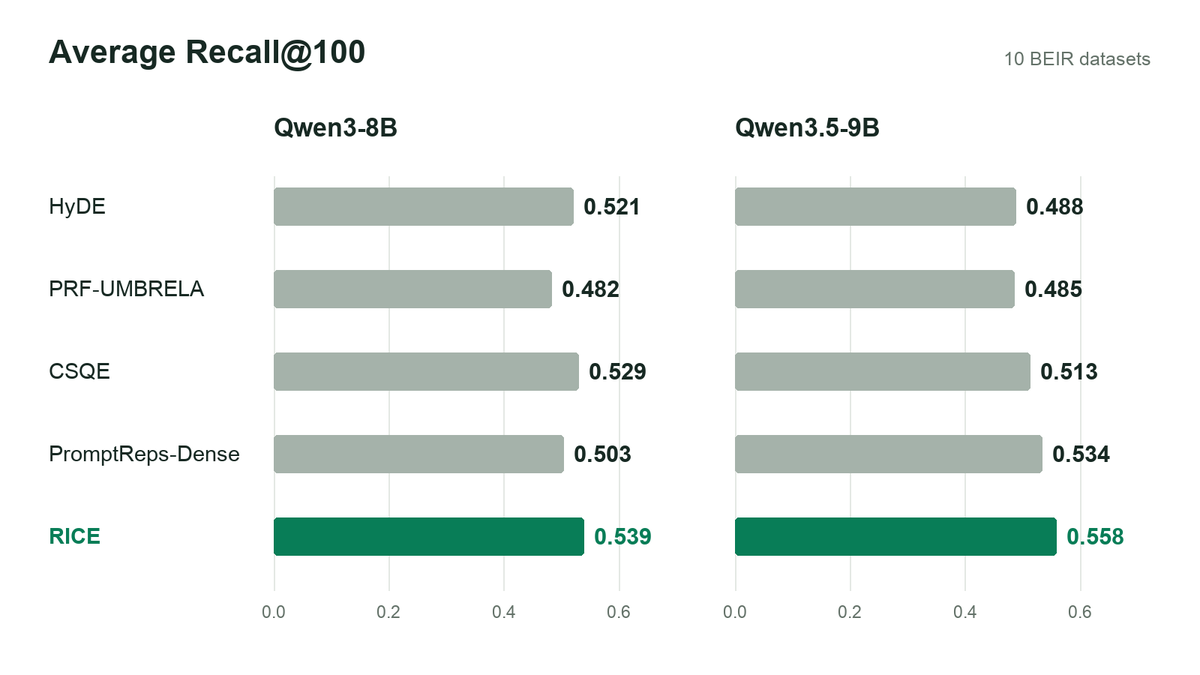
👉 Versus other dense retrieval methods like HyDE which work “out-of-the-box”, RICE 🍚 is the most effective
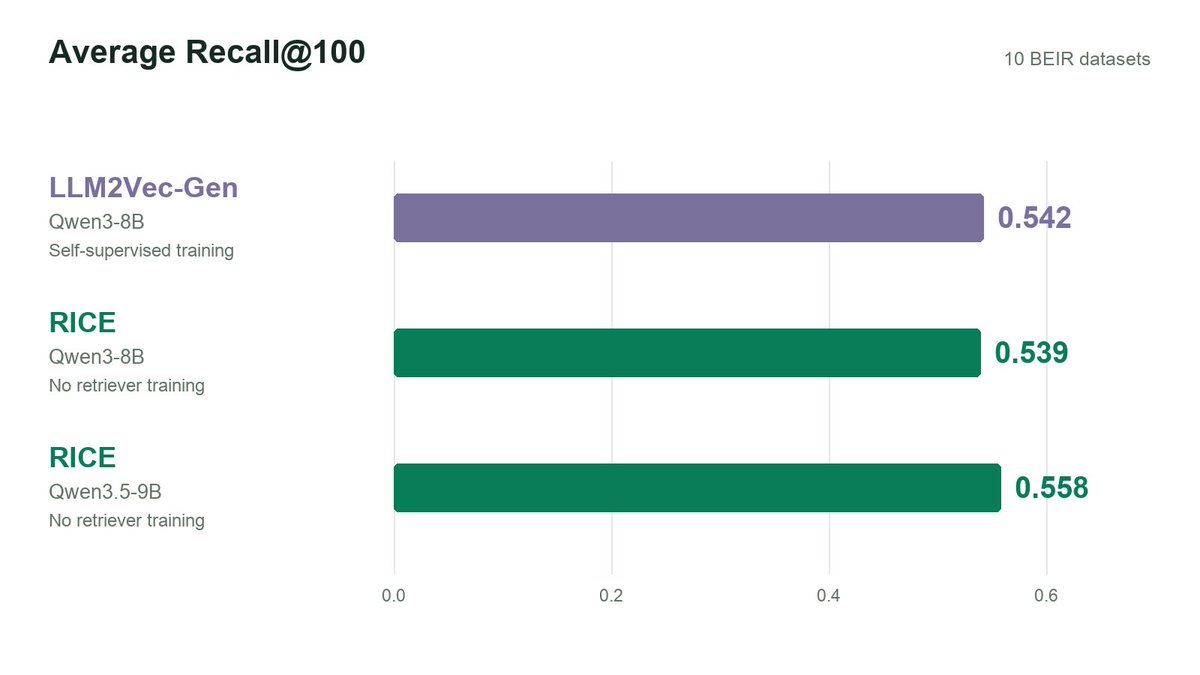
👉 Compared to LLM2Vec-Gen - an MTEB SOTA for self-supervised embeddings - RICE 🍚 remains competitive despite relying on *zero* parameter updates
The RICE recipe 👨🍳
1️⃣ Start with your few query–document pairs 🥩🥦
2️⃣ Use PromptReps to generate one representative word for each example document
3️⃣ Use these pairs and words as demonstrations when encoding both queries and documents
Here’s what we find 👇
This is what motivates our core question: Can we prompt LLMs, using a few human-labeled examples, to build effective representations for dense retrieval?
Our answer: Yes 🔥
The missing ingredient? RICE 🍚
First, how can we build dense retrievers with limited labeled data? 💡
1️⃣ Use your few examples to prompt an LLM to generate task-specific training data 🐊
Or you can just skip training ...
2️⃣ Prompt the LLM to produce retrieval representations directly, PromptReps-style 💬