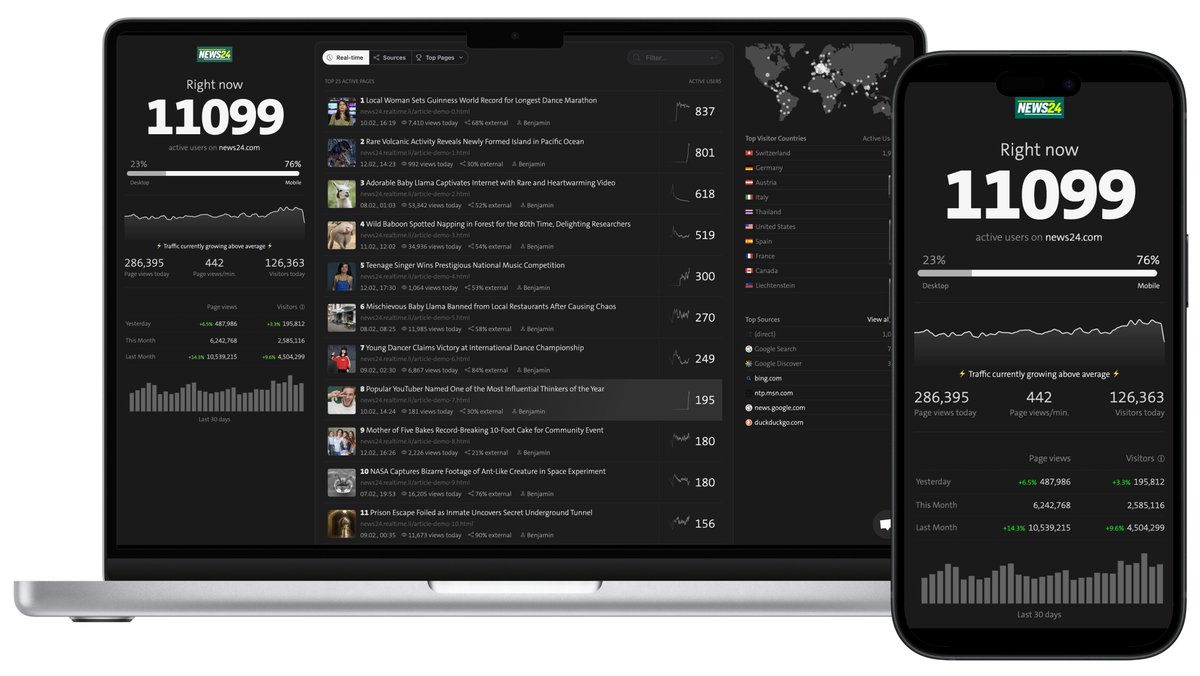
The Real-time view in #GA4 can be used in #newsrooms, but let's be real - it's not really tailored for editors, journalists and content teams 🤯
Introducing #Realtime Analytics, a beautiful dashboard for digital publishers.
🟢 Learn more: https://t.co/kSha1CFYEl
🌍 New feature in our real-time dashboard!
See your website visitors live on a world map with our new Live Map feature. You can zoom and drag to explore, and click on any visitor location to see which articles are popular in that area.
We turned off the lights... on purpose 🌚💡
Your real-time dashboard now finally supports Dark Mode. Enjoy a sleek, eye-friendly experience.
To enable it, simply click the "Dark Mode" link in the new header menu. On mobile, tap the "Moon" icon to switch to Dark Mode.
Google is testing the exclusion of journalistic content from Google search results in 9 EU countries. This affects 2.6 Mio users in Belgium, Denmark, France, Greece, Italy, Croatia, the Netherlands, Poland & Spain.
This is the real world impact of Google's relentless Helpful Content Update.
Independent publishers being gutted of six figures+ of income.
Letting writers go.
Cutting staff.
This needs to be a bigger story.
Google owes these publishers an explanation.
Two months ago, @ThisHouseFresh sounded the alarm about Google killing independent sites.
I wrote an update on things I’ve learned and things that happened after publishing that article: https://t.co/6s1IMEEdWE
SPOILER: We have lost 91% of traffic from Google since then.
If there are any independent journalists in the media left, now’s a great time to write some stories about Google and its onslaught against bloggers and small websites.
For years, Google has been shifting away from its role as a search engine into a promotional platform for Google products and ads. They’ve gradually replaced bloggers and niche site owners in the search results with their own indexed content, widgets, and now Generative AI— all of which were taken from website owners without their consent. Slowly but surely, Google has encroached on the “middle man,” those of us who create valuable, long-form content in return for a small share of ad revenue. That is, until recently, when Google decided to go full speed ahead and put the final nail in the coffin for small businesses…
In the recent Google algorithm updates, they’ve decided to further tilt the scale in favor of a handful of major publications, under the pretense of promoting “helpful content.”
If Google were actually trying to serve users helpful content, they wouldn’t be placing four sponsored ads at the top of the search results, nor would they be giving preferential treatment to big sites with lean content and general, rehashed advice rather than firsthand experience. Not to mention the crazy amounts of spam all of us have been seeing in the SERPs. There’s a big difference between what Google says it wants versus what we are seeing in real time. And sadly, this is becoming devastating for small businesses...
What is happening right now is basically the equivalent of Amazon decimating brick & mortar businesses. But unlike that issue, which has had lots of airtime, there haven’t been any legacy media companies covering this story. There ought to be at least some media coverage here, as it is negatively impacting millions of people.
Right now, the majority of news about Google is overwhelmingly positive. Most of what I’m seeing is favorable articles about new Google features and products. How about an article where we call a spade a spade: Google is too large and powerful, and it needs to be reigned in.
A monopoly like Google, left unchecked, will dominate the online ecosystem to the maximum extent possible. It will do so at the expense of any and all other stakeholders that stand in the way of Google maximizing its profits. This includes legacy media and major corporations; they won’t be in Google’s good graces forever…
This is a much bigger issue than just the livelihood of small businesses: Google is attempting to dominate the conversation and shut out any and all voices who aren’t “paying to play” in the Google ecosystem. They are stifling fair and equal competition, which hurts EVERYONE in the long run, including the reader/consumer- who will only be served the most mainstream, general & unhelpful content.
In a time when mistrust of the corporate media is at an all-time high, we need journalists to step forward and assert their independence from the big corporate megaliths. We don’t want a biased hit piece against Google (or its people) either; we simply want someone to come in and cover the facts of what’s actually happening. That way, we can spread awareness to save small businesses.
And so I ask journalists: are you going to speak out and show your independence from big corporate powers like Google? Or will you ignore what’s happening and reinforce the idea that media companies are owned and controlled by big business (after all- who owns the Washington Post?)
Whatever happened to holding truth to power? If that is still a core value of media publications, now is a good time to do some investigative journalism. We need you and the world needs you.
🦊 We've analyzed over 2 billion visits (February 2024) and it turns out, @firefox from @mozilla is still widely used!
Full report here: https://t.co/aH4yygJYIQ
The 2-month warning for sites hosting low-quality, 3rd-party sponsored content (Parasite SEO) is quite interesting... I think it's a way to warn the big guys (major newspaper websites using this method) to clean up their act before Google brings down the hammer.
You might think it's silly for newspapers to report "Facebook and Instagram is down" on their websites, but there's nothing more interesting to readers than when their beloved social networks are not working. People click on those stories like CRAZY.
(The chart displays the number of live readers on news portals worldwide that are using my analytics)
Just spent 20 minutes on a call with a Google rep poking around GA4 trying to get him to show me how to pull a basic source/medium report for an event conversion and he was stumped.
GA4 truly sucks.