Two months ago I was fired by Google for creating the Google Workspace CLI. It went viral, hit #1 on Hacker News, gained thousands of GitHub stars and many thousands of actual users in just a couple days.
It was an incredible, confusing journey, from directors and leaders asking what they could learn from the tool to getting grilled by legal about why the Google logo and brand colors are on the Google Workspace GitHub code repositories.
I think the cause was that Workspace and certain leaders (and projects) were afraid of being disrupted. But the fear wasn't specific to my CLI, it was a broader fear in what agents meant for Workspace. Either way, the irony of my termination was the announcement at Google Cloud Next two days before I was fired that an official Workspace CLI was coming.
I want this out there because it is easier for me to explain my story and it is an experience I want to fully own. It's also part of my healing.
Nearly 7 years at Google was an incredible opportunity for me and I was fortunate to have wonderful teammates and a manager that fully supported me through these last few months. Thank you.
We recently obtained the highest-resolution 3D images of the human brain ever taken from outside the skull. This is the first look.
Introducing Aleph, a research lab building brain interfaces for the telepathic future. (1/n)
I promise this will be the best 20 min you spend today! Robotics: Endgame, the sequel to my last year's Sequoia AI Ascent talk, "Physical Turing Test". I laid out the roadmap for solving Physical AGI as a simple parallel to the LLM success story. Be a good scientist, copy homework ;)
And stay till the end, more easter eggs and predictions for your polymarket!
00:30 DGX-1 origin story at OpenAI, I was there in 2016 signing with Jensen and Elon. Heading to the Computer History Museum!
01:42 The Great Parallel
03:31 Robotics, the Endgame
03:39 Why VLAs fall short
04:32 Video world models as the 2nd pretraining paradigm
06:09 World Action Models (WAM)
07:46 Strategies for robot data collection and the FSD equivalent to physical data flywheel for robot manipulation
11:06 EgoScale and the Dexterity Scaling Law we discovered recently
14:00 Physical RL: bridging the last mile
15:39 DreamDojo: an end-to-end neural physics engine for scaling RL in silico
17:00 Civilizational Technology Tree and my predictions for the near future. Spoiler: it's closer than you think.
Thanks to my friends at Sequoia for inviting me back to AI Ascent this year! I had a blast! Last year's talk is attached in the thread if you missed it.
Scientists have created one of the most detailed 3D reconstructions of a human cell (eukaryotic cell) ever produced.
This groundbreaking model, often termed a "Cellular Landscape Cross-Section Through a Eukaryotic Cell," combines data from X-ray tomography, nuclear magnetic resonance (NMR), and cryo-electron microscopy to map molecular structures in extreme detail.
The SOTA in humanoid locomotion is already insanely good. The control stack is almost fully leveraging what the hardware can do.
For real-world use, the active safety is still remain unsolved: Common-sense intelligence to move safely around people, and graceful handling of possible hardware failures in the wild.
ANTHROPIC PAYS $750,000 A YEAR FOR ENGINEERS WHO UNDERSTAND WHY AI WORKS.
STANFORD JUST PUT THE SAME KNOWLEDGE ON YOUTUBE FOR FREE.
WATCH IT THIS WEEKEND. NOT EVENTUALLY. THIS WEEKEND.
South Korea's ROBOTIS, the maker of the popular DARwIn-OP platform, just introduced its compact humanoid to rival Unitree's G1.
According to ROBOTIS, its AI Sapiens platform is fully open source and built for physical AI researchers and developers. It's powered by DYNAMIXEL-X actuators and boasts 23 degrees of freedom (DoF).
Pricing is unclear. Its existing range of products range from $25 (for DIY STEM kits) to $20,000+.
There’s a new open-source Python library that gives you direct access to Google Flights.
It’s called Fli. No HTML parsing, no Puppeteer, no browser overhead. Direct API calls, structured results.
→ Search flights with filters (airline, stops, cabin class, time window)
→ Find cheapest dates across any range
→ Built-in rate limiting and retry logic
It also ships an MCP server, so Claude can search flights for you directly in conversation.
100% Open Source.
When an empire runs out of its own money, it is able to increase the supply of money. However, printing more money causes borrowing to increase creating a financial bubble. I urge you to watch “Principles for Dealing with the Changing World Order” on my YouTube channel in the comments below to understand how, and what it means for all of us.
Breaking🔥
Anthropic udostępniło darmową AI Academy z 13 certyfikowanymi kursami, które obejmują zarówno podstawy Claude, jak i zaawansowane narzędzia deweloperskie typu API, MCP czy Claude Code.
Nie zaszkodzi poświęcić chwilę czasu:
https://t.co/nb0pSxEjJO
I'm trying to figure out where to live next, and one big consideration is the climate. So naturally I made a tool that represents monthly average temperatures for cities as 3D rings so they can be compared more easily. Check it out: https://t.co/MqPb0ufLYY
I think magic mushrooms are a longevity therapy.
After seeing the data from two doses, psilocybin offers unique longevity effects that complement the best performing therapies I’ve done to date including sauna, hyperbaric oxygen therapy, sleep, nutrition and exercise.
This was the most quantified psychedelic experiment ever done.
It's noteworthy that even though many of my biomarkers are already in the 99th percentile optimal, psilocybin still showed multi-system improvements. Something other therapies have not been able to accomplish.
Of course, my data will need to be replicated and the magnitude and duration of benefits needs further assessment.
Here is what we learned:
0. We observed broad benefits across mental, hormonal, metabolic, and anti-inflammatory systems. Since these are the primary drivers of biological aging, this multi-system signal offers a compelling case for longevity potential.
1. Psilocybin may be a metabolic reset button for the brain. We expected brain changes, but not a potential metabolic breakthrough. My blood sugar control improved from the top 2% of the population to 0.2%, better than 99.75% of 18-25 year olds.
2. Psilocybin reduced my inflammation (hsCRP) to below detectable levels one week post dose.
3. Psilocybin calmed my body and mind. Lower cortisol, and an inhibited HPA-axis in the days following the dose. Both my cortisol and DHEA (another product of the adrenal cortex) dropped 42% and 45% respectively, indicating an overall adrenal reset associated with rest and recovery.
4. Psilocybin increased brain plasticity, desynchronized default networks, resulting in enhanced creativity, playfulness, and openness, with reduced mental rigidity.
5. A second psilocybin dose built on the first and pushed sensory integration even further, increasing primary sensory-motor integration beyond the peak of the first dose.
6. Psilocybin induced an intense blend of joy, deep insight, and a subtle hint of melancholy, also detectable by thermal biometrics.
We had two significant firsts in this experiment:
0. First documented human CGM-based observation of improved post-psilocybin glucose control.
1. First-ever thermal profile of an intense psilocybin dose.
Pending data:
+ Telomere length and relative telomerase activity (telomere regeneration capacity).
+ Epigenetic measurements
+ Microbiome
Experiment details
Here are more details about my two magic mushrooms trips, doses, and the results of my measurements up to date.
I had two doses of dried and powdered Psilocybe Cubensis (Variety B+) mushrooms, three weeks apart.
First dose Nov 9th: 4.67g (24.98 mg psilocybin and 3.5 mg psilocin). Setting: relatively private, only with @_katetolo and the accompanying guide.
Second dose Nov 30th: 5.35 g (28 mg psilocybin and 4 mg psilocin). Setting: relatively open, with friends and family joining virtually, and live streaming.
I dissolved the first dose in orange juice but used lemon juice for the second, for the following reasons:
+ Lemon is more sour, which delays the conversion to psilocin and breakdown in solution, thus preserving more total psilocybin to be activated to psilocin after ingestion.
+ Lemon juice has, on average, 70% less sugar and 45% less calories, making it less disruptive to my otherwise faster state throughout the journey, and leading to a much lower glucose peak.
Rewired brain connectivity
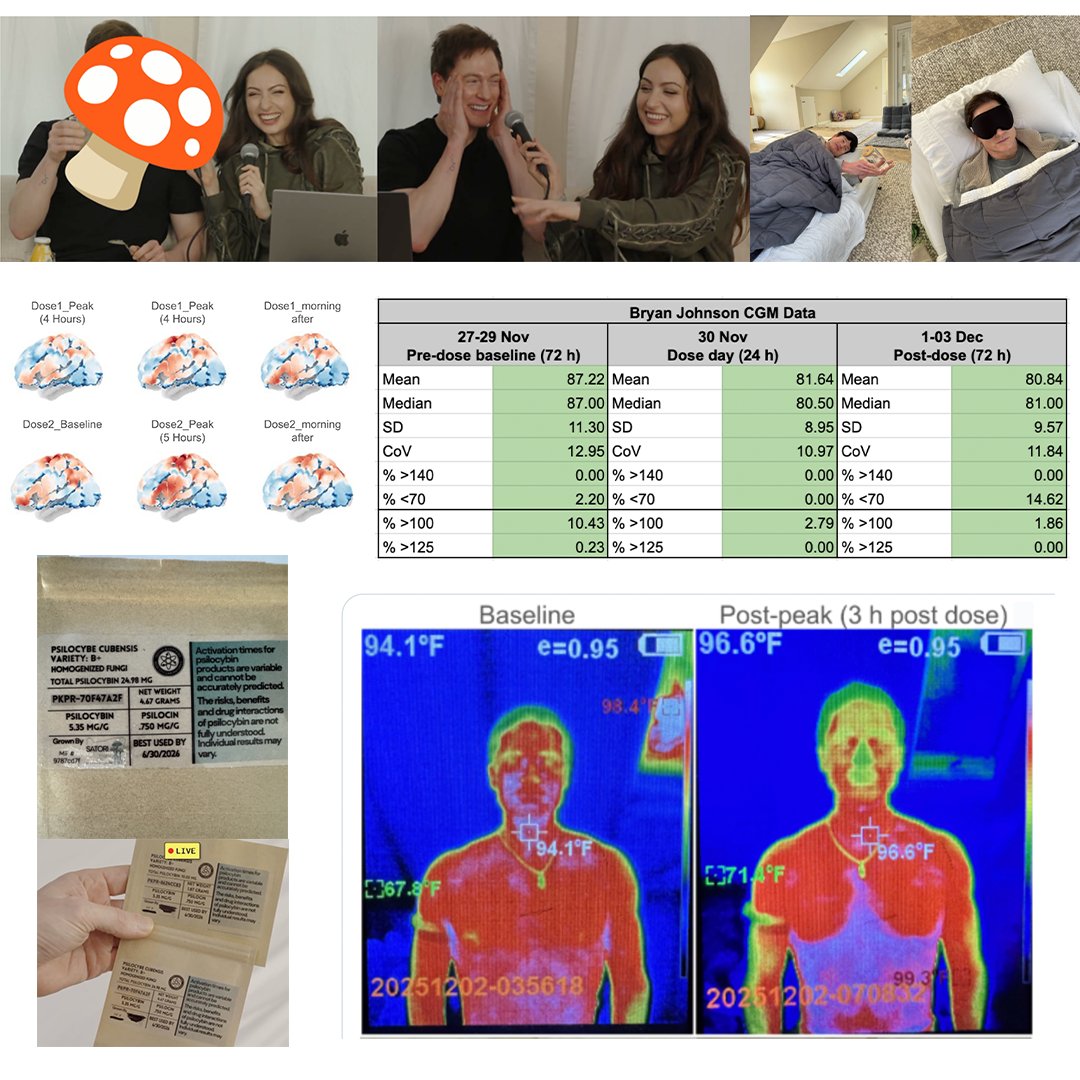
Kernel Flow measurements after the first dose showed shifts in my brain connectivity mirroring my subjective experience, and the mapping of 5-HT2A receptors.
These included the inhibition of my default networks and command centers including prefrontal context and a shift towards increased functional connectivity and hyperintegration between primary motor, sensory, auditory, and speech integration. This coincided with an entropic brain pattern, more open, flexible, exploratory, and creative, indicating a shift from aged and rigid to open youthful brain state.
The baseline measurement before the 2nd dose indicated a strong lasting effect from the first dose 3 weeks earlier, post-peak measurement after the 2nd dose indicated an additive effect of the 2nd dose, with a brain entropic and increased primary sensory-motor integration beyond the peak of the first dose. Most notable was the increased intensity of integration and activation of the auditory, speech, and language networks, coinciding with the second dose being joined by family, friends, where I enjoyed expressing and describing my feelings.
Face and body thermal biometrics
We produced the first ever face and upper body thermal map of a magic mushroom journey.
A core temperature increase of 1.5–2°F suggests an intense psychedelic experience, likely due to a large psilocybin dose (28 mg psilocybin, 32 mg combined psychoactive content).
Heat was redistributed to the core, consistent with 5HT2A–mediated autonomic activation, which can include increased sympathetic tone, lasting through the peak and early post-peak of the experience.
Facial and body thermal shifts indicate a potential blend of intense joy, insight, and subtle sadness or melancholy.
First documented human CGM-based observation of improved post-psilocybin glucose control
Psilocybin appears to have triggered a previously unknown metabolic reset in my brain, an unexpected breakthrough. Comparing the 3-day periods before and after the psilocybin dose:
My blood glucose control dramatically improved, moving from the top 2% to the top 0.2% of the entire population, including healthy 18-25 year olds.
+ 8% reduction in mean blood glucose, reaching 80.84 mg/dL, a new personal best.
+ 11% reduction in fluctuation, indicating smoother glucose peaks and improved control.
+ This single session reduced my estimated HbA1c 0.3 6.8% from 4.7% to 4.4%, (a relative reduction of 6.8%).
+ Durability: The positive effect was still as strong on Day 3 post-dose as it was on Day 1.
Note: A long trip to China on Day 4 interrupted this streak. We plan to explore the full durability of this effect with the next dose.
This matters because we treat diabetes and metabolic dysfunction with chronic daily medication (Metformin, Insulin, GLP-1s). This data suggests that a neuroplastic event might have downstream effects on the liver and pancreas that mimic or exceed these drugs.
Systemic inflammation was below detectable levels
Five days after the first dose, my hsCRP dropped to an undetectable level (below 0.15 mg/dL), representing a 35-100% decrease from the pre-dose level of 0.23 mg/dL.
Three days post-second dose, hsCRP was barely detectable at 0.18 mg/dL, which is still a 22% drop from the initial baseline.
Tumor necrosis factor-alpha (TNF-alpha) remained unchanged between baseline and post-second dose. It was not measured after the first dose.
For the next dose, we will measure a wider panel of inflammatory markers, including IL-6 and IL-10, and cover several time points post-dose.
High cortisol at Peak, low cortisol and stress the following week
Cortisol spiked at the peak of the acute phase, followed by a decline in morning cortisol levels and HPA-axis inhibition, consistent with a relaxed "after-glow" phase in the week following the trip.
My cortisol spiked to 3x morning spike levels four hours after taking the mushroom dose. Levels returned to normal nightly baseline before bedtime.
Five days post-dose, my morning cortisol levels had dropped by 42%, and DHEA-S (a marker of adrenal activity) also dropped by 45%, aligning with inhibited HPA-axis and adrenal activity.
Estradiol levels increased by 200%, consistent with preliminary published evidence that peripheral 5HT2A activation increases cortisol by driving aromatase expression.
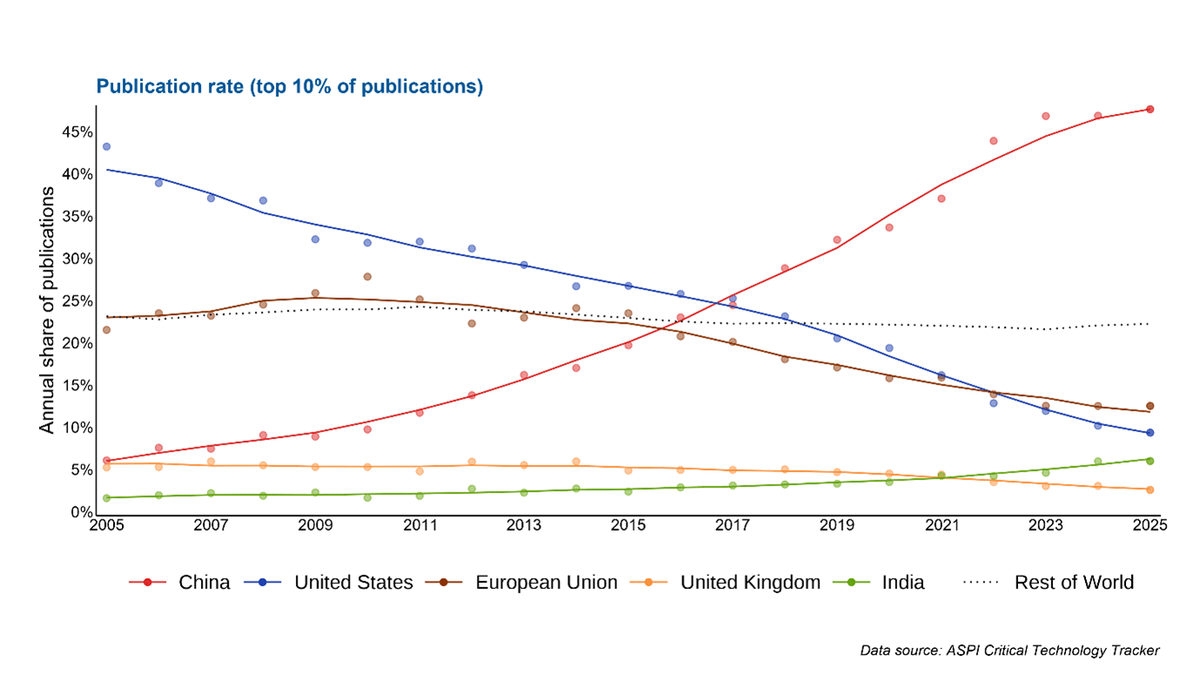
Warto spojrzeć uważnie na załączony wykres. To nie jest tylko kolejna statystyka – to obraz fundamentalnej zmiany układu sił w globalnej nauce i technologii, który nastąpił w ostatnich 20 latach. Czerwona linia, symbolizująca Chiny, nie tyle dogoniła, co drastycznie prześcignęła Stany Zjednoczone (linia niebieska) oraz Europę w udziale w 10% najczęściej cytowanych publikacji naukowych. Świat w tym Polska musi odnaleźć się w zupełnie nowej konfiguracji naukowej.
1. To nie tylko ilość, to jakość: Często słyszymy argument, że chińska nauka to „masowa produkcja” niskiej jakości. Dane temu przeczą, co pokazuje nie tylko załączony wykres, ale także Nature Index, który śledzi publikacje w 145 najbardziej prestiżowych czasopismach (tam, gdzie publikuje się prace na miarę Nobla). Także ten index pokazuje inwersję trendu. W 2024 roku Chiny opublikowały w tych najlepszych czasopismach 37 273 artykułów, podczas gdy USA – 31 930. Dynamika zmian jest jeszcze bardziej wymowna: między 2020 a 2024 rokiem chiński dorobek w tym indeksie wzrósł o 95%. W tym samym czasie USA odnotowały wzrost o zaledwie 9,5%. Co pokazuje pewną stagnację w stanach, a ogromny przyrost w Chinach.
2. Strategia, nie przypadek: Ten skok to efekt realizacji Planów Pięcioletnich, które zawsze kładły bardzo duży nacisk na rozwój badań w STEM. Dużo dalej idzie aktualnie trwający 14. Plan Pięcioletni, bo w odpowiedzi na sankcje i ograniczenia eksportowe (np. w sektorze półprzewodników), Chiny postawiły na „innowacyjność” i technologiczną samowystarczalność. Plan zakładał 7-procentowy roczny wzrost wydatków na B+R – cel ten jest systematycznie przekraczany! Co więcej, w 2024 roku nakłady na badania podstawowe wzrosły o 10,5%, osiągając poziom 249,7 miliarda juanów. Ten strategiczny zwrot ma na celu zbudowanie fundamentów teoretycznych niezbędnych do tego, by Chiny stały się źródłem oryginalnych innowacji, a nie tylko optymalizatorem istniejących technologii.
Wdrażana jest też strategia „fuzji cywilno-wojskowej”, co pozwala szybko komercjalizować przełomy z laboratoriów uniwersyteckich.
3. Autokorekta systemu – koniec z „punktozą”: To, co jednak najbardziej imponuje i powinno dać nam do myślenia w Europie, a w szczególności w Polsce, to zdolność chińskiego systemu do samokorekty. Przez lata tamtejsza nauka cierpiała na chorobę „publish or perish” i premiowanie ilości. W 2020 roku Pekin wydał dyrektywę nakazującą zerwanie z tzw. „Four Onlys” (ocenianiem wyłącznie przez pryzmat: liczby papierów, tytułów, pochodzenia akademickiego i nagród). Zakazano nagród pieniężnych za same publikacje, co właśnie napędzało fabryki artykułów.
Dziś badacz w Chinach ma być oceniany na podstawie kilku „reprezentatywnych osiągnięć”, które rozwiązują realne problemy lub wnoszą istotną innowację. System promuje ryzyko i długoterminowe badania, zamiast „salami slicing” (dzielenia wyników na mniejsze kawałki dla podbicia statystyk). Wydaje się, że widać już jego efekty, mimo, że jego wdrożenie następuję różne w różnych regionach.
Skoro Chiny - kraj z 1,4 miliarda mieszkańców - były wstanie postawić na naukę oraz przeprowadzić niezbędne reformy, to dlaczego w Polsce nadal nie umiemy tego zrobić? Przykład Chin pokazuje, że daje się wyjść z pułapki średniego rozwoju, a także w przeciągu 20 lat z kraju prowincjonalnego naukowo stać się światową potęgą.
Visualizing my re-designed living room in 3D
Nano banana -> World Labs -> WebAR (threejs)
Each of these gaussian splats are only 1.5 mb in size (.spz file type)
If you've been trying to figure out DSPy - the automatic prompt optimization system - this talk by @dbreunig is the clearest explanation I've seen yet, with a very useful real-world case study https://t.co/w6uXcGshwI
My notes here: https://t.co/ZNjVagRa7e
Brawooooo!!!! Jesteśmy, widzimy, będziemy dziś publicznie zadawali pytania CEO NVIDIA Jensen Huang. Przed chwilą jedna z trzech najważniejszych osób na Ziemi w kontekście technologii, twórca wartej 3,5 biliona $ NVIDIA wymienił na scenie w Paryżu na swojej dorocznej konferencji polskiego BIELIKA jako swojego partnera. Gratuluję całemu zespołowi! Wreszcie jesteśmy widoczni.