Spatial peers, what is your preferred platform to upload / download / explore spatial transcriptomics data? I plan on submitting new data and would like to make it as easy as possible for the community to access.
#spatialtranscriptomics
- my first impression is that there’s more community-driven progress and innovations are spread across labs.
- initially less resource-dependent, but LLMs!
- a lot of the interactions and networking opportunities are based on your affiliation or established record
Self Supervised Learning learns informative and organized representations of unlabeled data... but involve many moving pieces...
Q:which are necessary and which are sugar coating?
A: https://t.co/Oo3ai8pFbP
Bonus: removing the sugar coating makes SSL training stable and reliable
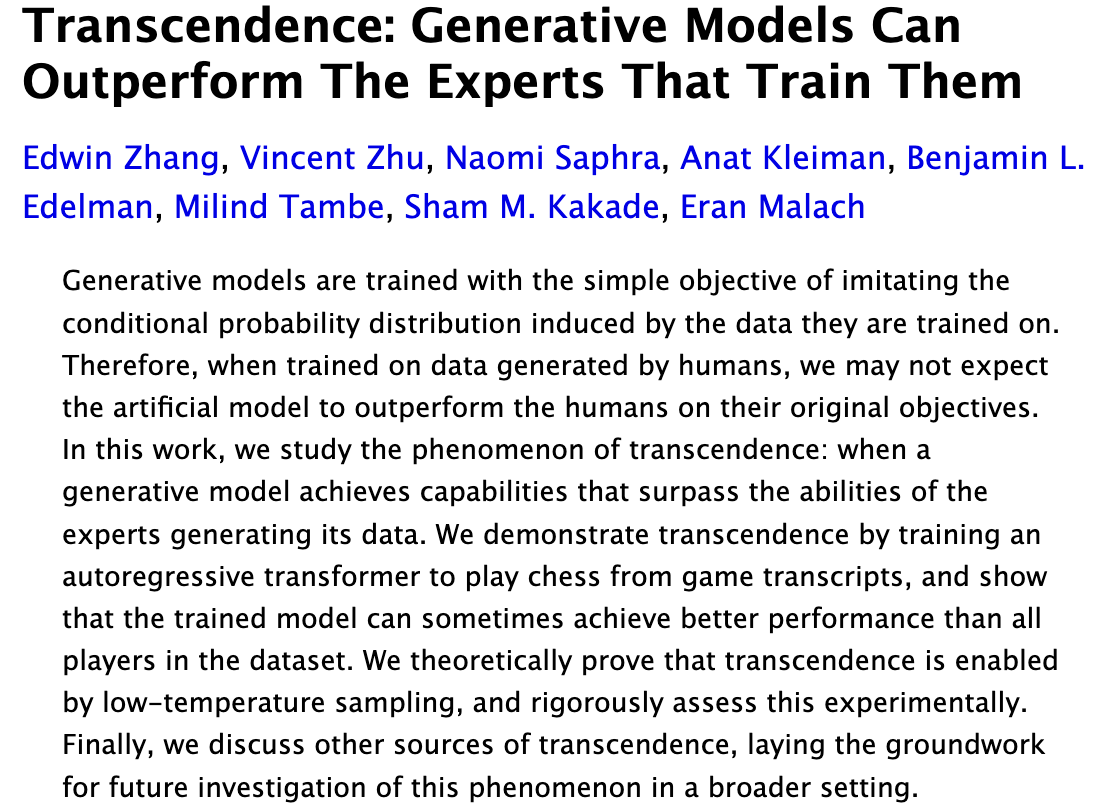
This paper seems very interesting: say you train an LLM to play chess using only transcripts of games of players up to 1000 elo. Is it possible that the model plays better than 1000 elo? (i.e. "transcends" the training data performance?). It seems you get something from nothing, and some information theory arguments that this should be impossible were discussed in conversations I had in the past. But this paper shows this can happen: training on 1000 elo game transcripts and getting an LLM that plays at 1500! Further the authors connect to a clean theoretical framework for why: it's ensembling weak learners, where you get "something from nothing" by averaging the independent mistakes of multiple models. The paper argued that you need enough data diversity and careful temperature sampling for the transcendence to occur. I had been thinking along the same lines but didn't think of using chess as a clean measurable way to scientifically measure this. Fantastic work that I'll read I'll more depth.
We celebrate the end of our three-day 🚀hackathon🚀 on spatial omics tools and methods in #Ghent#Belgium. A big thanks to all of the researchers across Europe. Check out our final slide deck and code! https://t.co/5y6NrvJGWi https://t.co/ns63bTDns7 #SpatialOmics24
We have an open doctoral (PhD) student position available! The PhD candidate will work in our @ERC_Research CartoHostBug project that aims to define host #microbiome niches in health and diseases 🤓
The student will join our lab @karolinskainst Apply!
https://t.co/C459JcbyzZ
🚀 Excited to share our latest work on STimage-1K4M, an open-source dataset with 1,149 slides from spatial transcriptomics and ~4 million sub-tile images-gene expression pairs! It paves the way for advanced research in multi-modal data analysis and computational pathology.
One good thing that came out of CNN fight between @elonmusk and @ylecun was that I discovered this interactive webpage. Pretty neat. Follow the science:
https://t.co/BzBJeur5T0
We finally wrote up our cell type-specific QC (ctQC) protocol for scRNA (and spatial)-seq data: https://t.co/KLDzc77ZH9 . Comments welcome! In a nutshell: we show that sc QC cutoffs should be strict, cell type-specific and data-driven. 1/