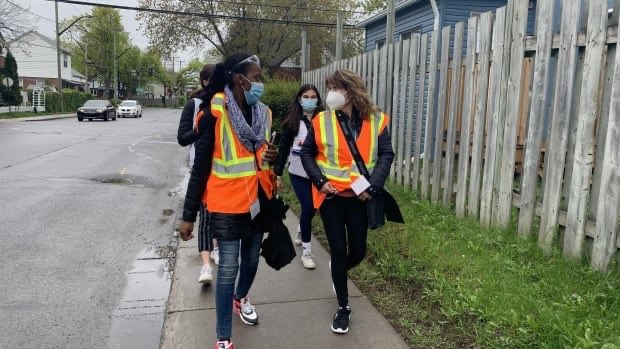
A look inside one of Montreal’s ICUs. Grateful to the patients and health-care workers who shared their stories. w/ @JessRubinger and cameraman @Martelsi
From Jim Crow to Jim Code: Using artificial intelligence in healthcare is alluring, but we must keep algorithmic #racism out of health care’s #AI toolkit, by @AlbergaHannah
https://t.co/oPFktclHjX via @GlobeDebate#cdnhealth#cdnpoli#SystemicRacism
Congratulations to the four McGill researchers recognized by the @RSCTheAcademies, including oceanographer Alfonso Mucci, who was awarded the Miller Medal, and statistician Christian Genest, recipient of the Synge Award.
@EPS_McGill
https://t.co/RtjqTX5bBE
Wasserstein barycenters are useful in stats/ML but typical algorithms discretize the domain, leading to low-dimensional/coarse approximations. With PhD student Lingxiao Li, postdoc Aude Genevay @a_gnv, and @MITIBMLab's Misha Yurochkin we construct a continuous barycenter!🔥🎊🎈🎉
Amid America's #COVID19 disaster, I must come clean about a lie I spread as a health insurance exec: We spent big $$ to push the idea that Canada's single-payer system was awful & the U.S. system much better. It was a lie & the nations' COVID responses prove it. The truth: (1/6)
Regularized Neural ODEs (RN-ODE) - elegant improvement for one of the more exciting research directions in ML .. proposes two simple loss regularization terms to encourage well-behaved solutions .. cool work!
paper: https://t.co/la8IWygpeE
Excited about our new paper: Adversarial robustness which scales to ImageNet Scaleable input gradient regularization for adversarial robustness https://t.co/jGmlKm7Yhq https://t.co/ho9eLzl8GG
"By changing a few pixels on a lung scan, for instance, someone could fool an A.I. system into seeing an illness that is not really there"
#GANs#MachineLearning#adversarialnetworks#2MA
https://t.co/Zjzn6MDB9O
A good summary of criticisms of Deep Learning for Vision (https://t.co/TCcC6cxDCq). IMO one overarching issue is that research is done to beat benchmarks and publish papers, rarely “regularized” by real-world problems with data characteristics that may be significantly different.
Ilias Diakonikolas and Daniel Kane organized a workshop at @TTIC_Connect, and the slides are now uploaded (https://t.co/scqZ5Ezr0F). Ilias also gave a tutorial at @SimonsInstitute (video & slides https://t.co/M20qug9fxt) 3/3
@ylecun For good theory, we need precise questions. What matters besides accuracy? Adversarially robust? Compressible? Interpretable? Confidence? Any pointers to a review discussing open problems?