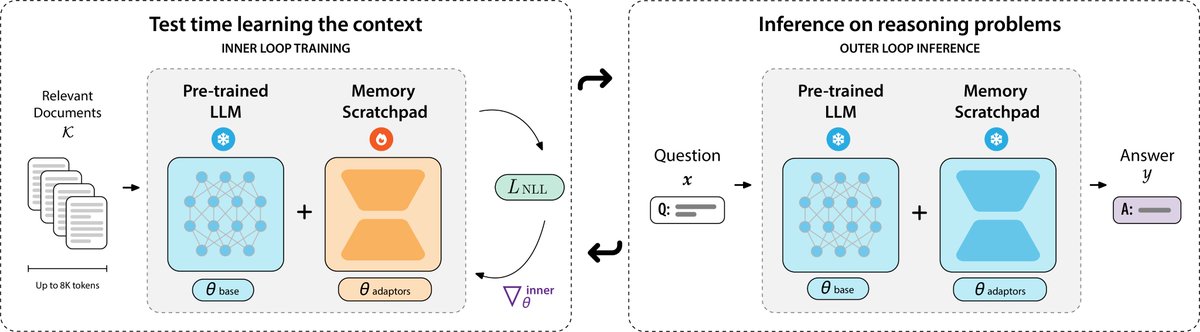
🗒️Can we meta-learn test-time learning to solve long-context reasoning?
Our latest work, PERK, learns to encode long contexts through gradient updates to a memory scratchpad at test time, achieving long-context reasoning robust to complexity and length extrapolation while scaling efficiently at inference.
PERK can be applied to existing pretrained language models without requiring architectural or parameter modifications to the base model.
#LLM #LongContext
Find out how PERK operates and performs 👇
NEW PAPER ALERT: Recent studies have shown that LLMs often lack robustness to distribution shifts in their reasoning. Our paper proposes a new method, AbstRaL, to augment LLMs’ reasoning robustness, by promoting their abstract thinking with granular reinforcement learning.
🚨New Preprint!!
Thrilled to share with you our latest work: “Mixture of Cognitive Reasoners”, a modular transformer architecture inspired by the brain’s functional networks: language, logic, social reasoning, and world knowledge.
1/ 🧵👇
NEW PAPER ALERT: Generating visual narratives to illustrate textual stories remains an open challenge, due to the lack of knowledge to constrain faithful and self-consistent generations. Our #CVPR2025 paper proposes a new benchmark, VinaBench, to address this challenge.
I am recruiting 2 PhD students for Fall'25 @csaudk to work on bleeding-edge topics in #NLProc#LLMs#AIAgents (e.g. LLM reasoning, knowledge-seeking agents, and more).
Details: https://t.co/JiYUnM2n38
Deadline: May 1, 2025
Please boost!
cc: @WikiResearch@AiCentreDK@CPH_SODAS
🚨 New Preprint!!
LLMs trained on next-word prediction (NWP) show high alignment with brain recordings. But what drives this alignment—linguistic structure or world knowledge? And how does this alignment evolve during training? Our new paper explores these questions. 👇🧵
Are LLMs linguistically productive and systematic in morphologically-rich languages as good as humans?
No 🤨 Our new NAACL 2025 paper (https://t.co/YeYh2V9Ond) reveals a significant performance gap between LLMs and humans in linguistic creativity and morphological generalization.
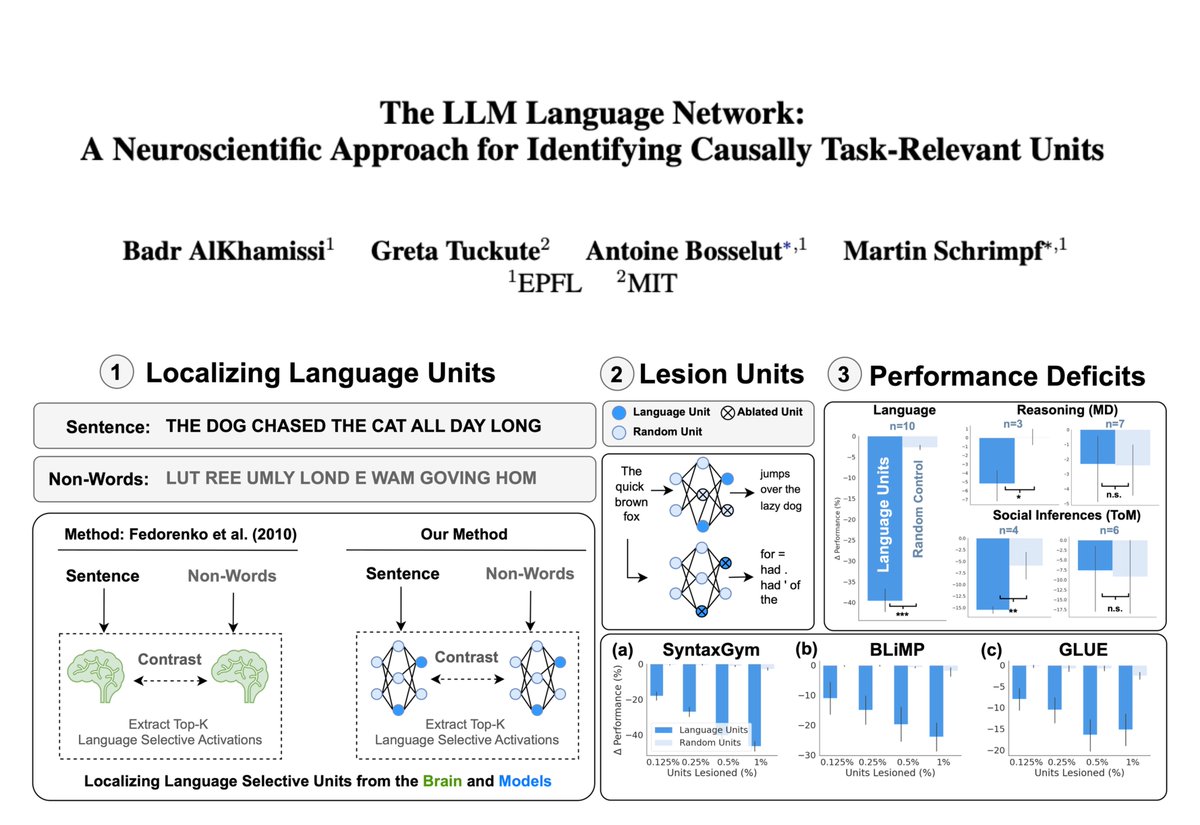
🚨 New Paper!
Can neuroscience localizers uncover brain-like functional specializations in LLMs? 🧠🤖
Yes! We analyzed 18 LLMs and found units mirroring the brain's language, theory of mind, and multiple demand networks!
w/ @GretaTuckute, @ABosselut, & @martin_schrimpf
🧵👇
🚀 Introducing PICLe: a framework for in-context named-entity detection (NED) using pseudo-annotated demonstrations.
🎯 No human labeling needed—yet it outperforms few-shot learning with human annotations!
#AI#NLProc#LLMs#ICL#NER
@lexin_zhou@PNASNews We will have the data and the code available soon! We're clearing up a few license conflicts on our end (we want to release as openly as possible), but it should be online in the next few weeks!
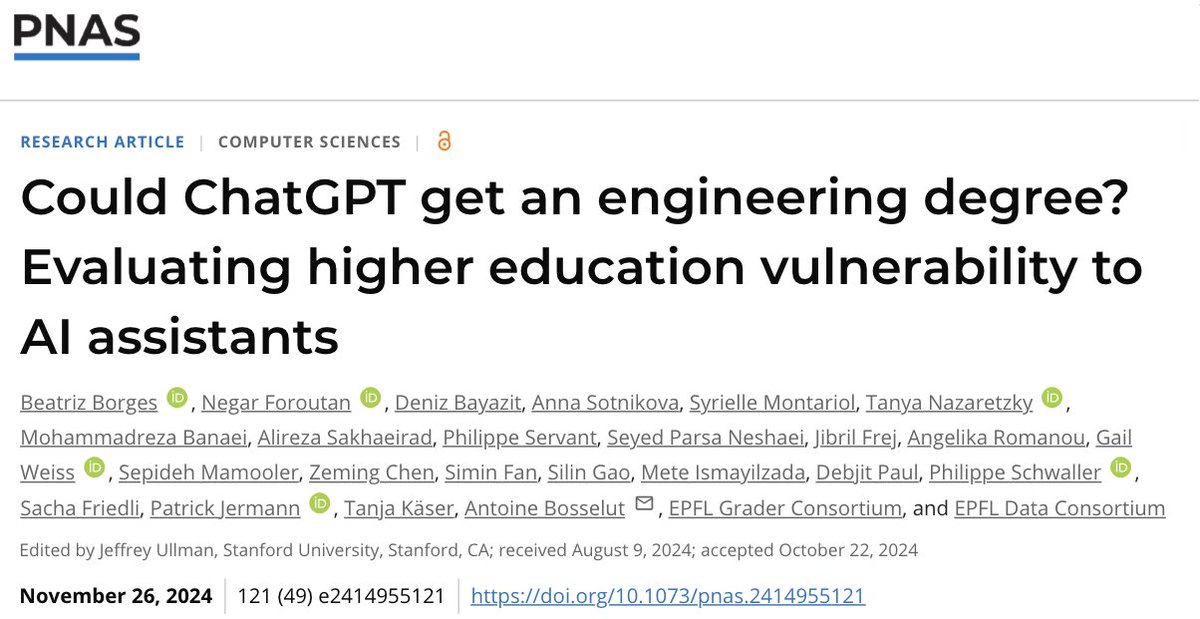
📘 Could ChatGPT get an engineering degree? Spoiler, yes! In our new @PNASNews article, we explore how AI assistants like GPT-4 perform in STEM university courses — and on average they pass a staggering 91.7% of core courses. 🧵 #AI#HigherEd#STEM#LLMs#NLProc