Uganda’s greatest threats are not always floods, wars, or economic shocks.
Sometimes they are hidden in how we think, lead, execute, and organize ourselves.
I share three silent threats Uganda must confront: Weak execution, Elite disunity, and Declining public leadership.
Ideas are good. Execution is better.
Watch the full episode. 👇
#Uganda #Leadership #Execution
When a senior and celebrated legal mind of @DanOgalo freely say this, does it signal anything to those in charge of administration in the @JudiciaryUG?
@observerug@Winnie_Byanyima Oh! Then you begin to understand why the @judiciaryug via His Lordship Justice Baguma is flouting basic procedural principles of justice.He appears to be in a hurry to give effect to Muhoozi’s tweets.The trial is nothing but a charade.
As police continues for the hunt of AAA’s cars, they should also check out the fleet at PLU secretariat. Government plates swapped with private plates occasionally. Isn’t that weird?
@PoliceUg@KagutaMuseveni
But why am I laughing 🤣🤣
So now they're changing the captain in the middle of the seas 😂😂.
Dear @sejudav , @rwomchechen , what do we call this in military? What about uncle @DanOgalo in law or @Jadwong in journalism?
"you gauge the level of leadership of a country by what and how its Cabinet Ministers communicate and debate. It is a reflection of the manner in which the affairs of such nation are managed." Says @DanOgalo
Hon @TinkasiimireBa2, you are a political reject whose stupidity and primitivity pushed you to withdraw just a cheap harrier car from your girlfriend. You are just a mafia and a schemer. You don’t have moral authority to speak when MEN are talking.
The word "THOSE" in unconventional speech may mean a person one doesn't want to refer by name but everyone know him or her.
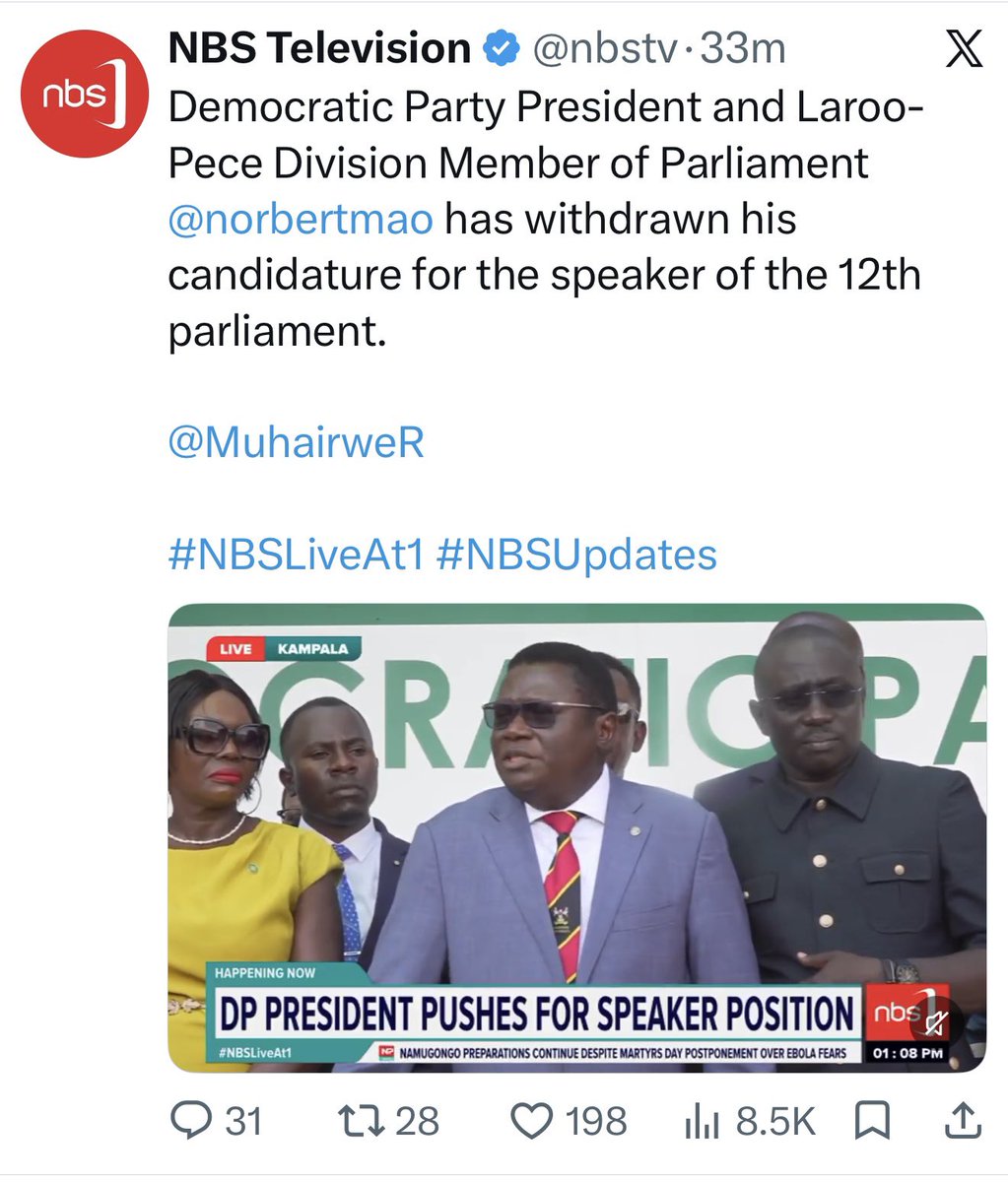
So who was @norbertmao referring to?
#Mao4Speaker
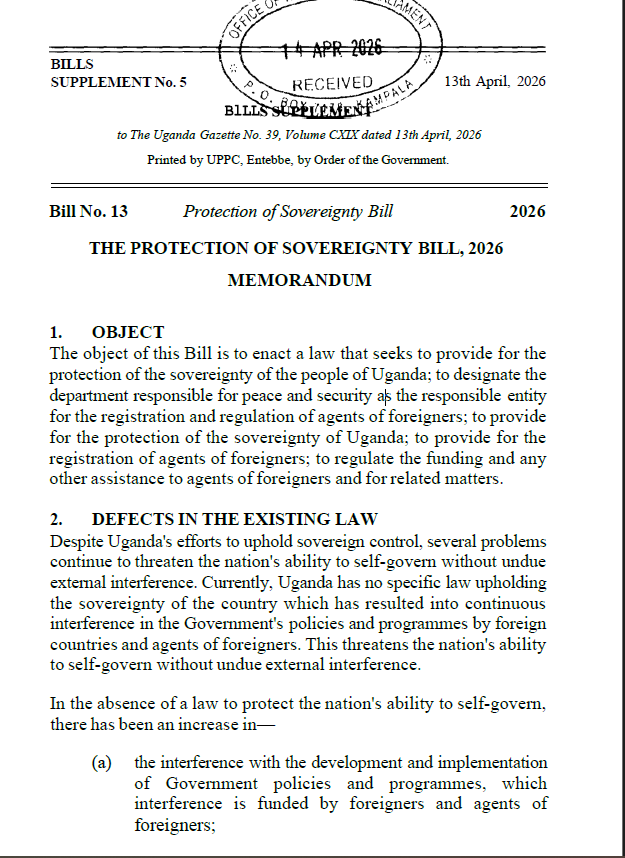
I finally got a copy of The Protection of Sovereignty Bill last evening, went through it and let me tell you, some people are in trouble....my take:
This Bill is being paraded as a shield for Uganda’s sovereignty and yet I thought we already have that in the Constitution. In reality it is a weapon aimed directly at the heart of our constitutional freedoms. It pretends to guard us against foreign interference but we are a poor country heavily dependent on foreign aid (government and private citizens). Its provisions are so sweeping, so vague, and so punitive that they would criminalise legitimate civil society, journalism, and even ordinary Ugandans who dare to engage with the wider world.
Clause after clause strips power from institutions and hands it to Cabinet and the Minister of Internal Affairs, concentrating unchecked discretion in the Executive. The definition of “agent of a foreigner” is so dangerously broad that it could ensnare NGOs delivering some service like Road Safety NGOs under @ROSACUg, health services, businesses trading internationally, or even citizens with relatives abroad.
The Bill dresses repression in the language of “economic sabotage” and “disruptive activities.” BUT criticism of government mismanagement is not sabotage it is holding it accountable. Cooperation with foreign partners in education, health, and development is not subversion, it is progress. By equating foreign support with treason, this Bill risks isolating Uganda from the very partnerships that have sustained our people.
Sovereignty is not preserved by silencing voices, strangling civil society, or threatening citizens with twenty-year prison sentences. Sovereignty is preserved when government is accountable, when institutions are independent, and when Ugandans are free to speak, organize, and participate without fear.
If passed in its current form, this Bill will not protect Uganda’s sovereignty but it will erode it. It will shrink freedoms, concentrate power, and undermine the democratic values that sovereignty is meant to defend.
It is not about not sovereignty, it is about suffocation.
COMPARATIVE TO OTHER COUNTRIES
Ethiopia: Charities and Societies Proclamation (2009)
Ethiopia introduced one of the most restrictive NGO laws on the continent in 2009. It barred organizations receiving more than 10% of their funding from foreign sources from engaging in human rights, advocacy, or governance work. The impact was devastating: civil society was crippled, international cooperation collapsed, and the country faced widespread condemnation. Recognizing that the law undermined democratic development, Ethiopia repealed it in 2019 and replaced it with a more liberal framework.
Kenya: NGO Coordination Act (1990, amended).
Kenya’s NGO Coordination Act requires registration of NGOs and disclosure of foreign funding. In 2013, draft amendments proposed capping foreign funding at 15%. This sparked strong public and international backlash, and the proposal was abandoned. The lesson from Kenya is transparency can be achieved without punitive restrictions, and civic space can be preserved by rejecting extreme measures.
Tanzania: NGO Act (2002, amended 2019)
Tanzania’s NGO Act mandates registration, government oversight of NGO activities, and reporting of foreign funding. Amendments in 2019 expanded state power, allowing authorities to deregister NGOs arbitrarily. In practice, this has been used selectively against critics of government. The Tanzanian example shows how over-regulation risks turning sovereignty laws into political weapons rather than genuine safeguards.
South Africa: Foreign Agents Registration Debate (2023)
South Africa has debated introducing a foreign agents registration law, modeled partly on the U.S. Foreign Agents Registration Act (FARA). The proposal would require disclosure of foreign-funded advocacy groups. Unlike Ethiopia or Tanzania, the debate has been framed around transparency rather than repression. The lesson here is that disclosure requirements, if narrowly tailored, can balance sovereignty with constitutional freedoms.
Nigeria: Foreign Contributions Regulation (proposed 2017)
Nigeria attempted to regulate foreign donations to NGOs and political groups in 2017. The proposal was heavily criticized as unconstitutional and was never fully enacted. Nigeria’s experience demonstrates that overreach not only undermines legitimacy but also invites legal challenges that weaken the credibility of such laws.
@Parliament_Ug
“Something happened in Butambala where a character called Muwanga Kivumbi was defeated. The plan was that everywhere NUP is defeated, gangs with pangas should attack the polling station. And that’s what they did. When Kivumbi was defeated, they came with pangas to attack the polling station and they were shot. Seven of them were shot there with pangas.” Said President Museveni on Jan. 18.
Family members of six of those that were murdered, four injured people, and many residents all confirm the shooting happened at Muwanga Kivumbi’s house not at the polling station the President claims they were shot at with pangas. Was the President lying or did he also act on false intelligence? Will those that lied to him and killed Ugandans in cold blood be helped accountable? Even if they had attacked a polling station, did the law change to arresting suspects to shooting them? Also, most of them were shot with their hands raised and others had run into the garage and locked themselves inside so the army can’t claim that they attacked them. #SpotlightOnUgElections26
#StopImpunityUg