Famously (there is a beautiful Works in Progress piece on this) in 2016, Geoffrey Hinton told an audience in Toronto that medical schools should stop training radiologists, since AI would soon outperform them at reading scans. Ten years later, there are more radiologists than ever, and they earn more than they did then.
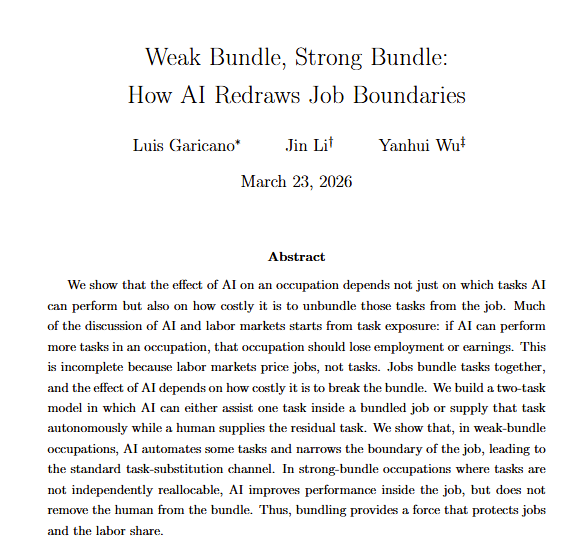
Hinton was right about the task, but he was wrong (so far!) on the future of the radiology profession. Times have never been better for them. The gap between those two claims, the difference between tasks and jobs, is the subject of a paper I have written with Jin Li and Yanhui Wu, and that we release today: "Weak Bundle, Strong Bundle: How AI Redraws Job Boundaries." (Very relatedly we are also finishing the first draft of our book "Messy Jobs" on AI and Jobs!! You will be the first to hear).
We start from the observation that the growing literature on AI and labor markets measures the AI shock by task exposure: people count how many tasks AI can perform in a given occupation AI can perform, and infer that more exposure means more displacement. Eloundou et al. published a paper in Science in 2024 that started this literature, and many follow the same logic. The inference they make is that the more exposed tasks, the worse the outcomes.
This is incomplete, because labor markets price jobs, not tasks. A radiologist does not just sell image classification, but does many other jobs: triages cases, communicates with other physicians, trains residents, makes the difficult decisions, and signs a diagnosis. The market buys a bundled service. The question AI poses is not whether it can do one task inside the bundle. The question is whether that task can be pulled out.
Thread (1/3)
https://t.co/wEYMfjGbeX
software engineering in 2026:
- your package manager is compromised
- your cloud provider blocks your account
- github itself is hacked
software is solved
HS2 was a brilliant idea for £10bn, and is a terrible one for £100bn. That’s why getting costs down is the most important thing for Britain to do if it wants infrastructure abundance.
Starting today on @TheRestHistory, a 3 part series on THE SHE WOLVES: the great queens of medieval England.
The incomparable @hrcastor on the empress MATILDA; ELEANOR OF AQUITAINE; & ISABELLA OF FRANCE.
Massive, massive drama!
All 3 episodes here: https://t.co/NNgwZQXyfF
Physical, not purely digital products are solving some of society's biggest problems. And printed circuit boards (PCBs) are vital for building pretty much every bit of electronics-driven hardware you can imagine. That's a supply chain that has drifted away from most Western countries...
@Paul_Swinney@TheDataCity Are there any interesting outliers if one adds Z-axis with funding volume? Currently geo distribution looks a bit like function of pop. density + transport infra?
Twitter has convinced itself that bond market traders are all crazed Randians who hate the state.
Not so. The Swedish and the Danish government can borrow at sensationally cheap rates. Bond markets like sound public finances. They don't care about big state vs small state.
unpopular take: the most underrated piece of object engineering in your house is your front-load washer door seal. it's a torus of EPDM rubber (ethylene propylene diene monomer, picked because it survives hot water + detergent + bleach for 10+ years). it has 3 sealing lips, drainage channels routed to prevent mold, and a bellows geometry that absorbs drum vibration without leaking under 1200 RPM spin. it costs your manufacturer maybe $4. it does more mechanical work than your car's serpentine belt and you've never noticed it. that's the gold standard