@richgizmo@TheMirzaBeig@julien_kaye you can use the target eye property to render different textures per eye, so sbs or spatial video. for these you would use stereo depth estimation, midas is for monocular depth estimation.
@ImmersiveRoach but maybe everyone else gets to play video games and gamedevs „resort“ to karaoke.
this might be a personal one: playing games with devs feels like work - not after work.
@ImmersiveRoach performative art has immediate feedback/reward? and it reinforces a no judgment zone among the devs. i also pondered this - its also big in zurich.
@JCorvinusVR@benz145 spatial computing as a term was introduced in 2003 by mit media lab in regards to mean it like this. in other fields (remote sensing) its as old as 1985.
it seems obvious that people do not perceive cultural affordance as relevant to vr. everything is believed to be design at fault, but intuitive design needs intuition from the user. that takes time.
I did the annual ‘show the family VR on Thanksgiving’ with Quest 3 and I’m again reminded that if I wasn’t there to hand-hold people through the whole process, they’d struggle painfully to figure out how to use the headset. This is why VR demos so well but retention falls off a cliff: demo-ers smooth over all the UX friction.
We are preparing for a kickstarter campaign. If you want to get a glimpse you can sign up for playtesting 👀 at
https://t.co/2RdeMvv3QU and find some bugs
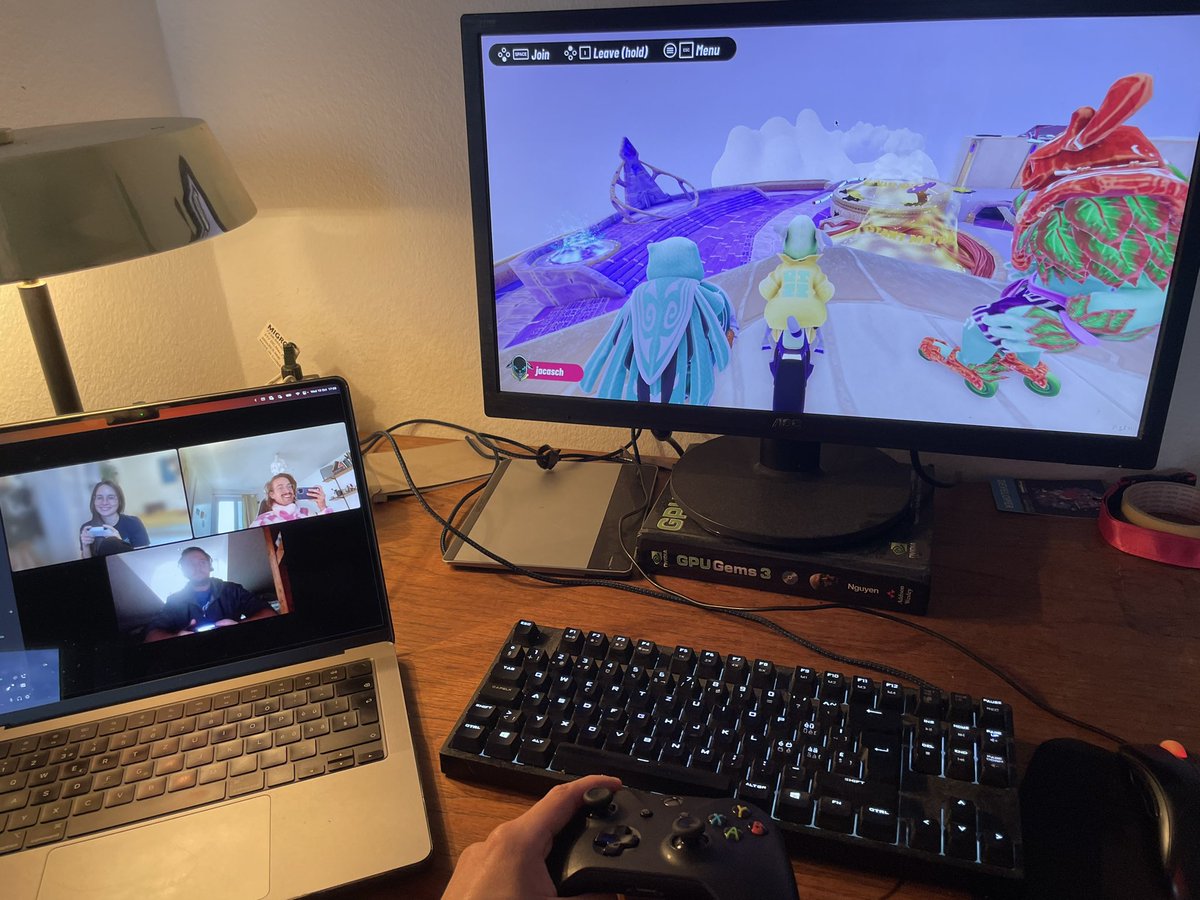
I just had a awesome test race with the @NinokoStudio Team @PoetMultimedia and @DeniseHohl ❤️
#UltimateGodspeed
@XRarchitect@aurepuerta_dev u can use the keyboard (apple,logitech) to align. include the keyboard in the scan and anchor your environment to the tracked keyboard. then the initial tracking origin does not matter, and the scene aligns as soon as the keyboard is found.