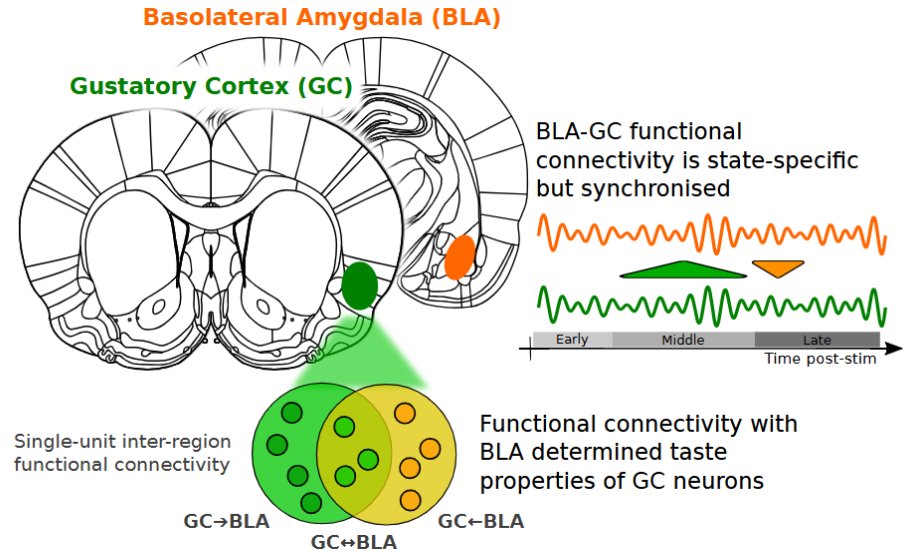
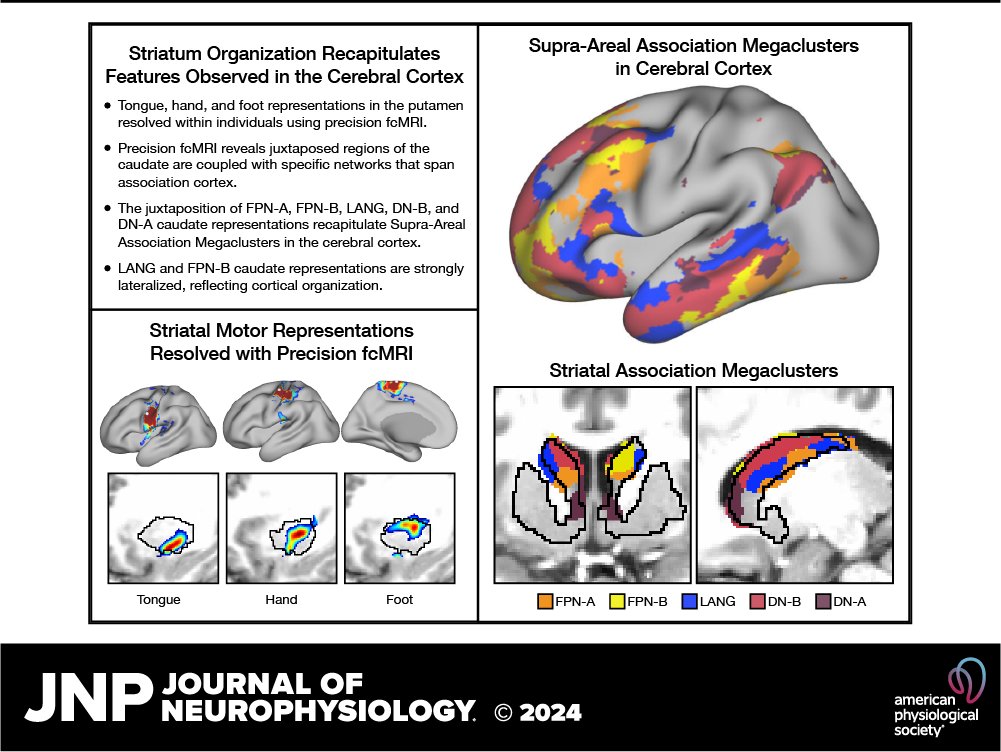
It's time for this week's #ArticleinPress! From @BrandeisU, #Sensory and palatability coding of #taste stimuli in cortex involves dynamic and asymmetric cortico-amygdalar interactions (Abuzar Mahmood et al.):
https://t.co/I82WkBt4qA
Force Production and Barbell Velocity Characteristics... : The Journal of Strength & Conditioning Research https://t.co/Megm0Ammkx Loads of 100-60% to enhance rapid force production characteristics and 100-80% to provide strength development. Limitations noted well. @JYUBiolPA
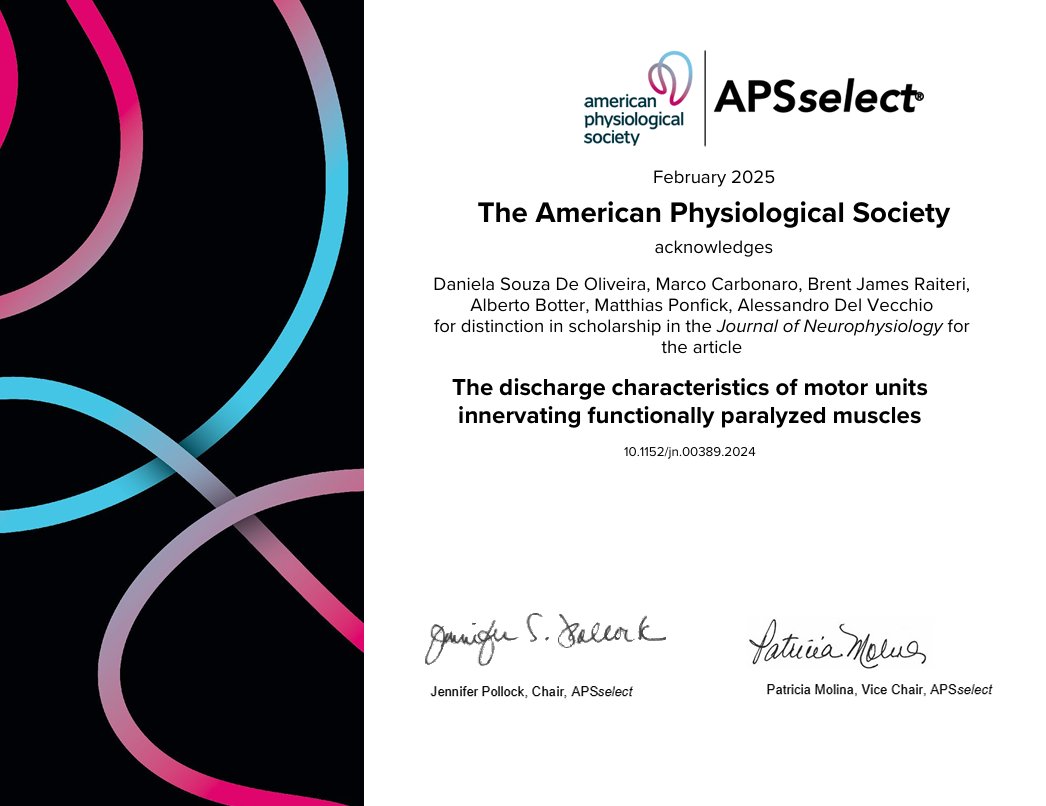
Our new paper is now available on @JNeurophysiol, and I am very pleased that we have been acknowledged by @APSPhysiology for distinction in scholarship
https://t.co/nAzznLWw4Y…
💥Preprint update💥
Based on feedback from reviewers, we updated our work that aims to understand gain control in force output. In addition to human motor unit data, we’ve used in silico models of motoneuron firing in an attempt to understand scaling of force output
{1/3}
-Changes in motor unit behaviour across repeated bouts of eccentric exercise-
New In @ExpPhysiol
By @PaulAnsdell@JSkarabot@GlynHowatson@goodall_stuart
New insights into MU behaviour during repeated bouts of ECC exercise - important topic 👌🏼
https://t.co/lwFQ8Dw7wL
Skeletal muscle myosin heavy chain fragmentation as a potential marker of protein degradation in response to resistance training and disuse atrophy. Final version by @DanielPlotkin_ and the lab! Great collab with @cleiton_libardi team too. https://t.co/MQHqYUL8Kf
Now available online - our recent work on the effects of acute intermittent hypoxia on discharge behaviour of motor units during maximal efforts in iSCI. Great team effort with Babak Afsharipour, @AlesHolobar, @MilapSandhu0, and Zev Rymer!
https://t.co/HA4DvhQbGI
🌟 Opening for a Fully Funded PhD Assistantship in my lab🌟
Anyone interested in intermittent fasting or how nutritional supplements help (or don't help) people get jacked can reach out to [email protected]
More information on our program: https://t.co/HaUTglnL7Q
#ISEK2024 workshop
Motor unit filters in EMG-based motor unit identification: from theory to practice
⚡️ Motor unit filter in decomposition of high-density surface EMG
🔎 Motor unit identification during isometric, evoked, and dynamic contractions
This paper "Long-Term Resistance Trained Human Muscles Have More Fibres, More Myofibrils and Tighter Myofilament Packing than Untrained" https://t.co/inVOWZ5eUI does not show that fibre splitting (hyperplasia) happens.
It shows that well-trained folks
The nervous system is incredible.
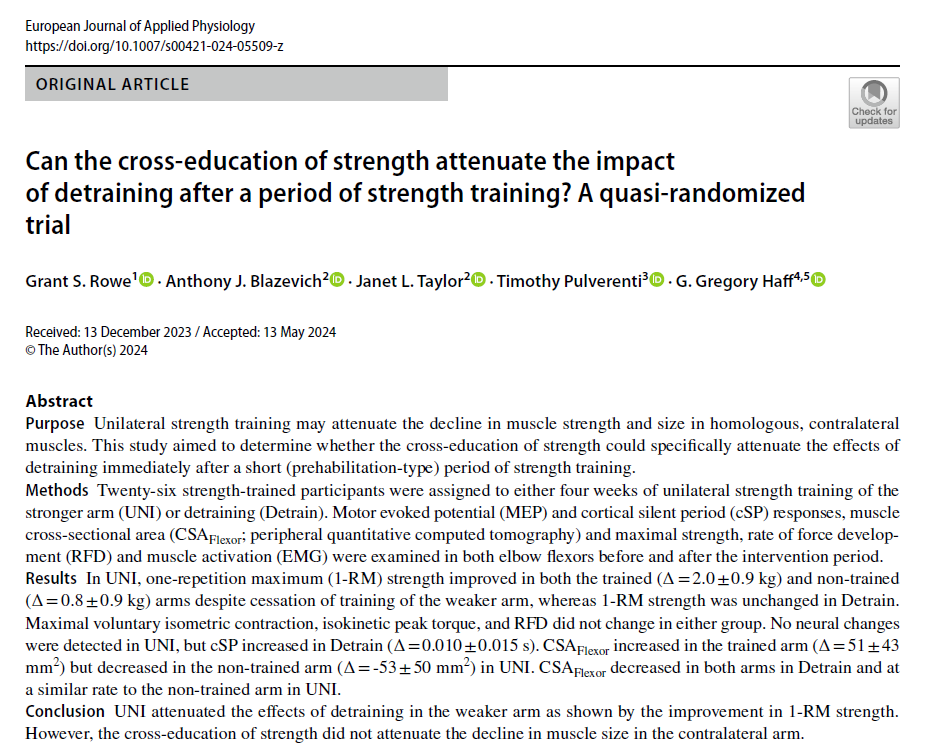
After 4 weeks of elbow flexor training on both arms (3 sessions per week at 75% 1-RM), continuing to train only one arm (at 90% 1-RM) for the next 4 weeks:
- Further increased strength of the other (non-trained) elbow flexors by 7.2%
- But was not sufficient to stop the loss of muscle size
This “cross-education” effect could be leveraged to slow detraining effects (of strength) after short-term training periods when continued training of one limb is not possible.
https://t.co/es8N6jf6HM
One of the top experts in the field, Prof. Dr. @JSkarabot, will reveal the answers and guide you through the world of MU behavior. Apply now and secure your spot at Summer School Hybrid Neural Interfaces
Registration: https://t.co/QCigTGeLB0
Welp, I finally finished the last dissertation data collection session! Time to break it all down and start getting ready to submit it! Can’t thank all those that helped with this process and all the participants than came in for training. On to the next project 😂
Our lab’s 1st attempt at a preprint, led by @Jpbeausejour_ We welcome feedback, especially if you conduct TMS research during active contractions. 🧠@UCF_CNSlab
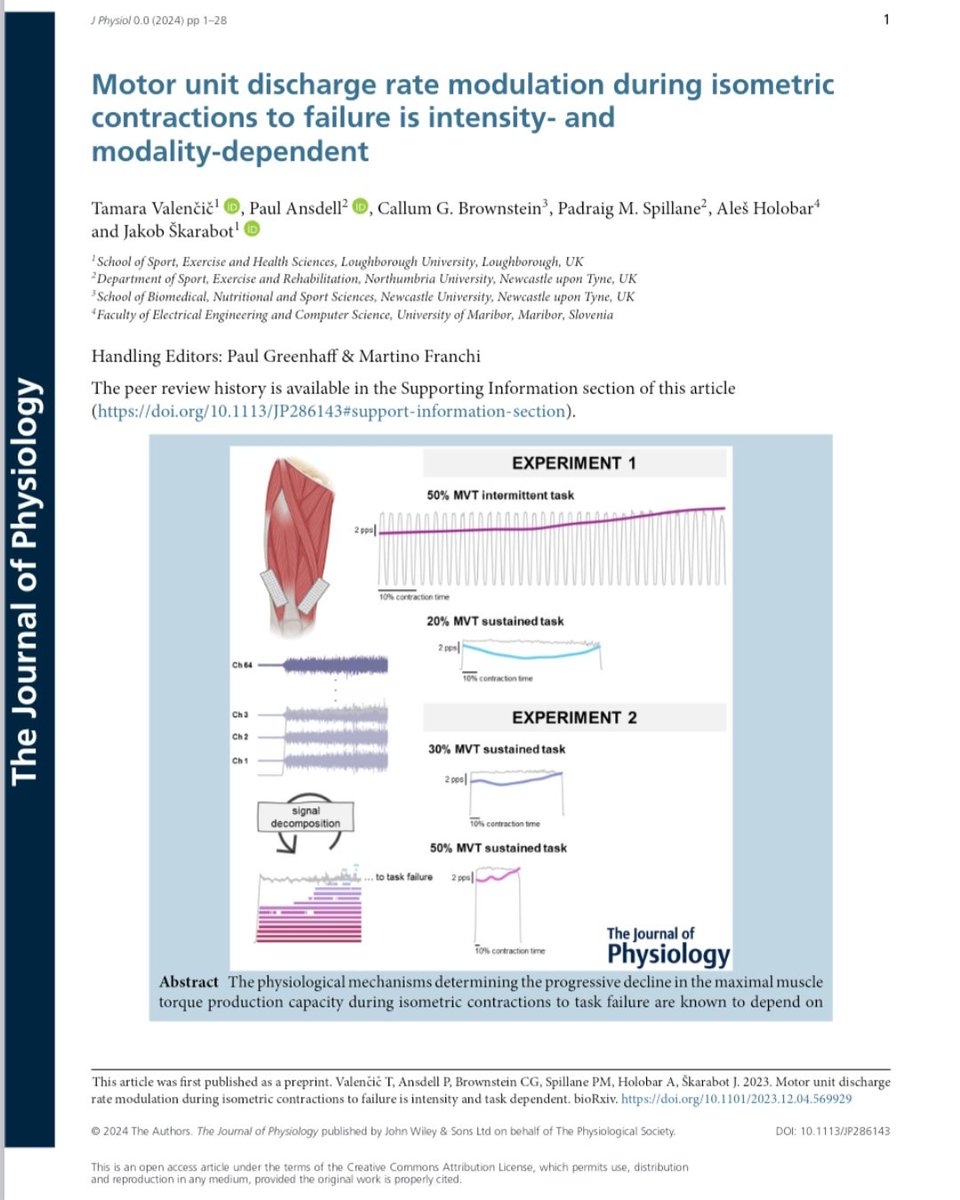
🔹️Incredibly excited and proud to finally be able to share this paper with the world! ☺️🎉
🔹️We show that discharge rate adjustments of the vastii motor units during isometric contractions to failure depend on contraction intensity and modality.🤓
https://t.co/03mbWQ10df