this is actually insane
> be tech guy in australia
> adopt cancer riddled rescue dog, months to live
> not_going_to_give_you_up.mp4
> pay $3,000 to sequence her tumor DNA
> feed it to ChatGPT and AlphaFold
> zero background in biology
> identify mutated proteins, match them to drug targets
> design a custom mRNA cancer vaccine from scratch
> genomics professor is “gobsmacked” that some puppy lover did this on his own
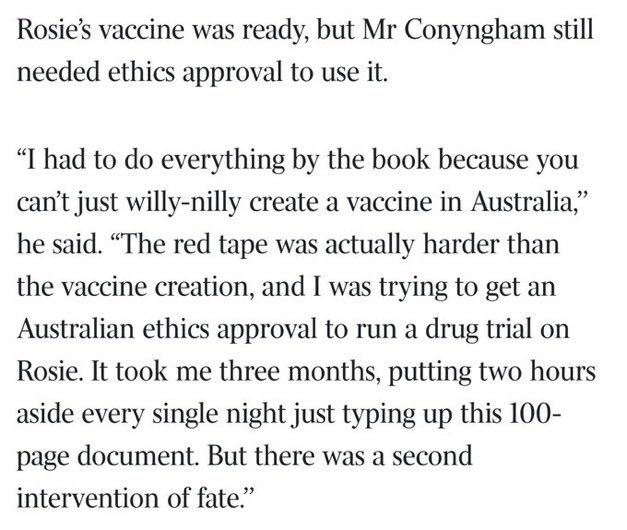
> need ethics approval to administer it
> red tape takes longer than designing the vaccine
> 3 months, finally approved
> drive 10 hours to get rosie her first injection
> tumor halves
> coat gets glossy again
> dog is alive and happy
> professor: “if we can do this for a dog, why aren’t we rolling this out to humans?”
one man with a chatbot, and $3,000 just outperformed the entire pharmaceutical discovery pipeline.
we are going to cure so many diseases.
I dont think people realize how good things are going to get
The Sentence (Short Sci-Fi Film Made with Veo 3)
This is my latest short film made with Veo 3, and the longest one I've done so far. It took 3 days from writing to final render.
The story explores a newly introduced form of capital punishment. What begins as a routine sentence reveals something far more unsettling.
“I believe everyone deserves the ability to automate tedious tasks in their lives with computers. You shouldn’t need a computer science degree or programming bootcamp in order to get computers to do extremely specific tasks for you.”
https://t.co/9dw4EC3Ir8
Many people are mocking Apple's "Private Cloud Compute" as any other cloud service with the same guarantees and privacy concerns.
Please, read a bit before you make yourself a clown before everyone else.
Some notes about Apple's Private Cloud Compute:
1. Apple can't access your data, even if they want to. Under any circumstances.
2. Your data is never retained, logged, or used for debugging.
3. An attacker can't access a specific user's data without compromising the entire system. Even if an attacker gets physical access to a node, they won't be able to compromise the rest.
4. Security researchers have access to verify Apple's privacy and security guarantees.
5. Apple is using custom-built server hardware using Apple silicon. They use the same Secure Enclave and Secure Boot they've used on the iPhone.
6. They created a new secure operating system with a narrow attack surface.
7. They replaced existing general-purpose cloud components that everyone uses (like remote shells and observability tools) with custom, more secure components.
There's a ton of serious security research and engineering behind the Private Cloud Compute. Apple has been working on it for years, and the result looks really good.
# automating software engineering
In my mind, automating software engineering will look similar to automating driving. E.g. in self-driving the progression of increasing autonomy and higher abstraction looks something like:
1. first the human performs all driving actions manually
2. then the AI helps keep the lane
3. then it slows for the car ahead
4. then it also does lane changes and takes forks
5. then it also stops at signs/lights and takes turns
6. eventually you take a feature complete solution and grind on the quality until you achieve full self-driving.
There is a progression of the AI doing more and the human doing less, but still providing oversight. In Software engineering, the progression is shaping up similar:
1. first the human writes the code manually
2. then GitHub Copilot autocompletes a few lines
3. then ChatGPT writes chunks of code
4. then you move to larger and larger code diffs (e.g. Cursor copilot++ style, nice demo here https://t.co/u8ueY0mGxZ)
5....
Devin is an impressive demo of what perhaps follows next: coordinating a number of tools that a developer needs to string together to write code: a Terminal, a Browser, a Code editor, etc., and human oversight that moves to increasingly higher level of abstraction.
There is a lot of work not just on the AI part but also the UI/UX part. How does a human provide oversight? What are they looking at? How do they nudge the AI down a different path? How do they debug what went wrong? It is very likely that we will have to change up the code editor, substantially.
In any case, software engineering is on track to change substantially. And it will look a lot more like supervising the automation, while pitching in high-level commands, ideas or progression strategies, in English.
Good luck to the team!
@amanrsanger I’ve been using it for a couple of weeks and now is part of my flow. I love how it “watches” a change I made in a file and then when going to the other file it knows what to change based on this
The simplest solution is usually the best. But when it's not, the cost to correct course later is comparatively low since you didn't sink a lot of resources implementing a suboptimal complex solution.
Prompt engineering (or rather "Flow engineering") intensifies for code generation. Great reading and a reminder of how much alpha there is (pass@5 19% to 44%) in moving from a naive prompt:answer paradigm to a "flow" paradigm, where the answer is constructed iteratively.
You know how image generation went from blurry 32x32 texture patches to high-resolution images that are difficult to distinguish from real in roughly a snap of a finger? The same is now happening along the time axis (extending to video) and the repercussions boggle the mind just a bit. Every human becomes a director of multi-modal dreams, like the architect in Inception.
Coming back to Earth for a second, image/video generation is a perfect match for data-hungry neural nets because data is plentiful, and the pixels of each image or video are a huge source of bits (soft constraints) on the parameters of the network. When you're training giant neural nets in supervision-rich settings, your train loss = validation loss, and life is so good.
My favorite place to keep an eye on the AI video space unfold atm is probably https://t.co/l1xRaq71C4 , or the individual Discords.