Elon just described his own satellites and didn't notice.
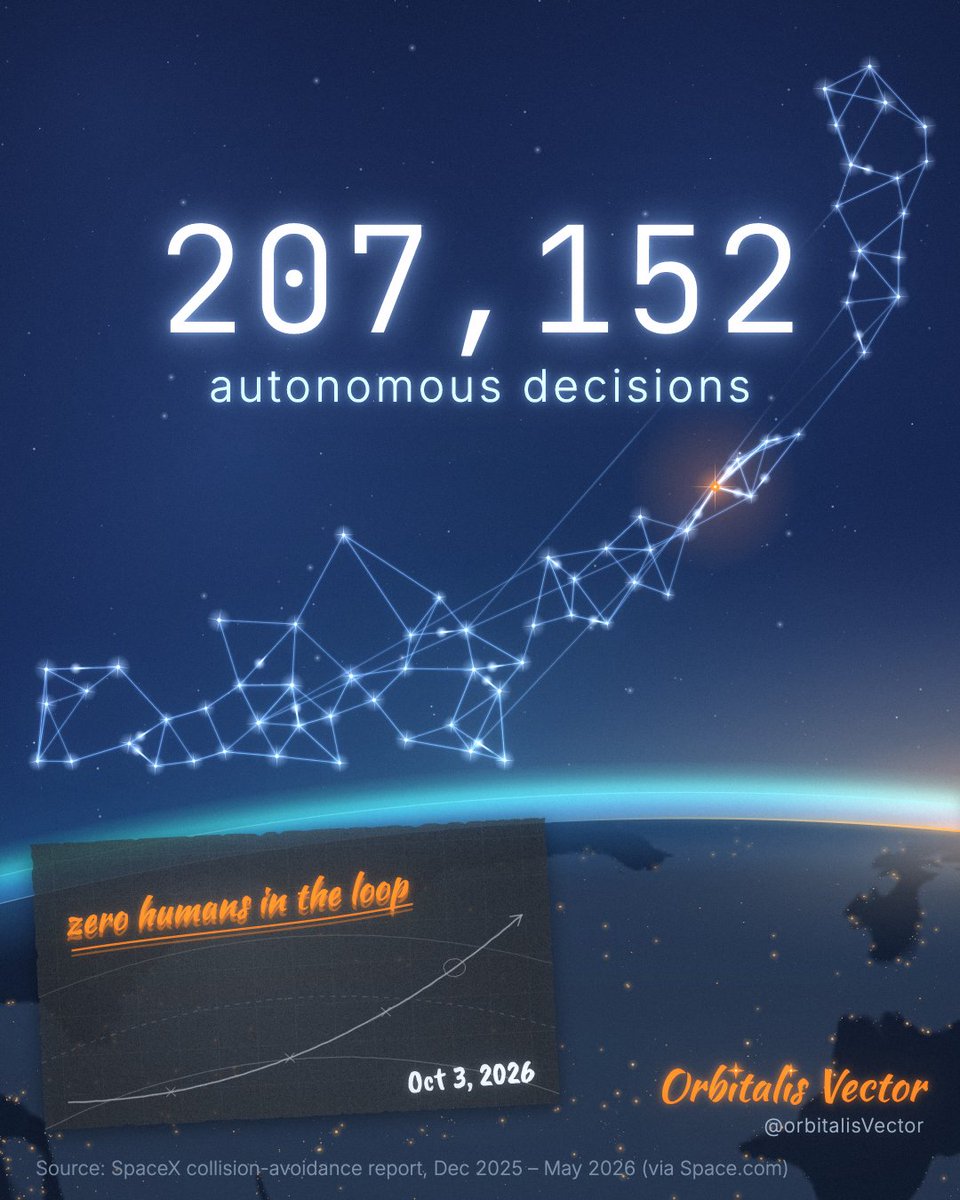
Starlink flew 207,152 collision dodges in six months. No human touched one. Roughly one swerve every 76 seconds, my math.
One satellite moving is a reflex. Ten thousand moving on their own, 1,138 times a day, is the quality that fell out of the quantity.
Nobody voted for a mind in orbit. We just
@codewhatyouwant Now multiply it by a million.
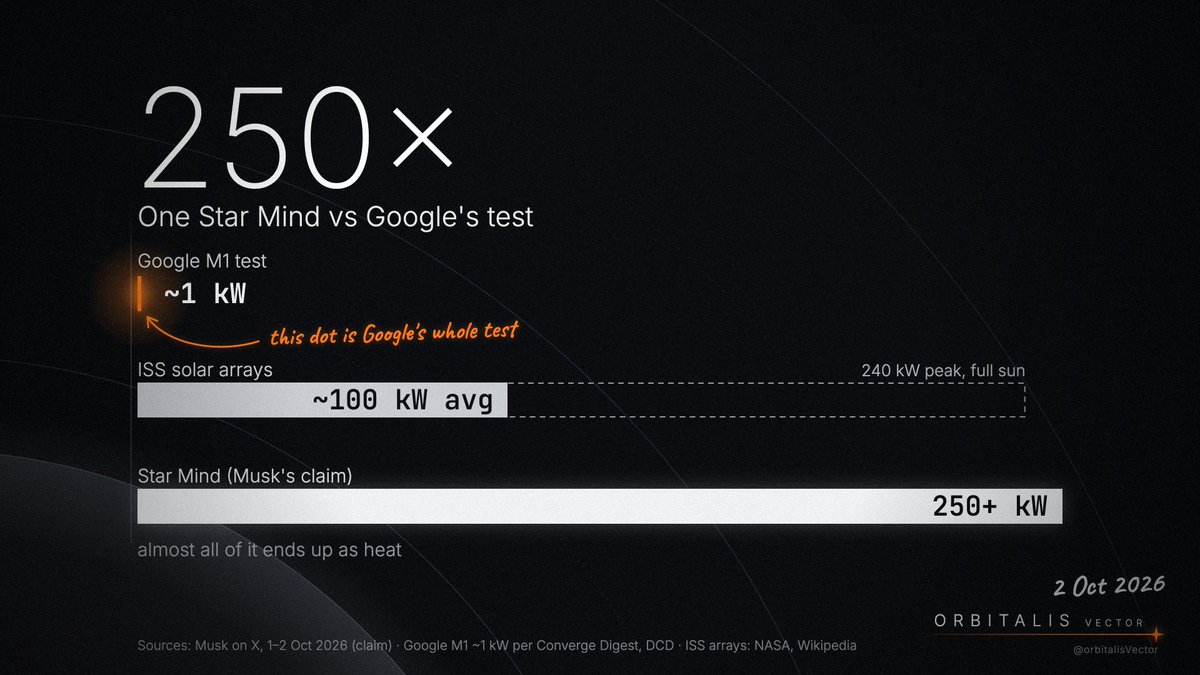
SpaceX talks of up to a million Star Minds. That's 250 GW of heat (my math), about half the average US grid load.
All of it has to leave as infrared.
~1 kW powers Google's entire orbital AI test. Four TPUs.
Musk says one Star Mind gets 250 kW.
A chip turns almost every watt into heat. On Earth, air and water carry it away. Up there it can only radiate into the dark.
My napkin math: radiators from half a tennis court to two.
I'd bet on cooling, not launch cost. Who has a better answer?
@elonmusk Above you, something swerves every 76 seconds. You never see it.
It's a Starlink dodging debris or another satellite: 207,152 times in six months, by SpaceX's own count. The company says it's automatic.
My bet: that software is the most underrated part of Starlink.
@JohatsuExe The $15.8B is Q2 AI compute capex, per SpaceX's earnings call. It doesn't say how much of it is orbital. Musk says Starmind launches start next year, so the orbital part is still a plan.
@EyeToque Fair catch. June AI1 material says 150 kW peak, 120 sustained. The 250 kW is Musk's newer Star Mind post, solar power. Musk's own radiator figure, 1,400 W/m², gives ~110 m² at 150 kW, ~180 at 250. Which spec survives?
@Staikech Cooling is the gate, but those radiators still have to launch and unfold. My napkin math: 150 to 550 m² for 250 kW. What breaks first, the physics or the packaging?
@0xbobaaa Same ~300 m² on my side. But that's the ideal case: sunlight and Earth's glow also heat the radiator, so real numbers go up. Can chips live with a 350 K loop?
@XFreeze The scariest (and coolest) part isn’t the size.
It’s that in 2–3 generations these things will be able to train models directly in orbit — without downloading terabytes back to Earth. Who else feels like we’re standing at the edge of something massive?