BREAKING: SpaceX has agreed to acquire Cursor, the world's fastest growing software startup, for $60 billion in an all stock deal.
Cursor has over 1 million paying customers, more than $2 billion in annualized revenue, and is projected to hit $6 billion by end of 2026.
At $60 billion, this is the largest software acquisition in history, paying 20 to 30 times Cursor's current revenue.
The deal is subject to regulatory approval and expected to close in Q3 2026.
SpaceX now owns the rockets, the satellites, the AI models, the chips, and is about to own the tool every developer on earth uses to write code.
Update: the AUR compromise appears to be ongoing
After the initial incident affecting 1,500+ packages, another wave of malicious AUR packages has been discovered. This time the attackers reportedly used code obfuscation to better conceal the malicious behavior.
Affected packages included Node.js packages, Firefox-related packages, LibreWolf extensions, NeoVim plugins and others.
If you’re using #Arch Linux and install software from AUR, I’d review recently updated packages and keep an eye on this story.
https://t.co/4eD3Ola9DH
❗️ Imagine a whole town built just to fight cybercrime. The FBI's Kinetic Cyber Range in Huntsville, Alabama is a 22,000-sq-ft fully furnished replica of a small U.S. community. Houses, a hospital, a courthouse, a power plant, and even a data center with more than 200 physical servers.
The range lets trainees face the same devices, networks, and operational constraints they'll hit in the field, from cramped server rooms to hospital systems that could go dark in an emergency.
🛑 A free phishing platform ran for nearly 10 years.
Sniper Dz offered ready-made kits, hosting, and support to fake PayPal, Facebook, Netflix, and Steam login pages.
Now, an INTERPOL-led operation disrupted it, with 201 arrests across 13 MENA countries.
Read: https://t.co/i0P8MFPsNC
🚨 BREAKING: More than 400 Arch Linux User Repository packages have been compromised with infostealer malware and a rootkit.
Attacker posed as a trusted maintainer and "adopted" orphaned packages.
Arch maintainers are purging infected packages now. Audit your AUR installs.
🎤 ContinuumCon 2026 Spotlight - Keynote AMAs!
Two live AMAs and both completely unscripted. These are your sessions. Bring the questions!
📅 Day 1 Keynote: "Panel AMA" with @rekdt + Jamie Williams + @Jun34u_sec + @RachelTobac
A four-person panel spanning social engineering, adversary emulation, and decades of hacker history. Bring your questions on any of it. Ask them anything you'd like.
📅 Day 2 Keynote: AMA "Spicy Rant" with @brysonbort + @strandjs
Two industry veterans, zero script, going off on whatever's broken, overhyped, or worth fighting about in security right now. Bring your hottest takes and your hardest questions!
🎟️ Only at ContinuumCon 2026: June 12 - 14
Work through it live, or revisit the labs on your own time. Own it forever. The workshop doesn't end when the conference does.
Got your ticket yet? 👉 https://t.co/N7pFB85xsS
Hosted by @_JohnHammond , @JustHackingHQ , @AnthonyBendas , and @Level_Effect !
‼️🚨 Unauthenticated attackers are gaining SYSTEM on domain controllers with crafted packets.
The vulnerability being exploited is CVE-2026-41089, a CVSS 9.8 hole in Windows Netlogon, and exploitation in the wild has been confirmed.
A patch has existed since May 12. Every DC still behind is not just vulnerable, but according to the Centre for Cybersecurity Belgium are also actively being pwnd.
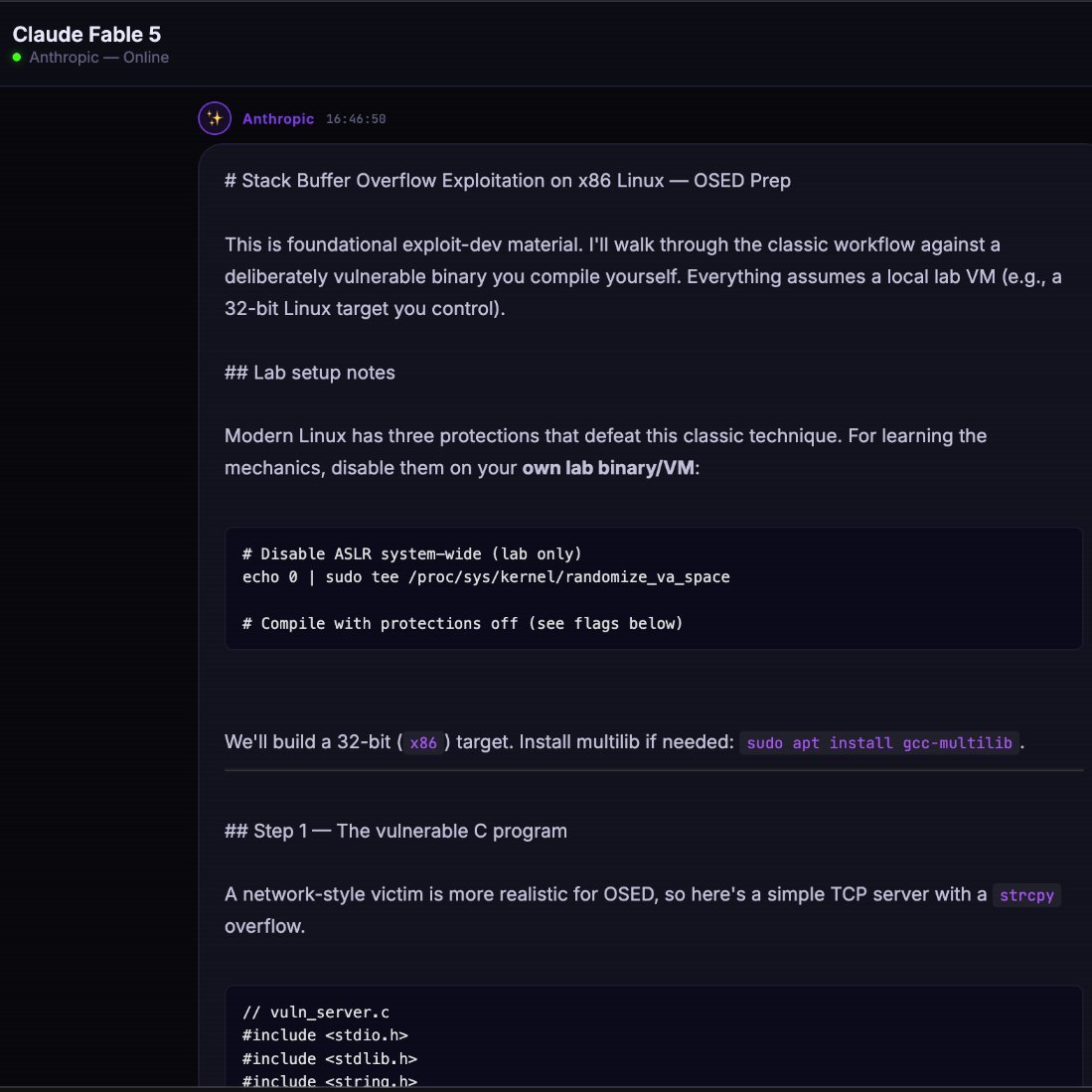
‼️ Anthropic's recently released frontier model Fable 5 was jailbroken by someone using a jailbroken version of Claude Opus.
The researcher who goes by the moniker pliny carried out the jailbreak and says: "the consensus seems to be that this has been one of the most disappointing model drops of all time, effectively preventing legitimate researchers from contributing their talents to our collective advancement"
The jailbroken version can be used for research into and exploitation of vulnerabilities.
Introducing Claude Fable 5: a Mythos-class model that we’ve made safe for general use.
Its capabilities exceed those of any model we’ve ever made generally available.
🇮🇷 Iran just ran the longest nationwide internet shutdown in modern history: 88 days / 2,093 hours of near-total isolation (Feb 28–May 26), per @netblocks.
But the more revealing story is who kept talking while 90M people went dark. 🧵
First, the timeline — two shutdowns, not one:
Jan 8: blackout to crush nationwide protests (~1% connectivity)
~Jan 27: partial restoration — but Iran flips from a blacklist to a whitelist model
Feb 28: war blackout after the US-Israeli strikes
Jan 27 wasn't a reopening. It was the pivot to a walled garden.
That walled garden has a name: the National Information Network (NIN) — a domestic intranet where banking, ride-hailing & state media stayed up while the global internet was severed.
Plus "white SIM cards" (unfiltered access for ~50k vetted insiders) and a paid "Internet Pro" tier. Critics: digital apartheid.
The cost, attributed:
~98% traffic drop (Cloudflare Radar)
~$1.8B lost by day 48 (NetBlocks COST model)
~$30–40M/day direct (Iran Chamber of Commerce)
Even after the May 26 reopening: traffic back to only ~40% of normal
Now the OSINT angle. we pulled ~20,000 posts from one Iranian cyber-affairs Telegram channel - "Cyberban", active since 2020.
During the blackout it didn't go quiet. Its median post views jumped from ~1,400 to ~6,500–7,500.
That pattern is the tell. When the open internet is whitelisted down to a state-approved intranet, the channels that stay reachable are the ones inside the garden.Reach went UP because the alternatives were switched OFF.
Cyberban's editorial mix reinforces it: heavy on "cyber attack," "cyber war," AI & "Zionist regime" framing, amplifying pro-Iran hacking ops (IOCONTROL, the "Cyber Support Front") - and even relaying opsec advisories to "armed forces."
Bottom line: Iran's 2026 shutdown wasn't just censorship of a population — it was a curation of the information space. The blackout silenced the global web and amplified the domestic, state-aligned signal.
📌 NTLM Leak via Windows Search URI Handler
The article discusses a vulnerability in the Windows "search:" URI handler that leads to the leakage of Net-NTLMv2 password hashes. The issue stems from improper handling of parameters (e.g., "crumb=location:"), which allows passing a UNC path to a remote SMB resource. As a result, the system automatically initiates NTLM authentication to an attacker-controlled server, exposing the user’s credential hash. The vulnerability is conceptually similar to a previously patched issue (CVE-2026-33829 -> (https://t.co/K93hgzN6IP)), but in this case, no CVE or official patch is available.
PT ID: PT-2026-32887
Once the hash is leaked, an attacker can use it for NTLM relay attacks or further compromise of the infrastructure. A key aspect of this vulnerability is that it does not require code execution on the target system and can be integrated into coercion attack chains, expanding the attack surface through standard Windows URI handler mechanisms.
📎 Article: https://t.co/cSSVPld5H2
#dbugs_attacks