We're announcing a major update to Weather Lab, our interactive website for sharing Google’s AI weather models from @GoogleDeepMind and @GoogleResearch: https://t.co/7vCH7Qw2Fo
Excited to share that our paper TimeSAE was presented at @ICML2026. We believe the future of Mechanistic Interpretability lies in moving beyond Sparse Autoencoders toward causal, faithful explanations. TimeSAE is a step in that direction. @ExplainableML
A model’s chain of thought acts like a scratch pad, offering a window into its reasoning. 📝
On the latest episode of our podcast, host @fryrsquared sits down with @NeelNanda5 to explore interpretability – the science of reverse engineering how neural networks learn and think.
Timecodes:
00:00 Introduction
02:41 Motivation for interpretability research
04:01 Mechanistic interpretability
08:14 Chain of thought monitoring
18:14 Interpretability techniques
35:00 Auditing models for safety
48:53 What comes next for interpretability
𝐛𝐞𝐬𝐭-𝐨𝐟-𝐧 is a strong baseline for
- improving agents
- scaling inference-time compute
- preference alignment
- jailbreaking models
How does 𝐁𝐨𝐧 work? and why is it so strong?
Find some answers in the paper we wrote over two Christmas breaks!🧵
🚀Announcing LangGraph Studio: The first agent IDE
LangGraph Studio offers a new way to develop LLM applications by providing a specialized agent IDE that enables visualization, interaction, and debugging of complex agentic applications
With visual graphs and the ability to edit state, you can better understand agent workflows and iterate faster. LangGraph Studio integrates with LangSmith so you can collaborate with teammates to debug failure modes
LangGraph Studio is available for free to all LangSmith users on any plan tier during its early development.
Read more about it here: https://t.co/VKnJkOpusv
Watch a YouTube walkthrough: https://t.co/1qruVoJXe9
Try out LangGraph Studio for free here: https://t.co/3pwnQLkDTd
Sign up for a LangSmith account: https://t.co/NZbDhzp8xX
Thank you to @huggingface for the delightful invitation to an enriching AI dinner last week. Meeting inspiring individuals is always a pleasure. Engaging in passionate conversations about AI and its implications with fellow enthusiasts brings me immense joy 😍🦙@llama🤗.
We just released a big 🎁GIVT update!
📈 Larger models and improved image generation results across the board
💡 Improved GMM formulation and adapter module
💻 Code, model checkpoints, and a colab are now available at https://t.co/zaf5orekfZ
More details below... 1/
Oldies but goldies: Georg Frobenius, Über Matrizen aus positiven Elementen, 1908. Perron-Frobenius theorem ensures that Markov chains with positive transitions converge toward the stationary distribution. https://t.co/xfnUxhMDYP
We are excited to announce an internship opportunity at @TotalEnergies: Generative Model for Synthetic Data: Privacy-Robustness-Utility Trilemma. Join us in shaping the future of Privacy, Robustness, and Utility of Generative Models!
https://t.co/Ek9JPApZ4z
@compTimeSeries 🔍 Introducing XGen! 📊 new comprehensive archive and eXplainable Time Series Generation Framework for Energy is here. 🌟 Discover how XGen enhances time series forecasting in the energy domain! https://t.co/fV1owS8Kmq #EnergyForecasting#XGenFramework 🚀
Our workshop on "Challenges in Deployable Generative Modeling" was accepted to ICML 2023! @icmlconf 🎉🎉
Looking forward to exploring the potentials and risks of Generative AI across diverse real-world domains with some amazing speakers in person!
Joins us in Hawaii!🏖️🏝️
Had a great conversation with Yoshua Bengio. Both of us agreed that a good step forward for AI risk is to articulate the concrete scenarios where AI can lead to significant harm. More to come, and looking forward to continuing the conversation!
A NYT article on the debate around whether LLM base models should be closed or open.
Meta argues for openness, starting with the release of LLaMA (for non-commercial use), while OpenAI and Google want to keep things closed and proprietary.
They argue that openness can be dangerous. But they are just protecting their commercial interests.
I argue that closeness is *considerably* more dangerous than openness.
Once LLMs become the main channel through which everyone accesses information, people (and governments) will *demand* that it be open and transparent. Basic infrastructure must be open.
"Dr. LeCun also pointed to recent history to explain why Meta was committed to open-sourcing A.I. technology. He said the evolution of the consumer internet was the result of open, communal standards that helped build the fastest, most widespread knowledge-sharing network the world had ever seen.
“Progress is faster when it is open,” he said. “You have a more vibrant ecosystem where everyone can contribute."
"In Battle Over A.I., Meta Decides to Give Away Its Crown Jewels." https://t.co/CFvEJuYQ1n
Excited to announce that #OxML2023 is kicking off next week (8-10 May) with one of our most popular modules, ML x Fundamentals!🎉🙌
Our amazing speakers will delve into some of the most critical topics in #MachineLearning, including:
- Rasul Tutunov (@HuaweiUK): Fundamentals of Mathematics for ML
- Yali Du (@yalidux– @KingsCollegeLon): Fundamentals of Optimisation for ML
- Matthieu Zimmer (@HuaweiUK): Fundamentals of Reinforcement Learning – from Basics to Deep RL
- Eduardo C. Garrido Merchán (@UCOMILLAS): Basic pillars of GPT4: Understanding DL fundamentals for a better comprehension of LLM
- Haitham Ammar (@hbouammar – @HuaweiUK & @ucl): Fundamentals of Bayesian Optimisation
This module is designed to equip all #OxML participants with the necessary theoretical background to excel in the field of ML.
@CIFAR_News @DeepMind @oxdeepmedicine@oxmartinschool@rezakhorshidi@monalinejad@TakedaPharma
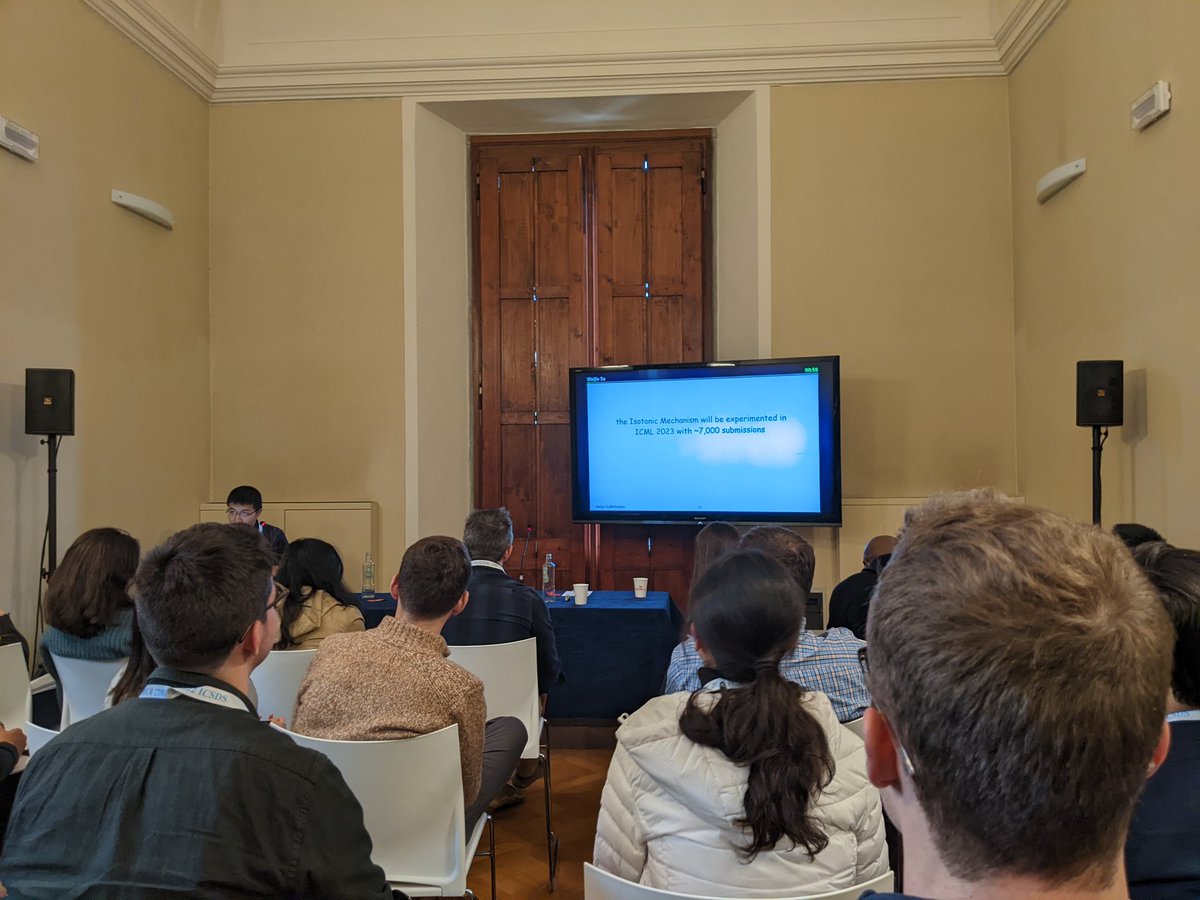
Very interesting! #ICML2023 will experiment with letting authors review their own papers 🤔
Here's the paper by @weijie444, which uses authors' rankings of their own papers to improve reviewing outcomes. It incentivizes authors to tell the truth. https://t.co/9ExP53DFgm
[Report] "Releasing Internal Code into a New #OpenSource Project: A Guide for Stakeholders" - published by the @linuxfoundation and now available for download https://t.co/5mVCzhlKBK
cc: @LFAIDataFdn