Scientists have created one of the most detailed 3D reconstructions of a human cell (eukaryotic cell) ever produced.
This groundbreaking model, often termed a "Cellular Landscape Cross-Section Through a Eukaryotic Cell," combines data from X-ray tomography, nuclear magnetic resonance (NMR), and cryo-electron microscopy to map molecular structures in extreme detail.
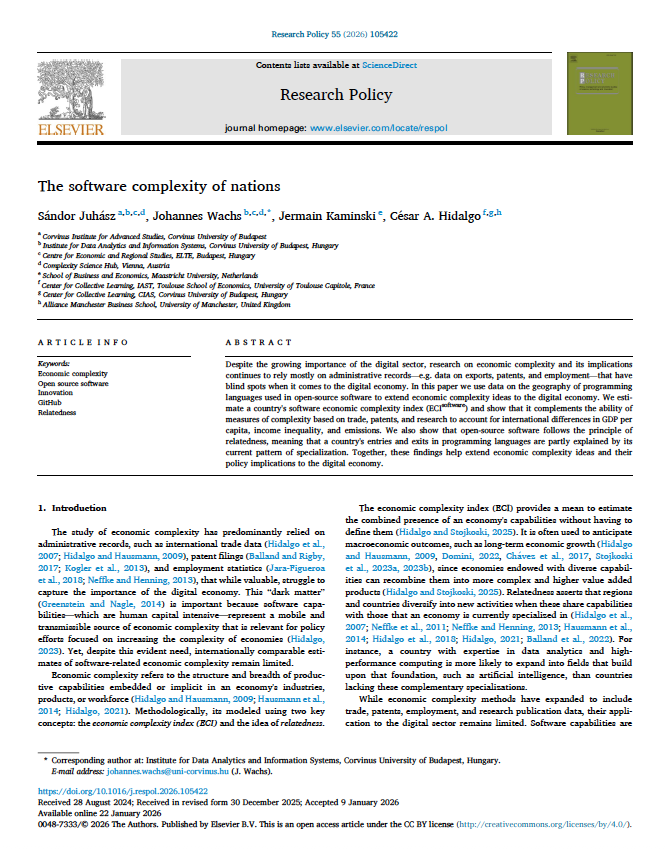
New Paper: The Software Complexity of Nations (Research Policy, 2026)
Most work on economic complexity relies on trade, patents, employment, or publications data. These sources, however, systematically misrepresents software.
Code does not cross borders through customs, service categories are too coarse to capture real digital capabilities, and many important software innovations are not patentable. As a result, a large share of modern productive capabilities remains invisible in multidimensional economic complexity metrics.
In this paper, we use the geography of open-source software to estimate a country’s software economic complexity (ECI software). Using GitHub data, we track where developers contribute code and group programming languages into technology stacks to estimate software specialization matrices from where we derive an Economic Complexity Index for software capabilities.
We find that:
Software captures a real and distinct capability dimension. Countries’ software ECI correlates but is not redundant to complexity measures based on trade, patents, or research. In fact, software complexity comes with a few surprises, like Russia and Indonesia being substantially more sophisticated in Software than in Products (This is also true for India, but I would say that's not surprising).
Software complexity correlates well with macro outcomes. Even after controlling for other complexity dimensions, software ECI is strongly correlated with higher GDP per capita and lower income inequality. It also relates to lower emissions intensity in simpler specifications. Unfortunately, since the time series of software data are rather short, we could not explore whether Software complexity explains future economic growth (but we will be able to do that in the future :-)).
Digital diversification is also path-dependent. This should come to no surprise to anyone familiar with the principle of relatedness, but it is good to know. Countries tend to enter new software stacks that are related to the ones they already have. Software capabilities accumulate much like industrial capabilities.
The broader implication is that software is not just another sector, but a mobile and highly human-capital-intensive source of economic complexity. Software opens new paths for structural transformation, which could be particularly interesting for economies that are geographically isolated.
This was a great collaboration with @johannes_wachs@sandor_juhasz and @jermainkaminski
You can read more at:
https://t.co/D3fg8z9rax
https://t.co/nLwSujWHzw
Professor @ozgurkelesh is hiring @unccharlotte
PhD Students & Postdoc Openings — Ultrafast Laser Nanomanufacturing
PhD students and a postdoc to work on ultrafast laser nanomanufacturing
Email [email protected] with your CV + 2–3 sentences on your relevant experience.
In the 1960s families spent about 1/3 of their income in food, motivating a poverty line of food expenditures x 3.
Today that factor would be 16. This article by @profplum99 explores in detail how to think about poverty lines in a world where our needs have changed.
This is a very cool paper. It first shows that first-gen college students don't realize a lot of unwritten rules that lead to success (the value of internships, student clubs, letters from professors).
But giving them access to an LLM for guidance significantly closes the gap.
Applications are now open for the University of California President's Postdoctoral Fellowship Program (UC-PPFP).
Please contact me if you are interested in applying to this program and be a part of our research group @ucmerced, pushing the boundaries of AFM🔬 📖 🏅
Can creativity be taught? “Absolutely!” Thank you @Nature for writing about how we need to nurture BOTH the ‘day science’ and ‘night science’ aspects of our work. The system of science is not really rewarding creativity now and we need to change this!
https://t.co/yMZUuifeso
Researchers have been sneaking secret messages into their papers in an effort to trick AI tools into giving them a positive peer-review report
Read the full story: https://t.co/1kOYRLf72i
@MishaTeplitskiy “Our results indicate that additional resources to institutions that historically received insufficient investment unlocked the research potential of aspiring researchers.”
Is lower productivity at poorer institutions the result of fewer resources vs. researchers who work there have fewer publishable ideas?
This provides some evidence for resources
“My understanding of information has been deeply influenced by @cesifoti, Why Information Grows (New York: Basic Books, 2015).” Me too @harari_yuval . Two fantastic books!
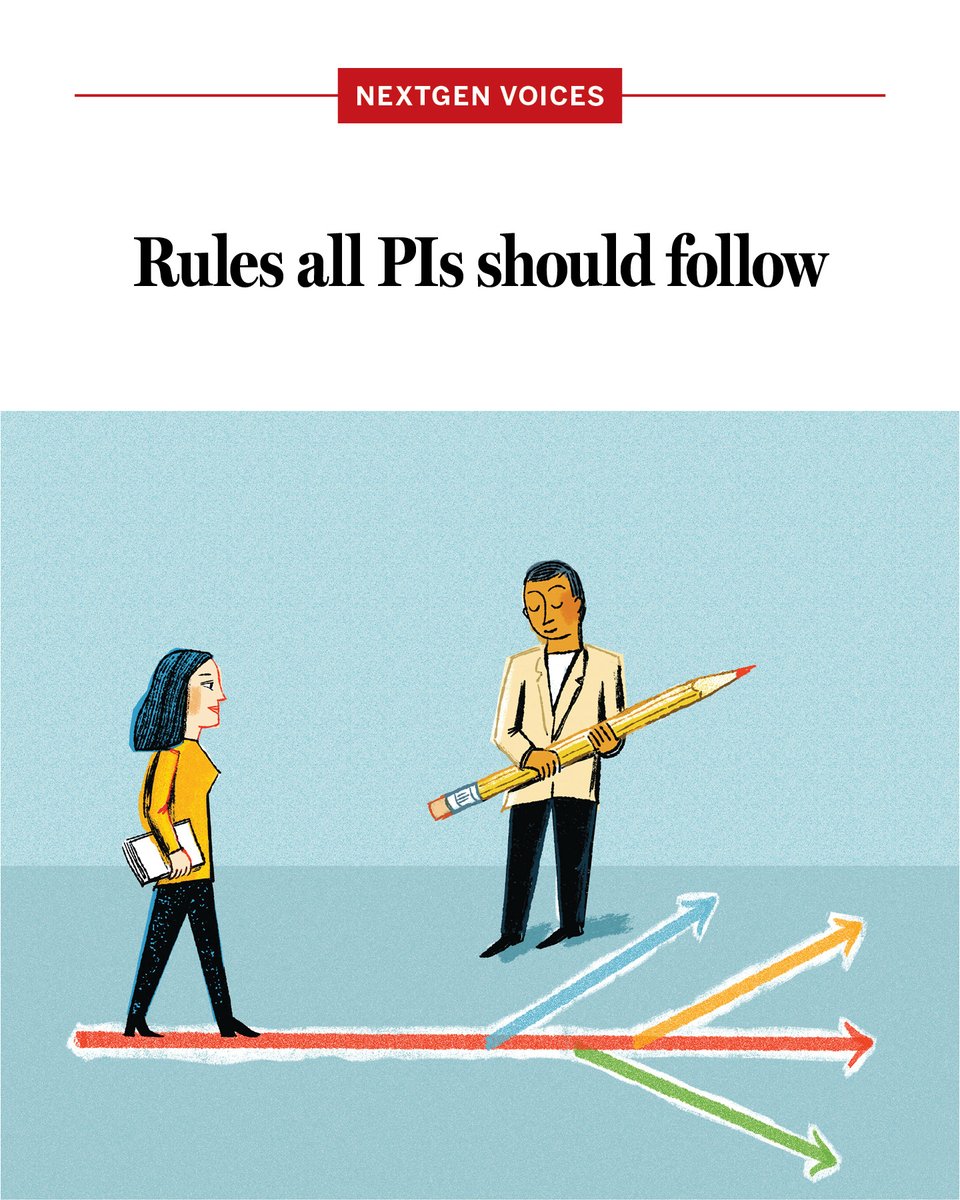
#NextGenSci asked young scientists to write a rule that all principal investigators should be required to follow to improve the experience of young scientists in their lab.
Check out their answers on #NationalHigherEducationDay: https://t.co/18ao7BZeFT
@volky77 Evet, yurt dışındayız şu an. Teşekkür ederim, klasik pairing’lerin dışına çıkmak istedik biraz. Köpüklü şaraplar (özellikle Dom) yağlı A5 etlerle şaşırtıcı derecede iyi gitti. Ama iyi bir Cabernet Sauvignon ya da Bordeaux blend her zaman ağır top! Bir dahaki sefere onu da deneriz
Our group has an opening for two postdoctoral research positions on battery materials. For more info & apply, please see the link below
https://t.co/TJdGTyH3tE
I am at @ECSorg meeting in Montreal so feel free to reach out if you want to know more about it as well.
For those of you looking for a big helping of LLMs for Thanksgiving, here you go! 🤖🦃 (link in next post)
In this work, we release 34 examples (each with open code!) demonstrating applications of LLMs in materials science and chemistry across:
🔶molecular and material property prediction;
🔷molecular and material design;
🔶automation and novel software interfaces;
🔷enhanced scientific communication and education; 🔶research data management and automation;
🔷hypothesis generation and evaluation; and
🔶knowledge extraction and reasoning from scientific literature