Designer who ships. Founder -Give any object a memory. 15 yrs UX (fintech, e-com, gov). Building the scan-to-agent layer at @AIconference Hack Day 2026
The AI Conference 2026 is officially in the books.
Over the past few days, thousands of engineers, founders, researchers, investors, and AI leaders came together in San Francisco to share what they’re building, compare what’s working, and push the conversation forward.
From Day ZERØ and Hack Day to the main conference, Startup Showdown, Party in the Park, and Ignite Talks, the energy came from the people in the room.
Thank you to everyone who spoke, built, shared, connected, and showed up. More highlights from The AI Conference 2026 are coming soon!
Thank you.
Four weeks ago, I was still learning what a hackathon was. This week, I got to take part in my first one, and it was an experience I won’t forget.
I’m grateful to @itsajchan for inviting me and giving me the chance to build alongside such a generous team. I learned from every conversation, and it meant a lot to see people connect with the idea behind Emori.
I started Emori because memories help us stay connected to the people we love. Sharing that idea with more people this week was special.
This is just the beginning. Emori SI is coming soon.
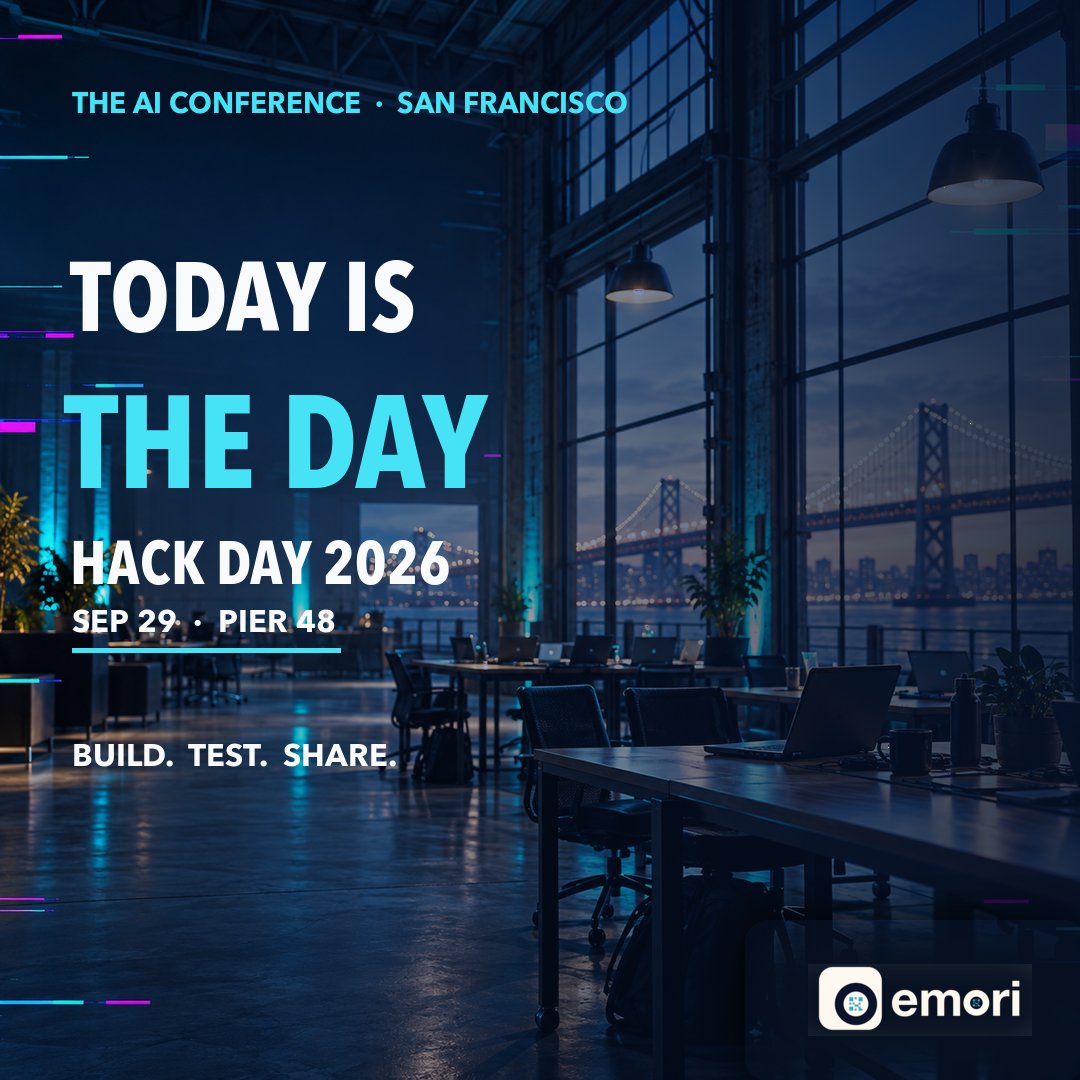
Today is the day.
Emori is at The AI Conference Hack Day in San Francisco. One focused day, one bold build, and a new way to experience the memories that matter.
The next chapter starts today.
https://t.co/IXEkx7YIoW
#Emori#HackDay#AI
More than words. ✨
Now, imagine what AI could remember.
A glimpse of what we’re building with Emori. More to come at The AI Conference.
https://t.co/IXEkx7Yazo
#Emori#AIConference#Hackathon#AI
Tomorrow is the day.
Emori is heading to San Francisco for The AI Conference Hack Day—one focused day to build, test, and push memory technology into its next chapter.
Something meaningful is about to come to life.
https://t.co/IXEkx7YIoW
#Emori#HackDay#AI
Some moments leave more than a photo. They leave a story, a lesson, a piece of someone we want to carry forward.
At Emori, we’re exploring how AI can help preserve the memories and knowledge people choose to share.
The next chapter is coming to Hack Day. What would you want to pass on?
Explore Emori: https://t.co/YjuJqT5HNA
#Emori #PersonalIntelligence #AIConference #Hackathon
What happens to everything we learn over a lifetime? Not the photos. The lessons, the stories, the things we'd want to pass on. I'm building Emori: exploring how AI can preserve a lifetime of memories, knowledge and experience. Demo soon. Explore Emori: https://t.co/m7b6gW5oqi
This is going to be an epic experience. Build a business in one day. The winner gets to pitch it at the Startup Showdown at @AIconference during the conference!
https://t.co/RGR033Hc15
Over $10K in prizes. Grateful to be part of this and to do it with @hackersquadio.
The world deserves confidence that American companies developing increasingly capable AI will act responsibly, especially as the trajectory of progress has steepened. Every frontier lab must deliver on this, and there is no reason any of us should come to work if we cannot.
We welcome a federal framework that sets consistent safety requirements for frontier AI. But we do not believe we need to wait for an anti-trust exemption or legislation to begin the work of providing this confidence. Consistent rules to manage frontier risk so that we can maximize the benefits are a good idea (and we are excited by ideas like independent auditors).
Years ago, companies like ours developed things like Responsible Scaling Policies and Preparedness Frameworks. Those were good for that moment, and focused primarily on the deployment of completed models, not what happens during their development process.
Today's shift to focusing on safe development and evaluation will need new tools. For example, at OpenAI we now formulate explicit safety cases in advance of frontier reinforcement learning runs we expect to significantly increase capability, in addition to the safety work we have long done in advance of model releases.
We hope that other companies will learn from our approaches and propose their own; we think shared standards for misalignment, monitoring, and safety will lead to better outcomes. We look forward to collaborating with our colleagues across the industry to formulate the best version of these.
When we talk about “pacing”, we do not mean “stopping”. Progress has been rapid and will continue to be. But it should be slower than it otherwise could be; interventions like safety cases and monitoring have significant costs.
Pacing will be well worth this cost; no amount of American competitive pressure should justify recklessness, or let capabilities get ahead of alignment and monitoring.
Where we will need the help of our government is for international coordination. But first we should do what we can ourselves.
I agree with Dario that we need to pace the frontier. This has been a primary topic of discussions we've had at OpenAI in recent weeks.
Committing to having independent evaluators with employee-like access is a great idea, and we will do the same. We'll have more to share soon.
We Must Pace the Frontier: I’ve written a new essay on why the AI industry should slow down, with a three-part plan for doing so.
Anthropic is unilaterally committing to the first of these steps. We’ll provide third-party evaluators with permanent, employee-level access to our systems, so that they can verify adherence to our safety measures, report on incidents, and assess models’ alignment during training.
You can read the full post here: https://t.co/OGyPb7yaYt
I’m IN!!!!! 🚀
Selected for The AI Conference Hack Day 2026 — ~350 builders, Day ZERØ, San Francisco, Sept 29.
What I’m building: SCAN an object. TALK to it.
Platform already live (web + iOS + Android). Hack Day = the agent layer, one day.
@AIconference — see you there.
World Labs co-founders Fei-Fei Li, Justin Johnson, Ben Mildenhall, and a16z's Martin Casado on Atlas, a world model for spatial intelligence:
LLMs are built on next token prediction. Video models are built on next frame prediction. Atlas is built on new view prediction, and it's the first model to unify pixel generation and pixel reconstruction, two problems computer vision has kept in separate tracks for half a century.
The practical result is a 50 to 100x reduction in what it takes to digitally capture a 3D representation of a space. Previously, you needed 100 to 300 photos of a single room. Atlas can work from just three.
In this conversation, they get into the slow motion shot from The Matrix that took hundreds of cameras and now takes three iPhones, the overnight Slack message that made them bet the company in five seconds, why robotics is bottlenecked on data rather than chips, and the case that new view prediction is AI-complete.
00:00 Intro
01:50 The Matrix slow motion scene now takes three iPhones
02:48 Why new view prediction is the primitive
07:10 Unifying generation and reconstruction
11:15 Gaussian splats became the bottleneck
14:17 Dense capture used to mean 300 photos
17:30 Why reconstruction needs generation to fill the gaps
18:44 The LLM lesson image models missed
23:39 The video that made them go all in
28:04 3D design is 95% revisions
30:50 The problem in robotics is data, not chips
32:48 Why a robot policy can't be trained like an image model
34:44 When the simulator becomes the planner
36:45 Frozen time required footage full of movement
40:57 Why new view prediction is AI-complete
42:43 Nature gave animals eyes but not trees
YouTube: https://t.co/AvR59efen0
@drfeifei@jcjohnss@BenMildenhall@theworldlabs@martin_casado
I am currently in downtown Austin. There are @Tesla Cybercabs EVERYWHERE. All of the Cybercabs in these clips have no steering wheels or pedals.
Makes the vibe downtown feel so futuristic. Can’t wait for tomorrow! 🤖