@lihanc02 What do you think is effective cost model to compare different chips?
Also, the trend for heterogeneous chips has been on for a while. With agent driving both software stack and chip efforts, do you think nvidia will lose its competitive edge over time due to closed sota model?
@farazdotai@ChrisRisebrough@anamhira Why do we need inference engineers then? Or how do you feel like the role of inference engineers should change? Beyond optimizing agent infra/verification
@ste_veng Also I am curious to hear what engineer/researcher’s role should be or where the system bottleneck will lie after agent infra / verification. So much has been changing in the space
@joefioti I do assume blackwell GPUs to be supply constrained and hence more firms consider heterogeneous hardware, but I was just curious on rental vs. full hardware buy and margin discussion
@joefioti I’m just curious and you don’t have to share if it is not public info. How much of luminal’s compute is rented and how much are the GPUs/other hetero. HW owned by luminal?
I first thought most inference providers would try to buy hardwares themselves (unless supply constrained)
@farazdotai what do you mean by “framework for maximizing inference”? Is this different from serving framework like SGLang/vLLM?
Also which layer of compiler do you mean? Is compiler on GPUs really needed when manual optimization does so well in perf with agents?
@joefioti The investment makes sense for quant firms with models, because their ultra low latency determines whether you beat competitor or not in trading decision
Very excited to finally share OpenAI's "deep research" model, which achieves twice the score of o3-mini on Humanity's Last Exam, and can even perform some tasks that would take PhD experts 10+ hours to do!
A few thoughts on the implications: Deep research can be seen as a new interface for the internet, in addition to being an incredible agent. The current way that we humans use the internet is quite clunky--it takes time to search and click around, we're limited by time and attention, and we don't know the full range of websites out there.
AI, on the other hand, never gets tired, can browse many websites at a time and has nearly unlimited world knowledge. With a deep research model that browses the web so well, we are entering a world where any information that would take a human hours to compile, can be synthesized by AI for you in a few minutes.
We now have the luxury of:
- Instead of combing through hundreds of reviews to decide on a hotel, restaurant, or product, AI will synthesize all the relevant info for us
- When we travel, we'll get the best tips from all corners of the web, even ones from niche forums
- For any new scientific idea, we can quickly get a list of all the relevant literature, related ideas, and people to connect with
It's basically like a version of the internet personalized for what you want to know. This paradigm will be so powerful that in the future, navigating the internet manually via a browser will be "old-school", like performing arithmetic calculations by hand instead of using a calculator.
Everyone wants to teach "AI skills" but nobody knows what "AI skills" are as of today, let alone for the future. We can teach a bit about how LLMs work, and give some advice on prompting, but, beyond that, what are people supposed to learn to make them "AI ready"? No clear vision
@GaryMarcus Hi Gary, correct me if I’m wrong, but I believe Berkeley replication cost 30 dollars with a 1.5B model on a minimal task set, so it did not fully replicate the whole DeepSeek model and we can’t extend and assume 60 million dollar training cost is true.
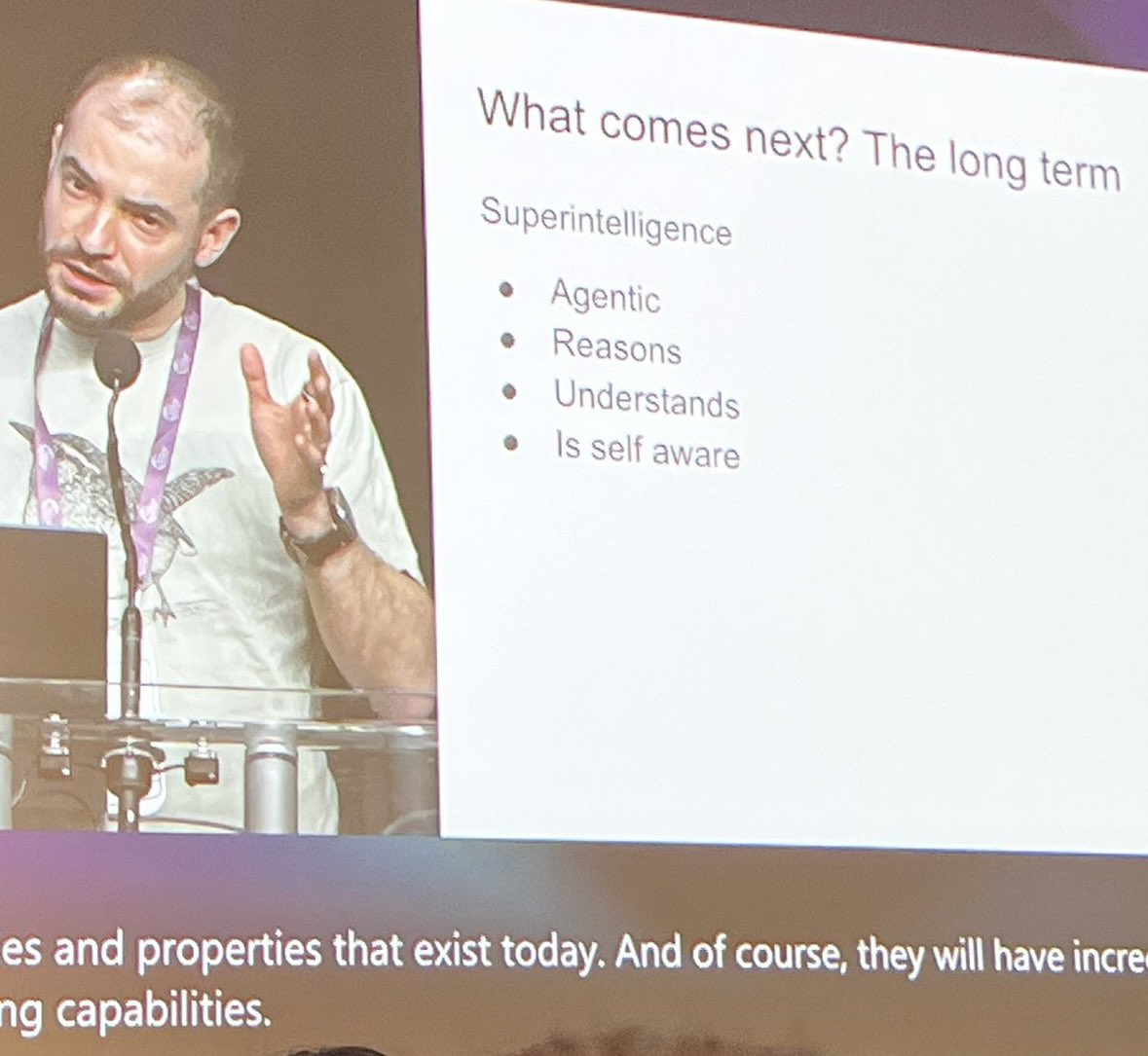
🚨Ilya Sutskever finally confirmed
> scaling LLMs at the pre-training stage plateaued
> the compute is scaling but data isn’t and new or synthetic data isn’t moving the needle
What’s next
> same as human brain, stopped growing in size but humanity kept advancing, the agents and tools on top of LLMs will fuel the progress
> sequence to sequence learning
> agentic behavior
> teach self awareness
Think of it as the “iPhone”, which kept getting bigger and more useful from hardware point, but plateaued and the while focused shifted to applications.
2025 will be the year of Agents!
> @Replit for coding
> @seobotai for content
> @crewAIInc for the rest
It's a bit sad and confusing that LLMs ("Large Language Models") have little to do with language; It's just historical. They are highly general purpose technology for statistical modeling of token streams. A better name would be Autoregressive Transformers or something.
They don't care if the tokens happen to represent little text chunks. It could just as well be little image patches, audio chunks, action choices, molecules, or whatever. If you can reduce your problem to that of modeling token streams (for any arbitrary vocabulary of some set of discrete tokens), you can "throw an LLM at it".
Actually, as the LLM stack becomes more and more mature, we may see a convergence of a large number of problems into this modeling paradigm. That is, the problem is fixed at that of "next token prediction" with an LLM, it's just the usage/meaning of the tokens that changes per domain.
If that is the case, it's also possible that deep learning frameworks (e.g. PyTorch and friends) are way too general for what most problems want to look like over time. What's up with thousands of ops and layers that you can reconfigure arbitrarily if 80% of problems just want to use an LLM?
I don't think this is true but I think it's half true.
FlashAttention is widely used to accelerate Transformers, already making attention 4-8x faster, but has yet to take advantage of modern GPUs. We’re releasing FlashAttention-3: 1.5-2x faster on FP16, up to 740 TFLOPS on H100 (75% util), and FP8 gets close to 1.2 PFLOPS!
1/
We’re really grateful to Jan for everything he's done for OpenAI, and we know he'll continue to contribute to the mission from outside. In light of the questions his departure has raised, we wanted to explain a bit about how we think about our overall strategy.
First, we have raised awareness of the risks and opportunities of AGI so that the world can better prepare for it. We've repeatedly demonstrated the incredible possibilities from scaling up deep learning and analyzed their implications; called for international governance of AGI before such calls were popular; and helped pioneer the science of assessing AI systems for catastrophic risks.
Second, we have been putting in place the foundations needed for safe deployment of increasingly capable systems. Figuring out how to make a new technology safe for the first time isn't easy. For example, our teams did a great deal of work to bring GPT-4 to the world in a safe way, and since then have continuously improved model behavior and abuse monitoring in response to lessons learned from deployment.
Third, the future is going to be harder than the past. We need to keep elevating our safety work to match the stakes of each new model. We adopted our Preparedness Framework last year to help systematize how we do this.
This seems like as good of a time as any to talk about how we view the future.
As models continue to become much more capable, we expect they'll start being integrated with the world more deeply. Users will increasingly interact with systems — composed of many multimodal models plus tools — which can take actions on their behalf, rather than talking to a single model with just text inputs and outputs.
We think such systems will be incredibly beneficial and helpful to people, and it'll be possible to deliver them safely, but it's going to take an enormous amount of foundational work. This includes thoughtfulness around what they're connected to as they train, solutions to hard problems such as scalable oversight, and other new kinds of safety work. As we build in this direction, we're not sure yet when we’ll reach our safety bar for releases, and it’s ok if that pushes out release timelines.
We know we can't imagine every possible future scenario. So we need to have a very tight feedback loop, rigorous testing, careful consideration at every step, world-class security, and harmony of safety and capabilities. We will keep doing safety research targeting different timescales. We are also continuing to collaborate with governments and many stakeholders on safety.
There's no proven playbook for how to navigate the path to AGI. We think that empirical understanding can help inform the way forward. We believe both in delivering on the tremendous upside and working to mitigate the serious risks; we take our role here very seriously and carefully weigh feedback on our actions.
— Sam and Greg