We were taught that Earth orbits the Sun in a closed circle. In reality, Earth has never returned to the same point in space once in 4.5 billion years.
Right now, the Sun is carrying Earth and every planet around the center of the Milky Way at 230 km/s (828,000 km/h), more than 18,000 kilometers every 80 seconds.
Because the Solar System is tilted 60.2° to the galactic plane and bobs up and down through the galactic disc roughly every 30 million years, the planets trace open 3D corkscrew helices across deep space rather than flat loops.
The last time the Sun stood where it stands today, one Galactic Year (230 million years) ago, the very first dinosaurs were only beginning to appear on Earth. Since forming 4.6 billion years ago, our Sun has completed only 20 laps.
Geçen hafta Claude ile 6 saatimi dijital ayak izimi silmeye ayırdım.
Adım, telefonum ve adresimin bulunduğu 47 kaydı sildirdim. Kullanmadığım 12 eski hesabı tamamen kapattım.
Nasıl yaptım, adım adım anlatıyorum:
É por isso que não há viajantes do tempo.
Para que a viagem no tempo como conhecemos na ficção desse certo, seria necessário se teleportar para a exata coordenada do universo que o planeta estava ou estará. Muitos viajantes devem ter morrido sem considerar isso.
>2027
>wake up and go to bathroom
>Iran has hacked the smart toilet servers, cant flush
>wander to kitchen
>A North Korean cyberattack has taken my smart coffee machine offline
>”ok I’ll just boil water on the stove”
>smart sink bricked by Russian DDoS
>smart stove offline because I forgot to pay my stove subscription again
>fml
>”maybe a movie will distract me”
>try to turn on smart TV
>I’ve been banned from my smart remote bc it overheard me criticizing Israel
>mfw
In my 40 odd years on this planet, one of the few key insights I’ve had is that Jung was right about this. 99% of things don’t really matter and hiking the skill of just shrugging it off and moving on is one of the most important things you can do.
Almost every argument you have with someone is pointless. Every social slight is either imagined, exaggerated or has minuscule consequences. This seems to really hurt people in professional settings. They become obsessive and discontented. Just move on
The only places really worth it are family and close friends/community
Reddit call was absolutely fascinating. Everyone should listen to it as a bellwether for where the internet is going
- AI Mode is increasingly default Google experience
- AI Mode provides rich info and data in line, less incentive to leave search
- AI Mose incentivizes dialog, Google wants to keep you engaged to serve more ads at each turn
- Google will milk search for as much revenue as possible as they transition from a search company to a cloud service and chip company
- As traffic from humans becomes more scarce this will put Google in an increasingly adversarial position to the rest of the internet
- This is a massive headwind to all media type companies who are not destinations
- This is a massive headwind to all content-driven go-to-market motions especially in the SMB. You have seen companies like HubSpot and https://t.co/VXqYR5hpCy get crushed by this funnel collapse
We are entering the end game - a knife fight for the remaining and dwindling volume of human traffic on the internet
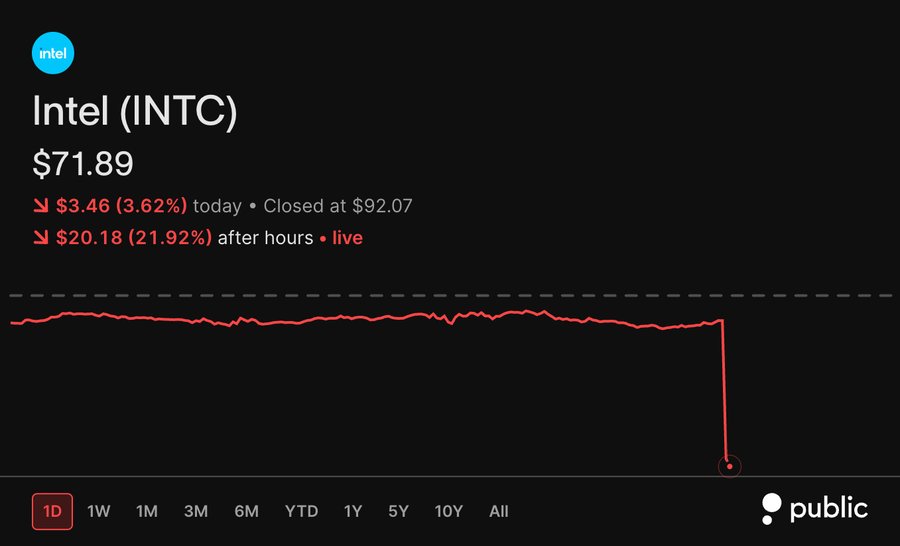
I'm dumping the majority of my Intel shares. This was genuinely one of the saddest earnings calls.
I had SO much hope for this company. I genuinely believed Intel was finally turning things around under Lip-Bu Tan and to be fair, they've made some real progress. But after listening to the entire earnings call, I honestly think Intel messed up BAD. And what makes this even more frustrating is that Intel has one of the biggest opportunities in the semiconductor industry sitting right in front of it, yet it cannot fully take advantage of it.
First, the guidance was absolutely terrible. Intel reported $16.5 billion in Q3 revenue and adjusted EPS of $0.52, which were actually pretty solid results. But then management guided for just $15 billion to $16 billion in Q4 revenue, compared to Wall Street's expectations of around $17.1 billion. They also expect adjusted EPS to fall to $0.25, compared to expectations of roughly $0.43. Even worse, gross margins are expected to fall from 44.1% to just 38% in a single quarter. That's a massive decline, especially for a company that's supposed to be improving its profitability.
But the biggest problem is what management said about 2027. Intel's PC business is getting destroyed by the ongoing memory shortage. Companies like Samsung, SK Hynix, and Micron are benefiting from enormous AI demand, but that same demand is making memory more expensive and harder to find for traditional computers.
And when memory becomes more expensive, the entire computer becomes more expensive. That means fewer people and businesses are willing to upgrade their PCs, which directly hurts Intel. Management now expects the overall PC market to shrink by around 12% in 2026 and another 10% in 2027. Intel also expects its own client revenue to fall more than 20% in Q4 alone. What really caught my attention was when management basically admitted that they don't expect the memory situation to improve in 2027. So this isn't just a temporary problem that disappears next quarter. It could continue hurting Intel for another year or longer.
Now, here's what frustrates me the MOST. Intel's data center business is absolutely booming, but they cannot manufacture enough chips to meet demand. Data Center and AI revenue grew nearly 80% year over year to $7.3 billion. Management expects industry server CPU shipments to grow more than 30% in both 2026 and 2027, and Lip-Bu Tan even believes the server CPU market could grow from around $40 billion today to more than $200 billion over the next five years because of AI agents. That's an unbelievable opportunity. But Intel is dealing with manufacturing capacity limitations, production bottlenecks, and shortages of the materials needed to package its chips. In other words, customers WANT to buy more Intel server CPUs, but Intel cannot produce enough of them.
And management made it pretty clear that these supply problems will continue into the first half of 2027, with meaningful improvements not expected until the second half. This is what bothers me more than anything. We're experiencing one of the strongest periods of CPU demand in years, and Intel is leaving billions of dollars in potential sales on the table while competitors fight for market share. Then there's the tragic accident at Intel's factory in Israel, which forced production to shut down for approximately two weeks. Management expects this to reduce Q4 revenue by around $300 million, with a similar impact potentially extending into Q1. It also accounts for about two percentage points of the expected Q4 gross margin decline. Obviously, this was an unfortunate situation, but it creates even more problems for a company that was already struggling to produce enough chips.
And don't even get me started on the foundry business. This was supposed to be one of the biggest reasons to invest in Intel. The idea was that Intel could become a serious competitor to TSMC by manufacturing chips for other companies. And yes, Intel is making progress. Its 18A manufacturing process is improving, production costs are coming down, and management sounds more confident about 14A but here's the reality. Intel's foundry business still lost $1.9 BILLION in Q3. External foundry revenue was only $411 million, and part of that came from a one time customer program. Management keeps talking about potential customers, improving yields, and future opportunities. But where are the major external customer commitments that will actually make this business profitable? I'm not saying they won't come. I'm saying investors have already been waiting years for this turnaround, and we're still talking about what MIGHT happen in 2027 and 2028.
And then came another comment that really disappointed me. Intel doesn't expect to generate positive free cash flow in 2027. The company already expects to spend around $20 billion on capital expenditures in 2026, and management said spending will increase significantly next year. So we're looking at another year of massive investments, continued foundry losses, a declining PC market, and potentially negative free cash flow. And remember, Intel raised $23 billion by issuing additional shares in August, meaning existing shareholders also have to deal with dilution. At some point, investors need to ask when all this spending is actually going to translate into sustainable profits.
Now, I want to be fair because there ARE positives here. Intel's server CPU demand is incredibly strong. Its manufacturing technology is improving. Granite Rapids is becoming more profitable, its custom silicon business is growing rapidly, and its upcoming products like Diamond Rapids and Nova Lake could help it regain market share. I also think the long term opportunity in AI infrastructure, advanced packaging, and foundry services is enormous. But here's the issue. Almost every major positive Intel talks about is something that could happen in the FUTURE. More manufacturing capacity in the second half of 2027. Potential foundry customers. A stronger product roadmap. Better profitability. Eventually positive free cash flow.
Meanwhile, all the problems are happening RIGHT NOW. The PC business is declining right now. Manufacturing constraints are hurting sales right now. Foundry is losing billions right now. And margins are expected to fall significantly next quarter. The worst part is that Intel doesn't even have a demand problem in its server business. It has an execution problem. And that's arguably even more frustrating because the opportunity is already there.
I understand that rebuilding a company like Intel takes years, and I still respect what Lip-Bu Tan is trying to accomplish. But after the massive rally in this stock, investors were expecting Intel to finally start delivering meaningful results, not another year of excuses and promises. I was willing to be patient with Intel because I believed the turnaround was gaining momentum. But this earnings call genuinely changed my perspective.
I'm not selling because I suddenly believe Intel is a terrible company or that its technology has no future. I'm selling because I no longer think the risk and reward are nearly as attractive as they were before. I'm dumping the majority of my position, but I'll likely keep a smaller stake because I still believe there's long-term potential here. I really wanted Intel to succeed. I still do. But wanting a company to succeed and believing its stock is a good investment at the current valuation are two completely different things.
And after listening to management today, I just cannot justify maintaining the same level of exposure. Intel had the opportunity to prove that its turnaround was finally working. Instead, management gave investors even more reasons to question it. This was genuinely disappointing.