Roger Federer told Dartmouth's graduating class the number he thinks explains his whole career:
"In tennis, perfection is impossible. In the 1,526 singles matches I played in my career, I won almost 80% of those matches."
Then he asked them to guess a second number:
"Now, I have a question for you. What percentage of points do you think I won in those matches? Only 54%. In other words, even top-ranked tennis players win barely more than half of the points they play."
What that does to you over a career:
"When you lose every second point on average, you learn not to dwell on every shot. You teach yourself to think, okay, I double-faulted, it's only a point. Okay, I came to the net, then I got passed again, it's only a point."
It applies to the good ones too:
"Even a great shot, an overhead back-end smash that ends up on ESPN's top-10 playlist. That, too, is just a point."
The part that matters is what he does with the point once it ends:
"When you're playing a point, it has to be the most important thing in the world, and it is. But when it's behind you, it's behind you. This mindset is really crucial, because it frees you to fully commit to the next point at the next point after that. With intensity, clarity, and focus."
And his definition of the best players alive:
"The best in the world are not the best because they win every point. It's because they know they lose again and again and have learned how to deal with it."
- Roger Federer (@rogerfederer) on Dartmouth Commencement (@dartmouth)
Refusing to carry the last point is the same skill as refusing to carry the day's open loops to bed. That one is the sixth fix in my new cortisol piece.
China has successfully drilled an ultra-deep borehole called Shenditake 1 in the Taklamakan Desert, reaching a depth of 10,910 meters (approximately 11 km).
The entire project took 580 days to complete. Engineers faced extreme conditions, with temperatures exceeding 200°C at the bottom of the well. The drilling also uncovered ancient rock formations more than 500 million years old, providing valuable geological insights.
This is a major scientific and engineering achievement by China National Petroleum Corporation. While the viral post rounds the numbers slightly for dramatic effect, the core facts are accurate. It is currently Asia’s deepest vertical well and one of the most impressive ultra-deep drilling operations in recent history.
Inkling and Inkling-Small are both available on Tinker with a limited-time discount, and all Tinker models can now be chatted with on Tinker Playground. As always, we're keen to see what you build.
Like Inkling, it's natively multimodal. It’s encoder-free, with audio and images processed jointly with text. It nearly matches Inkling across multimodal evals, and it can use Python to crop, zoom, and inspect images while reasoning over documents and charts.
It matches or exceeds Inkling on reasoning and agentic tasks. 31.6% on HLE, ahead of Inkling’s 29.7%, and the advantage holds at every thinking budget. On SWEBench-Verified it exceeds 80%.
Inkling-Small began training after its larger counterpart, so it benefits from everything we learned: an improved pre-training data mix, a refined ML recipe, on-policy distillation with Inkling as the teacher, and two further weeks of agentic coding RL.
Efficiency is the point. Across agentic tool use (Terminal-Bench 2.1), reasoning (HLE), and instruction following (IFBench), Inkling-Small delivers more performance per FLOP than Inkling. Variable thinking effort lets you pick your point on the cost/performance curve.
Today, we are releasing Inkling-Small.
Inkling-Small achieves comparable performance to Inkling at a quarter of its size. It features 276B total parameters, 12B active. We are making the full weights available.
https://t.co/BtYNcpkDRA
Fine-tune it on Tinker today, or chat with it in text, image, and audio on Tinker Playground.
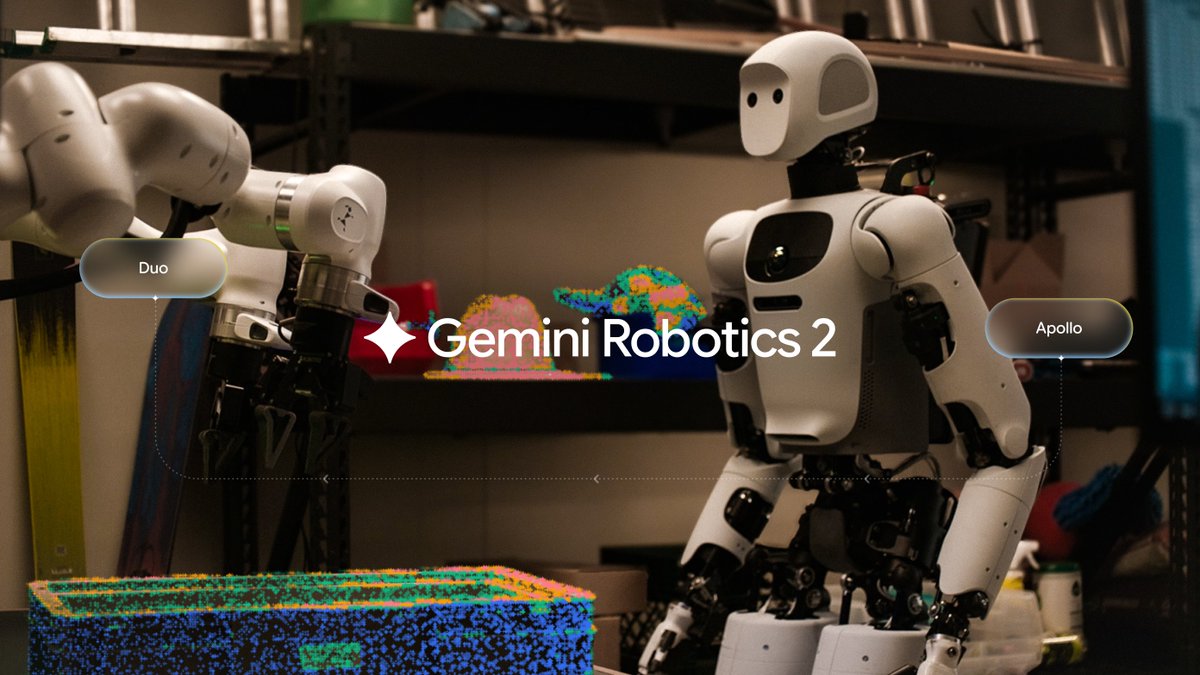
Google just took another big step toward general-purpose robotics.
They have released Gemini Robotics 2.
Instead of controlling only a robot's arms, it can now control the entire body.
That means robots can:
- Walk, crouch, stretch, and manipulate objects
- Perform delicate tasks like tying knots and sealing Ziplock bags
- Plan and execute multi-step tasks lasting several minutes
- Collaborate with other robots to complete jobs together
- Adapt to entirely new robot bodies with just a few hours of training
- Run locally on-device for low latency and offline use
Google also introduced Gemini Robotics ER 2, the reasoning model that acts as the robot's "brain."
It understands instructions, plans actions, tracks progress, self-corrects when something goes wrong, and even knows when to ask a human for help.
To be genuinely useful in our homes and workplaces, robots need finesse.
Gemini Robotics 2 equips different hardware platforms with high dexterity. It can control a five-fingered hand to tie a knot or screw in a lightbulb - while also managing parallel grippers for complex packing tasks.
We’re additionally introducing multi-robot collaboration so completely different types of robots can communicate and work together to solve problems a single robot couldn’t do alone. 🤝
Find out more → https://t.co/P1BJRWSx9U
Building a machine that India had only ever imported takes longer than any pitch deck admits.
@MuddaKaushik and Navin Jain started Ethereal Machines in 2014 to build multi-axis CNC machines in Bengaluru, the kind that came from Germany and Japan. There was no playbook for it here. Most of that work was quiet, slow and unglamorous.
One night in May 2019 is a fair picture of those years. A power backup was not in the budget, so the work carried on under a car's headlights, in a garage.
On @moneycontrolcom's Rising Bharat Summit panel, Kaushik put the honest version of it. Call it cool if you want; you will still spend years in the garage. The machines running in Bengaluru today were built on exactly those years.
Thanks to moneycontrol for the room. Full panel below.
#MakeInIndia #DeepTech #AdvancedManufacturing #Manufacturing #FounderStory
One of the toughest things to do is to get customers to leave you a Google Review. At best we send a polite prompt after a delivery. Tying reviews to incentives/discounts is not our thing. Important to maintain a good Google rating because many new customers discover us there.
What a week with Kimi K3 and Opus 5 launch!
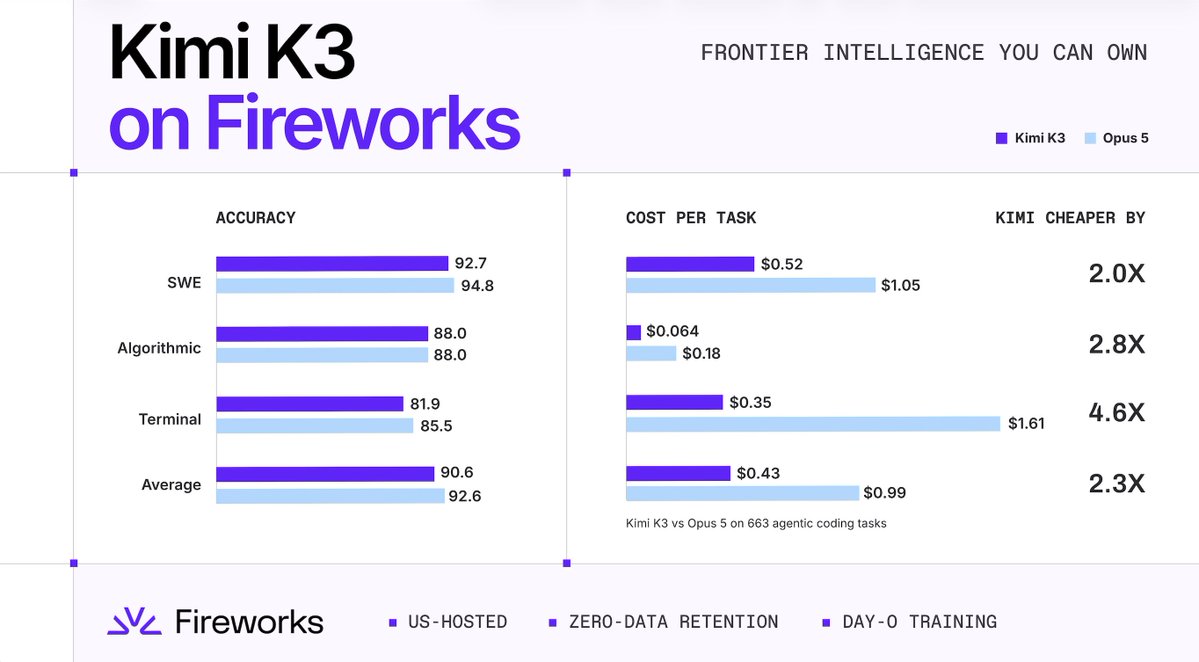
We compared these two great models across SWE (480), Algorithmic(100), Terminal (83), the task level quality is very close with Opus 5 being on par or better, and K3's per-task cost is 2x to 4.6x cheaper, using serverless pricing.
Key measurement is per-task cost, not per-token cost. In general, open models tend to be more verbose than close models. Hence the quick study.
We aim to continue to increase per-task serving efficiency (via Fireworks Inference) and quality (via Fireworks Training).
Share what you find out for the tasks you care about. 👇
More details of our study -- https://t.co/b5UcjeMVE4
Releasing the model weights and technical report of Kimi K3.
Kimi K3 is our most capable model: a 2.8T MoE model with native visual understanding and a 1M-token context window.
New model architecture: 2.5x the intelligence per unit of compute, not just more params.
Alongside Kimi K3, we're opening up more of the stack behind it — high-performance attention kernels, MoE communication library, and infrastructure for running agent environments at scale.
Model weights: https://t.co/7m7eEg6Y0B
Tech report: https://t.co/yeu6cjpMCT
Tech blog: https://t.co/YTfiMSNM1f
An Indian institute filmed a professor teaching classical physics with no notes, no slides, and a green board. Almost nobody outside India watches it.
This is Classical Physics, lecture 1, taught by V. Balakrishnan at IIT Madras, published free by NPTEL, India's national open courseware programme.
Balakrishnan taught at IIT Madras for decades. Students who sat in that room describe the same thing: the whole subject held in his head, delivered in order, no paper on the podium.
Lecture 1 is the introduction. What classical mechanics claims, where the claims hold, and the exact points where they stop holding and quantum takes over.
Watch how he speaks. Complete sentences, no filler, each idea finished before the next begins. Rare in any lecture hall on any continent.
A physicist I know worked through the whole NPTEL series and rates it above the western courses he paid for.
Free on YouTube, 17 years online, low resolution, no marketing.
The teaching was never concentrated in the famous universities.
Chamath: Google is a compounding machine and can win the entire AI stack
@chamath reacts to $GOOG dropping ~7% after raising its capex forecast to ~$200B for 2026:
“Do you know what Google's 25-year average return on invested capital has been since going public? 32%.
When you are a machine, and a group of people, and a business model that compounds money at 32% over a 20-year average, you give these guys the benefit of the doubt.
These are not people that are flying fast and loose, they are methodically investing in their edge.
They are going to get massively rewarded.
Google has an incredible search experience. They seem to be navigating this transition to use AI. They have an incredible cloud business, and they have an incredible silicon business.
The best thing that can happen to them is 500 different models proliferate, and they support all of them. Because they will make so much money at the silicon layer, they'll make so much money as the cloud provider, and they'll find a bunch of apps, including YouTube and other things, to make money from because you use the AI to target ads better or to help make better content, etc., etc.
Jason:
“Fragmentation is good for them.”
Chamath:
“Oh, it's great for them. It's a compounding machine.”
Big day, rumors are:
OpenAI upgrades Codex with real-time voice and parallel worker agents.
Cerebras pushes GPT-5.6 Sol to speeds of up to 750 tok/s.
And on top maybe even Opus 5. Im al in for it!