Your brain switches between glucose, lactate, ketones, and fatty acids throughout the day to match energy demand. In Alzheimer's disease, this fuel flexibility is progressively lost. A Journal of Neurochemistry review reveals why the brain gets metabolically stuck.
Alzheimer's disease has long been characterized by reduced glucose metabolism visible on brain scans. The standard interpretation was that neurons couldn't access enough fuel. But a new framework from researchers at the University of Kentucky proposes something different: the brain isn't starving for energy. It's locked into a rigid metabolic program that can't adapt to changing needs.
Metabolic flexibility describes the ability of cells to sense, access, and switch between different fuel sources based on availability and demand. In a healthy brain, neurons primarily use glucose.
But they can also run on lactate produced by support cells called astrocytes.
During fasting or ketogenic diets, both neurons and glia can use ketones.
Fatty acids provide another backup fuel source.
This fuel switching happens constantly. After a meal, the brain uses glucose. During sleep, it may shift toward lactate and ketones. Under metabolic stress, cells activate alternative pathways to maintain energy production. The system stays flexible, matching fuel use to functional requirements.
In Alzheimer's disease, this adaptability breaks down.
The review argues that AD is fundamentally a disorder of metabolic inflexibility where cellular metabolism gets actively reprogrammed to support inflammatory and disease-associated processes at the cost of neuronal function.
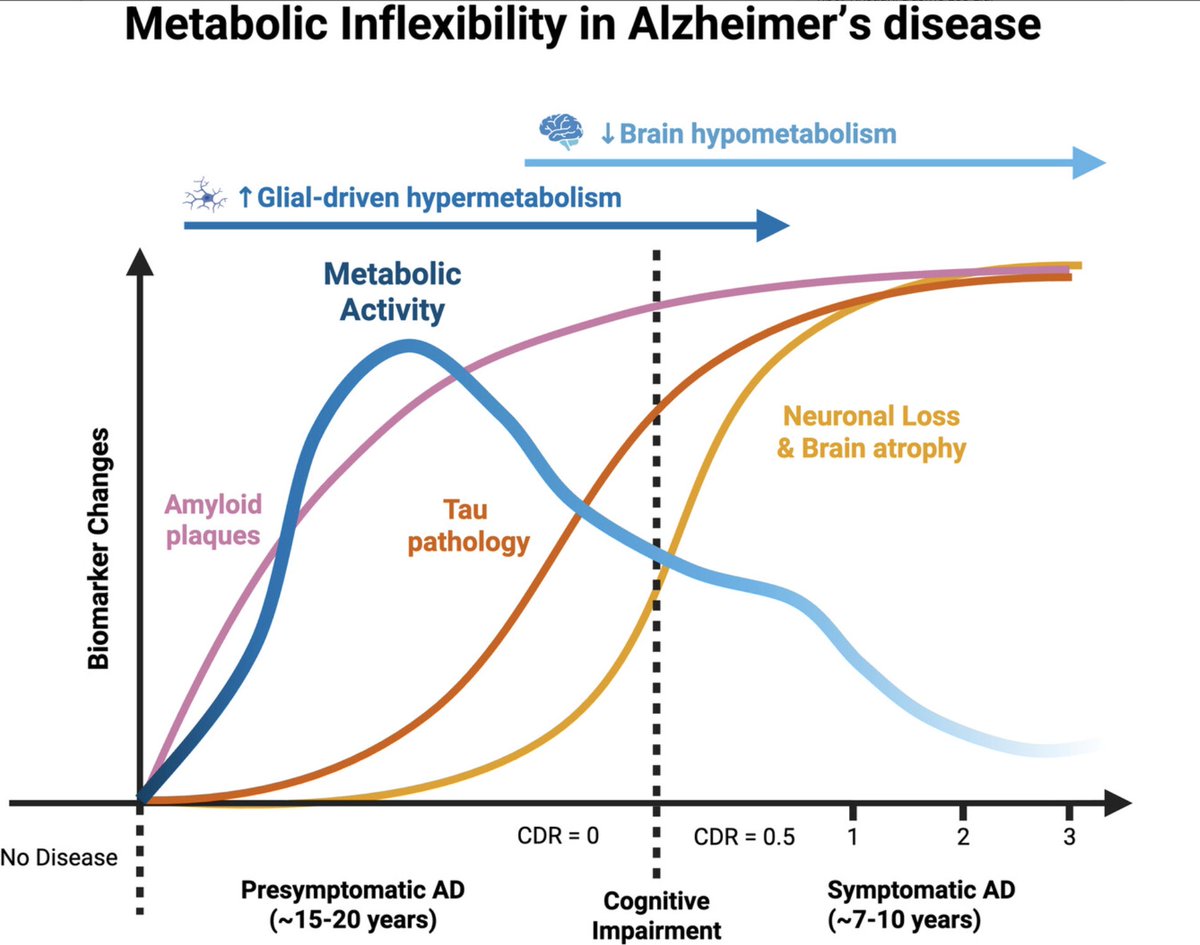
Alzheimer's disease doesn't progress in a straight line of declining metabolism. It unfolds in two distinct phases that seem contradictory.
In the early stages, often years or decades before symptoms appear, the brain actually burns more glucose than normal. This hypermetabolism comes from immune cells ramping up their energy consumption to fight inflammation. Think of it as the brain running hot, immune cells working overtime.
Later, in the stages when cognitive decline becomes apparent, the pattern flips. The whole brain shifts into hypometabolism, burning less glucose than it should. This is the energy collapse, where neurons can't get enough fuel to maintain normal function. By this point, the metabolic machinery that would allow cells to adapt has broken down.
The shift from early hypermetabolism to late-stage collapse follows a biphasic trajectory:
• Early stage: Immune cells and support cells burn excessive glucose to fuel inflammation
• Late stage: Brain-wide energy shortage as neurons lose access to fuel
The brain's immune cells, called microglia, drive this metabolic shift. When they detect damage, they switch to a faster way of burning glucose that prioritizes speed over efficiency. This helps them respond to threats quickly. But once locked into this mode, they consume glucose at rates that starve nearby neurons of fuel.
Support cells called astrocytes normally convert glucose into lactate and deliver it to neurons as fuel. In Alzheimer's disease, these cells stop making lactate and start hoarding glucose for themselves instead. The fuel pipeline to neurons shuts down.
Both cell types lose their flexibility. They get stuck burning fuel in ways that support their own inflammatory responses but cut off the energy supply that neurons need to function.
This metabolic rigidity creates a vicious cycle. When cells can't switch fuels flexibly, they get stressed. That stress increases production of amyloid-β plaques and tau tangles, the hallmark proteins of Alzheimer's disease. These proteins trigger more inflammation, which locks cells even deeper into their rigid metabolic programs.
The damage spreads beyond individual cells. Neurons become overactive when they can't meet energy demands, throwing off the brain's excitation-inhibition balance. Network connectivity breaks down. Sleep fragments. Cognitive function declines as the whole system fails to coordinate.
System-level consequences include:
These cellular-level changes show up as system-wide brain dysfunction:
• Neurons fire erratically when starved of energy, disrupting communication patterns
• The default mode network, critical for memory and self-referential thinking, loses connectivity
• Sleep architecture deteriorates, reducing the brain's ability to clear waste during rest
�� Memory, attention, and executive function decline as metabolic failure spreads across brain regions
Here's what makes this framework different from viewing Alzheimer's as simple energy failure: the metabolic programs are initially adaptive. Microglia activate glycolysis because it helps them respond to damage. Astrocytes shift fuel use to support their own functions under stress. These are protective responses.
But they become chronically maladaptive. What works as a short-term stress response traps the brain in a metabolic state that can't support normal neuronal function. The longer these programs run, the more rigid they become, and the harder it is for cells to switch back to flexible fuel use.
The critical insight from the review: metabolic inflexibility may be reversible.
Unlike permanent structural damage, metabolic programs can potentially be reprogrammed.
The authors propose that restoring metabolic flexibility could mitigate amyloid and tau pathology, reduce neuronal loss, and improve functional outcomes.
Evidence supporting reversibility comes from preclinical studies testing metabolic interventions.
Ketogenic diets, which force the brain to use ketones instead of glucose, have shown some cognitive benefits in animal models and small human trials. Compounds that enhance mitochondrial function or shift cells away from pure glycolysis are being tested.
Other approaches target specific aspects of metabolic inflexibility.
Drugs that improve insulin signaling in the brain could help cells take up and use glucose more effectively.
Interventions that reduce microglial inflammation might allow these cells to return to more balanced metabolic programs. Enhancing the astrocyte-neuron lactate shuttle could restore an important fuel pathway.
The review synthesizes human neuroimaging data showing regional patterns of hypometabolism that correlate with cognitive decline, cerebrospinal fluid studies demonstrating altered metabolite profiles, and animal research revealing the cellular mechanisms behind these changes.
Clinical trials are actively testing metabolic interventions.
Some focus on dietary approaches like ketogenic diets or medium-chain triglycerides that boost ketone availability.
Others test drugs that improve glucose metabolism or mitochondrial function.
Results so far have been mixed, but the framework suggests timing matters. Early intervention, before metabolic programs become too rigid, may be critical.
The view of Alzheimer's disease as a disorder of metabolic inflexibility reframes how we think about disease progression. It's not just about plaques and tangles accumulating. It's about the brain's support systems getting stuck in metabolic states that prioritize inflammation over neuronal support, speed over efficiency, and short-term survival over long-term function.
Those choices, made at the cellular level, compound over time. They create an environment where neurons can't get the fuel they need in the forms they can use. Network function deteriorates. Cognitive abilities decline. The brain collapses energetically not because fuel is absent, but because the metabolic machinery to access and use it flexibly has been dismantled.
Restoring that flexibility means more than just providing alternative fuels. It means helping cells regain the ability to switch between fuels based on need, rebalancing the metabolic priorities of glia to support rather than compete with neurons, and breaking the feed-forward cycles that lock the brain into rigid metabolic programs.
Whether this approach translates into effective therapies remains to be determined. But redefining Alzheimer's disease as metabolic inflexibility rather than simple metabolic failure opens new intervention points at stages of disease where structural damage may still be limited and metabolic programs potentially reversible.
A study with almost 74,000 subjects ages 50-85.
Conclusion:
-The wealthiest Americans had approximately the same survival rates as the poorest people in Europe.
Wealth helps enormously within the United States, but even high wealth does not completely overcome the US–European mortality disadvantage.
Wealthy Americans presumably have much greater ability to buy excellent medical care, better housing, healthier food, gyms, preventive testing and so forth. Yet their survival remained roughly comparable to the poorest group in Northern/Western Europe.
The study doesn’t provide direct answers to why this happens. However, maybe wealth cannot outperform lifestyle, strong social safety net, great food around friends and family, lower stress, walking significantly more everyday to your bakery (yes, believe it or not, Europeans are big on bread), local food stores, coffee shops, affording to retire when it is time without worrying about paying bills especially when you get sick…
As both an American and European citizen, I believe it may be time for Americans to recalibrate how we think about longevity.
We are increasingly chasing the latest intervention such as rapamycin, peptides, cold plunges, red-light therapy…hoping that targeting a single enzyme or metabolic pathway will move the needle.
As a systems physiologist, I struggle with that view. Human physiology is not a collection of isolated pathways. Trillions of cells communicate across metabolic, vascular, endocrine, immune and neurological systems. Health emerges from their integration.
Perhaps longevity is less about hacking individual pathways and more about creating the environment in which the whole organism can thrive.
Wild to see ~90GW peaks daily in Texas w/ no drama whatsoever. No conservation calls: we had 13 in 2023 (!) with 5 GW less demand. There's 25 GW of extra capacity now at the time of highest demand. Solar power is the difference. Batteries charging for tonight. #txlege#txenergy
@Th3GhostRaider And here’s them in their first 192ish games. And when talking GOAT debate, you have to include playoffs. The top two in catches, yards and TD’s in the playoffs? Kelce and Jerry Rice. The 3 rings to go with career success and playoff records are what make Kelce our GOAT
“We conclude that current evidence does not support Zone 2 training as the optimal intensity for improving mitochondrial or fatty acid oxidative capacity.
Further, evidence suggests prioritizing higher exercise intensities (> Zone 2) is critical to maximize cardiometabolic health benefits, particularly in the context of lower training volumes.”
🚨Did you know that fructose can fuel cancer by hijacking your liver? (🔗 at end)
1/5) It sounds dramatic, but new research - published in @Nature has uncovered a chilling new connection between fructose and cancer growth.
And it’s not just about sugar making us gain weight; the effects are far deeper and more direct.
🧵Let me break it down. But first, background…
High fructose diets are already associated with increased risks of certain cancer, like pancreatic cancer.
And there are many known mechanisms whereby fructose can support cancer growth and survival.
🤨But I particularly like these new data, because they reveal just how sneaky cancer can be, effectively hijacking the liver for its own purposes
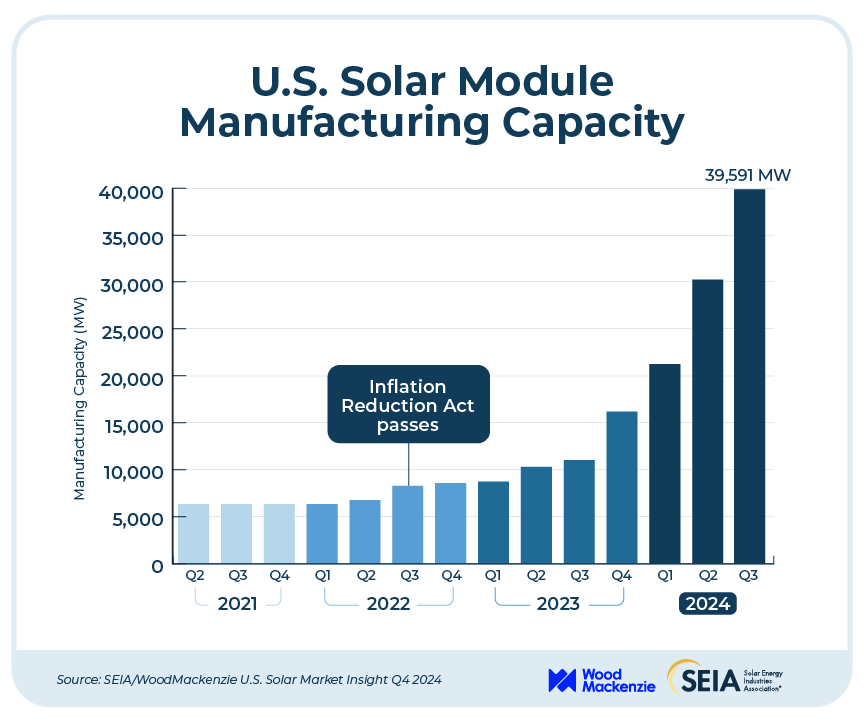
BREAKING: After a record Q3, U.S. solar manufacturing has reached a critical threshold.
At full capacity, American #solar module factories can now produce enough to meet nearly all demand for solar in the U.S.
Read SEIA's Solar Market Insight report: https://t.co/Ete0cBvpGI
U.S. school districts are starting to switch from diesel to electric buses, boosted by a $5 billion federal grant program.
There is urgency to phasing out diesel, experts say, as children are highly vulnerable to air pollution.
Read more @YaleE360: https://t.co/h10ZTaA9At
@BrianRoemmele -Presidential Freedom Award 2009-
Poitier, in his 1967 speech for the Southern Christian Leadership Conference said that Martin Luther King (MLK-1st President of SCLC) by adhering to his convictions for #socialjustice and human #dignity, “has made a better man of me.”
In this episode (#312) of The Drive, I speak with George A. Brooks, Ph.D. This conversation discusses the fundamentals of metabolism, common misconceptions between lactate and lactic acid, and how lactate serves as a fuel for the brain and muscles.
https://t.co/otil7VGCzl