Ngai Tahu/English/Scottish/American. Some on the left call me a class traitor, some on the right call me a grifter, I dgaf. BCA/LLB working on an MBA. AHF
Apparently, job losses are only a national tragedy when they happen to people with university degrees.
Over the past decade, New Zealand has lost:
• Around 300 direct jobs at Marsden Point when our only oil refinery closed. Local leaders estimate including contractors and supply-chain businesses, the loss was well over 1,000 jobs.
• Around 120 direct jobs when the Holcim cement plant at Westport shut down, with significant flow-on effects for contractors, transport operators, and the coal industry that supplied it.
• Around 230 direct jobs when Winstone Pulp closed its Karioi pulp mill and Tangiwai sawmill, along with many forestry, harvesting, engineering, and transport jobs that depended on those operations.
• Around 230 direct jobs at Kinleith Mill when paper production was shut down, affecting contractors and suppliers throughout Tokoroa and the wider forestry sector.
• Around 175-230 direct jobs when the Whakatāne paper mill collapsed, plus the contractors, trucking companies, maintenance firms, and local businesses that relied on it.
• Around 300 direct jobs when the Waimate Meat Company closed, with major impacts on livestock transport, contractors, and local service businesses.
• Between 1,500 and 2,000 direct jobs across the coal sector following the collapse of Solid Energy and the decline of mining operations, alongside hundreds of contractor jobs in engineering, maintenance, transport, and support services.
All up, that's around 3,000–4,000 direct blue collar jobs gone. Once you include contractors, suppliers, transport firms, engineers, maintenance crews, and the businesses that depended on those workers spending money in their communities, the true impact was likely somewhere between 6,000 and 10,000 jobs.
Thousands lost their livelihoods. Sure there were a few stories, but they often emphasised how necessary it was for the environment or some other cause.
In many cases, the same people now lamenting public sector redundancies were actively cheering these closures on. We were told they were necessary. A transition away from unethical or dirty sectors. Progress. The price of climate action.
Workers were told to retrain. Learn how to code!!! "You just need to adapt!"
Now the cuts have reached Wellington and suddenly every redundancy is treated as a national emergency.
The same people who told coal miners, refinery workers, and mill workers to embrace change are now horrified that policy analysts, communications advisors, and bureaucrats might have to do the same.
Losing your job is hard regardless of who you are. A miner's mortgage matters just as much as a social media manager's mortgage. A forestry worker's family matters just as much as a policy advisor's family.
But the reaction over the past decade suggests many people in our political and media class don't actually believe that. To them, a blue collar worker losing their job was economic progress and necessary climate action.
A public servant losing theirs is a humanitarian crisis.
It seems that job losses only become a national conversation when they happen to people with the power to dominate the conversation.
You’ve got to be kidding me. Apart from being one of the nasty bullies on the internet (who claims to be gay despite a long term marriage to a man) Emily Writes is a completely unreliable source. She’s aggressively partisan.
@ClintVSmith Where do you get the 1 billion dollar figure from - at best it's an estimate by MUNZ (you know the well known politically neutral union, just like you are politically neutral)
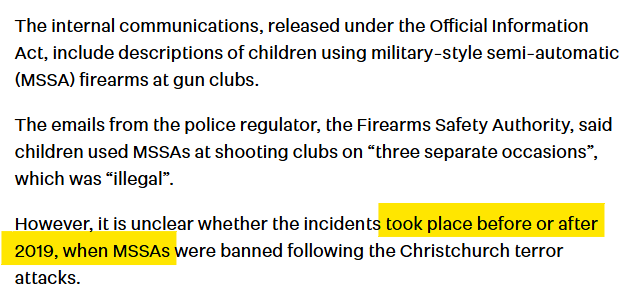
@ginnyandersen Hang on. You are a member of the government that removed in-person checking of firearms licenses. And you have the gall to stand up and whinge about something that likely happened before 2019 under your government?
You really are a twatwaffle, I can see why Chris likes you.
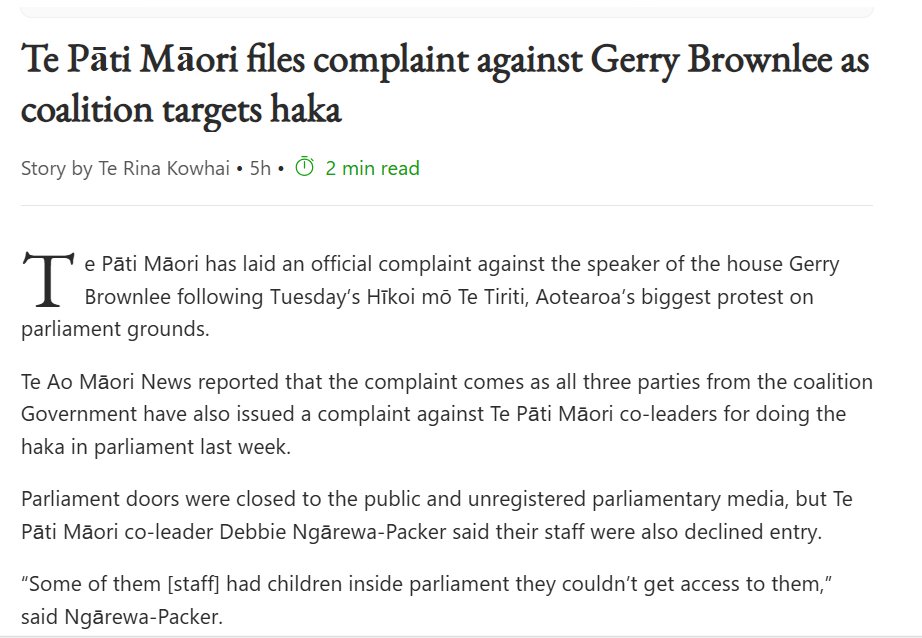
Packer claimed they were targeted because they were Māori and has made an official complaint against Gerry Brownlee.
Ngārewa-Packer said: “The Speaker has overused his power and has done a whole lot of things that he’s never done for other protests.”
The last time a speaker of the house made a move like this was during the anti-Covid mandate protests.
Then-Speaker Trevor Mallard took several controversial actions which included trespass notices against members of Parliament such as Winston Peters.
Thread.
This is not a political statement as many have said. Saying it is, well, THAT’S the political statement. And it was brilliant of Kellie-Jay Keen to force their hand.
This is just a word. A word we need in the English language bc adult human females exist. 1/
@ssjcake@goodlobster1 TPM can't even get a larger percentage than the other parties on the Maori role and they sure as F do not represent me or my whanau - they are the only party currently sitting in Parliament I have never (and will never) vote for
@dbseymour This is where the Hikoi is going! John Ansell in Greytown, Wairarapa this afternoon as #NewZealander had his flag ripped off him & snapped in half by the ‘peaceful’ Hikoi for daring to carry a #NewZealand flag. Then told they had no right to be in NZ
#nzpol