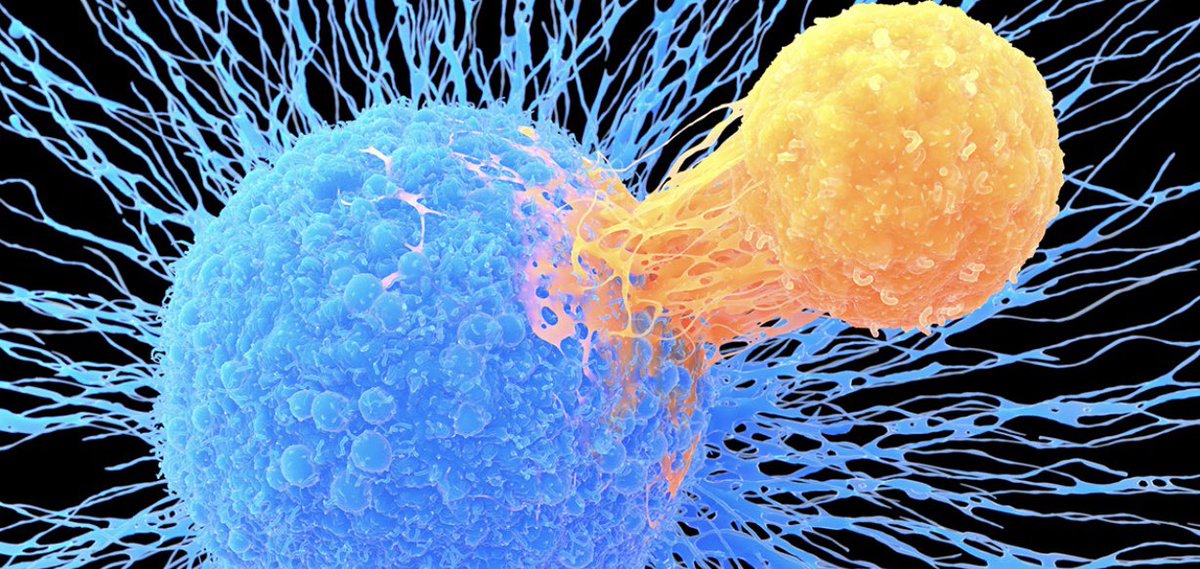
What happens when “zombie” cells escape the immune system?
A new study from our #laCaixaFoundFellows Pau Garcia-Baucells explores how these cells evade immune surveillance—and why targeting this process could help prevent or treat cancer and age-related diseases.
https://t.co/nwY2doGjFB
What happens when “zombie” cells escape the immune system?
A new study from our #laCaixaFoundFellows Pau Garcia-Baucells explores how these cells evade immune surveillance—and why targeting this process could help prevent or treat cancer and age-related diseases.
https://t.co/LbivSijosF
Our latest review is out in @NatRevImmunol!
We discuss the intricate relationship between the immune system and senescent cells, the mechanisms underlying immune recognition and evasion, and current immune-based therapies targeting senescent cells.
https://t.co/ZjPPUsXMnx
1/ Ready to study at one of the world’s top universities?
🌍 The 2026 call for @FundlaCaixa Postgraduate #Fellowships abroad is now open.
Dare to go further.
🔗 https://t.co/gUHUbANeg8
🧬 Is aging just wear-and-tear, or is it a built-in flaw in our biological “software”?
Dr. João Pedro de Magalhães @jpsenescence proposes an interesting perspective on the theoretical underpinning of aging: our DNA is the hardware, while the epigenome—the chemical tags that turn genes on or off—acts as software. Over time, this “software” may become maladaptive, driving the aging process rather than merely reacting to damage.
Here’s what you need to know. 👇
🔍 The Research
In a his paper “Ageing as a software design flaw,” Dr. de Magalhães compares the epigenome to computer software that executes genetic instructions. Early in life, this developmental program orchestrates our growth from a single cell to a fully formed adult. But after hitting our reproductive prime, these same genetic scripts might start working against us, suggesting aging may be less about accumulated damage and more about developmental instructions gone awry.
Key Concepts from the Review:
• DNA as Hardware: Our genetic code remains mostly stable—like the unchanging foundation of a computer.
• Epigenome as Software: Chemical marks (e.g., methyl groups) dynamically switch genes on/off, akin to software toggles.
• Developmental Programs: These processes guide everything from cell division to tissue formation, but may later trigger deterioration.
📊 Core Findings & Perspectives
1️⃣ Epigenetic Clocks (Horvath Clock)
• Dr. Steve Horvath’s work reveals that ~400 sites in our genome can predict chronological age with remarkable accuracy.
• This “clock” starts ticking almost from conception, suggesting aging isn’t random. Instead, it follows an orderly pattern written into our developmental script.
2️⃣ Predictable, Not Random
• Aging markers like grey hair or bone density loss unfold predictably, not chaotically.
• Across species—from mice to humans—the pace of development correlates with lifespan. Mice live fast and die young because their “growth software” runs at a breakneck speed.
3️⃣ Maladaptive Developmental Software
• Phenomena like presbyopia—the stiffening of the eye’s lens—illustrate how growth-related processes beneficial in youth (lens expansion) can be harmful in mid-to-later life.
• Similar dynamics appear in other tissues (hormone changes, immune shifts) past reproductive age.
📖 Why Does This Matter?
Traditional theories often treat aging as a linear accumulation of damage. But if aging is part of a developmental program, then wear and tear isn’t the sole culprit. Instead, we might be dealing with a quasi-programmed decline, where the very instructions that ensure reproductive success later drive degeneration.
• Antagonistic Pleiotropy: Genes that are advantageous early in life (e.g., promoting growth, rapid cell division) can have detrimental effects later, once survival for reproduction is achieved.
• Evolutionary Limitations: Natural selection strongly favors traits that help us pass on our genes, but it’s less “concerned” with what happens afterward—so flaws in the software persist.
🛠️ Interventions & Practical Applications
If our “developmental software” inadvertently fuels aging, slowing or resetting it could boost healthspan:
1️⃣ mTOR Inhibition (Rapamycin)
• mTOR drives cell growth and metabolism. Early in life, this is crucial for development. Later, overactive mTOR can accelerate tissue damage.
• Rapamycin, by dialing down mTOR, extends lifespan in yeast, worms, flies, and mice—and is being explored in humans.
2️⃣ GH/IGF-1 Modulation (Metformin, Caloric Restriction)
• High GH/IGF-1 (Growth Hormone/Insulin-like Growth Factor) fosters rapid growth but can promote diseases in old age.
• Metformin and calorie restriction both reduce IGF-1 levels, correlating with improved metabolic health and increased longevity in animal models.
3️⃣ Cellular Reprogramming (Yamanaka Factors)
• Shinya Yamanaka’s breakthrough showed that four transcription factors (Oct3/4, Sox2, Klf4, c-Myc) can revert adult cells to a stem-cell-like state, effectively resetting epigenetic age.
• Full reprogramming poses cancer risks, but partial or cyclical approaches may offer a “factory reset” on aging without unchecked cell growth.
💡 Key Takeaway
When we stop viewing aging as random decay and start viewing it as a continuation of developmental processes, a new frontier for intervention emerges. Rather than playing “whack-a-mole” with diseases as they appear, we can aim to modify the genetic and epigenetic programs before pathology sets in. From targeting pathways like mTOR/GH/IGF-1 to exploring partial cellular reprogramming, the prospect of true anti-aging therapies may rest on hacking the same software that built us in the first place.
🔗 Read the Full Review
Curious to dive deeper into the idea of aging as a developmental software flaw? Explore our analysis to learn how epigenetic clocks, cancer paradoxes, and species-wide comparisons all converge on one notion: aging might be a predictable, programmable process that we can slow—or even reset.
https://t.co/YapWsjkTfF
1/7
Excited to share our work on centriolar satellites as sites of translation for centrosomal/ciliary proteins. Check out the preprint by Claudia and Alex with contributions from @JeroenDobbelae5, @Shiviya1, @JuGarBau
https://t.co/YeN2u3dWkt
New study finds immune T cells engineered to kill zombie senescent cells 🧟♀️ can reverse key aspects of aging in mice 🐁 including metabolic & physical decline. Imagine a single treatment that protects from aging, for life…see thread https://t.co/suabdxqLDy
Super insightful and original talk on how we can untangle the aging process by employing CAR T cells to target senescent cells @corina_amor_MD@KeystoneSymp
Super thrilled to share that I am attending the Keystone Symposia (@KeystoneSymp) on Emerging Cellular Therapies in Santa Fe. As always, I have to thank the @BecariosFLC and the @amor_lab for supporting me in this amazing opportunity.
Excited to share this work exploring the profile of senolytic CAR T cells in physiological aging. Great collaboration with Inés Fernández-Maestre, that started @MSKCC and bore fruit @amor_lab@CSHL
https://t.co/syjiHEaQmw
2/ 🌏 🔝 Estos 100 #becariosFundlaCaixa se seguirán formando en algunas de las mejores universidades y centros del mundo.
5⃣8⃣ lo harán en Europa,
4⃣0⃣ en América del Norte,
1⃣ en Asia
y 1⃣ en Oceanía.
#Becas#FundaciónlaCaixa