Climate change does not cause wildfires, but hot and dry conditions make them much more likely to spread. In Canada, 9 of the 10 worst wildfire years were both dryer and hotter than normal. And these fires are burning in areas that were historically not managed or suppressed.
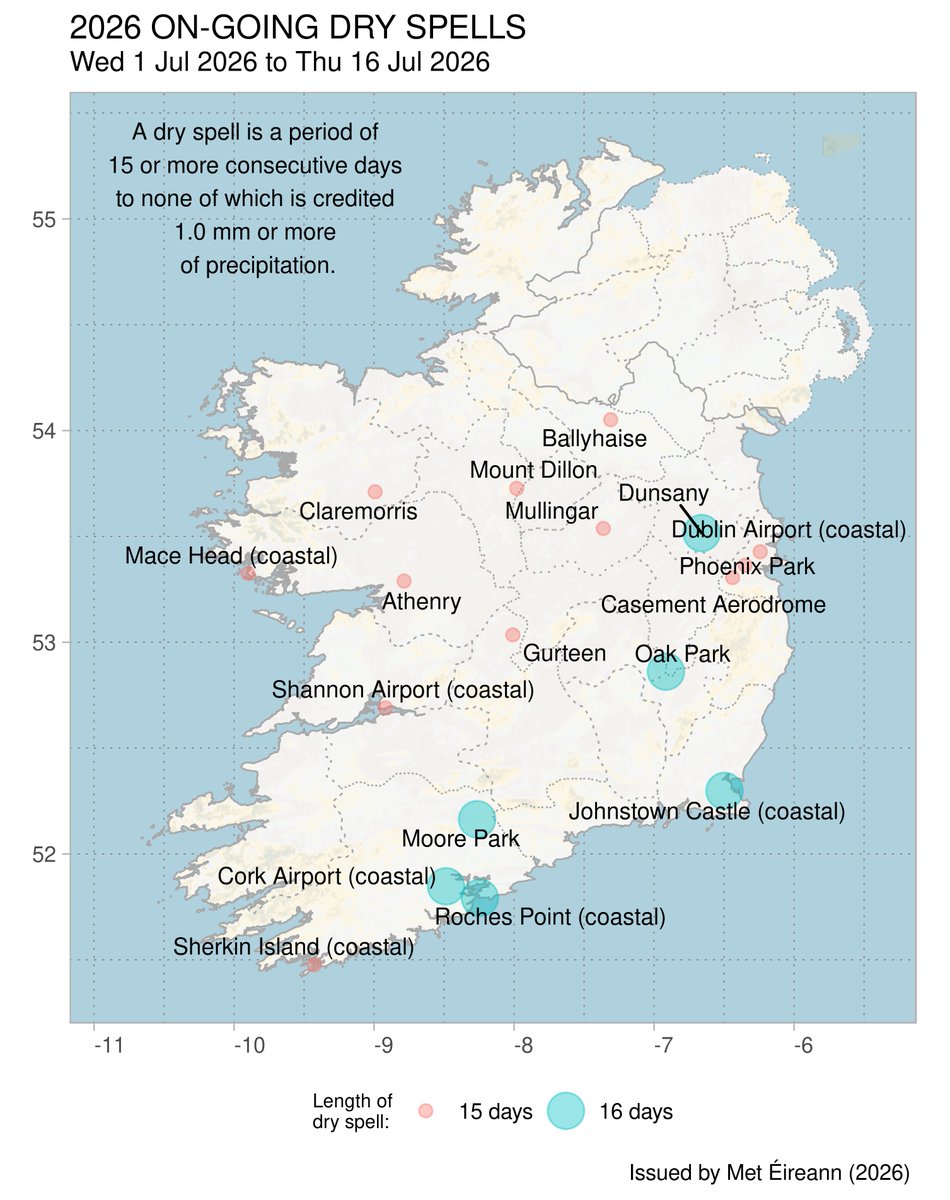
Numerous climatological dry periods are now ongoing across the country
👉18 out of 25 synoptic stations have ongoing Dry Spells
👉of these, 10 stations have also reached Absolute Drought criteria
The longest heatwaves on record for Ireland 11 or more days👇. These include both synoptic stations and climate stations. Climate station data is not yet in for the current event🧵
Heatwaves are ongoing at 7 synoptic stations
👉Oak Park and Valentia obs. have equalled their longest heatwave on record
👉Moore Park is having its longest heatwave on record and joint 3nd longest on record for Ireland🧵
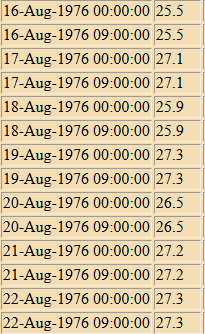
@SnowbieWx@rorymcevoy@CarlowWeather The longest heatwave on record for Ireland was 14 days from Saturday 14 to Friday 27 August 1976 inclusive at both Birr Castle, Co. Offaly (highest 28.2 °C) and Ballybrittas, Co. Laois (highest 29.5 °C).
@SnowbieWx@rorymcevoy@CarlowWeather There was 12 consecutive Summer Days at Kilkenny (Greenshill), Co Kilkenny which began 24 June 2018, while five other climate stations achieved up to 11 Summer Days starting 24/25 June 2018
Heatwaves, 5 or more consecutive Summer Days (> 25.0 °C) at a Met Éireann station, are ongoing at 5 synoptic stations
👉3 stations, Mace Head, Co Galway, Claremorris & Newport, Co Mayo are on heatwave watch for tomorrow
👉Moore Park is having its longest heatwave on record
The 2026/2027 El Niño event has already grown faster than any prior events (at least on an ONI basis). Here its observed and projected future evolution compared to the strongest prior El Niño events in recorded history.
Full analysis at The Climate Brink https://t.co/FvDpZt27zn
For more details and figures (and details what this means for 2026 and 2027 global temperatures), check out the full article over at The Climate Brink: https://t.co/FvDpZt2FoV
It's not just the daytime highs that matter for our health. High overnight temperatures make hot days more hazardous and increase overall heat stress.
Understand the difference between hot days, heatwaves, and their effects to your health: https://t.co/TagpoMbu4Y
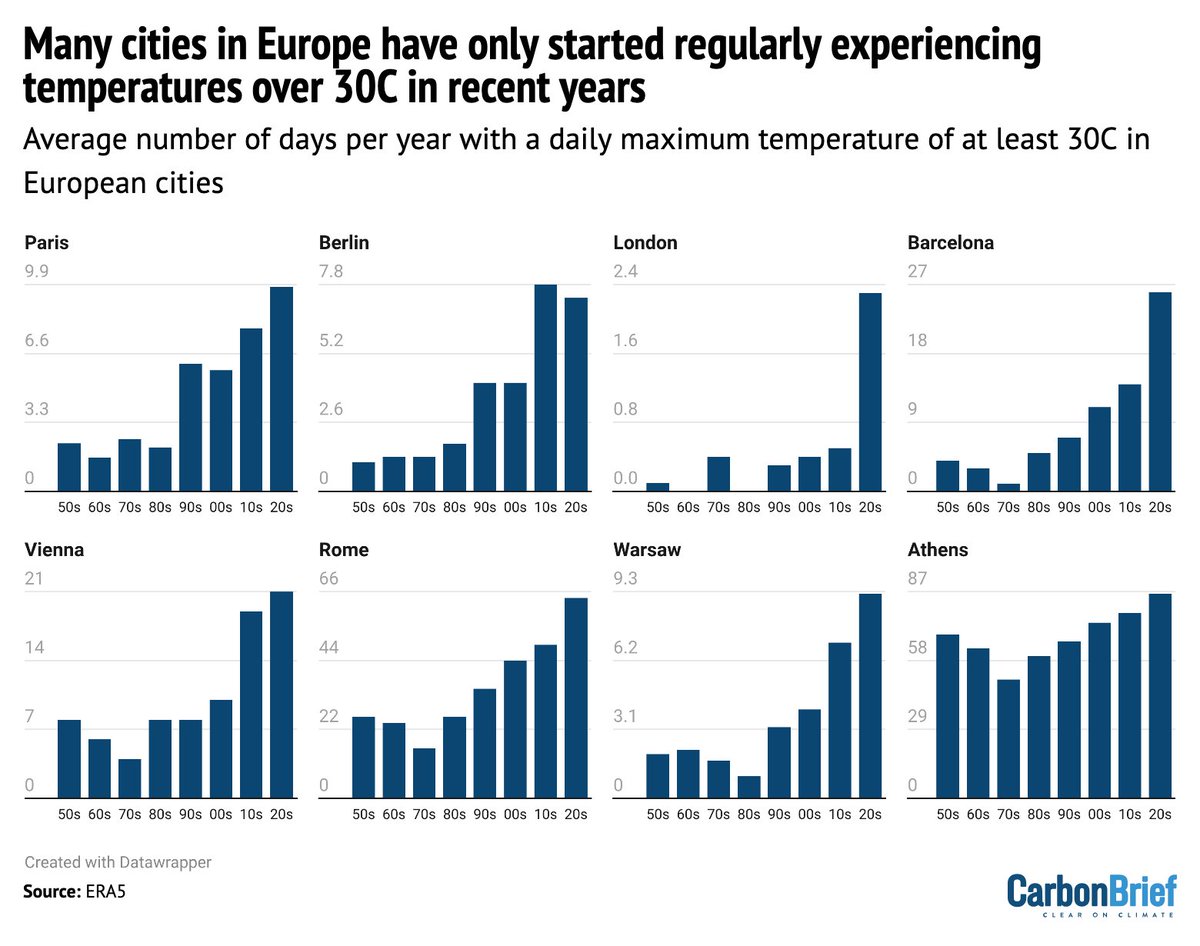
Why is AC so rare in much of Europe? Well, until recently it simply wasn't hot enough to need it. Here is the average number of days above 30C (86F) for major cities over time:
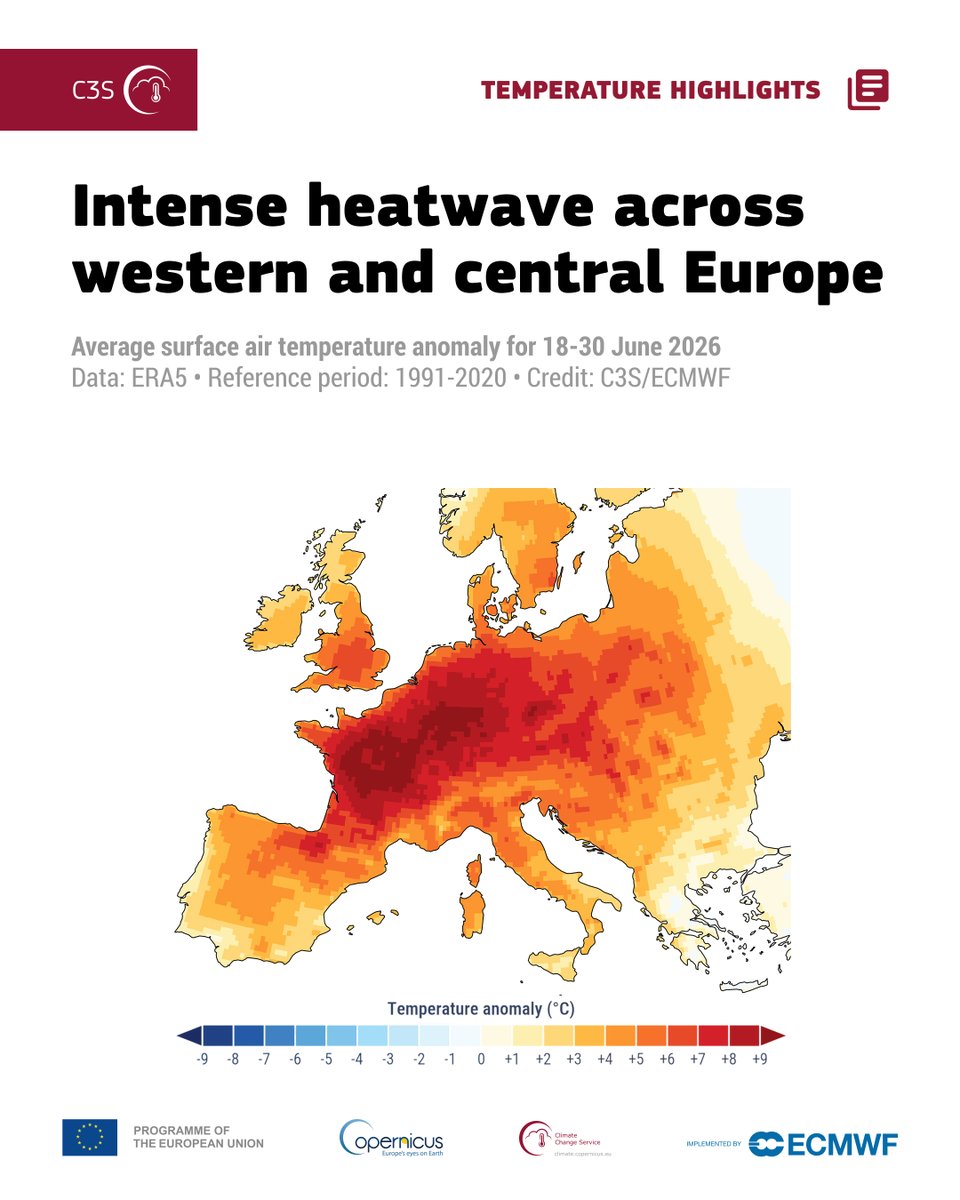
June 2026 is Western Europe’s warmest June on record and the 2nd-warmest June globally, according to @CopernicusEU Climate Change Service's latest bulletin. The global average surface air temperature was 16.54°C—1.39°C above pre-industrial levels.
🔗 https://t.co/E25oWMkSse
🌡️ Western Europe recorded its warmest June on record in 2026.
📈 According to the latest #CopernicusEU Climate Change Service bulletin, temperatures peaked at +9°C above avg across parts of 🇫🇷 and 🇩🇪 during the late-June heatwave.
🔗 https://t.co/tW12y1cXDg
#ImageOfTheDay
🌡#C3S Climate Bulletin reports the second-warmest June globally, 1.39°C above pre-industrial level. Western Europe saw its warmest June on record amid an intense heatwave, while average sea surface temperature over 60°S–60°N reached 20.86°C,the highest on record for June.
⬇️
Another study by Bischof et al. 2023 found in dedicated model simulations "that cold subpolar North Atlantic sea surface temperatures significantly increase heat wave duration and magnitude downstream over the European continent." ⬇️
https://t.co/5y1IiQmpH6
The first half of 2026 has been marked by sustained ocean warmth, with marine heatwaves persisting and expanding across much of the global ocean.
Our mid-year bulletin, out now, looks at the Mediterranean, the North Atlantic, and the tropical Pacific.
Read more: https://t.co/8KX519i9fo
Copernicus Marine is implemented by @MercatorOcean International on behalf of the European Commission.
#OceanMonitoring #CopernicusMarine