Today we're sharing our work on interaction models. A new class of model trained from scratch to handle real-time interaction natively, instead of gluing it onto a turn-based one.
https://t.co/MoS5s4cm60
We’re retiring older models in Codex when you sign in to Codex with your ChatGPT account on April 14:
• gpt-5.2-codex
• gpt-5.1-codex-mini
• gpt-5.1-codex-max
• gpt-5.1-codex
• gpt-5.1
• gpt-5
opencode 1.3.0 will no longer autoload the claude max plugin
we did our best to convince anthropic to support developer choice but they sent lawyers
it's your right to access services however you wish but it is also their right to block whoever they want
we can't maintain an official plugin so it's been removed from github and marked deprecated on npm
appreciate our partners at openai, github and gitlab who are going the other direction and supporting developer freedom
President Trump wants to build a wall through Big Bend National Park.
One of the most sacred places in Texas.
Texans have a message for him: Come and take it.
We’ve identified industrial-scale distillation attacks on our models by DeepSeek, Moonshot AI, and MiniMax.
These labs created over 24,000 fraudulent accounts and generated over 16 million exchanges with Claude, extracting its capabilities to train and improve their own models.
People come X to get a pulse on humanity. Because of that, the platform must make every effort to resist anything that misrepresents or adulterates that pulse.
There is nothing more unsettling than expecting you’re reading the words of a human -- only to find it was a machine, or an account operating at the direction of an undisclosed commercial or governmental entity.
In the AI era, our product, policies, and approach will need to evolve meaningfully. Some things may not work, but we intend to employ every available tool and strategy to secure the global town square.
Most people take melatonin right before bed.
That might be one of the worst times to take it.
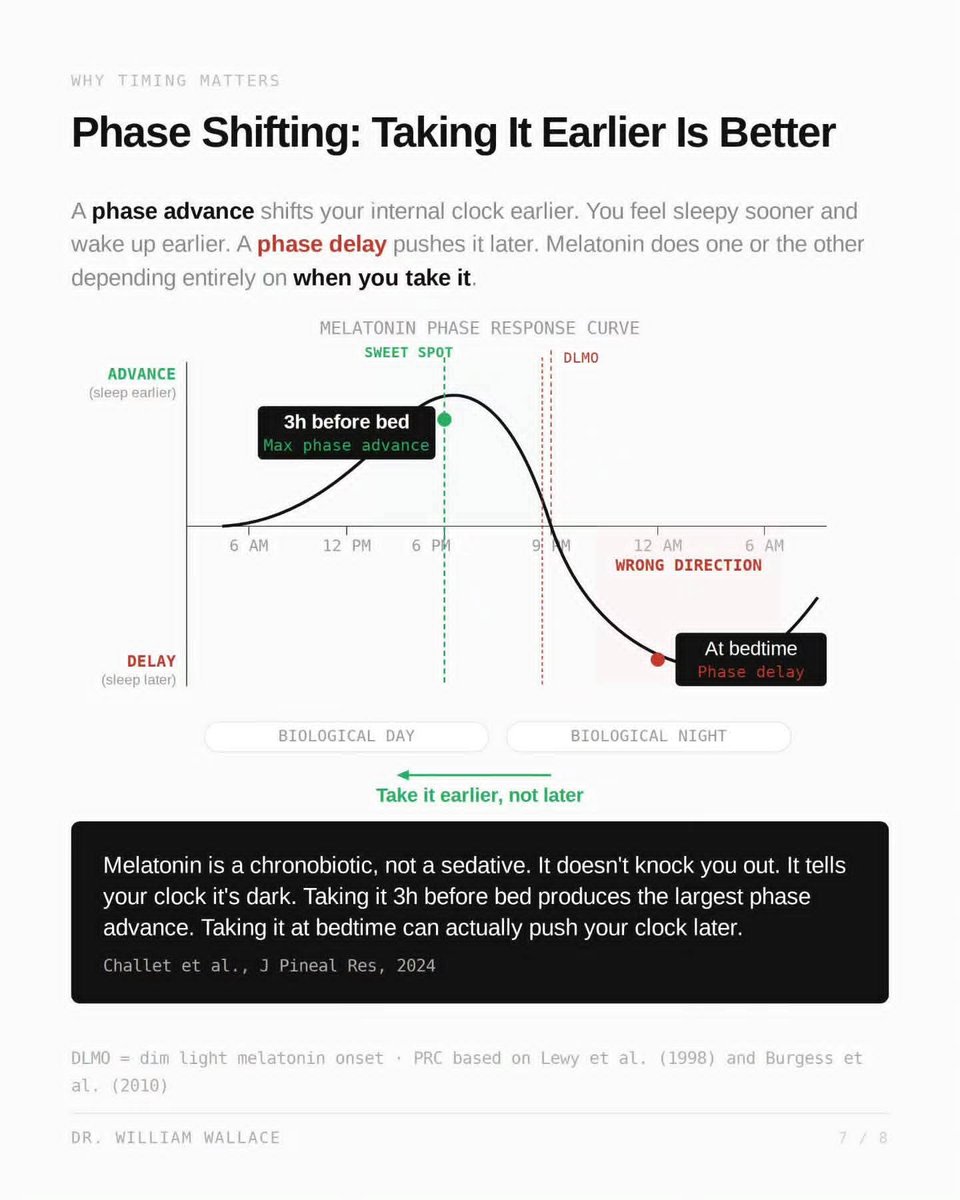
Melatonin isn't a sedative, it's a chronobiotic. It doesn't knock you out. It signals to your circadian clock that it's dark. And the effect it has on your sleep timing depends entirely on WHEN you take it.
There's a concept called the Phase Response Curve. It shows that melatonin taken ~3 hours before your usual bedtime produces the largest phase advance, meaning it shifts your internal clock earlier, so you fall asleep sooner and wake up easier.
But take it AT bedtime? You can actually push your clock in the wrong direction. That's a phase delay. You end up falling asleep later over time, not earlier.
The sweet spot sits just before dim light melatonin onset, the point when your brain would naturally start releasing melatonin. For most people, that's roughly 3 hours before habitual bedtime.
Timing > dose.
Lewy et al. (1998), Burgess et al. (2010), and Challet et al., J Pineal Res (2024).