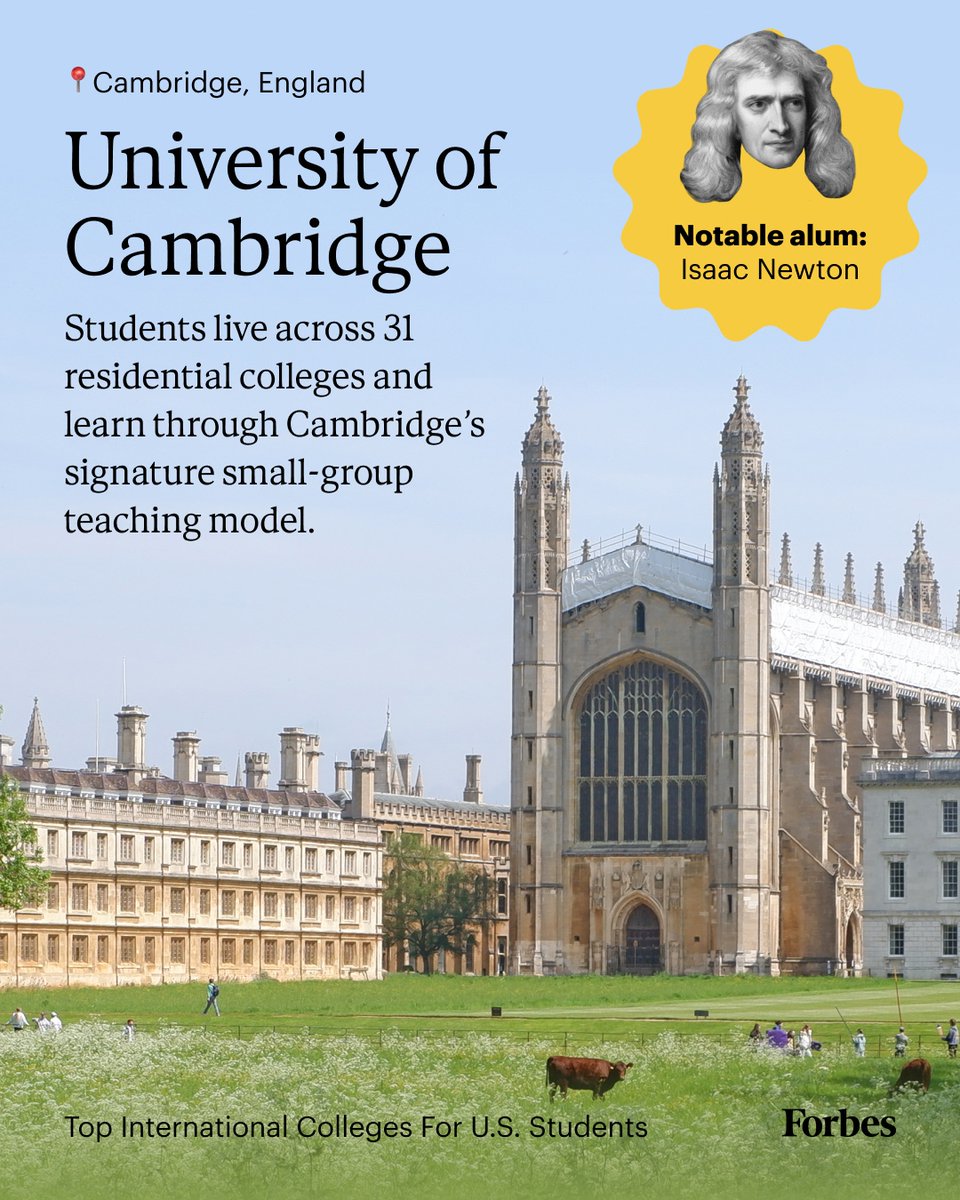
The University of Cambridge is one of 15 schools featured on Forbes' list of Top International Colleges For U.S. Undergraduate Students.
Founded in 1209, Cambridge is one of the world’s oldest universities, with 12,850 undergraduates divided among 31 constituent residential colleges where students live, eat and socialize. Students can apply to a specific college or submit an open application, but they do need to apply directly to a chosen course of study.
Read more about Cambridge—and the other highlighted colleges—on the full list: https://t.co/FwtctgDWi0
📸: Andrew Kerr/iStock via Getty Images; Science & Society Picture Library via Getty Images
🦙 @ollama is used by 9 million developers and 85% of the Fortune 500, giving co-founder and CEO Jeffrey Morgan (@jmorgan) a unique view into which AI models people are actually using and how that’s changing.
Right now, the biggest shift he sees is toward open models, driven by coding agents, falling costs, and capabilities that are rapidly catching up to the frontier labs. On Ollama Cloud, that shift has driven a 150x increase in token usage since the start of the year.
In this episode of @LightconePod, Jeff joins @garrytan, @snowmaker, @sdianahu, and @harjtaggar to talk about the future of open models and the story behind Ollama, from two years of searching for the right idea to building one of the most widely used AI developer tools in the world.
00:43 — The Shift to Open Models
03:03 — How AI Agents Are Driving Token Usage
05:31 — Are Open Models Catching Up?
08:26 — What Happens When a New Model Launches
11:31 — Ollama as an Operating System for AI
14:05 — The New Opportunities Above the Model Layer
18:19 — Why 80–90% of Enterprise Tokens Could Be Open
20:57 — The Future Is Local and Cloud
26:40 — Why AI Is Coming Back to Your Computer
28:56 — The Coming Era of Unlimited Tokens
32:30 — Do We Still Need a “God Model”?
33:41 — Open Models and Geopolitics
36:14 — The Origins of Ollama
40:36 — Two Years Lost in the Wilderness
42:39 — The Pivot That Changed Everything
47:02 — How Ollama Found a Business Model
49:43 — Why Second-Time Founders Did YC
Perplexity is one of the top AI search tools.
The secret is knowing how to prompt it well.
With clear, structured prompts…
Perplexity becomes:
✓ Your research guide.
✓ Your strategy partner.
✓ Your decision coach.
[ 🔖 bookmark this post for later ]
Here are 15 powerful prompts to try:
1. Market Research – Compare top companies on pricing, features, reviews, and USPs.
2. Trend Analysis – Summarize industry trends, adoption rates, and impact.
3. Competitor Benchmarking – Evaluate tools or companies across pricing, features, and scale.
4. Customer Insights – Spot common complaints, requests, and positive feedback.
5. Case Studies – Share real-world cases showing strategies with measurable results.
6. Industry Reports – Extract stats, challenges, opportunities, and takeaways.
7. Skill Development – Learn a concept with steps, resources, and tips.
8. Expert Opinions – Compare expert views to highlight insights and differences.
9. Content Ideas – Generate 10 LinkedIn post ideas for your niche.
10. Summarizing PDFs – Condense PDFs into clear, bullet-point insights.
11. Product Comparison – Create side-by-side comparisons with use cases.
12. Developing Strategies – List proven methods for goals and outcomes.
13. Event and News Summary – Compile highlights and impact of events.
14. Decision Evaluation – Outline pros and cons of options with cost and scalability.
15. Business Idea Validation – Evaluate ideas with market, risks, and growth.
Try these prompts to get more out of Perplexity.
Use it as an AI partner for work and everyday tasks.
📌 Learn 30 free AI tools in 30 days: https://t.co/7MJCwAPtaQ
👉 Follow me @AndrewBolis for more and 🔄 Repost this to help others use AI
Hands-On Genetic Algorithms with #Python — Apply genetic algorithms to solve real-world #AI and #MachineLearning problems [2nd Edition]: https://t.co/sr5D96zQO4 v/ @PacktDataML
𝓚𝓮𝔂 𝓕𝓮𝓪𝓽𝓾𝓻𝓮𝓼:
🔵Learn how to implement genetic algorithms using Python libraries DEAP, scikit-learn, and NumPy
🟢Take advantage of cloud computing technology to increase the performance of your solutions
🟠Discover bio-inspired algorithms such as particle swarm optimization (PSO)
Our @NASAArtemis Moon rocket's trek to the launch pad began at 7:04am ET (1204 UTC). Crawler-transporter 2 is slowly moving it on top of the mobile launcher, with the four-mile journey expected to take about 12 hours. Watch a live feed of the move: https://t.co/tq2PLM891j
Marc Andreessen: Revolutionary technologies were often viewed as “trivialities” or “jokes”
“If you read history, the great innovations of the past are now well understood as being very important. In almost every case, they were not widely understood as such at the time. In fact, I would assert that they were often actually viewed as trivialities or jokes.”
He gives three examples:
1. The telephone. “When Thomas Edison was first working on the telephone, the assumption of the use case motivating his early work was the idea that telegraph operators needed to be able to talk to each other. It was considered implausible that you would have a system that would let any ordinary person pick up the telephone and talk to another person - that was clearly impossible… Completely missing the larger opportunity.”
2. The Internet. “I have personal experience with this one. The Internet was laughed at. It was heaped with scorn from 1993 to 1997-98. In fact, those of you who were in the industry at the time will remember the New York Times had a reporter on staff named Peter Lewis… I’m convinced he was specifically hired by the editors to just write negative stories about the Internet. It was all he did, and it was always the Internet was never going to be a consumer medium. The Internet is not nearly as big as these people think. Nobody is ever going to trust the internet for e-commerce.”
3. The car. “The car was absolutely viewed as a triviality and a toy when it first emerged. In fact, J.P. Morgan himself refused to invest in Ford Motor Company with the response that it’s just a toy for rich people, which is in fact what it was at the time. If you had one of the first cars, you had to be a rich person. You had to have a driver. You often actually had to also have a stoker with your early cars to keep the engine going. And then you also had to travel with a full-time mechanic because the thing would break down every three miles.”
Marc concludes:
“The great innovations of the present, I believe, are virtually guaranteed to be viewed as trivial and to be viewed as jokes. I think history 50 to 100 years from now will enshroud them in legend. In our time, they won’t be recognized as such. Of course, in the future, when they become legends, our descendants will themselves have their own trivial innovations to laugh at.”
Video source: @MilkenInstitute (2013)
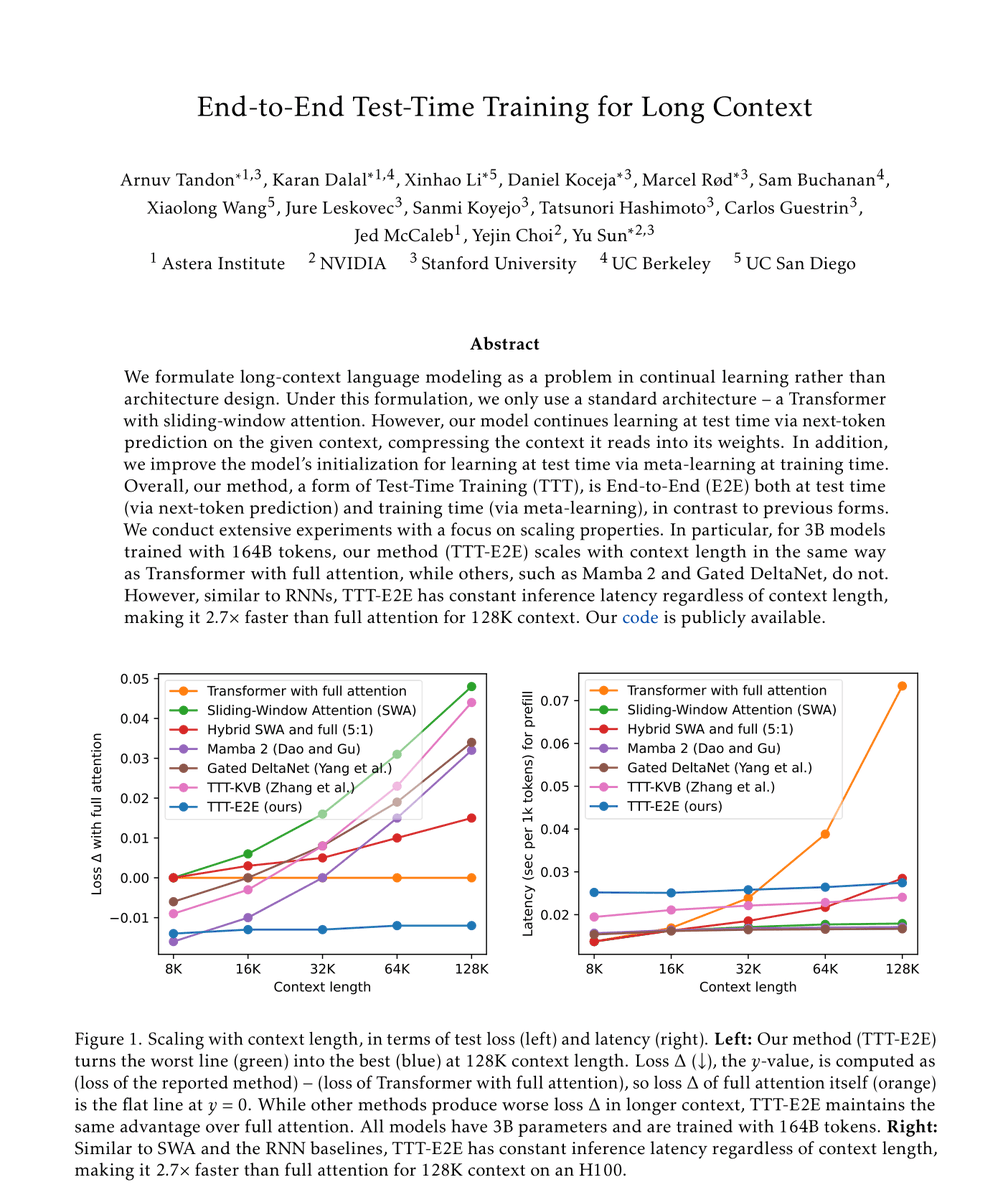
Our new paper, “End-to-End Test-Time Training for Long Context,” is a step towards continual learning in language models.
We introduce a new method that blurs the boundary between training and inference. At test-time, our model continues learning from given context using the same next-token prediction objective as training.
With this end-to-end objective, our model can efficiently compress substantial context into its weights and still use it effectively, unlocking extremely long context windows for complex reasoning and applications in agents and robotics.
Paper: https://t.co/tqPYECjFpn
Code: https://t.co/tADD7wYDAL
MCKINSEY JUST DROPPED THEIR 2025 AI REPORT.
HERE’S THE TLDR:
1/ 90% of companies “use AI,” but 67% are still stuck in pilot mode. Corporate AI theater is alive and well lol.
2/ 62% of orgs are experimenting with AI agents, 23% are scaling AI agents. Most are in tech and healthcare.
3/ The impact gap is massive. 64% say AI helps innovation, but only 39% see real EBIT gains.
4/ The high performers (top 6%) think bigger. They rebuild workflows, set growth goals, and invest real budgets not just POCs.
5/ Leaders who own AI personally are 3x more likely to scale it. Makes sense.
6/ The winners use AI to transform how work gets done, not just speed it up.
7/ The average company measures efficiency. The best ones measure how fast their agents can act.
8/ Risk management is catching up with 51% have already seen AI backfire, mostly from inaccuracy.
9/ The workforce impact is foggy. 32% expect cuts, 13% expect growth, everyone else is guessing.
10/ AI adoption is mainstream, but true transformation hasn’t started. Early days.
Stanford University tops the list of the best U.S. colleges in the latest WSJ/College Pulse rankings, returning to the top of this list for the first time since the 2017 rankings. Ivy League schools also figure prominently in the top five. https://t.co/RhR9e3ET1d