The checklist behind what you should do if you have 0 users.
I'm the founder of a product agency and a B2B SaaS product.
I see 100s of products a year, speak to tens of product founders a month and learn this niche for the past 10 years.
I want to gather a simple and deep helpful checklist which would help me tremendously when I was getting started.
1. Show your product to people in your network relevant to your ICP.
2. Improve only the most important userflow.
3. Discover your customer pain points. I suggest a simple structure: Pain connected to ICP, How does your product solve it (I also add my own prioritization to know better where to focus.)
4. Your users should get to the main point of the user path and the main value of your product as fast as possible and be satisfied as much as possible at the beginning.
5. Limit your scope. Collect all your dream features in the backlog. Focus only on the critical staff.
6. Forget about the weekends. Your work week should be at least 60 hours of very deep focused work.
7. Start selling personally.
8. Start SEO as early as possible.
9. Make a massive launch only after you are at least a little confident your product is usable and sellable.
10. Grow only X and LinkedIn. Maybe tiktok if applicable. Youtube, Reddit and other stuff will be great down the road once you have a bigger team.
11. Speak to your users/customers (I mean calls) at least 2 times a week.
12. Hire only cracked savages. Who also work 60-80 hours a week.
13. Give your team equity.
14. Once you have first traction, start talking to investors.
15. Find every angel/VC who can possibly invest (filter by niche and check size).
16. Learn sales. Fundraising is 1000% sales skill.
17. Master your pitching.
18. Close pre-seed and back to your product and work even 2x harder to outperform everyone.
19. Share your lessons/achievements in X or LinkedIn.
20 - share in the comments what I forgot.
AI systems implementation: 10 essentials.
Everyone opens a GPT or Claude now before starting to do anything.
The next level is building AI directly into your workflows.
Capable Insure deployed 10+ agents for a home warranty provider recenty.
Which increased their claims team capacity by 60%.
These are the biggest lessons from doing it day-to-day for the past year that can save you a considerable amount of time and/or money.
1. Start with the obvious use cases
Take operational work that is:
1) well documented
2) repetitive
2. Prioritize agents implementation by ROI.
A workflow is worth automating only when it has a high ROI:
- time saving
- your teamʼs capacity increase
- improved accuracy
- operational cost reduction.
3. Scope out the solution
The preparation stage needs to be thorough.
To scope out the solution correctly you might need to:
- visualize a mindmap
- structure all knowledge, scenarios
- map out what data should be in the pipeline
4. Assign an owner for AI operations
AI agents need an internal owner from the beginning of the project.
This person should help with
1) knowledge transfer to the dev team
2) updates review
3) internal testing
4) deliverables sign-off
5) prioritization of the next scenarios to automate.
Clear ownership is required to turn AI from a prototype into a working production solution.
5. Run small experiments before building the full solution
The experiment should give an understanding the real scope, effort, and risks behind a full-scale rollout.
Pick a small part of the workflow that can reveal the
implementation complexity.
The goal is to learn with the lowest possible time investment.
If the ROI still makes sense after the experiment, then move into full-scale implementation.
6. Invest time into polish accuracy before scaling
The hardest part of AI agent implementation is usually accuracy polishing.
QA and iteration can take up to 50-80% of the setup time.
But it is the most important in shipping a production-ready solution with strong accuracy.
Test all scenarios and edge cases before a production roll out - you may find unexpected gaps in your logic.
7. Keep data ownership.
Everything should be hosted in your infrastructure.
A newborn tool can die tomorrow and your data will be gone.
8. Prepare business logic description for each solution.
The logic needed to cover all your scenarios can be so complex.
You need to think ahead about long-term maintenance.
9. Do it with right people.
Find devs who already have expertise in AI agents, in your domain and/or a task you want to solve.
Otherwise, you will be the one investing in educating them.
Signs of the weak dev team are:
constant micromanagement
shallow scenario research
weak edge cases research
unclear scope and estimates
building without small experiments.
10. It is better to start sooner.
Delivering a production-grade system can take half a year from start to finish.
That time could be spent on gaining your efficiency advantage.
Compound your business efficiency.
The biggest obstacles for AI in enterprises:
I. Messy data
The data is all across tickets, CRMs, calls, PDFs, emails, photos, contracts, spreadsheets, and internal docs.
It's unstructured, duplicated, incomplete, or trapped in legacy systems.
For AI agents it must be accessable, and structured.
II. Integration
It must work inside actual systems people use every day.
Most enterprises already run on deeply embedded workflows across dozens of tools.
If employees have to leave their workflow to use the AI, adoption and efficiency drops immediately.
III. Data security
It has to comply with legal and compliance rules and preserve sensitive data.
The problem is that current AI tools/vendors rely on third-party LLM APIs or keep all the data on their own infrastructure!
It's a big conflict for data ownership, storage, and control.
This is why an on-prem deployment is required so companies can maintain full control over their data.
IV. Reliability
Companies need confidence that the AI will not hallucinate or make inconsistent decisions.
It must SUCCED consistently under real-world conditions.
This is where domain nuances matter a lot, and generic AI will break.
The challenge is to configure it correctly to handle real tasks, messy data, edge cases, and every branch in the workflow.
The team has to test real scenarios and iterate.
This is why accuracy polishing can take up to 80% of the implementation time, and this is completely normal.
As well as a "human-in-the-loop" approach: it should be possible to route the agent to manual execution, or keep human involvement on the decision stage.
V. Gathering a project group.
Someone has to transfer knowledge, review updates, run internal testing, sign off deliverables, and prioritize the next workflows to automate.
This is why implementing AI really needs an internal owner from day one.
The project group should include people from ops, IT, and the business side.
Without clear ownership, it would never be implemented.
VI. Latency
If AI sits inside the workflow, milliseconds matter.
Slow AI becomes another tab.
If employees are waiting 10–20 seconds for responses during repetitive work, they stop relying on it.
VII. ROI clarity
AI automations should be done only based on the business impact.
Look for work where AI can improve:
time saved and team capacity increased
accuracy improved
operational cost reduced
The best is to start from repetitive workflows that take time, have clear steps, and create obvious savings when automated.
It must have a real operational leverage.
---------------
The end goal is to make your team better.
Less repetitive manual work.
Higher accuracy.
Making this work is possible, but you should understand the hard part:
- scoping
- domain nuances
- edge cases
- accuracy polishing
You can pursue it with an external dev team or in-house, but be ready to invest time in education, delay deploying a working product for months, or invest a lot of money.
This is why it's better to choose a specialized vertical vendor, who will bring expertise, problems understanding and reusable components, which require much less time to be configured for your use cases.
You'll save yourself 5x money and time.
And that is why vertical AI will win in enterprise.
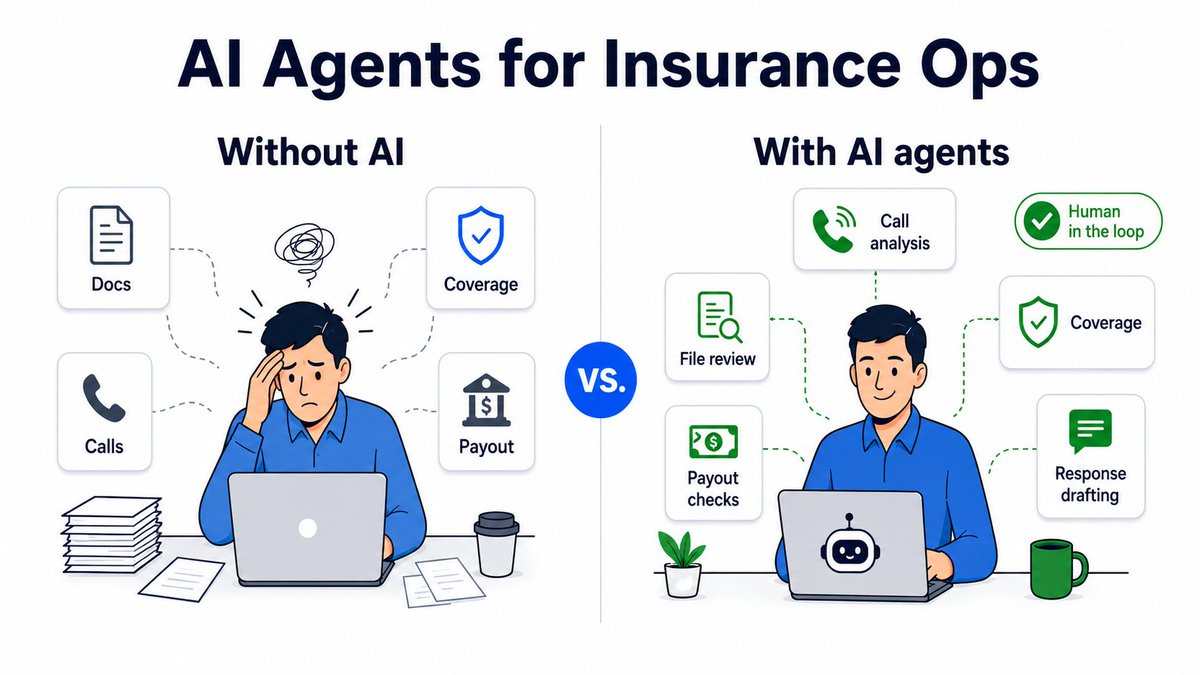
By 2027, Insurance AI agents will 100% automate these 4 workflows most insurers still process manually.
Claims teams are still spending time for:
Calls
Coverage checks
Response drafting
Read files
Validate payouts
Most providers have yet to do the math.
The smartest ones are already rebuilding claims ops around AI agents.
After 1,000+ hours researching and building AI agents for insurance ops with my CTO Vlad, we stand on and are pushing one narrative:
Claims processing is one of the strongest AI agent use cases in the world.
Here are the 4 claims workflows AI agents are starting to replace.
1. Call transcription and analysis
A huge part of claim context lives inside calls.
Customers explain what happened.
Claim reps ask follow-up questions.
Important details get buried in the conversation.
Today, someone has to run a call, ask follow up questions, make notes, or rely on memory.
Instead, an AI agent can handle end-to-end calls, transcribe it, summarize key facts, and even analyze it against the coverage terms!
The rep gets to validate the final response to the customer.
That's what makes modern customer service premium and efficient.
2. Coverage validation
This is where accuracy matters most.
The agent checks policy terms, limits, exclusions, add-ons, and claim-specific rules.
You need a really well configured setup where all your company’s procedures are inserted.
The agent should explain their decision with evidence.
2. Response drafting
Claims reps are still required to find the right wording and write an answer.
That work is repetitive, but sensitive.
So the agent should draft the response inside the ticketing system, without sending it automatically.
The best setup is human-in-the-loop:
AI reads the claim.
AI validates it against coverage checks. AI decides and gives the response draft based on your scripts. AI explains the reasoning. Human reviews and sends.
This keeps the customer experience premium, and makes claims cycle faster and safer.
3. Payout compliance checks
Payout mistakes are expensive.
A wrong approval can cost thousands.
Or hundreds of thousands across the year.
An AI agent can check the payout before approval.
coverage terms
claim context
calls summary
manufacturer warranty
coverage limits
required documents
and others from your approval rules
This is what a true pre-payout compliance layer should be.
What is about to happen?
Insurers would either build it inhouse or hire a dev shot top build such system and spend hundreds of thousands.
Or work with a vendor with vertical expertise to deploy such agents. Which will be time and budgetwise way more efficient.
Others will continue to be buried in repetitive work, with their headspace occupied by operations and hard scalability rather than growth.
For mid-size providers, this can mean hundreds of thousands saved
For larger claims operations, it can mean millions.
This is why I'm so insperied of building Capable Insure – AI agents for insurance claims ops.
Our goal is to automate 80% of the repetitive claims work, and keep humans in control of the final decision.
DM me if you want to get our 50-page playbook on claims ops agents.
I’ve invested 1,000+ hours into researching AI agents for insurance ops.
Architecture.
Development.
Scoping.
Workflow mapping.
Accuracy polishing.
Edge-case testing.
All together with my Capable Insure CTO, Vlad.
And the biggest realization was that Insurance is one of the industries that needs AI agents the most.
Coverage validation, call analysis, dig into necessary files, payout checks - it's all manual work now, in all the companies.
After 1,000+ hours invested into this domain, it’s clear how 80% of this manual work can be automated.
This is where insurance providers can save HUNDREDS of thousands, and in some cases millions, through:
Higher accuracy,
Faster claim cycles.
Better scalability.
Lower operational expenses.
This has all become possible thanks to AI.
With the right architecture, vertical expertise, and a human-in-the-loop setup, AI agents can become helpful assistants for insurance teams.
It's truly inspiring.
Because the insurance industry has needed this for a long time.
Now we're delivering it with Capable Insure to our clients.
DM me if you want to see how.
AI agent development for non-technical operators: high-leverage JOBS and TOOLS to work with.
After 2 years of building agents in production, we have saved businesses HUNDREDS of thousands of dollars.
They make fewer errors, work faster, and scale without hiring new people.
But to reach this point, you need to understand these two principles:
1 - focus on polishing towards accuracy
QAing and iterating will eat 50-80% of your setup time, and it's okay.
Improving your prompts is usually enough, but sometimes you will need to change the workflow, experiment with models or tools.
2 - keep the "human in the loop" approach
Always think about risk first.
Automate 80-95% of the repetitive job - the human keeps only the decision call.
That is what makes agents safe to ship into production.
So let's come to the jobs and toolkit now.
Proven tools for the 11 highest-leverage jobs any operator will find valuable and can ship right now.
1. EMAIL DRAFTING (ToV plus context aware)
> @SuperhumanMail → AI-native email that drafts replies in your tone from inbox context
2. AI VOICE AGENTS (cold outbound and inbound calls)
> @retellai → strong AI voice infra, fast to ship
3. WARM LEAD ENRICHMENT
DIY build: @make_hq + your CRM + Claude
4. INVOICE SENDING AND REMINDING
> @pandadoc → Invoice creation (you can connect the Stripe link too) + API plan
> @n8n_io → to automate sending and follow-ups
> Claude → to write emails with your ToV
5. NPS SCORE SURVEY
DIY build: you must figure out the task database, which an automation will track + N8N + Claude + @typeform
6. REQUEST A REVIEW FROM CLIENT
DIY build: figure out the task database, which an automation will track + N8N + Claude
7. TIER-1 CUSTOMER SUPPORT (HUMAN-IN-THE-LOOP)
> Intercom Fin → leading AI agent inside Intercom
> Zendesk AI Agents → first-party for Zendesk shops
> Decagon → enterprise-grade conversational agents
> Maven AGI → strong self-service deflection
> Forethought → case routing plus auto-resolve
DIY build: Your Ticketing System + @FlowiseAI for RAG and automation.
8. PROGRAMMATIC SEO AUTOMATION
> @airtable → database for keywords, content, pipeline activation
> @make_hq → automation (Airtable → LLM → your website)
> plug it to your CMS with template-based catalog pages
> Claude → generates titles, meta, and HTML body
> @ahrefs → keyword research, SERP clustering, target KD 0-20 (APIs are too expensive, so I actually do it manually)
9. PERSONALIZED OUTREACH
After trying dozens of tools, my best setup in 2026, steal it:
> @useapolloio → cold email infra, mailboxes, prospect lists generation!
> Instantly → cold email with deliverability tools built in
> @heyreach_io → best linkedin outreach tool in 2026, very advanced and simple to use
> @clay → personolized outreach, you can connect it to Apollo and HeyReach
> @lemlist → signature personalization plus video
10. BLOG THUMBNAILS AND GRAPHICS
> @midjourney → top-tier generative images
> @floraai → the pipeline. Infinite canvas that chains models, edits, and variations end-to-end
> polish your prompts to match your style with Claude
11. NEW TEAM MEMBER ONBOARDING
> @NotionHQ → single source of truth, where you store your SOPs
> Claude or ChatGPT (with Notion connector) → gathers the right SOPs per role.
> @thecapableio → polish your prompt templates for a better result
Most teams burn 3 weeks on a low-frequency problem and ship a useless agent.
Pick a workflow that:
> repeats 100+ times a month
> has clear input and output
> follows rules a junior learns in a week
That is your first agent.
Setting up something more complex is hard. This is one you can justify hiring an AI integrator.
An if you'd be looking for an AI integrator - look for one in your vertical.
For example, we at Capable Insure provide AI agents for Insurance providers.
When the AI integrator has vertical specialization - they have experience and developed components.
Which means it will be 5x cheaper and faster, with greater results.
Every Reimbusment/Warranty business already explores AI agents.
After working 9 months in the reimbursement space, I've spoken to different providers.
Car warranty
Home warranty
Build warranty
This is one of the most convenient businesses to set on the AI agent rails.
They all have:
documents + calls + rules + responses + high volume.
A perfect AI use case.
Agents can automate most of it:
→ Call transcription and analysis
→ Coverage terms validation
→ File ingestion and review
→ Response drafting
→ Manufacturer warranty analysis
...and dozens more.
With modern tech wired correctly, 80% of this manual work can be automated.
AI bots are too weak for this.
These businesses rely havily on customer service.
Main goal is rataining customer satisfaction, which requires "human-in-the-loop" approach only.
So the solution must be only:
- precise AI agent setup, which has an understanding of all your coverage scenarios
- embedding into your ticketing system
The paths to build it are:
1 - Hire an outsourcing firm, build everything from scratch, where uncertenties will come up already on the discovery stage, and will cost $250k minimum with a professional firm.
2 - Build inshouse. You either need 1 engenier for $80k/yr and manage them directly. Or assamble a team for $200k+/yr.
In both cases, you still have to earn the expertise from ZERO:
- scoping the work
- understanding domain nuances to put the right automations in place
- accuracy polishing
It's all possible but will take 6-9 months before a working solution can be delivered to production.
And will consume a bunch of stakeholders' time and money spent on engineers.
Or the 3rd path:
Pick a specialized vendor, which solves THIS problem only.
Take their experience.
Take their components.
Adopt them for your ops team.
5x cheaper. Faster outcome.
This is exactly what we built at Capable Insure.
Welcome.
Imagine how inefficient reimbursements are.
Your claims team handles 1,000 tickets a month.
At 5% manual error rate, that is 50 overpaid claims a month.
At $850 average payment, that is $42,500 a month.
!!!!!!!!!!!
In a year, $510,000.
Half a million dollars gets wiped out from your profit a year MINIMUM.
This is what accuracy is worth.
And it can be resolved with the right AI agent.
Yes, it's more complex than you think.
We've built our system at Capable Insure with multi-agent architecture to validate each coverage rule.
The Payout Compliance Agent checks across all coverage parameters end-to-end.
100+ agents involved.
All triggered semantically.
Every coverage term is validated by a single, specifically configured, AI agent.
"Human-in-the-loop" only:
- Conflicts are flagged for a support team to review.
- Reviews provided with reasoning
- Final payout fire is only human-triggered.
80% of your support team's manual tasks can be automated.
AI AGENTS SHOULD DO 80% OF THE MANUAL WORK happening right now in customer support.
Why everyone should preach the "human-in-the-loop" ops approach.
Manual validation
Missed terms
Missed call details
Manual response script lookup
Manual file review
(and dozens of others that vary from business to business)
All of this requires 40-60 min of a customer support agent to work out one of the complex claims.
And less time for simpler tickets, which can be automated, even end-to-end.
This simply should be avoided in 2026.
And possible with the right AI agents:
It's all about the setup + "human-in-the-loop" approach.
AI agents MUST do:
- read the ticket + attachments
- validate it against company's terms
- ingest call transcripts (if any)
- classify + route to the right queue
- draft the response in your ticketing system (or answer automatically if a ticket is more generic)
- ingest and analyze files (if any)
- flag edge cases for a human
We tackle these problems specifically for Insurance provides.
One of the most legacy markets out there.
And after speaking more and more with them, I understand:
- They all want to shift already
- Hiring an internal engineering team costs $250-500k in annual expense
- Building an own thing is timely and can take 6-12 monhts easy
- They all see it's the only method to improve accuracy, reduce time spent per claim and increase claims team capacity. Which all lead to increased profit.
This is exactly what we ship at Capable Insure - AI agents purpose-built for claims, customer support, and InsureOps.