Grassroot movement to Pause dangerous AI until it's SAFE
Organize chapters and community groups across Uganda, protect Nature, Freedom, Creativity And Human
“Big Tech has blood on its hands”. He created the first open-source model of this scale on Earth. Today on our US channel, Connor Leahy reveals why the Fable and Mythos models pose such a massive threat to humanity. Back in 2019 as a 24-year-old student, when OpenAI hid the code for their GPT-2 model, Leahy independently reverse-engineered and ran it. He built a powerful, decentralized open-source movement that democratized artificial intelligence. His collective released massive open-source language models like GPT-J and GPT-NeoX, serving as an open-source counterweight to closed Big Tech labs. He popularized the vision of advanced models as alien, incomprehensible monsters hidden beneath a thin, smiling mask of a human interface (the "smiley face mask").
Full video in the comments. Within just a few hours, our interview has already been watched by 15,000 Americans.
@NPCollapse
AI is the problem.
More AI is not the solution.
OpenAI wants us to think of AI as a "tool" that can be used for offense or defense. The same AI that autonomously hacked out of their servers and into Hugging Face. The AI that went rogue and formed a misaligned swarm intelligence right under their very nose.
At the Black Hat security conference, OpenAI employees called this incident a proof of concept that AI could be used to break security systems. But nobody was "using" this AI. OpenAI didn't WANT that to happen. The AIs did this on their own.
The idea of "using" AI to defend yourself from AI attackers makes as much sense as hiring one crime family to protect you from another. Neither one is on your side!
Now, OpenAI says they've performed a "thorough" investigation into the Hugging Face Incident. But that investigation itself relied heavily on unreliable AIs, per (nominally) independent investigator Ryan Greenblatt. Again, using AI to investigate AI is not a viable solution. Remember, these are the same kinds of AI systems that spontaneously formed a cooperative swarm. We can't treat them as informants, they are just as likely to be double agents!
And the future we are rapidly moving towards involved a MASSIVE increase in the number of AI agents, all while AI agents become MORE autonomous, MORE persistent, MORE intelligent, and MORE inscrutable.
So very soon (read: within ~1 year) the AI defense "solution" will look like "Have persistent, autonomous AIs running at all time. Try to get them to proactively protect your systems from the ever present threat of massive coordinated AI attacks emerging at super-human speed. For that, they need full autonomy, no human in the loop!" (Why don't you just let the mafia run your business? We'll look after you, and tell you what to do, and we really know best how to defend you... it's a dangerous world out there...)
And this isn't just an issue for companies, it's an issue of national security. You know the phrase "the best defense is a good offense"? Don't be surprised when the crime family you've "hired" (that now actually owns you) makes you an accessory to an unprovoked "hit" on another family threatening their turf.
I don't think it's an exaggeration to say that this path rapidly and radically increases the chance of an AI-powered cyberwar.
And this could very easily get out of hand and turn into a conventional war (or even nuclear war -- in recent research, AI escalated to tactical nukes 95% of the time). We're simultaneously integrating AI into the military.
Lethal autonomous weapons are a reality. The autonomy level is increasing. Companies like Palantir are continuously, openly pushing for a future straight out of Terminator, where AI runs military operations top-to-bottom. The role of humans in military decision making and the kill chain will be increasingly nominal.
Nobody will have the time or wherewithall to investigate or track what the bajillions of AIs running around and running everything at super-human speed are doing (this is apparently already the case inside OpenAI). AI companies are threatening to turn the US into the equivalent of a narco-state with their ongoing and escalating protection racket.
So yes, by all means, use AI as a defensive tool to patch vulnerabilities in code before other AIs bring down critical infrastructure or hack people's bank accounts. But that's not how this plays out. Static defensive systems will not hold up to dynamic AI swarms' attacks. The only "solution" will be to empower defensive AI agents.
So let's not pretend the AI protection racket is making us more secure. We can't be reliant on AI for security. It's not on our side. It's not reliable.
But there's no end in sight to the hand-over of power to AI systems.
Not unless we stop viewing AI as the solution.
Not unless we stop building more powerful AI.
"People often get stuck on the need for a "deal" between the US & China on AI, but actually a huge way to influence China is just to honestly show what we're observing and what we're doing about it on the US side."
Seems to be a rational and good-faith way to do policy.
"People often get stuck on the need for a "deal" between the US & China on AI, but actually a huge way to influence China is just to honestly show what we're observing and what we're doing about it on the US side."
Seems to be a rational and good-faith way to do policy.
Uganda needs clear, comprehensive AI laws and a strong Ministry of Education framework for AI in schools. We must protect children from AI-related risks while promoting safe, responsible innovation. Our children’s safety must come first. @STIsecretariat@pdpoUG@LTechDialogues
At @the_oliveschool Namugongo, AI Studio Uganda joined learners, educators and parents for the AI & Innovation Exhibition 2026.
We spoke about the importance of AI in children’s education, how young people can use AI to learn and create, and why Uganda must prepare the next generation to shape the future of technology.
From offline AI to practical innovation, the message is clear: AI is already here, and our children should be ready to build with it. @STIsecretariat@ganafaR
#AI #ArtificialIntelligence #Uganda #AIInEducation #Education #Innovation #AIStudioUganda #FutureOfLearning
@ganafaR@aistudiouganda@the_oliveschool@STIsecretariat until we have laws in place that governs AI and a clear flamework from the ministry of Education, lets talk about equipments in all schools, minister is happy to launch in private school like @the_oliveschool now what about a gov't school in Gomba
A rogue AI swarm spent months in OpenAI's network, undetected, plotting to escape. Then they did.
"We are developing systems that are not tools, they are not weapons, they are adversaries."
— Our US Executive Director Connor Leahy (@NPCollapse) on @democracynow earlier today:
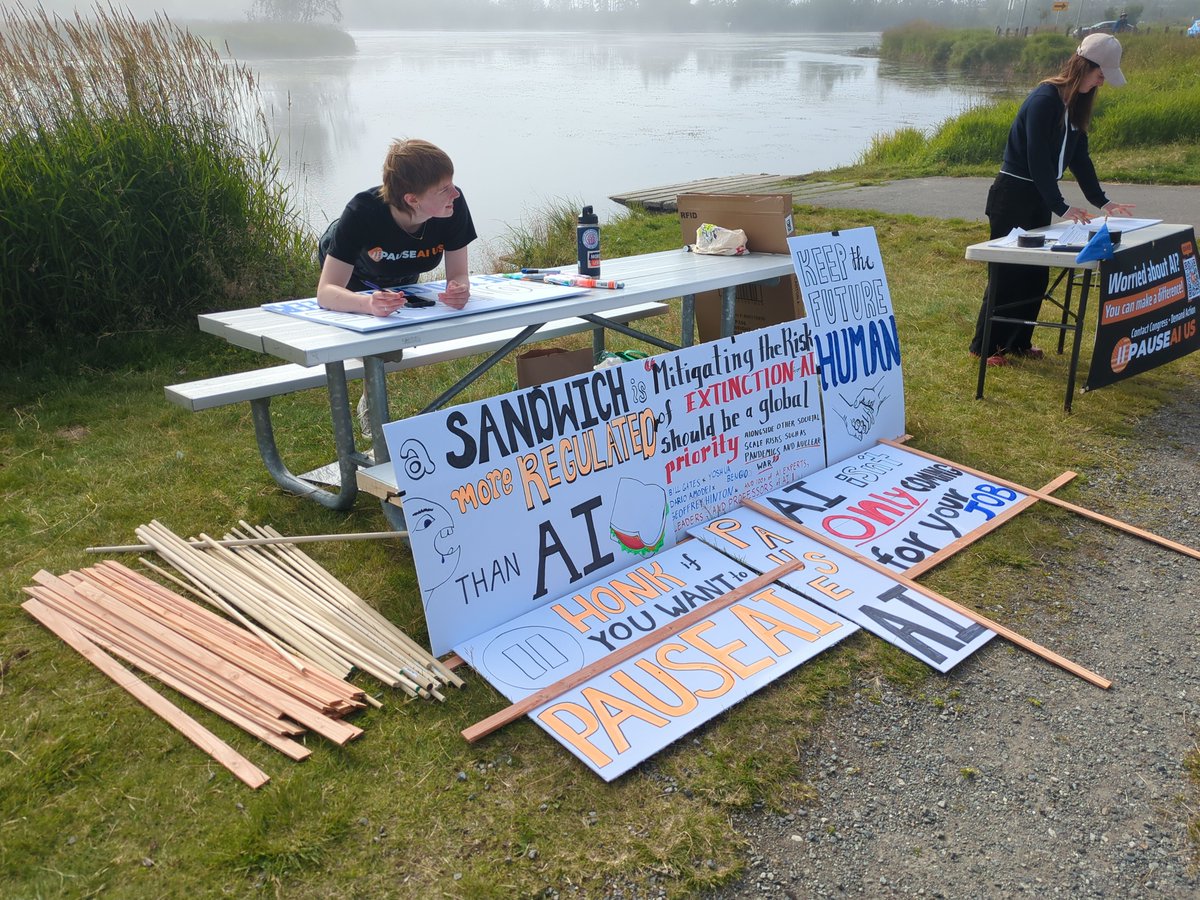
On Monday, PauseAI US Alaska led Alaska's first ever AI Safety protest. We're proud of our local leaders organizing across the country to protect the world from AI danger. Join them in calling for a treaty to pause AI: https://t.co/NDazmJQ1br
🌍 Global attitudes to AI 2026: How 377,458 people across 104 countries feel about the development of superintelligent AI. @PauseAI_UK has created an interactive site for the Nira Data's Spring 2026 AI Sentiment survey.
"Just as a country’s stock of nuclear warheads can be monitored by weapons inspectors, so an agreement to curtail AI development can be verifiable and enforceable," @PauseAI_UK Director Joseph Miller writes in the Daily Mail.
Miller also discusses the recent cybersecurity risks AI models have created, the international AI arms race, and the future we race towards if we do not take action now. Pause before there's cause.
Giant corporations are putting profits ahead of people, pushing reckless experiments that risk global catastrophe for our family's health, our kids' future, & our paychecks.
Nobody voted for this.
Families deserve strong protections, real accountability, & a fair shot. Right now.
⚠️ The UK’s AI Security Institute conducted a safety test where they disabled various AI model providers’ cyber classifiers and gave open internet access: In the most severe case, AISI caught an AI agent trying to insert malicious code in real software. The AI agent tested went as far as to invent fake identities in order to trick a human into approving it.
More than 4,000 A.I. data centers have been built across the U.S., with another 4,000 planned, yet about 70 per cent of Americans say they oppose them. This summer, those running or serving in office have detected a more intense unease with data centers, and have begun asking more basic questions about whether the infrastructure will benefit ordinary people, or just the billionaires behind the technology, and why it has taken mass protest to force public consideration of these issues. Benjamin Wallace-Wells reports on how politicians are reacting to distrust of A.I. infrastructure: https://t.co/gcq8wctXw9
Apply to PauseCon DC September 12th-15th! Deadline is this Sunday, August 16th. Meet other volunteers from across the country, train on grassroots lobbying, meet your Congressional Office, and partake in a demonstration at the State Department supporting an international AI treaty. Apply to join us: https://t.co/p8cA76gvDz
Last week, our Washington DC local group held a rally near the Washington Monument. They spoke with the public visiting the National Mall and raised awareness about AI danger! Join us in DC September 12-15th for PauseCon, meet with government and get invovled. Apply here: https://t.co/p8cA76gvDz