Estimating TCR diversity from a sample 🧪 can be quite tricky, but integrating information from multiple samples 🧪🧪🧪 helps! We discuss challenges and opportunities in our newest preprint @BinfUtrecht
#PhDproject
Long-term diversity of memory T cells:
Low, if source makes long-lived cells
High, if long-lived source makes short-lived cells that become less fit aka cellular aging
Nice discussions with @BorghansJose @CTI_UMCUtrecht, Rob de Boer @BinfUtrecht, now in @FrontImmunol
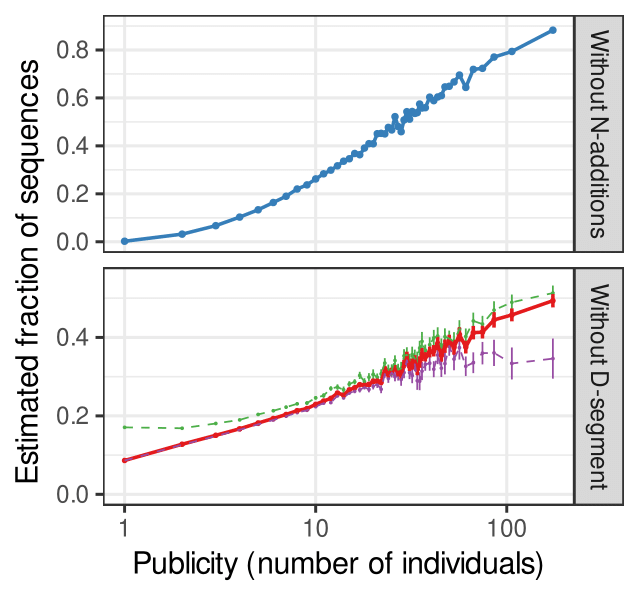
Together, our study highlights a limited-diversity set of TCRβ sequences that closely resemble TCRα sequences as they lack a D segment. Many thanks to all authors of previous studies for making their data (publicly) available! (6/6)
Excited to see our work published in PNAS: TCRβ rearrangements without a D segment are common, abundant, and public. https://t.co/Mn68LRYqmZ
Quick summary below 🧵 (1/6)
Sequences without a D segment seem to be preferentially produced before birth, when the TdT enzyme is still down-regulated. Such clones are long-lived and, perhaps as a result, they are excessively shared among individuals. (5/6)
Check out in @FrontAging: we studied how antigen-specific T-cell repertoires change during aging and CMV-infection. Really enjoyed the team effort with great people from @rivm and @CTI_UMCUtrecht@BinfUtrecht
Despite their likely generation very early in life, we find them in individuals of old age, and also in memory repertoires and the VDJdb, indicating that they are persistent and functional. Full story on bioRxiv: https://t.co/Ep7pcxYbEC (6/6)
Which TCRs are more common in the (naive) repertoire than others? We find that many abundant and public TCRβs have no D-segment: https://t.co/Ep7pcxYbEC .
Where do they come from and what do they do? A short summary (1/6)
Interestingly, cord blood samples of extremely preterm neonates contain many TCRβ rearrangements without D-segment, indicating that the TCR repertoire starts with this restricted set of β chains that look like α chains (5/6).
Deadline for a tenure track position in our group has been extended until June 15th! Educate the next generation of biologists in bioinformatics - full/part time (0.8-1.0 FTE). Please fwd to suitable friends or colleagues: https://t.co/5krac8oRXP - please RT
@3DiMMUNE Hi David, interesting analogy! Note that this is data from naive T cells in humans, without sorting epitope-specific cells. We find evidence for naive clones (TCR α&β nucleotide sequence) of > 10^5 cells, which means a much larger range of clone sizes than found in mice
First paper of my PhD out in @eLife : Combining experiments, bioinformatics and mathematical modelling, we find many small but also large naive T cell clones: https://t.co/3VE4JMH8q6. Many thanks to the team including @BennyChain@BinfUtrecht@jamimmunology