we interrupt joke time for kindness story because we sure can all stand to read about kindness
🌻🌻🌻KINDNESS 🌻🌻🌻
This kid dialed 911 telling the dispatcher he was running away from home after an argument with his mother.
This officer arrived, talked to the kid and went into his bedroom which was empty except for a deflated blowup bed. The boy essentially slept on the floor.
The officer encouraged the boy to stay home. The child’s mother dealing with financial hardship.
The officer left and soon returned with a bed,
a television and a game system. The child was elated beyond words. Not all angels wear wings.
ICE detain man wearing mariachi suit—mock him joking: "Sing us a song and maybe we'll let you go free."
Agents continue to taunt and pressure man to put on a show for them.
When man refused agents get angry yelling:
"This isn't your country!" and
"What are you even doing here?"
Hebert Kaleth Ibarra Castro is a 20 year old mariachi musician living in San Antonio, Texas.
He was detained during a traffic stop—despite having a legal adjustment of status in process after marriage a U.S. citizen.
Currently locked up at ICE Detention Facility in Pearsall, Texas.
Lidia Terrazas News doesn't have an account on this platform—so posting first credited video here to help raise awareness.
She was 15. She climbed out of a drive-thru window to save a stranger's life.
It was a regular lunch shift at McDonald's. Orders moving, cars pulling forward, the ordinary rhythm of a busy drive-thru in December.
Sydney Raley handed a woman her order and stepped back.
Then she stepped back to the window.
Something was wrong.
The woman in the driver's seat wasn't moving right. Her daughter sat beside her, frozen, eyes wide with the particular terror of watching someone you love and not knowing what to do
Sydney knew what to do.
She didn't call for a manager. Didn't wait for someone older, someone more qualified, someone whose job it was. She climbed through the drive-thru window, told the daughter to call 911, and went to work.
Two years earlier, a Red Cross babysitting course had taught her what to do when someone is choking. She had learned it the way teenagers learn most things, not knowing exactly when she'd need it.
She needed it now.
She worked to clear the blockage. A nearby bystander stepped in beside her. Together, in a parking lot, in December, they brought the woman back.
By the time the ambulance arrived, she was breathing.
Sydney went back to work.
That's the part that stays with you. Not the heroism, the smallness of what came before it. A teenager. A drive-thru window. A babysitting course she took years ago just to be responsible.
None of it looked like preparation for saving a life.
It was.
The daughter who sat frozen in that passenger seat will remember the girl who climbed through the window for the rest of her life. She'll tell the story at dinners, to her own children someday, about the afternoon everything went wrong and a 15-year-old decided it wasn't going to end that way.
Sydney was just finishing an order.
She finished something else entirely.
21 years ago today, on June 28, 2005, four Navy SEALs were inserted under cover of darkness into the Hindu Kush mountains of Afghanistan, a place so high and so cold the clouds drift below your feet. Their mission was to find a Taliban commander hiding in the village of Sawtalo Sar. Their names were Michael Murphy, Danny Dietz, Matthew Axelson, and Marcus Luttrell.
By morning, fate walked right up the mountain to meet them. A goat herder and a boy wandered straight into their hidden position. The team had a choice no man should ever have to make: kill unarmed civilians, or let them go and risk everything. They let them go. Within an hour, the mountain came alive with rifle fire.
What happened next is almost too brutal to put into words. Dozens of fighters swarmed the high ground above them. The four men fought their way down a near vertical slope, throwing themselves off ledges and cliffs to escape the fire, breaking bones, tearing flesh, leaving blood on the rocks, and still turning to shoot. One by one they were hit. Still they fought. They would not stop. They would not surrender.
Their radios could not reach the base down in the valley. They were screaming for help into dead air. And so Lieutenant Michael Murphy did something that should never be forgotten. He stood up. He walked out of the rocks and into open ground, into the full teeth of the enemy, with bullets cracking past him on every side, just to get a clear signal. He was shot in the back while making that call. He dropped the radio, picked it back up, finished the call, and said thank you. Then he kept fighting until he could fight no more. That single act of courage is the only reason the world ever learned their names.
Help came screaming up the valley. An MH-47 Chinook, call sign Red Wings 11, packed with eight more SEALs and eight Army Night Stalkers of the legendary 160th SOAR, refused to wait for gunship cover. Their brothers were dying and they would not sit still for it. As the bird flared over the ridge, a single rocket propelled grenade flew through the open rear ramp. The explosion tore the aircraft apart in the sky. All sixteen men aboard were killed the instant it hit the mountain.
Three on the ground. Sixteen in the air. Nineteen American sons gone in a single afternoon. It remains the worst loss of life in Naval Special Warfare history since World War II.
Michael Murphy was posthumously awarded the Medal of Honor. Danny Dietz and Matthew Axelson received the Navy Cross. Marcus Luttrell, blown off a cliff and shredded by shrapnel, was the only one to come home. He survived because a Pashtun villager named Mohammad Gulab found him broken in a ravine and, under an ancient code of honor older than the country these men died for, stood between him and the Taliban and refused to give him up.
Twenty one years later, do not let these be just names on a screen. They had mothers. They had wives. They had children who grew up with a flag folded into a triangle instead of a father. They chose each other over their own lives on a mountain most people will never even hear of.
So today, say their names out loud. All nineteen of them 🇺🇸
In remembrance:
Lt. Michael P. Murphy
Gunner's Mate 2nd Class Danny P. Dietz
Sonar Technician 2nd Class Matthew G. Axelson
Lt. Cmdr. Erik S. Kristensen
Senior Chief Daniel R. Healy
Petty Officer 2nd Class James E. Suh
Petty Officer 2nd Class Eric S. Patton
Chief Petty Officer Jacques J. Fontan
Petty Officer 1st Class Jeffery A. Lucas
Petty Officer 2nd Class Shane E. Patton
Petty Officer 1st Class Jeffrey S. Taylor
Maj. Stephen C. Reich
Chief Warrant Officer Corey J. Goodnature
Chief Warrant Officer Chris J. Scherkenbach
Master Sgt. James W. Ponder III
Sgt. 1st Class Marcus V. Muralles
Sgt. 1st Class Michael L. Russell
Staff Sgt. Shamus O. Goare
Sgt. Kip A. Jacoby
Operation Red Wings. June 28, 2005. Never forgotten.
In the fall of 1965, a phone rang in a failing car dealership on Cape Cod.
The man who picked it up had six children to feed, no money in the bank, and a stack of novels the literary world had filed away under "science fiction" and quietly ignored. His name was Kurt Vonnegut. He was 42 years old, and by almost any measure, he was running out of road.
What the caller offered was simple: a teaching post at the Iowa Writers' Workshop, for $8,500 a year.
He said yes before the conversation was over.
To understand why that phone call mattered, you have to know what Vonnegut was carrying when he answered it.
He had been 22 years old when German forces captured him at the Battle of the Bulge in December 1944. He had survived the Allied firebombing of Dresden — one of the most devastating air raids in history — by climbing underground into a meat locker beneath the slaughterhouse where he and other American prisoners of war were being held. When he came up the next morning, the city was gone. For weeks, he and the other survivors were put to work pulling bodies from the rubble.
He came home from that war to find that his mother had died the previous spring — she had taken her own life. Then, in 1958, his beloved older sister Alice died of cancer, just two days after her husband was killed in a train accident. Kurt and his wife Jane adopted three of Alice's four orphaned boys. Their family of five became a family of eight overnight.
Through all of it, he kept writing. Player Piano. The Sirens of Titan. Mother Night. Cat's Cradle. God Bless You, Mr. Rosewater. Book after book, year after year — and all of them shelved by the literary establishment in the science fiction section, which in 1965 was essentially a polite way of being ignored.
And always, underneath everything else, was Dresden. He had been trying to write about it since the war ended. For twenty years he tried. He could never get it right. The experience was too large, too shapeless, too brutal for the language he kept reaching for.
Iowa changed that.
He taught there from 1965 to 1967. He taught John Irving. He taught Gail Godwin. He gave the kind of workshop feedback students remembered word for word decades later. A Harper's review published during his first year there finally named him what he had always been: a serious literary writer. His salary was raised to $11,000. People began returning his calls.
And slowly, in a Victorian house in Iowa City, the book began to take shape.
He didn't finish it there — he completed it back in Cape Cod after a Guggenheim Fellowship took him to Dresden to see the city again with his own eyes. But Iowa gave him the breathing room to stop trying to write it as a war memoir and start writing it as only he could: through the eyes of a gentle, bewildered man named Billy Pilgrim, who becomes unstuck in time, drifting helplessly back and forth through the moments of his own life.
Slaughterhouse-Five was published in 1969. Vonnegut was 46. It arrived in the middle of the Vietnam War, in front of a country that was desperate to understand what war costs the people who survive it. It hit like a thunderclap. It has never gone out of print.
He went on to write fourteen novels in total. But the thing he came back to, again and again, more than any literary technique or structural principle, was something much simpler.
"God damn it," he wrote, "you've got to be kind."
He died on April 11, 2007, at the age of 84.
A phone rang in a failing car dealership. A broke, overlooked writer picked it up. He said yes.
Sometimes that's all it takes.
Social Security ensures people can live out their lives with dignity.
Millionaires and billionaires need to pay their fair share into the most significant insurance program the nation has ever had.
It’s time to scrap the cap!
@RepJohnLarson
YOU WANTED A WALL, TRUMP? YOU’LL HAVE ONE.
Mexico’s president, Claudia Sheinbaum, responded to Trump’s threats:
“So you voted to build a wall.
Well then, dear Americans — even if geography isn’t your strong suit, and you see America as a country rather than a continent — you should know that on the other side of that wall stand 7 billion people.
And if the word ‘people’ doesn’t resonate with you, let’s call them ‘consumers.’
Those 7 billion consumers can switch from iPhone to Samsung or Huawei in less than two days.
They can trade Levi’s for Zara or Massimo Dutti, and within six months replace Ford and Chevrolet with Toyota, KIA, Mazda, Honda, Hyundai, Volvo, Subaru, Renault, or BMW — brands that are already more popular in many places.
They can cancel DirecTV.
And even if they choose not to, they can stop watching Hollywood films and turn instead to higher-quality productions from Latin America or Europe — with richer storytelling and better filmmaking.
Believe it or not, people can skip Disney and visit the Xcaret resort in Cancún instead — or explore destinations across Mexico, Canada, or South America.
Even in Mexico, you can find better burgers than McDonald’s — with higher nutritional value.
Have you ever seen pyramids in the United States?
Egypt, Mexico, Peru, Guatemala, and Sudan have ancient wonders — none of them in the U.S.
If they were, Trump would probably have bought and resold them by now.
We know Nike isn’t the only sneaker brand. There’s Adidas — and even Mexican brands like Panama.
We understand economics better than you think.
And we also know that when those 7 billion consumers stop buying American products, unemployment will rise, and your economy — trapped behind its own self-imposed wall — will begin to collapse to the point where you’ll be begging for help.
We didn’t want to do this.
But you wanted a wall?
Well.
You’ve got one.”
Her approval rating has reached a historic level — according to a recent poll, it stands at 85%.
The Associated Press reported that Melania was paid over 20,00 dollars for modeling gigs in the USA before her legal H-1B work visa was finalized. Getting paid on a standard tourist visa is a violation of immigration law.
Should her permanent residency be rescinded?
Yes or No?
Mamdani announces $122 million to hire 1,000 more teachers in 2027. This must be why they say socialism is so horrible. Tax dollars go to the schools instead of endless foreign wars.
Margaret Hamilton is the pioneering computer scientist who led the development of NASA’s Apollo mission software. Her code helped land Apollo 11 safely on the Moon, even handling critical errors during descent. She coined the term "software engineering" and was awarded the Presidential Medal of Freedom in 2016 for her groundbreaking work.
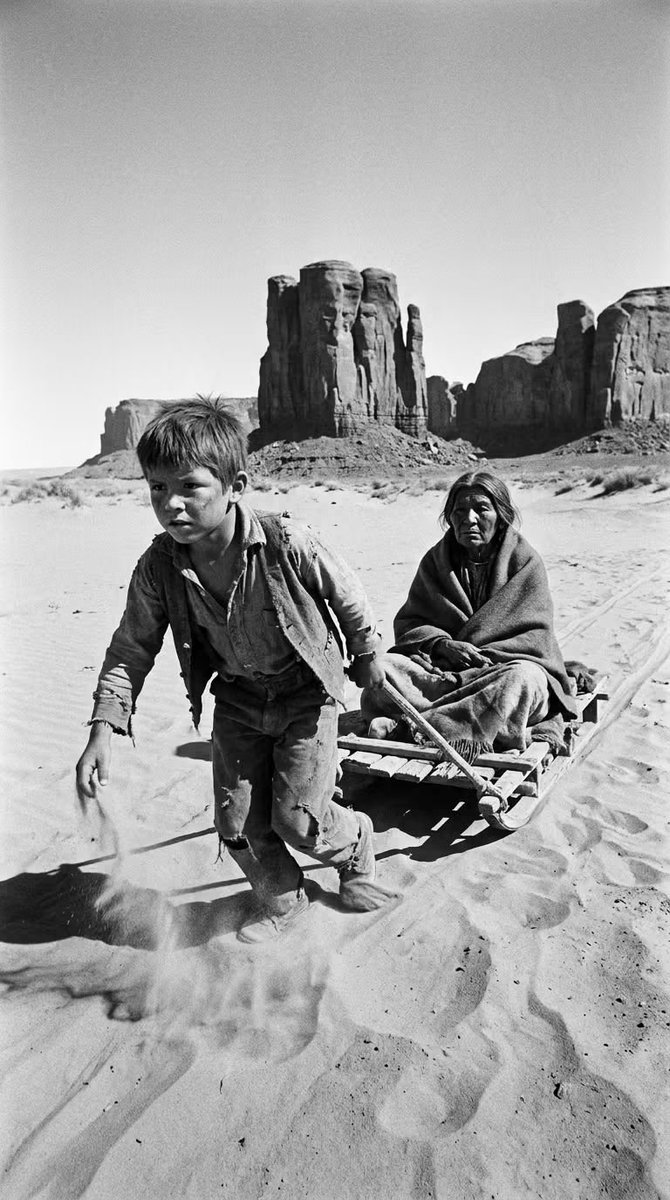
**The Boy Who Wouldn't Let Go – Navajo Nation, Arizona, 1912**
In the scorching summer of 1912, 11-year-old Tahoma Begay was herding sheep with his grandmother across the high desert of the Navajo Nation near Monument Valley. The nearest hogan and reliable water source were miles away, and the relentless sun offered little mercy.
Without warning, his grandmother collapsed from heat exhaustion. Alone in the vast desert, Tahoma realized there was no one to call for help.
Determined to save her, he took the herding rope, tied it securely around her waist, and looped the other end across his own shoulders. Then, with all the strength he could gather, he began pulling her across the hot desert toward the distant shade of the mesas.
The burning sand blistered his bare feet, the blazing sun beat down on his back, and every breath filled his lungs with dust. Whenever he stopped to rest, he carefully tipped a few precious drops from their nearly empty canteen onto his grandmother's lips. To comfort her, he softly sang the traditional Navajo songs she had taught him, hoping the familiar melodies would help her keep fighting.
Hour after hour, the young boy dragged her across the rugged landscape. His hands and knees became raw, his body weakened with thirst, but he refused to leave her behind.
As evening approached, Tahoma finally reached a small spring hidden among the rocks. The cool water revived his grandmother, and thanks to her grandson's determination, she survived.
For generations afterward, Navajo elders shared the story with younger family members, saying:
*"The desert tried to take her, but the boy's love was stronger than the sun."*
There was a small unit in World War II that operated deep behind Japanese lines more than a hundred times and never lost a single man.
They were called the Alamo Scouts.
Formed in late 1943 by General Walter Krueger, these men were hand-picked for one job: go where no one else could and come back with intelligence.
More than seven hundred volunteers tried out. He kept just 138. In teams of six or seven they slipped through the jungles of New Guinea and the Philippines, living for weeks inside enemy territory, mapping Japanese positions and sending back the intelligence that shaped entire invasions.
They did not just watch. On multiple missions they went in and brought people out. In New Guinea they freed dozens of captives the Japanese were holding.
Then came their most impressive mission:
American prisoners were starving in a camp at Cabanatuan, twenty-five miles inside Japanese-held Luzon. Before the Rangers could raid it, someone had to know exactly what was waiting. Two Alamo Scouts dressed as farm workers and set up a hidden observation post just a few hundred yards from the Japanese guards. For days they counted men and mapped the ground inch by inch.
The raid that followed freed more than five hundred Allied prisoners in a single night.
In total the Alamo Scouts ran 106 missions behind enemy lines across 1,482 days of sustained operations. Not one man was killed. Not one was captured.
The men who made it possible got almost none of the credit. Their work was secret, and secret men cannot be celebrated. When the war ended the Army no longer needed them, and the unit was quietly disbanded and forgotten.
The finest small-unit record of the war belonged to men most Americans have never heard of.
Now you have.
Former first lady Jackie Kennedy, who lost her husband in 1963, offers her condolences to Coretta Scott King at Martin Luther King Jr.’s funeral. April 9, 1968.