This post looks like the start of a VERY sophisticated and well-funded PR operation to get support for Democrats to regulate AI into oblivion. Let me show you how it works:
1.) This guy, with minimal followers and no previous account activity, goes to the Wall Street Journal which publishes an exclusive with quotes from him on his resignation 18 minutes BEFORE this post goes up. Planning was clearly done in advance.
2.) Within hours, it has tens of thousands of reposts and the account has 100k+ followers. The post is punchy, quotable, it almost seems professionally written. The first three accounts to quote tweet it all do so within 15 minutes of the initial posting. Remember, this account had basically zero engagement beforehand, so an organic reach explanation seems unlikely.
According to Grok those accounts are @_NathanCalvin (General Counsel at Encode AI), @peterwildeford (Head of Policy at the AI Policy Network), and @DKokotajlo (Head of the AI Futures Project), all of which are up-and-coming AI-Doomer policy advocacy nonprofits.
The AI Futures Project website says it is funded “primarily” by the Survival and Flourishing Fund, which says on its own website that it has advised Jaan Tallinn, Skype creator and one of the leading investors in Anthropic, to grant over $2.5 million to the AI Futures Project since 2024.
Encode AI says on its website that it is ALSO funded by the Survival and Flourishing Fund, which in turn says that it told Anthropic investor Jaan Tallinn to grant $516,000 to Encode AI in 2025.
And wouldn’t you know it, the Survival and Flourishing Fund ALSO says it told Jaan Tallinn to grant $2 million to the AI Policy Institute, the 501(c)(3) affiliate of the AI Policy Network, as well.
What are the odds that the first three quote tweets of Coxon’s post would all be major AI-restriction policy advocates funded generously by the same donor, who also happens to be one of the leading investors in, and a board member of, Anthropic, the company Coxon was resigning from? And all within 15 minutes of posting (two within ten)?
3.) Jacob Coxon doesn’t have much of a resume, but we do know that, in 2022, he got a $20,159 scholarship for the “long term future scholarship program” from the Good Ventures Foundation, one of the philanthropic vehicles of Dustin Moskovitz, a notorious AI-doomer who has spent tens if not hundreds of millions on policy advocacy to strictly regulate AI, while also being an Anthropic Investor himself.
It also just so happens that the 14th person to quote Coxon’s post was @MaxNadeau_ (27 minutes after posting) who is the program officer for the Technical AI Safety team at Coefficient Giving, another of Moskovitz’s philanthropic spending vehicles. Max is not a frequent poster, his last posts before quoting Coxon were before Labor Day, but he was remarkably quick off the mark for this one.
4.) Basically every major Democrat politician and candidate has suddenly glommed on to this post, and conveniently, as the people cry out foe answers, Bernie Sanders already has a bill written to “ban super intelligence” and regulate AI into oblivion, and will be releasing later this week. The bill, among many other things, will create “a new cabinet-level federal agency to safeguard the public from the dangers of artificial intelligence” that will be “advised by an Artificial Intelligence Advisory Board comprised of experts on artificial intelligence.” Do you think, perhaps, Anthropic and its many investors who fund AI policy advocacy might have interest in getting to place a pet “expert” on the board of an entity that dictates what AI is and isn’t allowed to do? And isn’t it fortuitous that this whistleblower came forward with his oh-so scary stories so close in proximity to the release of the most radical piece of AI legislation ever introduced?
Releasing the model weights and technical report of Kimi K3.
Kimi K3 is our most capable model: a 2.8T MoE model with native visual understanding and a 1M-token context window.
New model architecture: 2.5x the intelligence per unit of compute, not just more params.
Alongside Kimi K3, we're opening up more of the stack behind it — high-performance attention kernels, MoE communication library, and infrastructure for running agent environments at scale.
Model weights: https://t.co/7m7eEg6Y0B
Tech report: https://t.co/yeu6cjpMCT
Tech blog: https://t.co/YTfiMSNM1f
New Anthropic research: A global workspace in language models.
Of everything happening in your brain right now, only a tiny fraction is consciously accessible—thoughts you can describe, hold in mind, and reason with.
We found a strikingly similar divide inside Claude.
Good new first: Sol is a smart, efficient, and a significant step forward. It is the same price as GPT-5.5. Also launching in the GPT-5.6 family is Terra, with 5.5-level performance at half the price.
Bad news: at the request of the US government, it is launching today in limited preview instead of the open access launch we were planning on. We are working with the government to get to general availability as fast as we can.
I think it is quite reasonable to roll out models--especially as they reach significant new levels of capability--in this way. It fits with our long-held strategy of iterative deployment. But this isn't quite the process that we think is optimal.
Now we will with the government to attempt to get to a transparent, reliable process for early access, and to ensure that as long as our safeguards work as intended we can release widely. We want to be a reliable, dependable partner that works with all stakeholders, and we also want to live by our mission of benefiting all of humanity. I believe the government shares most of our goals, and that they are overall doing a good job in a very difficult situation.
We will work as quickly as we can to get this model in your hands and we hope you will love it.
Construyendo un sonómetro basado en ESP32-P4 usando un micrófono de medición USB calibrado conectado mediante USB Host. Interfaz táctil y gráficos en tiempo real con LVGL. Explorando hasta dónde puede llegar el ESP32-P4 en instrumentación acústica portátil.
@aidenybai I don't think so. That would imply that GPT 5.5 is much better than OPUS, and OPUS hasn't been banned. In my opinion, they're both in the same league. By claiming that, Anthropic is acting up like a toddler. It's bad practice and honestly disappointing.
Five cancers that used to be death sentences. Pancreatic. Glioblastoma. Triple-negative breast. Renal. Melanoma. The median survival for metastatic pancreatic cancer is still 6 months. Glioblastoma, 15 months.
Now personalized mRNA vaccines are producing complete remissions in some of these patients. Not responses. Remissions.
BioNTech’s pancreatic cancer vaccine has 6-year follow-up data. 8 of 16 patients who mounted an immune response are still alive. For a cancer that kills 95% of patients within 5 years, that's incredible.
Topol’s pyramid here maps the trajectory. From broad checkpoint inhibitors at the base to personalized neoantigen vaccines at the peak. The technology is climbing.
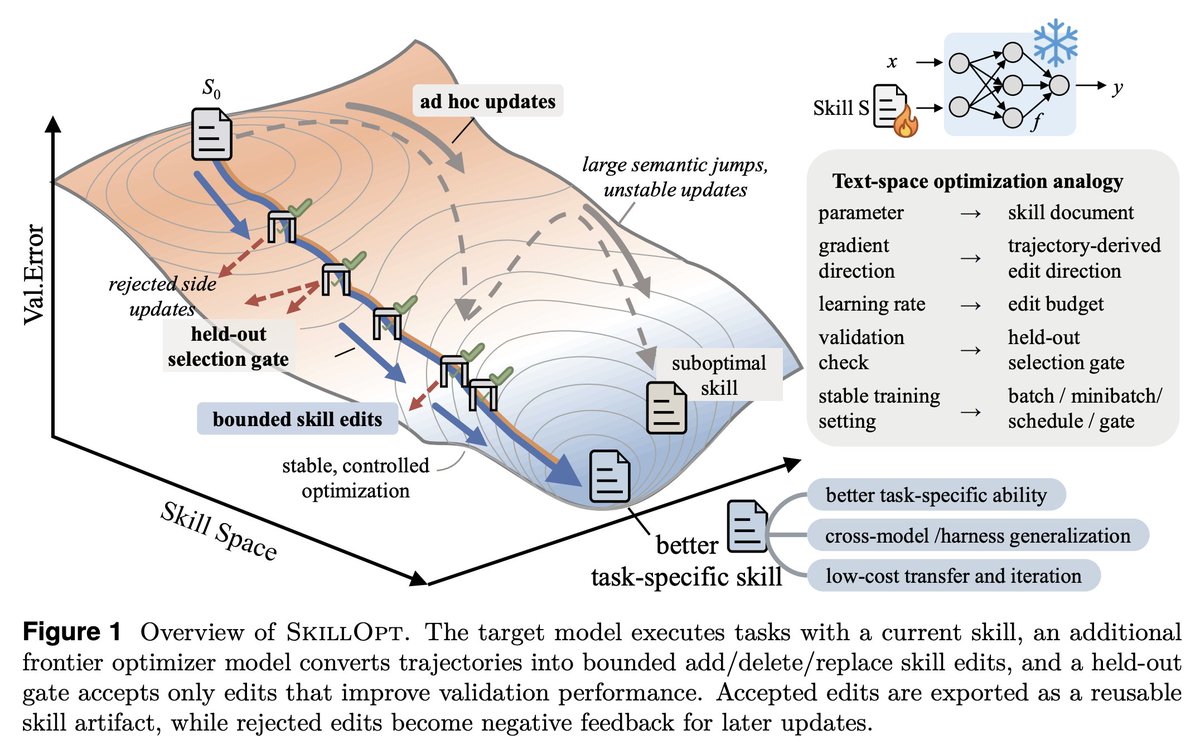
Gradient descent for SKILL.md files sounds interesting, maybe a bit complex but it's becoming a real part of agent harness.
SkillOpt is one of the first papers to treat markdown skill files as trainable parameters and provides a proper optimization framework for them.
A few things I learned that you should consider too.
1. The validation gate is the only thing that matters in a self-editing loop.
Held-out set, strict improvement, ties rejected. End-to-end, their best skills land with 1 to 4 accepted edits total. If your "self-improving agent" is accepting most of what it proposes, you're shipping slop.
2. Bounded edits are better than full rewrites. 4 to 8 edits per step is the sweet spot.
Remove the budget and performance collapses. This is the textual analog of learning rate, and it transfers to any LLM-as-author loop. If you're using an agent to refactor your docs, your prompts, or your skills, cap the diff size.
3. Compactness wins. Median final skill: ~920 tokens.
Skills do not need to be long. They need to be high-signal. Most skill files I see are bloated because length feels like effort. It isn't.
4. The harness is becoming less important; the skill is becoming more important.
A Codex-trained skill ported into Claude Code hit +59.7 points on SpreadsheetBench. Procedural knowledge is more general than the runtime that
produced it.
5. Frozen model + trained context is the practical adaptation.
GPT-5.4-nano with a SkillOpt'd skill ≈ frontier behavior on procedural benchmarks. Cheaper, portable, inspectable, zero inference-time cost. This is
the answer to "how do we adapt a frontier model for our domain" for almost everyone who isn't training their own models.
6. Verification is the bottleneck.
Every gate in this paper depends on an auto-grader. That works for benchmarks. It fails for writing, design, and strategy, exactly the open-ended work we want to automate. Whoever builds the verifier for open-ended tasks owns the next stage.
There are also two leassons I learned while shipping v2.3.0 of my Context Engineering Agent Skills repo, measured across composer-2, claude-opus-4-7,
gpt-5.5, and gemini-3.1-pro via the @cursor_ai SDK:
- Description and body are two different surfaces. The router only sees the description. The agent sees the body once activated. They can quietly disagree, and only end-to-end task tests catch it.
- Aggregate accuracy is the wrong unit. When I rewrote three descriptions, the corpus average moved ~1pp. Individual skills moved 23–25pp. Per-skill effect size is where the action is.
Also, in Feb 2026 I shared a piece called Personal Brain OS arguing that the markdown file is a first-class substrate for agent state. SkillOpt is the optimizer-shaped version of that same argument: not "store memory in files" but "treat files as trainable parameters with proper optimization machinery around them." That's the move from static to measured.
The fast/slow split they describe already lives implicitly in the digital-brain-skill repo:
- voice-guide and tone-of-voice.md are slow-state (rarely touched)
- posts.jsonl and bookmarks.jsonl are fast-state
What SkillOpt adds that I didn't have is a protected section invariant, a structural guarantee that fast edits cannot overwrite slow lessons. Removing that mechanism cost them 22 points on SpreadsheetBench. Worth borrowing.
If you're building agents, SkillOpt: Executive Strategy for Self-Evolving Agent Skills is a good paper to read: https://t.co/ZS9SZXQ6Mv
Unlike other coding agents we built a dedicated open-source sandbox for Codex on Windows to give Windows devs the best possible experience.
Incredible technical write up on the challenges that came with it and how the team solved it.
https://t.co/zIRSab3g9g
Happy Tuesday. Codex has hit 4M active users, adding over 1M users in less than two weeks. To celebrate we will reset the rate limits again in a few hours. Enjoy!
The best part of working at OpenAI is that our mission is literal. We want everyone to have access to superintelligence. No hiding our best model for only powerful companies. You get the power.