Escenarios bastante interesantes.
Algo totalmente loco = no consideraron para nada a los robots.
Así que el escenario más extremo aún puede ser mucho más extremo. Sobre todo cuando consideras que un robot va a costar $1.5 USD a 2.5 USD. la hora por trabajar en literalmente lo que sea. Empacando cajas o haciendo cirugías super complejas en un cerebro humano.
Lo que tiene sentido en mi cabeza, es que vamos a ver el dinero concentrarse en aún menos manos, pero en cantidades ridículamente altas.
Márgenes van a explotar para aquellos que pueden usar estas nuevas tecnologías y protocolos.
Un ejemplo tonto: Una empresa de plomeros que tiene 30 trabajadores genera 100,000 USD al mes y tiene costos de sus trabajadores en 50,000 USD al mes. Ganancia pre impuestos = 50k
Van a poder cobrar 80 mil dólares al mes, ofrecer los servicios a los mejores precios y su costo va a ser de 10,000 USD al mes. Ganancia pre impuesto = 70,000 USD
El dueño de la empresa ahora tiene mucho más dinero PERO 30 humanos tienen que buscar o un nuevo trabajo o abrir un negocio nuevo (o vivir del gobierno).
Sea lo que sea o como sea, lo importante es y será avanzar lo más rápido posible con el cambio y no quedarse parado.
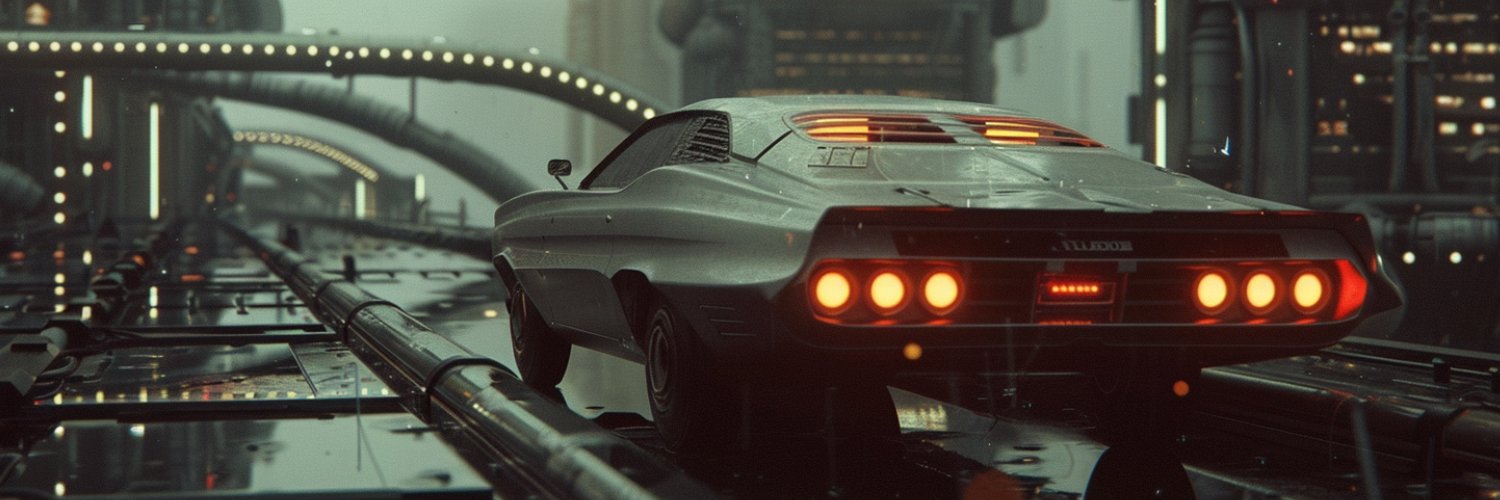
It is a grim possibility that, when the achievements of Breakaway black projects are factored in as an occulted substrate of cultural production, the period of 1975—2000 marked the End of History, and what began in 2001 (symbolized by 9/11) is a controlled demolition process.
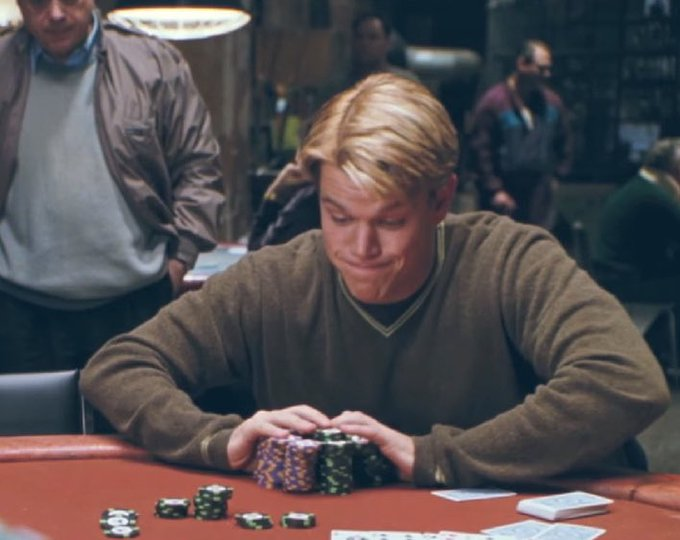
I've watched Lost in Translation more times than I can count and it still gets me every single time.
Charlotte is newly married. Her husband is busy, distracted, always somewhere else even when he's right there. He's not cruel. He's just boring. Absent in the way that people become absent when they stop trying to be interesting to you. And then she meets Bob. Older. Married. An actor with nothing left to prove and nothing left to lose.
And suddenly everything is alive again. They're singing karaoke at 2 AM. They're running through Tokyo like the city belongs to them. They're laughing at things that aren't even funny because everything feels funny when you're with someone who makes you feel seen. It's magic. That's what it looks like. That's what it feels like. Connection in its purest, most intoxicating form. But then they part. And that's it. That's the whole movie.
I think about this a lot. How the most electric connections often have nowhere to go. How the excitement at the beginning is never the truth of the thing, it's just the introduction. Bob and Charlotte never had to find out what comes after. The silence. The staying even when the sparkle fades. They got to live in the beautiful part forever and walk away before it got boring.
Most of us don't get that luxury. Most of us have to sit across the table in silence and decide if we're going to stay anyway.
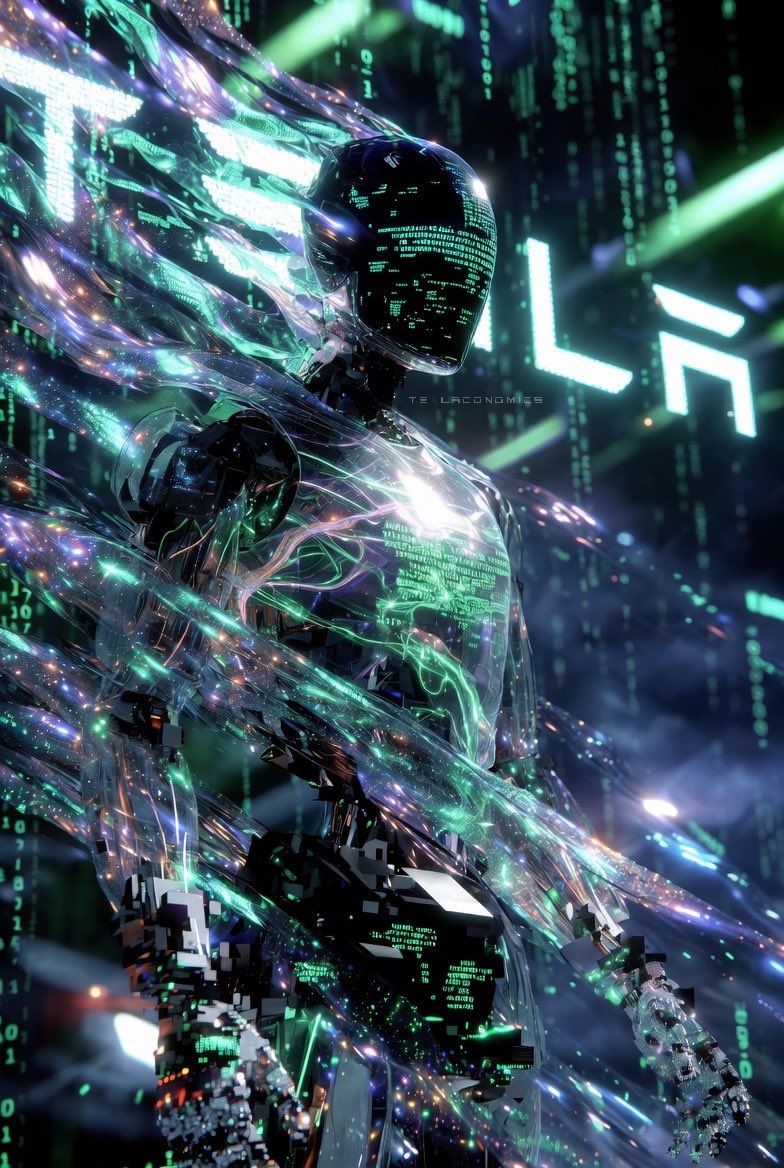
I’m so confident that the Tesla team is going to win the humanoid robot race, I put $ where my mouth is by consistently adding to my position on weakness, instead of selling my $TSLA that hovers today in the millions. I could honestly sell it all and go chill on an island with my significant other with no one hearing another word from me for the rest of my life if I really wanted to, but I firmly believe we are still in the early innings.
You see, anyone can build a humanoid robot that looks good in a demo, walks smooth, MBA-like presentation and all… I’ve already seen all those videos.
But that’s not the hard part.
The hardest part is building a robot that’s actually useful, can learn in the real world, can be manufactured at massive scale, at a profit, and can be improved every year with software.
This is where the gap widens, and why Tesla is so far ahead.
Tesla isn’t starting from zero, like other companies. They’ve already done the hardest thing in modern manufacturing, scaling insanely complex machines to millions of units per year. Teslas are already robots just disguised as cars. And now they’re repurposing that entire playbook into the biggest product in Tesla history, which is Optimus.
Ending Model S and X production at Fremont isn’t that “sad” anymore, when you zoom out. That factory is being converted to build humanoid robots, with Elon targeting up to 1 million Optimus units per year from that site alone. And I believe they are going to scale it up to billions eventually. This is something no robotics startup can even dream about, let alone actually do it in reality. Tesla already has the factories, the supply chains, the batteries, the motors, the actuators, and the assembly lines. They don’t need to wait on anyone, thus, they are doing it all on their own.
Then there’s vertical integration. Tesla designs almost everything in-house, like chips, motors, batteries, software, AI training systems. Manufacturing itself is treated like a product inside Tesla and it keeps getting better with every new product. Every iteration feeds data back into the system and these things compound over time. This is a major moat companies like Boston Dynamics or Figure simply don’t have bc they rely on fragmented suppliers and external systems.
Then, when it comes to
AI, this is where things get unfair.
Tesla is running real-world AI at scale every single day. Full Self-Driving has been training on billions of miles of real human behavior in messy, unpredictable environments. That’s exactly what a humanoid robot needs to operate in homes, factories, and warehouses.
Plus, FSD has an end-to-end neural network that handles perception, planning, and control, the same core problems Optimus has to solve. And to really differentiate your robot, you need to get this data from reality, simulations alone is not enough.
On top of that, Tesla’s deepening relationship with xAI takes this to another level. Tesla has already invested billions into xAI, and Grok is already integrated into Tesla vehicles. That means Optimus is going to be plugged into one of the fastest scaling AI stacks on the planet, backed by massive real-world data and massive compute.
This is the flywheel people underestimate that Tesla has already built:
1/ FSD data & tech improves robot intelligence
2/ Vertical integration drives costs down
3/ Manufacturing scale makes mass deployment possible
4/ Real-world feedback makes the system better every day
5/ All at a profit
That’s how you get to a $20k-$30k humanoid robot that actually does useful work, while everyone else is building a $200k science project.
Other companies might have cool demos, some have good AI, some have decent robotics. But no one else has all of it under one roof with real-world AI, manufacturing at scale, vertical integration, and a clear path to millions/billions of units.
That’s why I’m so confident in Optimus.
Mark my words, this is going to be the greatest product EVER built.
Apple ha presentado su campaña navideña 2025 con “A Critter Carol”, un anuncio filmado íntegramente con el iPhone 17 Pro sin IA y con marionetas.
Reivindica la creatividad manual en un momento dominado por los contenidos generados por IA. Dirigido por Mark Molloy y desarrollado por TBWA\Media Arts Lab junto a Smuggler, el spot muestra un coro de criaturas del bosque interpretando “Friends”, de Flight of the Conchords, en un escenario construido físicamente.
La pieza mantiene el espíritu “Shot on iPhone” sin restar protagonismo al elemento humano, subrayando que la tecnología es relevante cuando amplifica la creatividad de quienes la utilizan.
El anuncio destaca por su enfoque artesanal: nueve títeres hechos a mano, del mapache curioso al oso gentil, fueron creados con técnicas tradicionales y manipulados por titiriteros, reforzando la estética táctil e imperfecta que Apple buscaba.
Incluso la tipografía fue impresa con bloques de madera. Como explica Tor Myhren, VP de Marketing Communications de Apple, la intención era que los personajes lucieran “imperfectos y un poco desgastados”, transmitiendo autenticidad.
Molloy remata la idea: el objetivo era volver a un lenguaje visual donde la imperfección sea virtud y la artesanía, protagonista.
¿Qué opinas? ¿Postureo humanista? ¿Reivindicación genuina?
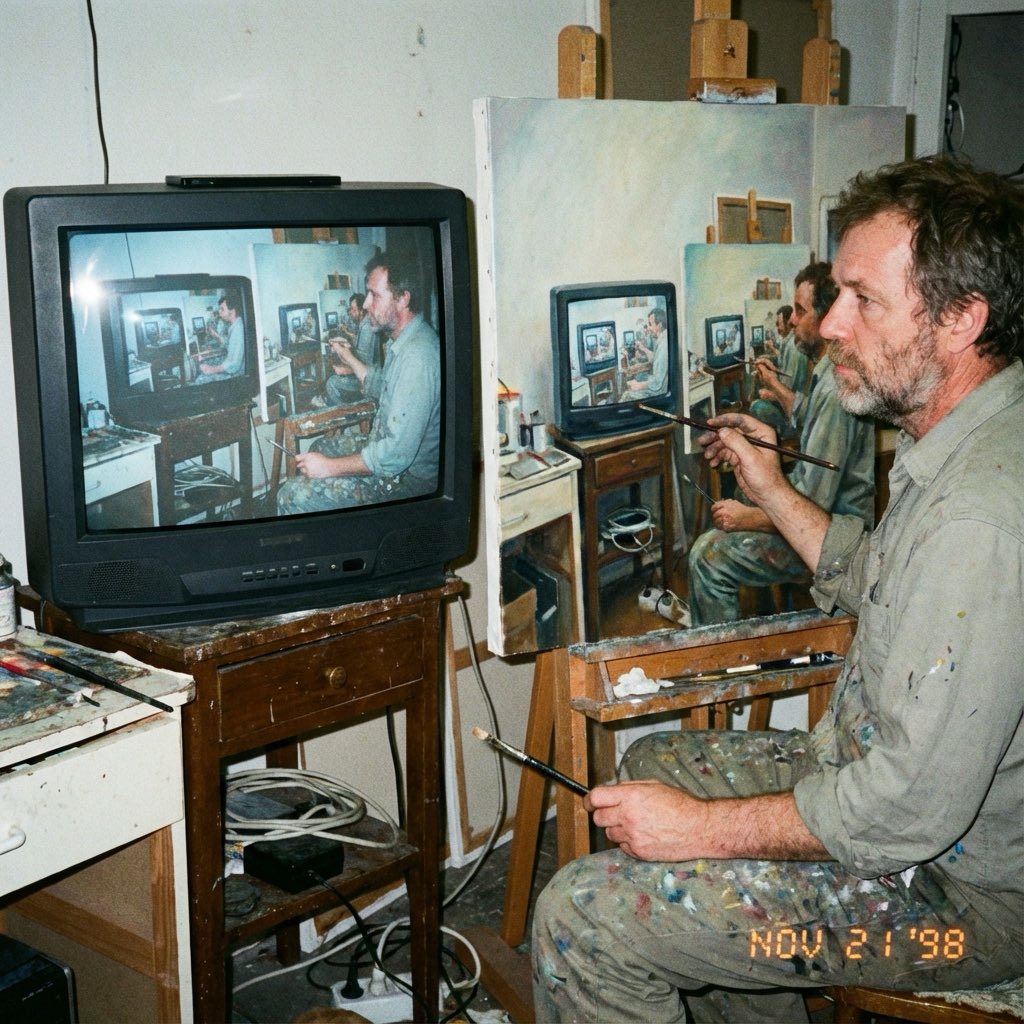
“Amateur photograph from 1998 of a middle-aged artist copying an image by hand from a computer screen to an oil painting on stretched canvas, but the image is itself the photo of the artist painting the recursive image.” Nano Banana Pro.
The smartphone just declared war on the camera industry
Xiaomi just dropped a wild idea: a smartphone with a detachable pro-grade camera lens.
A phone that snaps on a real lens with magnets. Yes, magnets.
It’s a clever move at a strange moment in history.
Camera sales keep falling. Smartphones keep rising.
And the real arms race isn’t glass anymore — it’s AI-powered image processing.
As an AI guy and a photographer, here’s my take:
Hardware won’t save the camera industry.
Software will.
The future of photography is no longer in the lens… it’s in the algorithm.
Phones will keep getting smarter.
Cameras will stay for the purists.
But detachable lenses?
Feels like a bridge between two worlds that are already drifting apart.
But maybe I’m wrong.
Maybe this hybrid future has a place.
What do you think — genius innovation or a beautiful dead end?
#AI #Tech #Photography #Innovation #Smartphones #FutureOfTech
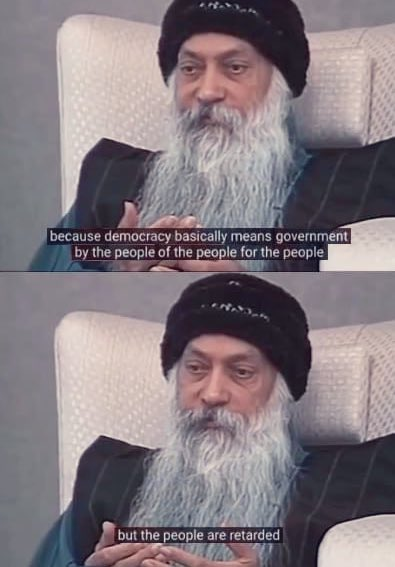
1️⃣ Ortega escribió La rebelión de las masas para anunciar un terremoto: la era en que el mediocre se siente con derecho a todo y obligación de nada. El “hombre-masa” no busca la verdad, sino el aplauso. Rechaza la exigencia, desprecia el mérito y convierte la ignorancia en bandera moral.
2️⃣ México vive hoy esa rebelión: un país donde la mediocridad se volvió consigna, donde el poder se disfraza de pueblo y la masa celebra su propio sometimiento. Hemos confundido la igualdad con el desprecio por la excelencia y la democracia con el ruido de los resentidos.
3️⃣ Ortega nos grita desde 1930: sin minorías lúcidas, sin cultura ni rigor, la civilización se desmorona. No hay futuro en la soberbia del ignorante. México necesita volver a admirar al que sabe, al que hace, al que piensa. La verdadera rebelión hoy sería contra la masa.