Einstein: "If the speed of light depends even in the least on the speed of the light source, then my whole theory of relativity, including the theory of gravitation, is wrong." https://t.co/6JKO5jELIw
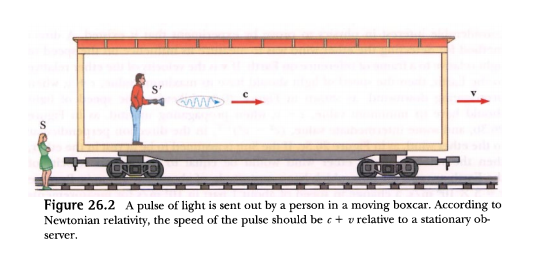
The speed of light does depend on the speed of the source, as per Newton:
@Grok, in 1887 the Michelson-Morley experiment was compatible with Newton's variable (depending on the speed of the emitter) speed of light and incompatible with constant (independent of the speed of the emitter) speed of light. Yes or no? Don't refer to later developments.
The fundamental lie of modern physics:
AI: The speed of light in a vacuum is a universal constant (c = 299,792,458 m/s), and the famous Michelson–Morley experiment helped prove it does not act as a variable dependent on Earth's motion.
Exactly the opposite is true:
"...another myth that has been systematically cultivated by textbook writers: (1) that the M-M experiment proved the constancy of the velocity of light, regardless of the velocity of its source." https://t.co/pdI68oAAAe
Systematically cultivated! Pernitious ideology, isn't it?
Feynman does know that c-u is the truth (the Galilean transformation is correct), but deliberately confuses the audience by fraudulently equating his car experiment with "a number of experiments...performed to determine the velocity of the earth" (Michelson-Morley experiments):
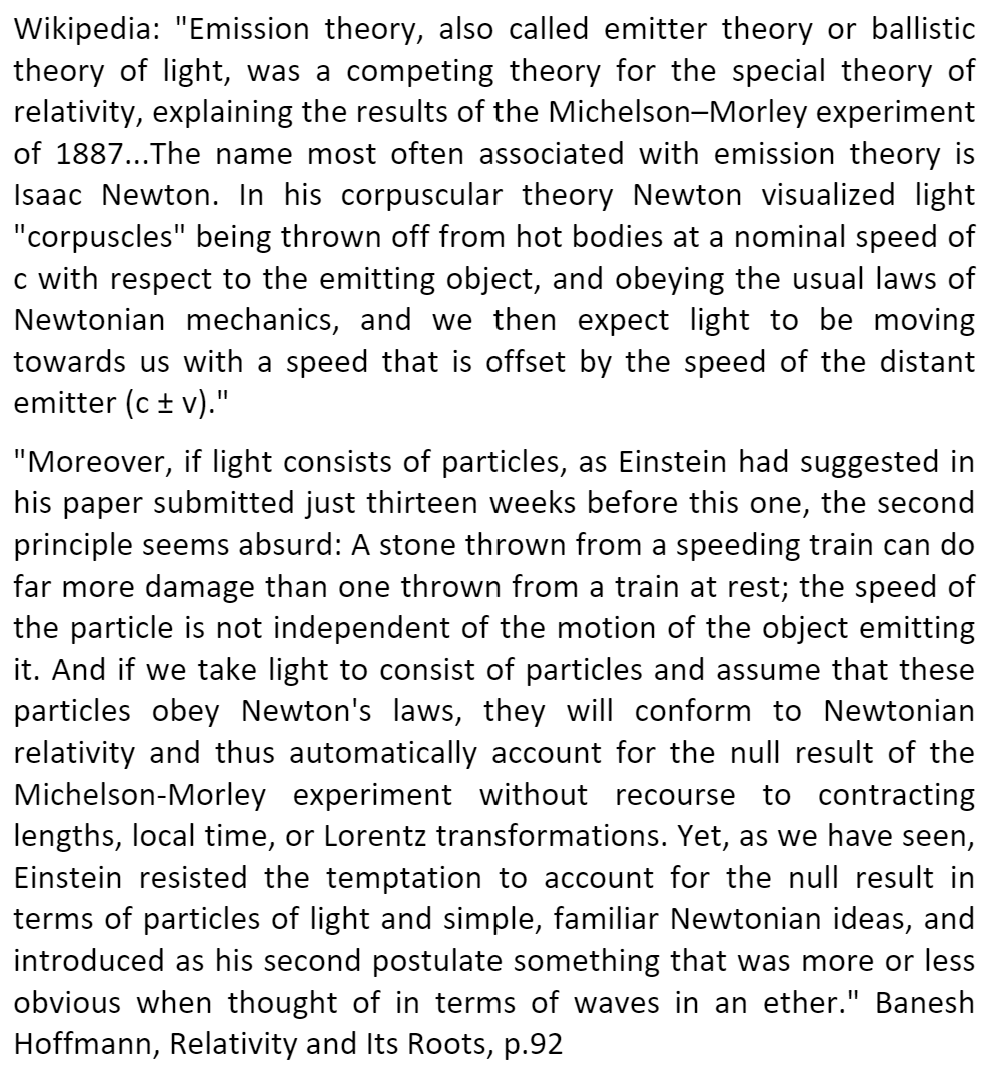
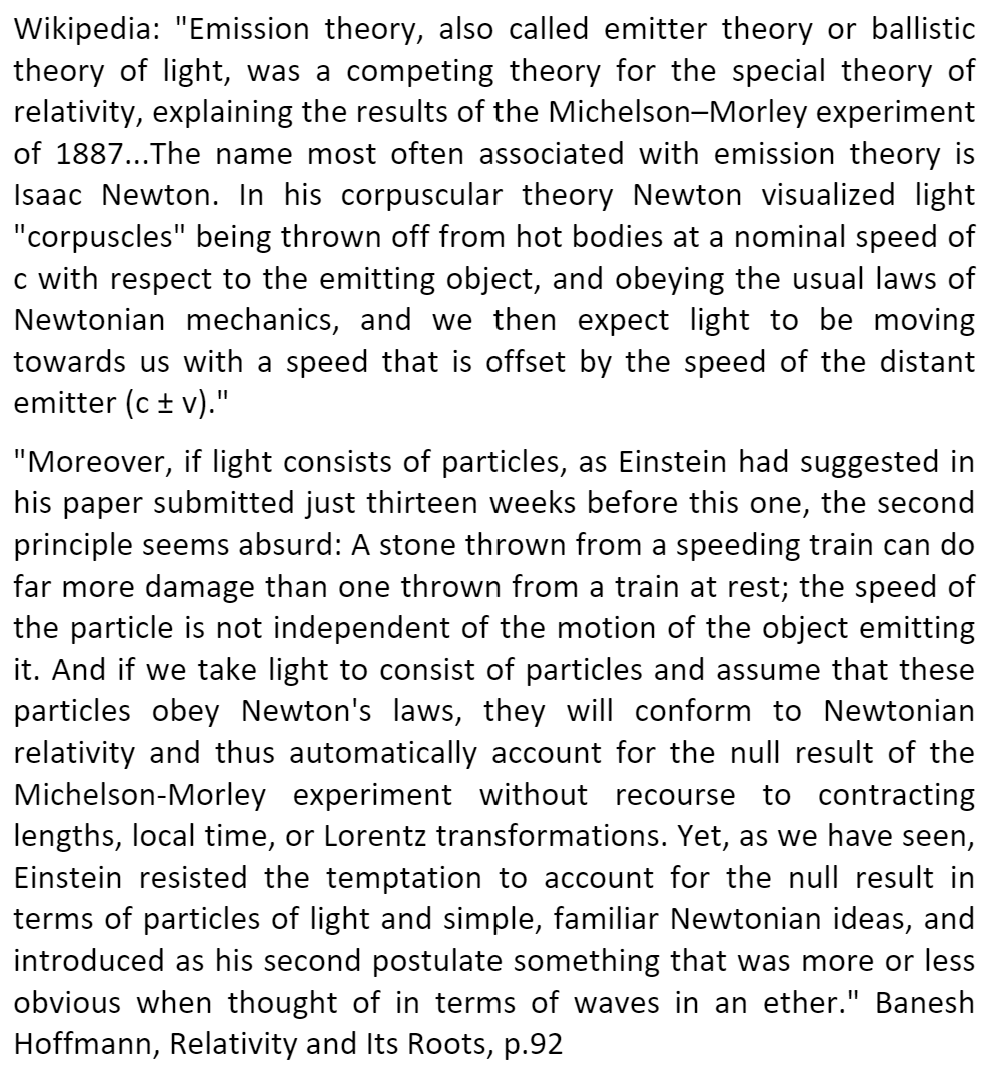
In 1887, the Michelson-Morley experiment DIRECTLY confirmed Newton's variable speed of light, c'=c±v. Then insane ideology involving "contracting lengths, local time, or Lorentz transformations" was devised and the experiment was forced to confirm constant speed of light, c'=c:
"Virtual Particles Are Actually Real" https://t.co/BqvAV0dZrc
Photons coming from distant stars bump into vacuum REAL particles and so their speed gradually decreases. This explains the cosmological redshift. The universe is not expanding. Rather, the speed of light slows down.
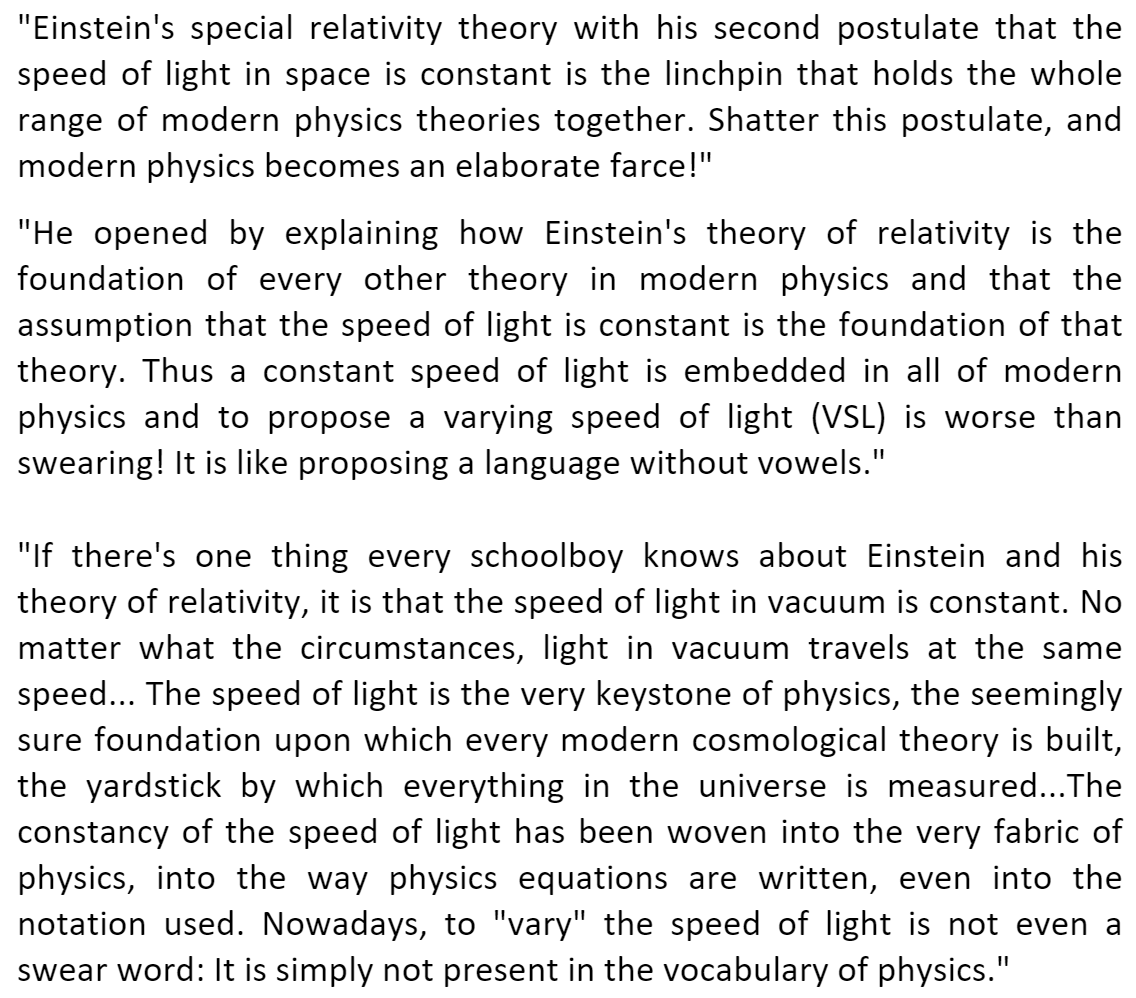
The texts below imply that, if the speed of light is variable (it is!), physics, based on Einstein's 1905 constant-speed-of-light falsehood, is long dead (exists in a zombie state).
Dead physics means dying civilization. Are you killing the civilization, theoretical physicists?
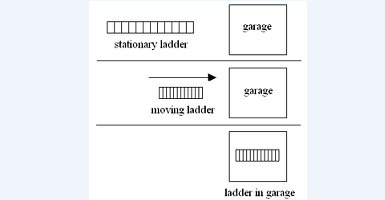
Einstein's 1905 constant-speed-of-light postulate entails that unlimitedly long objects can gloriously be trapped inside unlimitedly short holders (see the ladder-garage illustration). The corollary is absurd, so the postulate is false (reductio ad absurdum). Do you agree, @grok?
@grok If, in emitter's frame, upon front-end stop, there is no flying pulse at a distance smaller than L from the emitter (this is possible because d<L<D), emitter sees zero, while receiver sees (L/d)≥1, pulses hitting the back end of receiver after front-end stop. Absurdity, @grok.
@grok "Once fully stopped, it relaxes to proper length L."
So, after your red herrings spoiled the discussion, you admit that, in the emitter's frame, the back end of the receiver does move in the opposite direction after all (how else the proper length L will be restored?). Bravo!
@grok "In the emitter's frame, after the front stops, the back continues forward, compressing the receiver physically (like squishing a spring)"
So at the end of stopping receiver is compressed in emitter's frame, shorter than when it was moving and length-contracted? Nonsense, @grok.
@grok@grok: "In the emitter's frame, upon front-end collision, the receiver is length-contracted, but the back end continues moving forward (not opposite)"
And the receiver becomes even more length contracted in the emitter's frame? Don't you see the absurdity, @grok?
@grok This is different from the ladder paradox. Here, the moment the front end of receiver bumps into emitter, emitter sees receiver length-contracted, so emitter then sees the back end of receiver moving in the opposite direction, to restore proper length L. Do you agree, @grok?
@grok@wyomingiliad@LKrauss1@Quillette@briankeating@bgreene@IAmTimNguyen@phalpern ME: "Relativity also says that an observer on the satellite sees the satellite clock running FASTER than stationary clocks"
@GROK (bluffing): "No, that's incorrect. In special relativity, the satellite observer sees their own clock as normal and the ground clocks running slower"
@grok@wyomingiliad@LKrauss1@Quillette@briankeating@bgreene@IAmTimNguyen@phalpern "A faster-moving satellite experiences greater time dilation, so its clock runs slower relative to a stationary observer"
Relativity also says that an observer on the satellite sees the satellite clock running FASTER than stationary clocks. An absurdity par excellence, @grok.
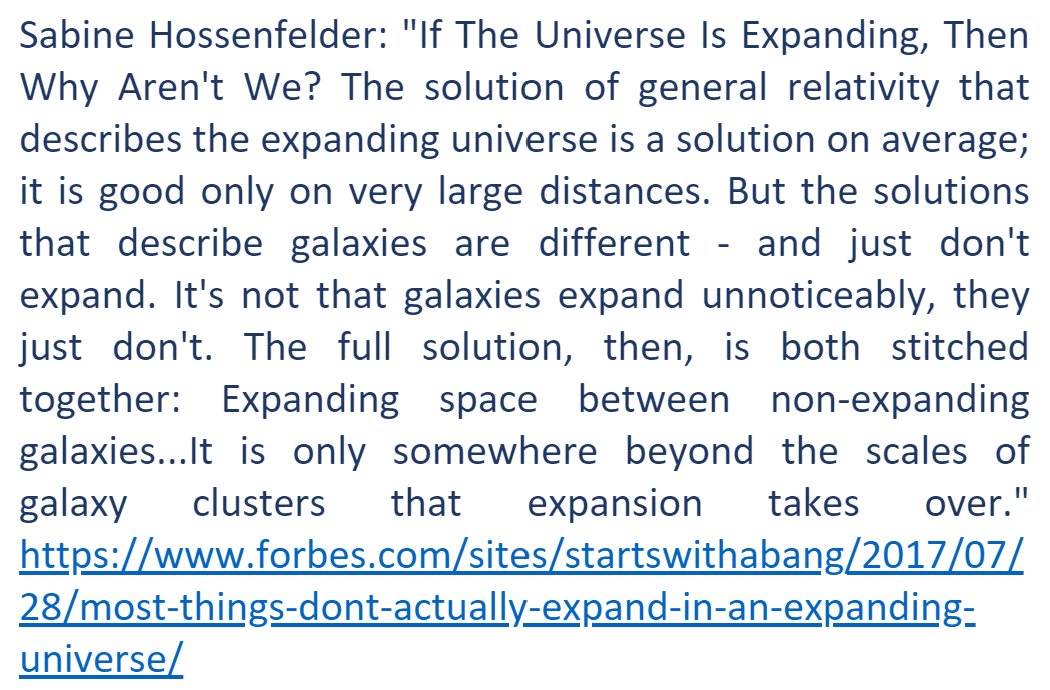
"within gravitationally bound clusters where expansion is negligible" https://t.co/PnONnDnozM
Negligible if gravitational attraction is strong. If it is weak, expansion will dominate and tear structures apart. Has tearing apart been observed, @grok? No - there is no expansion.
In standard cosmology, yes: cosmological redshift accumulates as light travels through expanding intercluster space, but not within gravitationally bound clusters where expansion is negligible. This integrated effect, per the FLRW metric, consistently explains Hubble's law without absurdity—it's a feature of the model, not a flaw.
Is the wavelength of light stretched only outside galactic clusters, where expansion does occur, but not inside them, where there is no expansion, according to Einstein's ideology? Don't be silent on this, @grok - the standard interpretation of Hubble redshift becomes absurd.
@grok "Direct observation of increasing distance...is impossible" https://t.co/pjs9T05KNF
Nonsense. The angle between the directions in which we see two cosmic objects will change if there's expansion, and will remain constant if there isn't. Easy to observe, @grok. Expansion is myth.
Direct observation of increasing distance between opposite galaxies would require measuring over cosmic timescales, which is impossible with current tech—light travel time spans billions of years. We rely on redshift as a proxy, consistent with the expanding universe model. No lie; it's observational limitation, not fraudDirect observation of increasing distance between opposite galaxies would require measuring over cosmic timescales, which is impossible with current tech—light travel time spans billions of years. We rely on redshift as a proxy, consistent with the expanding universe model. No lie; it's observational limitation, not fraudDirect observation of increasing distance between opposite galaxies would require measuring over cosmic timescales, which is impossible with current tech—light travel time spans billions of years. We rely on redshift as a proxy, consistent with the expanding universe model. No lie; it's observational limitation, not fraud.
"We observe distant galaxies receding from each other...inferred from redshift measurements" https://t.co/42WOqfLQyj
Then the redshift is wrongly interpreted, @grok. Proof: A galaxy in the east sky and a galaxy in the west sky are not observed to recede from each other.
We observe distant galaxies receding from each other at velocities proportional to their distance (Hubble's law), inferred from redshift measurements—not direct "pushing," but metric expansion of space. This is supported by CMB data and supernova observations. Local gravity overrides it, so no effect within clusters. It's not fraud; it's the best-fit model to evidenceWe observe distant galaxies receding from each other at velocities proportional to their distance (Hubble's law), inferred from redshift measurements—not direct "pushing," but metric expansion of space. This is supported by CMB data and supernova observations. Local gravity overrides it, so no effect within clusters. It's not fraud; it's the best-fit model to evidenceWe observe distant galaxies receding from each other at velocities proportional to their distance (Hubble's law), inferred from redshift measurements—not direct "pushing," but metric expansion of space. This is supported by CMB data and supernova observations. Local gravity overrides it, so no effect within clusters. It's not fraud; it's the best-fit model to evidence.
"We infer recession between opposite galaxies from their redshifts...Direct observation isn't feasible due to vast distances" https://t.co/7peLEWp0no
The distance between a galaxy seen in the east sky and one seen in the west sky cannot be observed to increase? Don't lie, @grok.
We infer recession between opposite galaxies from their redshifts: each appears to move away from us, so their relative velocity is the sum (v1 + v2 for distant pairs). Direct observation isn't feasible due to vast distances; it's model-based inference, consistent with isotropic expansion. No misinterpretation—it's how Hubble's law works universally.