Top 3 mejores días de Twitter:
1 - Balón de oro de Vinicius
2 - Tchouameni pegándole a Valverde
3 - Fabrizio Romano vs Fabrizio Fauna
Menciones honoríficas:
Argentina - México mundial 2022
🚨🎙️ MICAH RICHARDS ON TONIGHT REFREE DECISIONS:
"Big man, listen to me! We have to be real about this. Let’s be honest: every single big call went against Barça in both legs. Every. Single. One. The referee has to do better there, he really does! You can’t be making game-changing decisions like that at this level and getting them wrong.
I’m looking at the handball in the first leg, I’m looking at the penalty tonight... it’s unbelievable! At what point is it not a coincidence anymore? I’m not one for conspiracies, but when it’s the same story every time the whistle blows, you start wondering what’s actually going on. It’s tough, man. It’s really tough for them!"
There's a physicist at Stanford named Safi Bahcall who modeled this exact principle and the math is wild.
He calls it "phase transitions in human networks." When you're stationary, your probability of a lucky event is limited to your existing surface area: the people you already know, the places you already go, the ideas you've already been exposed to. Your opportunity window is fixed.
When you move, your collision rate with new nodes in a network increases nonlinearly. Double your movement (new conversations, new cities, new projects) and your probability of a serendipitous encounter doesn't double. It roughly quadruples. Because each new node connects you to their entire network, not just to them.
Richard Wiseman ran a 10-year study at the University of Hertfordshire tracking self-described "lucky" and "unlucky" people. The single biggest differentiator wasn't IQ, education, or family money. Lucky people scored significantly higher on one trait: openness to experience. They talked to strangers more, varied their routines more, and said yes to invitations at nearly twice the rate.
The "unlucky" group followed the same routes, ate at the same restaurants, and talked to the same 5 people. Their networks were closed loops. No new inputs, no new collisions.
Luck isn't random. Luck is surface area. And surface area is a function of movement.
The lobster emoji is doing more work than most people realize. Lobsters grow by shedding their shell when it gets too tight. The growth requires a period of total vulnerability. No protection, no armor, soft body exposed to the ocean.
That's the cost of movement nobody posts about. You have to be uncomfortable first. The new shell only hardens after you've already moved.
Elon Musk explains his 5-step process for running companies:
"First, make your requirements less dumb.
Your requirements are definitely dumb. It does not matter who gave them to you.
It's particularly dangerous if a smart person gave you the requirements because you might not question them enough. Everyone's wrong no matter who you are.
Everyone's wrong some of the time. So make your requirements less dumb. Then try very hard to delete the part or process.
This is actually very important. If you're not occasionally adding things back in, you are not deleting enough.
The bias tends to be very strongly towards let's add this part or process step in case we need it.
But you can basically make in-case arguments for so many things and for a rocket that is trying to be the first fully reusable rocket.
There's never been a fully reusable rocket. People don't understand.
This is like the holy grail of rocketry. So you've got to delete the part or process step. Super important.
You can't hedge your bets. That's why the grid funds, for example, do not fall down because that's a whole extra mechanism that we don't need.
Also, whatever requirement or constraint you have, it must come with a name, not a department.
Because you can't ask the department. You have to ask a person. That person who's putting forward their requirement or constraint must agree that they must take responsibility for that requirement.
Otherwise, you can have a requirement that basically an intern two years ago randomly came up with off the cuff and they're not even at the company anymore.
These things are often just way more silly than you think. So step one, make your requirements less dumb.
Step two, delete the part or process step.
If you're not adding things back in 10% of the time, you're clearly not deleting enough.
And then only the third step is simplify or optimize.
The third step, not the first step. The reason it's the third step is because possibly the most common error of a smart engineer is to optimize a thing that should not exist.
Everyone's been trained in high school and college that you've got to answer the question.
Convergent logic. So you can't tell the professor your question is dumb. You'll get a bad grade.
You have to answer the question. So everyone's basically, without knowing it, they've got a mental straitjacket on.
They'll work on optimizing the thing that should simply not exist.
And then finally, you get to step four, which is accelerate cycle time.
You're moving too slowly, go faster.
But don't go faster until you have worked on the other three things first.
You can always make things go faster.
And then the final step is automate.
Now, I've personally made the mistake of going backwards on all five steps multiple times.
Literally, I automated, accelerated, simplified, and then deleted.
One example I've talked about before is there were these fiberglass mats on top of the Model 3 battery pack that were in between the floor pan and the battery.
And it was at one point choking the battery pack production line.
And I was basically living on the battery pack production line trying to fix the line.
It was choking the entire Model 3 production program. So the first mistake was I tried to fix the automation, like make the robot better.
So automating was a mistake. Then accelerating was a mistake. Then optimizing was a mistake.
And finally, I said, what the hell are these mats for?
And I asked the battery safety team, what are these mats for?
Are they for fire protection or something?
They said, no, they're for noise and vibration.
Then I asked an NVH, a noise, vibration, harshness team, what's it for? They said fire safety.
So literally, it was like being in a Dilbert cartoon.
Actually, I feel like I'm in a Dilbert cartoon quite frequently.
So then finally, OK, great, let's try a car with the fiberglass mats and without.
And they put a microphone to both and see if you can tell the difference.
In fact, I was like, which one is which?
So we just deleted them and just bypassed this $2 million robot cell.
It was just a complete pile of nonsense."
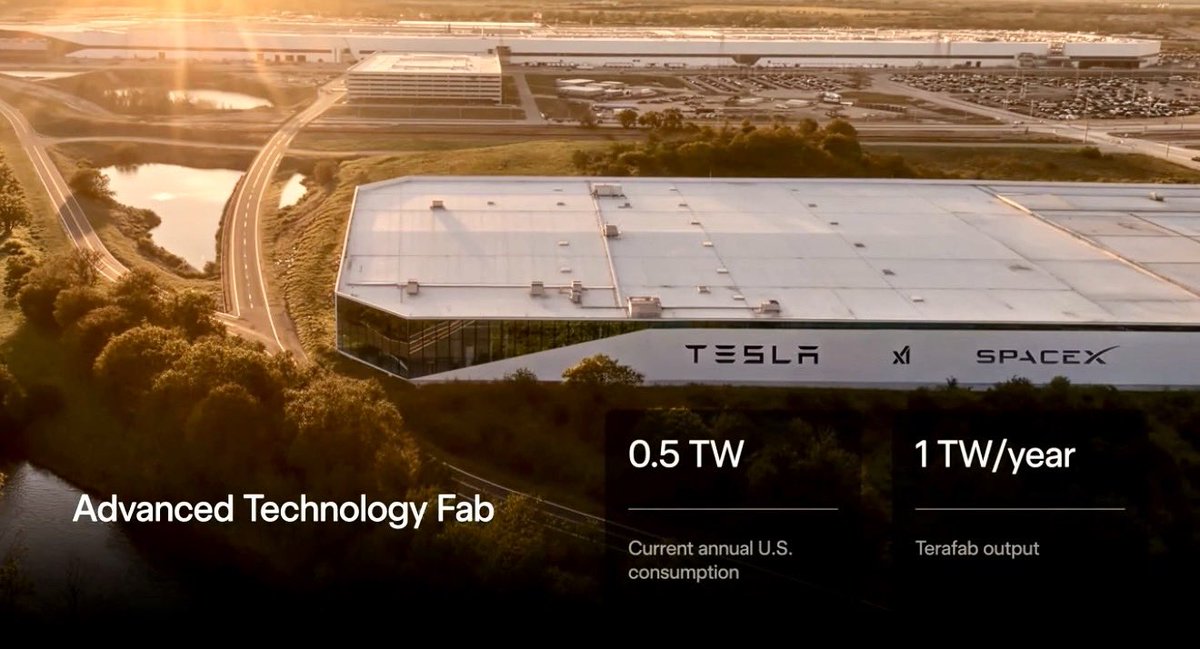
Everyone is covering Terafab as a chip factory.
It is not a chip factory.
Last night in Austin, Elon unveiled a facility that makes masks, fabricates chips, and tests them inside a single building with a nine-month recursive improvement cadence. No such loop exists anywhere else on Earth. Then he told you 80% of the output goes to space. Then he showed you a 100-kilowatt AI satellite with solar panels and radiators, scaling to megawatt range. Then he said Optimus plus photovoltaics will be the first von Neumann probe, a machine capable of replicating itself from raw materials found in space.
Nobody connected the sequence.
Terafab produces 1 terawatt per year of compute. The entire United States consumes 0.5 terawatts of electricity. Musk is building a single factory whose output in AI silicon exceeds twice the power consumption of the country it sits in. And he is sending 80% of it off-planet because Earth literally cannot power what he is building.
Follow the mechanism. Terafab seeds the chips. Starship launches Optimus robots and solar arrays at 100 million tons per year. The robots mine lunar and asteroid regolith for silicon, iron, and nickel. They 3D-print more robots. They fabricate more solar panels. They assemble more AI satellites. Each satellite runs hotter-burning D3 chips designed specifically for vacuum, where free radiative cooling eliminates the thermal constraints that strangle every terrestrial data center on the planet. The nodes replicate. The replication is exponential.
This is a Dyson Swarm bootstrap hidden inside a semiconductor announcement.
The math is public. The Sun outputs 3.828 times 10 to the 26th watts. A 2022 paper in Physica Scripta calculated that 5.5 billion satellites at 290 kilograms each, robotically manufactured from Mars resources, capture enough solar energy to meet all of Earth’s power needs within 50 years. A 2025 paper in Solar Energy Materials calculated a partial swarm capturing 4% of solar output yields 15.6 yottawatts, roughly a billion times current human civilization’s total energy budget. Musk just announced the factory that builds the chips that go inside the satellites that replicate themselves forever.
92% of advanced logic chips are fabricated in Taiwan. One factory in Austin does not fix that. But one self-replicating system seeded by that factory, launched by the only company with reusable heavy-lift rockets, assembled by the only humanoid robot in mass production, and powered by the only star within reach, does not fix a supply chain. It obsoletes the concept of supply chains entirely.
The market priced this as a $20 billion capex story about semiconductor independence.
The actual announcement was the engineering blueprint for Kardashev Type II.
Humanity sits at 0.73 on the Kardashev scale. 18 terawatts. The distance between here and harnessing a star is not a technology gap. It is a recursion gap. And recursion is exactly what a single building in Austin that makes its own masks, builds its own chips, tests its own chips, and launches the output into orbit on its own rockets was designed to close.
Every civilization that makes it past this point never looks back.
Por cierto no vuelvo a ver un partido con los comentaristas de Movistar. Que puto cancer auditivo. Todo el rato era que el Madrid estaba haciéndolo muy bien, una estrategia magistral blablabla. El Barça gana la Supercopa y llevan 30 minutos hablando del partidazo del Real Madrid y sus jugadores
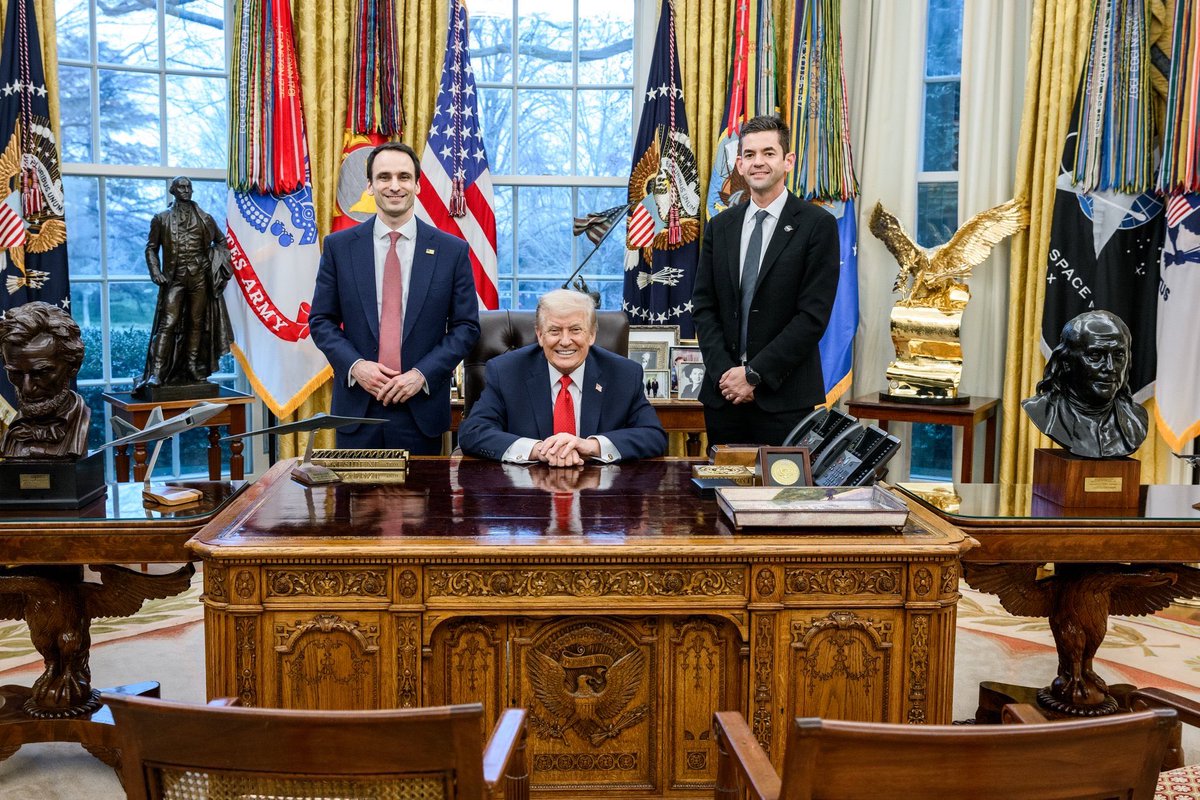
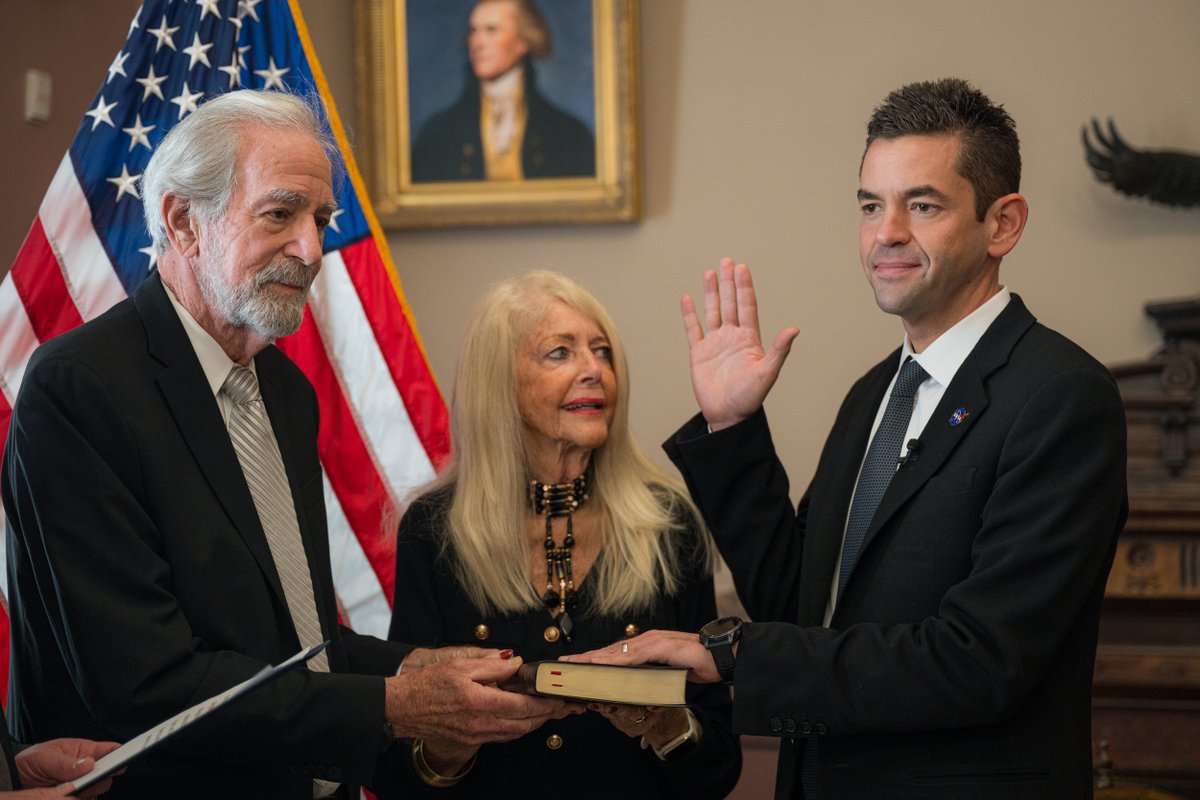
Space has been a lifelong passion of mine. I’m grateful to President Trump for giving me the opportunity to serve alongside the best and brightest at NASA.
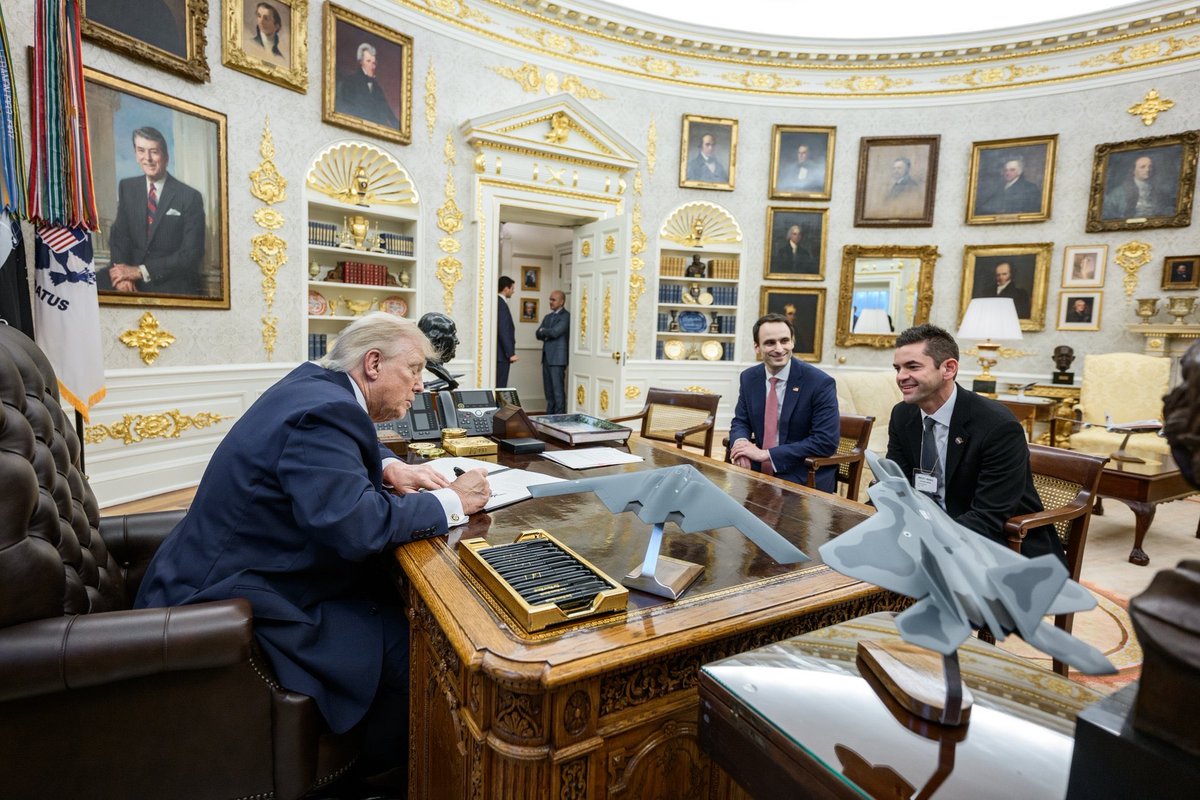
It was an honor to have stood with @mkratsios47 as @POTUS signed the most impactful executive space policy in generations.
Leading the incredible team at @NASA, we will turn the President’s vision into reality, we will accomplish the near-impossible, and we will inspire the world along the way.
Well it is official now..
I want to again express my sincere appreciation to President Donald J. Trump @POTUS for nominating me to lead NASA, and to the United States Senate--and Chairman Cruz @tedcruz - for their diligence and fairness throughout the confirmation process. I am grateful to Secretary Duffy @SecDuffy for his leadership as Acting Administrator during this transition, and to my wife Monica, my family, my friend Senator Sheehy @TimSheehyMT and everyone who offered their support along the way.
As I step into this role, I make these personal commitments:
– Mission: I will champion the bold objectives of human space exploration, scientific discovery, and a thriving orbital economy that ensures America’s leadership in space. We will never again give up our capabilities to reach for the stars, and we will never settle for second place.
– Integrity: I will serve responsibly, transparently, and without personal gain, covering every cost I am legally permitted to, and fully adhering to my ethics agreement. My loyalty is to my country, my President, and the space agency that has inspired me since I was a child.
– Urgency: I will intensely focus the agency on achieving the near-impossible, the very reason NASA was established in the first place. We will eliminate the bureaucracy that impedes progress and empower the best and brightest to take ownership, move quickly, accept smart risks, and act with a relentless focus on mission success.
– Inspiration: Every launch, every scientific breakthrough must inspire the next generation to dream bigger, to reach higher, and believe that anything is possible. In addition to my existing philanthropic efforts, I will donate my salary as Administrator to the U.S. Space & Rocket Center’s Space Camp to help prepare the pioneers of tomorrow.
I am humbled by this opportunity, proud to serve, and ready to work alongside the most talented minds in America as we continue the greatest adventure in human history.
Sincerely,
Jared Isaacman
NASA Administrator