A man working as a welder at SpaceX for $28 an hour has just become a millionaire.
Juan Hernandez, who came from Mexico, welded rockets for SpaceX at $28 an hour.
SpaceX gave him $10,000 in stock when he went full time in 2015, and he bought more with every paycheck for 10 years.
$SPCX is now trading at $167, making his shares worth over $1 million.
Here's a project I've been working on recently: a vision of what happens if Europe doesn't take AI seriously, inspired by AI 2027 https://t.co/b6PBu3nmeK
Tesla FSD (Supervised) has just officially been approved in Denmark!
This is the fourth European country to get FSD (Supervised) approved, and counting.
If self-driving cars are 8x safer than human drivers and we refuse to deploy them because of one bad case, we are choosing to let hundreds of thousands of people die per year to protect our feelings about control.
Out of all the announcements at @Google I/O today, this is the one closest to my heart - our foundational research on Co-Scientist was published in @Nature and we announced its broad availability via @GeminiApp for Science.
When you are suffering from a disease, time is everything. As our collaborator and @StanfordMed Professor Dr. Gary Peltz reminds us, there are thousands of diseases out there with zero treatments. There is simply so much left to solve.
Our goal with Co-Scientist has been to give scientists superpowers and help them get to these answers faster - compressing the scientific process from months and years down to hours and days.
Much like Galileo's telescope helped us look into the stars, Co-Scientist is designed to help us make sense of the vast complexity of biological and scientific data. It is among the first examples of a truly general-purpose multi-agent system for scientific discovery.
The core research question behind it was: How can an AI system engage in the rigorous, structured thinking that’s the hallmark of science and scientists?
To tackle this, Co-Scientist builds on the principles of self-play and self-improvement underpinning @GoogleDeepMind breakthroughs like AlphaGo, generalizing them to scientific reasoning through self-debates.
Since our preprint last year, we have further improved its capabilities and have been validating it in collaborations with scientists across over 100 institutions globally, spanning both academia and industry.
And we are thrilled to see the emergence of a new form of AI-human scientist collaboration that's already leading to important new insights, discoveries and peer reviewed publications - from understanding antimicrobial resistance (published in @CellCellPress) to decoding plant immunity, to identifying new treatments for liver fibrosis (Advanced Science), cancer, neurodegenerative diseases like ALS and the grand challenge of aging.
I have always believed AI's greatest promise is accelerating scientific discovery and advancing human health.
My genuine hope for the future is that AI tools like Co-Scientist help democratize science, giving anyone, anywhere the means to pursue their child-like curiosity and change the world.
This work was done with stellar team mates spanning @GoogleDeepMind@GoogleResearch, @googlecloud and @GoogleLabs especially Juro Gottweis (@Mysiak ), who is the heart and soul of this effort.
Special thanks also to all our wonderful collaborators: Gary Peltz, @CostaT_Lab, @jrpenades, @_e_d_v_ , @iambyronic, @OpsBug, @jgooten, @omarabudayyeh Ritu Raman, Ryan Flynn, Filippo Menolascina, Velia Siciliano, Clare Bryant, Matt Onsum, Katherine Labbé and more.
Nature paper link - https://t.co/ap4woY9Fo3
Google DeepMind blog - https://t.co/LLJZ27ufPP
Gemini for Science - https://t.co/lDhsHCCXrj.
This might be the coolest real estate business in the world.
Some dudes took over a ranch in Texas and built a telescope farm. They're managing hundreds and hundreds of scopes for other people and offering super dark skies and fiber internet so that folks can take amazing pictures of space.
Behold Starfront Observatories.
Podcast: You Have 5000 Days Navigating the End of Work as We Know It. Part 22: After Universal High Income.
This may be one of the most important understandings of the turmoil of the Interregnum you will see.
BEYOND UNIVERSAL HIGH INCOME!
You future with no more cronies…
Dostoevsky wrote this after nearly being executed:
“When I look back at my life, I feel pain not because of suffering, but because of wasted time. I see how carelessly I lived, how often I ignored the quiet voice of my soul, how rarely I understood the value of a single moment. Only when death stood before me did I realize that life is not merely existence—it is a miracle. Every minute is a treasure, and in every breath, there is the possibility of happiness.”
It just seems implausible this is what we are made of, essentially, nanotechnology about a billion years beyond anything we can design or make ourselves.
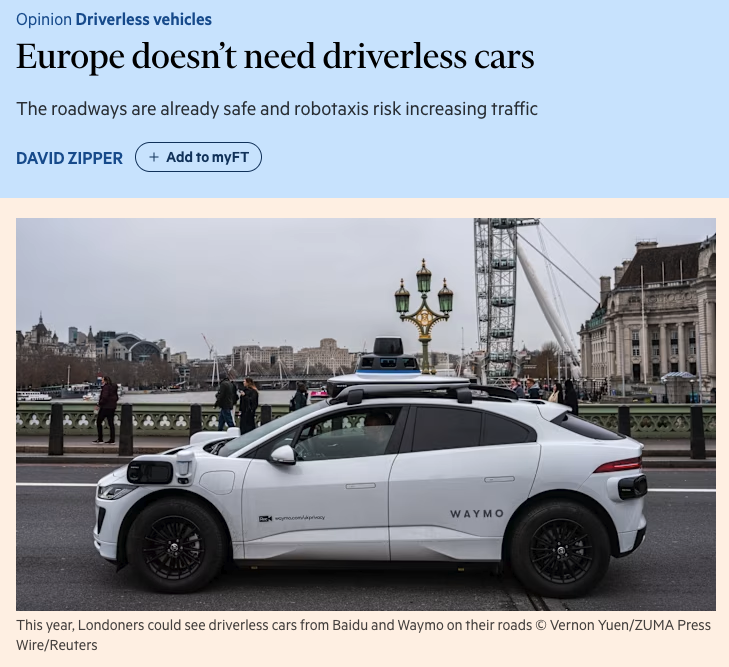
This is the strangest article I've ever read in the FT.
Europe doesn't "need" driverless cars, apparently, because people can already drive.
I presume Europe also doesn't need washing machines or computers, because people can already do laundry & write letters?
I have a guest essay in @nytimes today about autonomous vehicle safety. I wrote it because I’m tired of seeing children die. Done right, we can eliminate car crashes as a leading cause of death in the United States
@Waymo recently released data covering nearly 100 million driverless miles. I spent weeks analyzing it because the results seemed too good to be true. 91% fewer serious-injury crashes. 92% less pedestrians hit. 96% fewer injury crashes at intersections. The list goes on.
39,000 Americans died in crashes last year. More than homicide, plane crashes, and natural disasters combined. The #2 killer of children and young adults. The #1 cause of spinal cord injury. We’ve accepted this as the price of mobility.
We don’t have to.
In medicine, when a treatment shows this level of benefit, we stop the trial early. Continuing to give patients the placebo becomes unethical. When an intervention works this clearly, you change what you do.
In driving, we’re all the control group.
Cities like DC and Boston are blocking deployment. And cities are not the only forces mobilizing to slow this progress.
It’s time we stop treating this like a tech moonshot and start treating it like a public health intervention that will save lives.
Link to article below.
👀 this video of Waymo cars evading crashes with people and vehicles. I especially note the ones that require it having a 360° view.
My sincere thanks to Alex Ellerbeck and @acsifferlin for their wisdom and sure hand in editing this piece.
What if our descendants look back at our acceptance of aging the way we look back at medieval medicine?
We interviewed them.
Dystopian futures are easy to imagine. Optimistic futures take vision and courage to build.
VOICES FROM 2099: