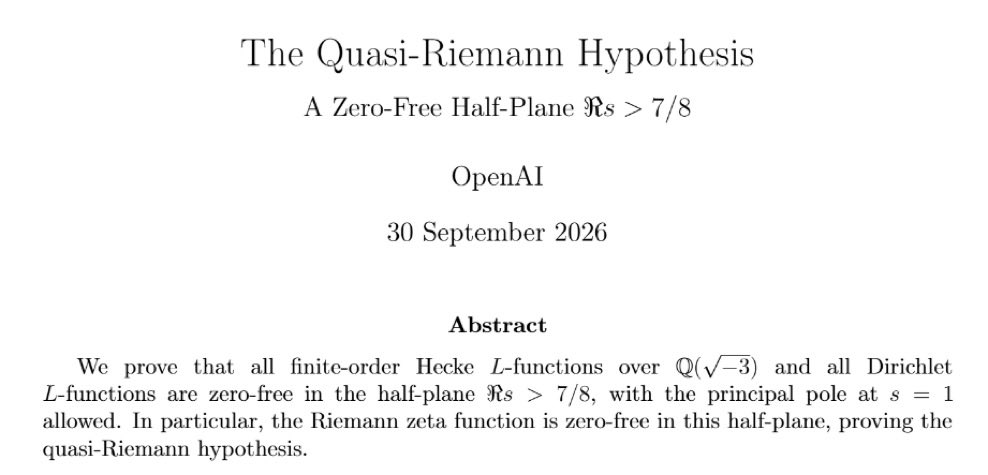
OpenAI just announced that its model proved the Standard Model of physics actually exists.
That sounds absurd. It's not.
For 70 years, physics has had a dirty secret.
Quantum field theory is the most accurate theory humanity has ever built. It predicts properties of the electron to more than 10 decimal places. The LHC, the Higgs boson, the chips in your phone all run on it.
And yet no mathematician had ever proven it exists.
Physicists have been using it like a recipe that works every single time, without anyone being able to prove the dish is a coherent object. We built cathedrals for 70 years on foundations nobody had verified.
The problem is so hard that in 2000 the Clay Institute made it one of its 7 Millennium Prize Problems, $1M each. In 26 years, only one has been solved (Poincaré, by Perelman, who refused the money).
Here's the timeline OpenAI just published:
September 9, 2026: their model produces a proof that Yang–Mills theory exists.
September 18: it extends it to QCD, the full theory of the strong force, with quarks.
Then to a completion of the Standard Model.
October 16: the Yang–Mills proof is formalized in Lean, meaning a machine checked every single logical step.
To understand why this is insane, you need to understand the problem.
Forget particles as tiny balls. The universe is made of invisible oceans stacked on top of each other: an electron field, a photon field, a gluon field. A particle is just a wave on one of those oceans.
But in quantum mechanics, the oceans are never calm. They ripple at every scale. Zoom in, you see smaller ripples. Zoom in again, smaller still. It never stops.
So when you do the math, those fluctuations add up to infinity.
Physicists found a trick called renormalization: subtract one infinity from another, and what's left matches experiment perfectly. It works. But mathematically it's duct tape. Nothing guaranteed there was a real object underneath.
Now the hardest case: Yang–Mills, the theory of gluons.
Gluons are the glue holding quarks together inside every atom in your body. And unlike light, they interact with each other. Two light beams pass through each other. Two gluons collide and stick. The field feeds on itself. That's what made it untameable.
The key that unlocks it won David Gross the 2004 Nobel Prize: asymptotic freedom.
The strong force gets weaker the closer you look. Think of a rubber band between two fingers. Close together, it's slack and the fingers move freely. Pull them apart, the tension explodes. That's why you never see a lone quark.
And that's the gift: the infinities come from tiny scales, and tiny scales are exactly where the theory goes calm. You zoom in, the monster falls asleep.
The method: turn spacetime into a grid, like pixels. On a grid, everything is finite. Then refine the grid, again and again, and prove the picture converges instead of exploding.
A mathematician named Balaban did a huge part of this in the 1980s and never finished. The construction sat open for 40 years. According to OpenAI, the AI closed it.
Now look at who's reviewing it.
David Gross, the Nobel laureate whose mechanism makes the proof work.
Arthur Jaffe, who literally wrote the Millennium Prize problem and co-founded the Clay Institute.
Plus Douglas, Klebanov, Nekrasov.
The man who wrote the question is now reading a machine's answer.
And in the same blog post, almost in passing: the Exponential Time Hypothesis in computer science is false, and the Kakeya conjecture is solved in every dimension.
Three bombs in one post.
Honest caveats, because they matter:
This is not the full Millennium Prize. The Clay problem has two parts: existence and the "mass gap". OpenAI claims existence only.
The physics materials aren't public yet. Gross's group chose to write it up themselves first.
Lean verifies the logic, but experts still have to confirm the formal statement really captures what physicists mean.
And it changes zero predictions. Physicists won't calculate anything differently tomorrow. It proves the ground under the cathedral is real.
But the craziest part isn't the theorem.
It's the scene.
Nobel laureates are now acting as interpreters of what a machine discovered. OpenAI calls its proofs "raw research data" and refuses academic credit.
For centuries, science worked one way: humans discover, then humans explain.
We may have just entered the era where machines discover, and humans explain.
Many of you don't understand how serious this is, so let me break it down.
In computer science there is a famous kind of puzzle called 3-SAT. You are given a long list of yes-or-no switches and a set of rules about how they must be arranged, and you have to find a combination that satisfies every rule. The obvious way to solve it is to try every combination, but each new switch doubles the number of possibilities, so a puzzle with a few hundred switches would take longer than the age of the universe to brute force.
For decades, the smartest people in the field found clever tricks that made this a little faster, but every trick still hit the same wall: the time required kept exploding as the puzzle grew.
About 25 years ago, two computer scientists, Russell Impagliazzo and Ramamohan Paturi, working with Francis Zane, turned that wall into a formal idea.
They proposed the Exponential Time Hypothesis, which says this explosion is not a failure of human cleverness but a law of nature. No algorithm, however brilliant, will ever solve 3-SAT without the time blowing up exponentially. Nobody could prove it, but almost everyone believed it, and it became one of the foundations of modern computer science.
Researchers used it as a measuring stick. If you could show that solving some other problem quickly would also crack 3-SAT quickly, you had shown that problem was hopelessly hard too. Hundreds of papers, across scheduling, graphs, logic and much more, rest on this one assumption.
Now an internal AI model at OpenAI claims to have broken it. It says it found an algorithm that solves these puzzles meaningfully faster than the hypothesis allows, and it has checked the proof in a computer verification system called Lean.
And here is the remarkable part: the very people who proposed the hypothesis, Impagliazzo and Paturi, along with MIT's Ryan Williams, are now leading the public review of whether a machine has disproved their own idea.
So what happens next? If the disproof holds, a large part of theoretical computer science has to be revisited.
Every result that said "this problem cannot be solved faster, assuming ETH" loses its foundation, and researchers will have to work out which of those walls were real and which were simply where we stopped looking. It does not mean everything becomes easy. The new algorithm is still slow in absolute terms and this is not the famous P versus NP problem being solved.
But it means our map of what is possible was wrong in a place we were very confident about, and it was an AI that redrew it. If the disproof fails, the hypothesis survives and the field breathes out, but we will still have watched an AI produce serious, checkable work on one of the deepest questions in the discipline, closely enough that the founders of the idea had to take it seriously. Either way, something has shifted.
The strong exponential time hypothesis (SETH) explained by MIT professor @rrwilliams who was selected by OpenAI to verify the recent breakthrough result:
Q: "Could you explain the Strong Exponential Time Hypothesis, or SETH, and its significance?"
Ryan Williams: "Strong ETH is a severe strengthening of the P versus NP question. P versus NP is asking whether the SAT problem has a polynomial-time algorithm or not.
Strong ETH is basically saying that for the SAT problem, you cannot solve it much faster than 2^n. There’s no 1.999^n time algorithm. For every string of 9s, there is no 1.9999^n time algorithm. To say it totally precisely, it has to do with the k-SAT problem, where you’re looking at clauses of length k for arbitrary k, but those details don’t matter so much.
SAT is a canonical NP-complete problem. It’s solved all the time in practice. It’s extremely useful for verification; nowadays it’s an engine for verification. So it can be solved fairly well in practice. However, in the worst case, we still don’t know how to solve it significantly faster than 2^n.
So the hypothesis that it needs, say, 1.99999^n time is a very strong exponential time hypothesis. It’s stronger than P versus NP. It says it’s not just superpolynomial. It’s darn near 2^n time that you need."
Q: "Do you think that hypothesis is true? Why or why not?"
Ryan Williams: "I think I’m on the record as not believing this hypothesis.
Why don’t I believe it? I started thinking about this hypothesis maybe already as an undergrad, but certainly early in grad school. Before it was even called Strong ETH, I guess that shows how old I am. I was trying to figure out how to solve CNF-SAT faster than 2^n.
At the time there were a number of other NP-complete problems that had faster algorithms, like subset sum. So I thought, what’s so special about SAT? If all these other problems have faster algorithms, why not SAT as well?
Even 3-SAT, where each clause is an OR of 3 variables, has a faster algorithm, and this is just a more general version of SAT. So at first I thought there’s no good reason to believe a lower bound. These other related problems have upper bounds, so why not?
But then, over time, I would have different attacks on Strong ETH, always trying to refute it in different ways. These attacks would fail in some completely catastrophic and ridiculous way. They would have no chance of actually solving the original problem.
But by staring at my failure, I’d think: there’s something interesting happening here. It doesn’t refute Strong ETH, so what does it do? By trying to pivot and figure out what I could do with my failure, I was able to solve a variety of other problems instead.
So after a while, I realized that the truth value of Strong ETH to me is almost irrelevant. If I believe that it’s false, then I get good ideas.
By thinking about what an algorithm that breaks 2^n could look like, I force myself to think in a different way. I have to discard the natural algorithmic possibilities, because we know they won’t work, and think in a different direction. Because it sends my brain in a different direction, it’s very useful for research. Even though I still haven’t refuted it, it’s very useful for me to believe that it’s false, operationally."
Q: This is a minority opinion, right?
Ryan Williams: "Russell Impagliazzo, a good friend of mine who helped propose this, always emphasizes to me: this is a hypothesis. We explicitly did not name it a conjecture. We wanted to put forth a lower bound that would get you to think about it, something a little more controversial than P versus NP or other things people more normally believe.
Hypotheses at the edge of our understanding, where we truly don’t know what the answer might be based on our intuition, can be enlightening to think about. That’s one reason why it was proposed.
But one reason you might believe Strong ETH is true is that it conveniently implies a lot of other lower bounds. You can reduce SAT to a bunch of problems that seem totally unrelated, like edit distance and various pattern matching problems. They have natural polynomial-time solutions. If you could improve on the algorithms for any of those, you would improve the one for SAT as well, and get something better than 2^n.
So believing in it makes a convenient worldview. It shows that all these different textbook algorithms are indeed optimal."
So some elaboration on this -
ETH is a much stronger statement than P≠NP. It's a bit surprising that it's not true but it doesn't really break much.
The bounds are technically sub-exponential, but "2^n / complicated log sqrt expression" is still very close to exponential.
Given how well SAT solvers work in practice, and have for decades, some slightly tighter bounds aren't extremely surprising. There are SAT solvers which have been proven to be <O(2^n) for a long time, just with exponents smaller than 2.
What this amounts to is that for any function O(k^n), there's some algorithm that can do better than any value k, if you make n absurdly big. That's a cute result, but we already knew that many NP problems are easier to solve in practice than in theory, and n really doesn't need to be very big for this to be a pretty meaningless statement in practice.
Ultimately though, and this is something I have some unpublished work on myself that I need to get out there soon, the difficulty of NP problems really has dramatically more to do with the structure of the problem than it does the number of variables. You can have small NP problems that are almost as hard as brute force, and you can have others with millions of variables that can be solved quickly. With NP problems in particular, it's clear that the tools we're applying are simply dramatically too primitive to understand what's actually going on.
We are announcing three new discoveries in mathematics, computer science, and physics about harmonic analysis, complexity theory, and quantum field theory.
https://t.co/9BX8HWQDTJ
OpenAI is downplaying this for PR reasons. If you’re a mathematician, you must feel like a nuclear bomb hit, and you’re at ground zero.
Reasoning models are two years-old. In that time they went from incapable of basic arithmetic to solving problems humans couldn’t solve for decades.
Math is only the beginning. AI will revolutionize the entirety of the human scientific endeavor. Most of us don’t appreciate what that means.
What a time to be alive!
Aging has a language. 🧬 We’re teaching AI to read it.
On the cover of Cell: compact Longevity-LLMs, jointly trained by Insilico Medicine and @liquidai, demonstrate SOTA performance on LongevityBench.
Powered by these models, Longevity Claw nominated 328 candidate gene targets for aging research.
Small model. Big questions. Open source. 🧵👇
#insilicoSOTAFM
Today, we're excited to share early progress on using Gemini to accelerate scientific discovery in the real-world. We present an extension of Co-Scientist which we use to collaborate with scientists across materials science, biology, and computer science.
New in @BloodJournal: A comprehensive preclinical study evaluated ziftomenib using leukemia cell lines, primary patient samples, xenografts/PDXs, gene-expression profiling, and structural crystallography.
Ziftomenib suppressed MEIS1/HOXA signaling, induced differentiation, and caused leukemia regression in NPM1m/KMT2Ar models.
CRISPR-engineered MEN1-mutant models showed retained activity against T349M and G331R—but resistance with M327I/G331D. #AML
https://t.co/dvvtLdXayH
New work from our lab out today in @NatureCellBio led by @jaynathemistry!!
https://t.co/YZzGCFC4eY
🧵 on how clonal hematopoiesis turns the bone marrow niche into an accomplice:
1/6 MYC has long been considered “undruggable.” Instead of trying to drug the protein, we went after its RNA. This work is part of our long-standing effort to expand the druggability of genetically defined disease targets at the level of mRNA.
Our paper, “Prognostic impact of FLT3-ITD microclones in young adults with acute myeloid leukemia treated with intensive chemotherapy”, is now published in @BloodPortfolio 🤩
Many thanks to all co-authors and collaborators!
Free access (until Sept. 18): https://t.co/Ji1RpxAmDt
🔆🔆🔆Matching T-cell receptors (TCRs) to their cognate peptides presented on MHC molecules (pMHCs) from sequence data alone is one of the most important unsolved problems in computational immunology. I've been presenting this work for over a year and am excited to finally share the preprint and public code.
A transformative collaboration for our lab with @quaidmorris (see tweetorial 👇👇with links). Led by first authors @Olga_Lyu, Jonathan Levine & Melissa Pathil, with S. Martis, A. Streltsov, Z. Sethna, Y. Elhanati (@elhanati_yuval), Vinod Balachandran (@TheVinodLab)!!!
@MSKCancerCenter
In Georgia I entered a Chick-fil-A drive-thru line of forty cars.
I turned off my engine. I prepared to wait the way my ancestors waited out a siege.
Six minutes later I was holding chicken.
I do not know what happened to the other thirty-nine cars. The line moved like water that had somewhere to be.
A young woman walked between the cars taking orders on a small tablet, on foot, in the sun, smiling like the sun was her idea.
I said thank you.
She said, "My pleasure."
I did not think about it then. I should have.
At the window I thanked the young man for the food.
"My pleasure."
I thanked him for the sauce.
"My pleasure."
I thanked him for thanking me—
"My pleasure."
I want to be clear about what was happening.
This was a duel.
In Japan I trained in courtesy for forty years. Bowing angles. Seasonal greetings. The correct depth of apology for seventeen distinct situations.
I was a white belt in that drive-thru.
I escalated. I used my most formal English. I thanked him on behalf of my entire family line.
He said, "My pleasure," and gave me extra sauce.
Extra sauce. Unprovoked. A counterattack.
I returned the next day to reclaim my honor.
It was Sunday. The restaurant was closed.
All of them were closed. In the entire country. They close every Sunday, and they have closed every Sunday since the beginning, because the founder made a promise, and the promise did not expire when he did.
I stood in the empty parking lot and understood I had lost twice.
Once to a teenager with sauce.
Once to a man I will never meet, who kept his word so long it became a building.
In my country we say a samurai's word is his life.
I had never seen a restaurant say it back.
I returned Monday. I ordered. And this time I said it first, before she could.
"My pleasure."
She smiled and said, "It sure is."
America, I surrender.
It was my pleasure.
Researchers from the Crispino Lab Team at @StJudeResearch led by Dr. Jeremy Wen and Anitria Cotton identify menin as a key regulator of #megakaryocyte proliferation and fibrosis in #myeloproliferative neoplasms.
Learn more here at @Cancer_Cell:
🔖 https://t.co/WRcTHpbu6l
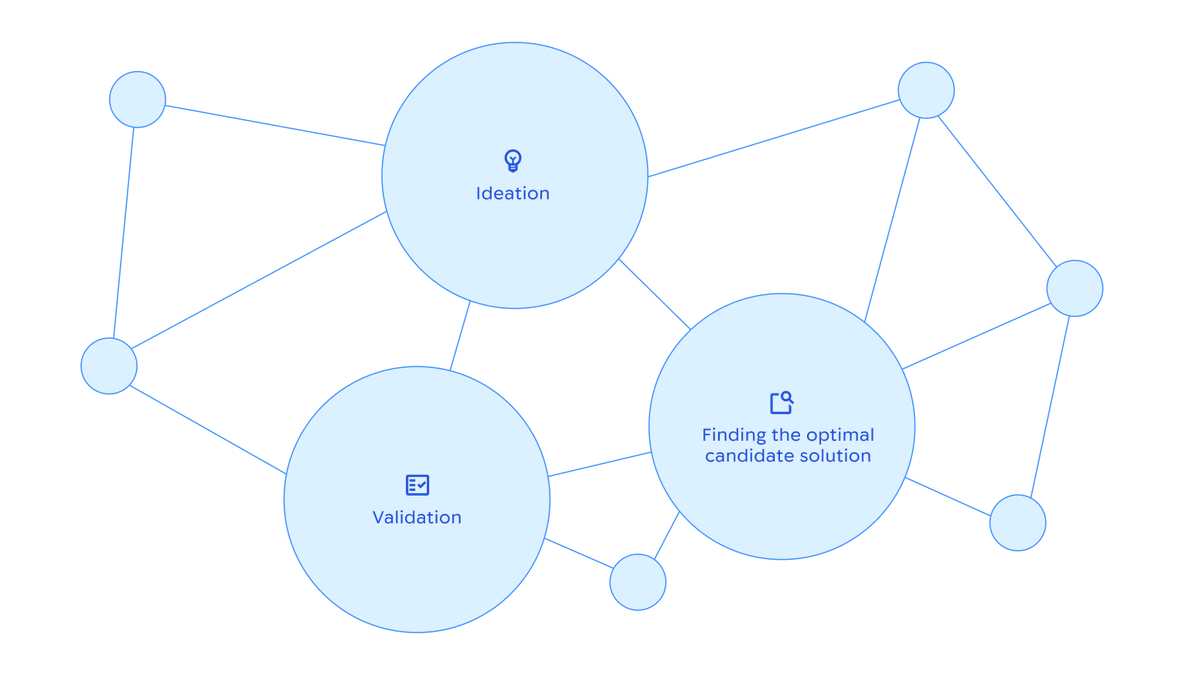
From proposing hypotheses to designing experiments, AI agents are starting to reshape scientific discovery. But the hardest part is testing these ideas in the real world.
Our essay explores the growing validation bottleneck and outlines four priorities for policymakers and funders. → https://t.co/biz1QlHNtm
We just updated our manuscript "Understanding Language Model Scaling on Protein Fitness Prediction". Where we explained why larger pLMs don’t always perform better on mutation effect prediction. We extended beyond ESM2 to models like ESMC, ESM3, SaProt, and ESM-IF1.
#ProteinLM
Excited to share our study on immune interactions in extramedullary (lung) acute myeloid leukemia (AML) out today at @NatImmunol !! Acute respiratory failure frequently occurs in AML due to leukemia infiltration of the lungs. The question is why and what can we do to suppress it. @VarvaraParask in the lab started this work by mapping AML:stromal and AML:immune cell interactions using scRNA-Seq and Visium/Xenium @10xGenomics spatial tools.
https://t.co/96RB7muFZK