On my 5th career: board member, blogger, skier. Before: Professor of Medicine, co-founder @UTJCB & @gchallenges 🇨🇦, Special Advisor to @WHO Director-General
It's finally here! I'm pleased to share that my new book, The Moral Case for Zionism, published by Post Hill Press/Wicked Son, is available online today (see link below).
This work is for Jews who are tired of apologizing for who they are, where they come from, and the story they're part of. But it's also for everyone else who cares about freedom, dignity, moral clarity, the health of our societies, and what's at stake right now.
Whether or not you end up agreeing with every word, I hope you'll read it with an open mind and let it start a conversation. And to everyone who's been part of this journey with me — thank you. I'm honoured, and I look forward to keeping our work in this space going for a very, very long time.
https://t.co/Sr7K7lAhD1
Great to see a BC-based company like ISE becoming part of a growing Canadian-Israeli partnership in advanced technology and defence.
When Canadian expertise and Israeli innovation work together, the opportunities for jobs, innovation and security are endless.
Hanan Al Kuwari, Qatar's nominee for WHO Director-General, has put forward the field's clearest safeguard for WHO's science: independent oversight of its scientific advice, with findings published in full. That's a mechanism you could check in 2030, and it earns two dots on my scorecard.
On results, she names the right issues but offers no mechanism yet: • Measurement: "WHO's success is measured in countries." But WHO tracks 192 indicators, and its delivery dashboard was never implemented. • Institutionalization: a senior team with "shared responsibility for results." But nothing sticks without changing how the Executive Board works. • Ecosystem: she names fragmentation as a cost countries pay. Would she revive countries rating the agencies that serve them, with the results going to the agencies' boards?
Her platform doesn't yet address impartiality: one standard for every member state and every party to a conflict, including non-state armed groups.
Two asks before the 18 November candidates' forum: a specific mechanism on results, and a plan for applying one standard in every conflict.
Link in first reply.
Hanan Al Kuwari, Qatar's nominee for WHO Director-General, has put forward the field's clearest safeguard for WHO's science: independent oversight of its scientific advice, with findings published in full. That's a mechanism you could check in 2030, and it earns two dots on my scorecard.
On results, she names the right issues but offers no mechanism yet: • Measurement: "WHO's success is measured in countries." But WHO tracks 192 indicators, and its delivery dashboard was never implemented. • Institutionalization: a senior team with "shared responsibility for results." But nothing sticks without changing how the Executive Board works. • Ecosystem: she names fragmentation as a cost countries pay. Would she revive countries rating the agencies that serve them, with the results going to the agencies' boards?
Her platform doesn't yet address impartiality: one standard for every member state and every party to a conflict, including non-state armed groups.
Two asks before the 18 November candidates' forum: a specific mechanism on results, and a plan for applying one standard in every conflict.
Link in first reply.
CIJA Calls on Government of Canada to Hold Palestinian Leaders Accountable for Broken Statehood Commitments
“Canada's joint statement implies that the Palestinian Authority (PA) has broken an explicit commitment on which recognition of Palestinian statehood was predicated: holding elections in 2026 in which Hamas would have no role. Yet the Canadian government offers no indication of what consequences the PA will face, while suggesting that Israel is somehow to blame for a decision made by the PA in cooperation with Hamas and Palestinian Islamic Jihad, both listed by Canada as terrorist entities.
“While the Canadian government pursues punitive measures and sanctions against Israel, it must demonstrate that the Palestinians will also be held accountable for failing to honour their commitments and undermining the prospects for peace.
"Otherwise, the government risks a dangerous double standard that has implications for both the region and for the safety of Canadians as security experts warn that criticism of Israel has been exploited to fuel antisemitism, violence and even acts of terror.”
Most of WHO’s money comes heavily earmarked, which fragments its support to countries. Leading an increase in assessed contributions has been a major achievement of the current Director-General. If we want the next Director-General to run WHO strategically and help fix the global health architecture, donors need to keep supporting that increase. https://t.co/vMb0EPmuVt
Before electing next director general @WHO to succeed @DrTedros, well to study the 8 incumbents who ruled over past 78 yrs. Their successes and foibles have much to teach future hopefuls in era of #globalhealth challenges. My column @HealthPolicyW https://t.co/P04x9ilcY5
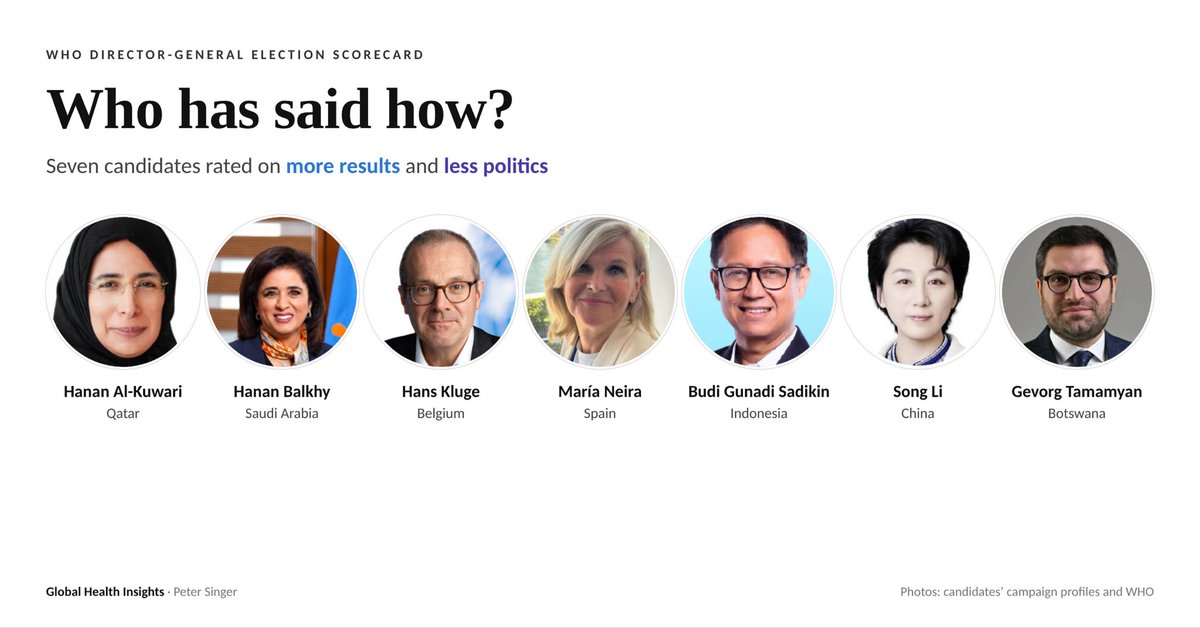
And they're off: seven candidates are in the race for WHO Director-General.
On the Global Health Insights podcast, @jocalynclark of The BMJ and I narrate the race so far.
Only three candidates have offered mechanisms specific enough to check:
• Hanan Al-Kuwari: independent oversight of WHO's scientific advice, published in full
• Hans Kluge: an independent global monitor of attacks on health care. The risk is politicization.
• Gevorg Tamamyan: an annual public report card from management to the Executive Board
By way of transparency, Tamamyan's proposal came after he called me. I make every candidate the same offer. The proposal was his.
Without mechanisms this specific, we have only slogans.
The campaign trail rewards handshakes and selfies. The scorecard does not.
Podcast, scorecard and rankings: https://t.co/8o4lmJF6h8
#WHS2026
And they're off: seven candidates are in the race for WHO Director-General.
On the Global Health Insights podcast, @jocalynclark of The BMJ and I narrate the race so far.
Only three candidates have offered mechanisms specific enough to check:
• Hanan Al-Kuwari: independent oversight of WHO's scientific advice, published in full
• Hans Kluge: an independent global monitor of attacks on health care. The risk is politicization.
• Gevorg Tamamyan: an annual public report card from management to the Executive Board
By way of transparency, Tamamyan's proposal came after he called me. I make every candidate the same offer. The proposal was his.
Without mechanisms this specific, we have only slogans.
The campaign trail rewards handshakes and selfies. The scorecard does not.
Podcast, scorecard and rankings: https://t.co/8o4lmJF6h8
#WHS2026
Candidates campaign in poetry and govern in prose. My WHO Director-General Election Scorecard looks for the prose.
Updated today, and the most interesting change is the first specific mechanism for results. Gevorg Tamamyan would have the Director-General and Assistant Directors-General present a public report card to WHO's Executive Board every year, plus an annual survey of member states' satisfaction with WHO.
(He proposed it after speaking with me, at his request. The proposal was his. I'll speak with any candidate who asks.)
Standings: Kluge 8/14, Al-Kuwari 7, Tamamyan 6, Balkhy, Neira and Sadikin 5. China's Song Li is not yet rated.
Without mechanisms like this, the campaign is just slogans.
See the scorecard here: https://t.co/jMdJrSW7C3
@LSHTM_TB@TogunToyin@WHO@LSHTM@MRC_Uganda@mrcunitgambia Thanks for sharing. I've updated my WHO DG Election Scorecard to include the Berlin panel. The question I'm asking every candidate is not what they would do, but how: specific mechanisms you could check in 2030. One specific mechanism so far on results. https://t.co/DpdlLiwsSS