Throughout my timeline. Here is the “short”, off the top of my head.
Cure all would be, to make the big carriers divest all non insurance assets.
Smaller stuff:
1. Make all cash purchases that are lower than current out of pocket, deductible
2. Require all contracts with any company or agency or org that gets taxpayer funds to be publicly posted, with prices.
3. If a HC entity gets fined by a state or federal agency more than once in 5 yrs, they can’t do business with the feds, or states, for 5 yrs
4. All non profit hospitals must publish their detailed general ledgers, prices paid to vendors, and any fees charged. Also require them to show yield (actual net revenue earned ) by plan
5. End Anti kickback waivers, require sales from brand manufacturers to distributor to be net of any rebates or fees. (Effectively cost plus)
6. End in network PAs/Denials. Your plan picked the doctors. If you don’t trust their judgement, don’t put them in your network
Then, Require a denial list provided daily to CEOs of self insured employers so they can see how their carrier is hurting or killing their members.
7. Create nationally standardized PBM, ASO/TPA, and other HC contracts employers sign, only the numbers and length can change
8. End all provider networks. End chargemaster pricing. Require direct contract cash prices to be inclusive of deductible so no patient OOP, but the cost is still less to the employer.
9. 10. Allow the fed or state government to negotiate the pricing of all accessories, like implants, screws, glues, etc , and it be made available to all providers.
10. Have the fed gov (taxpayers) guarantee the cost of any medical care that is priced at Medicare or less, for anyone not on Medicare or caid. Paid up front.
Repaid by the patient, on a means tested basis that starts at 3 pct of take home pay , but never exceeds 10 pct. With a maximum term of 20 years. After which it is written off.
Think of it as a guaranteed student or SBA loan. The key here is, because of the price caps, providers will find Ways to meet the price and push down pricing across the board. (They say they don’t make money at Medicare rates, but they make contribution margin and they know it. )
Since there is no insurance premium required , the pay back amount would be less than what you would pay in ACA premiums. The fed would have the option of buying stop loss insurance or taking the risk for high $ care.
Insurance carriers would have to innovate.
To each according to their healthcare needs, from each according to their ability to pay ✔️
@SenWarren@BillCassidy@RogerMarshallMD@AbdulElSayed@AOC@HawleyMO@BernieSanders@1klomp
The Dirty Little Secret of Wildfire
How America Traded Logging Jobs for a Perpetual Firefighting Economy
For much of the 20th century, the forests of the Pacific Northwest were managed as working landscapes. Private timber companies and federal land managers cut, planted, thinned, and tended the land with the understanding that the trees were an asset to be sustained across generations. Clearcuts functioned as firebreaks. Small crews routinely extinguished ignitions before they became news. The result was a regional economy built on living-wage jobs, steady tax revenue for schools and public safety, and forests that, for the most part, stayed green.
Occasional fires occurred. What did not occur were the annual, multi-hundred-thousand-acre, smoke-choked seasons that have become the new normal.
That changed in the late 1980s and early 1990s. The northern spotted owl was elevated into the most consequential bird in modern American policy. Scientists and environmental organizations argued that the species required large tracts of old-growth habitat. Petitions, lawsuits, and court orders followed. In June 1990 the U.S. Fish and Wildlife Service listed the owl as threatened. Federal Judge William Dwyer’s rulings and the 1994 Northwest Forest Plan locked up roughly 24 million acres of federal forest across Oregon, Washington, and northern California.
Federal timber harvests collapsed—often by 80 to 90 percent from 1980s levels in the key regions. Mills closed by the dozens. Supporting businesses disappeared. Unemployment surged. Some communities never fully recovered. Private industrial landowners continued managing their own ground because they still had direct financial skin in the game. Federal and state lands largely stopped being managed for timber production or for systematic fuel reduction at anything approaching the previous scale.
The forests kept growing. Fuels kept accumulating. An ignition that once would have been contained by a small crew with shovels and a radio now found denser, more continuous fuel beds. Large fires (5,000 acres and up) went from relatively rare events in the 1970s to routine occurrences in the 2000s and 2010s. In multiple recent seasons, more timber has burned than the industry harvested in its heyday. The irony is difficult to miss: forests “saved” from chainsaws have been delivered to ash in far greater volume.
Meanwhile, the northern spotted owl’s population has continued to decline across much of its range. Logging was never the primary driver. Competition from the invasive barred owl has proven far more significant, and habitat loss from high-severity fire now ranks high among the threats. The original crisis was urgent enough to trigger listing and sweeping land-use restrictions. The promised recovery under the Northwest Forest Plan has been, at best, incomplete.
The economic and ecological bill arrived in the form of unmanaged fuels and repeated megafires. And that is where the dirty little secret begins.
Once the timber economy on public land was kneecapped, a new industry rose to replace it. Wildland firefighting—suppression, logistics, aviation, camps, contracts, and the supporting apparatus—became a multi-billion-dollar annual enterprise. Agencies and contractors employ thousands. Budgets are large and sticky. In government, “use it or lose it” is not a slogan; it is an operating principle. A quiet fire season is a budgeting risk. Early, aggressive attack on every ignition that could still be handled by a small crew is expensive in the short term and reduces the later need for the full apparatus. Allowing fires to grow until they justify emergency declarations, large incident management teams, and federal cost-share arrangements is, from a certain bureaucratic perspective, rational and financially advantageous.
Local structural firefighters and many ground-level wildland crews do not share this incentive structure. They want the fire out. Once a fire reaches a certain size or complexity, however, control shifts upward to state and federal incident management teams whose metrics, funding streams, and political realities are different.
Neither major political party has shown a strong appetite for fixing the underlying problem. One side treats any expansion of active management or commercial thinning as an assault on old growth and the owl. The other side speaks frequently about forest health but rarely forces the structural changes in litigation risk, planning timelines, and budget incentives that would actually move the needle at scale. Campaign contributions and jobs flow from the existing system. Admitting that the original policy overcorrected and produced a more dangerous landscape remains politically costly.
Climate change and longer fire seasons are real factors. Drier fuels and hotter summers make everything worse. But denser, less-managed forests on the public estate are the accelerant that policy deliberately chose. Private industrial lands are managed more intensively and still burn, yet the severity is generally lower. Young plantations and certain silvicultural choices create their own risks, but private owners retain a direct financial reason to keep fuels in check and respond quickly. Public lands under the post-owl regime largely do not.
Oregon and the broader region now hold more trees than they did in the 1920s, largely because private landowners continued to replant. They also experience more catastrophic fire. The government did not “save” the forest. It changed who controlled the management decisions and, in the process, swapped a productive industry for a perpetual emergency-response industry. The owl was the symbol. The lasting result is a landscape that burns bigger, rural economies that never fully healed, and a political class with limited incentive to alter the arrangement. Instead of market-driven capital allocation, the new system runs on taxpayer subsidies.
Households and businesses understand that money spent inefficiently is money gone. Government tends to treat the same dollars as an everlasting well. Until the incentives change—until early detection, aggressive initial attack, mechanical thinning where appropriate, and genuine long-term forest management are rewarded more than the sheer size of the suppression effort—the same pattern will continue every summer: more smoke, more lost timber, more money spent, and the same speeches about how hard everyone is fighting the fires that policy helped create.
Let’s talk about physician payment for a minute and why that AMA graph just doesn’t feel like it tells the whole story. Here’s why…
Let’s start with how the AMA calculates its graphic. They work on the specified update, which is what Congress set out to do that year… but that’s only half the story
Each year, the conversion factor (CF) is recalculated by multiplying the prior year CF by the statutory update by the budget-neutrality adjustment. When you only go on the statutory update, you miss a big potential gain or loss due to budget neutrality.
@anish_koka has explained why budget neutrality has doomed the physician fee schedule permanently. The AMA has provided Congress with years of bad data that ignores the massive financial trouble that budget neutrality has caused and created a far rosier picture.
When you look at the AMA graph, it appears doctors have seen a 10% increase since 2000. The 2000 CF was $36.6137. The 2027 proposed CF is $32.84. That’s over 10% in the negative direction.
We need truth in advertising. I begged the specialty societies and the AMA to fix their graphs. I spent 3 years asking for it. No one listened.
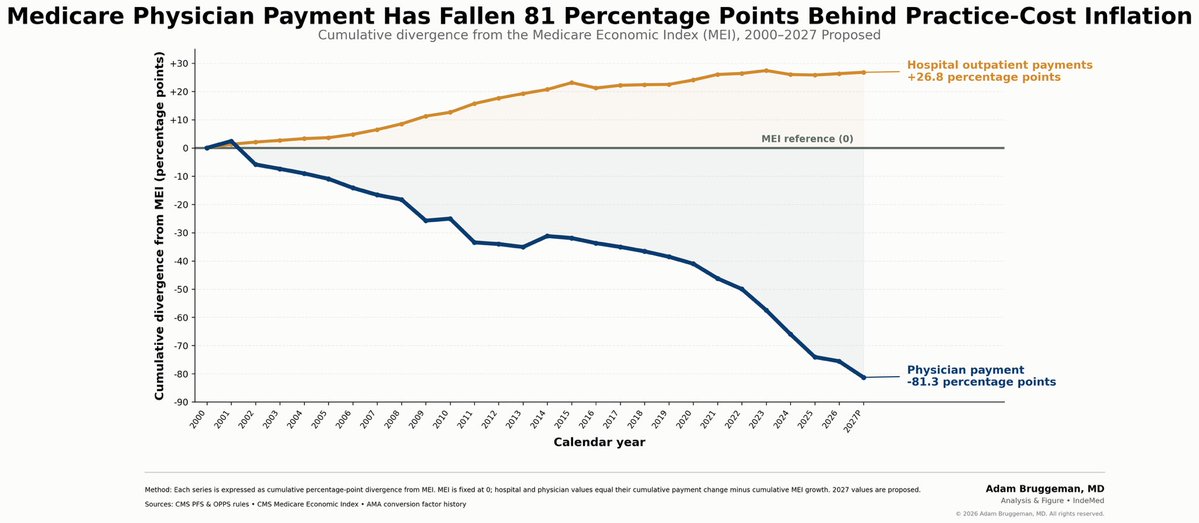
So, I did what I had to do and I pulled the data together. Below is the work product of that venture and a graph that I think (visually) shows the much more striking reason why doctors are leaving medicine or selling their practices.
The first graph looks at things from the perspective of the 2000 CF. If we just compare how much doctors and hospitals are paid, we see that physician pay via CF has declined 10.3% while hospital pay has increased 97% and inflation (MEI) has increased 71%. That seems pretty stark but I think the second graph uses the same numbers but in a more effective way.
The second graph assumes that MEI is the baseline. In other words, what if doctors just got what they were paid in 2000, updated for the cost of inflation. Now we see what really has happened. Doctors are 81.3% behind inflation while hospitals are 26.8% above inflation. No wonder hospitals are buyers and doctors are sellers in this market.
It’s time for truth in advertising. It’s time Congress and CMS heard the real numbers. 81% behind inflation over 25 years and even worse when compared to HOPDs. Our government created this crisis and they will need to understand the issues they created to get us out. Follow us at @IndeMedAction as we shine the light on issues critical to independent physicians.
This 1977 book by Kolesov discusses the benefits of arterial conduits with nearly a decade of angiographic patency evidence. Our western societies were a decade late in adopting these techniques. Kolesov should be posthumously recognized by the West for the master that he was.
Minnesota is doing something rare in healthcare: real 340B transparency.
Their 2025 report just dropped. Buckle up.
The headline: $1.34 BILLION in net 340B revenue in a single year. That’s a massive, unregulated corporate windfall. These subsidies are unavailable to independent physicians.
And no, this isn’t “for the safety net.” ~81% of MN’s 340B net revenue was captured by just 23 DSH hospitals. One system alone (UMN Medical Center) captured 26.1% ($334.7M).
“But what about federal grantees??” Safety net clinics (FQHCs/tribal centers) got under 1% of net 340B revenue statewide. So spare me the press releases about the underserved. They are the marketing face for a program that mostly bankrolls big hospital expansion.
Middlemen are feasting, too: ~$165M in 340B operational costs. This is a massive toll paid to pharmacies and TPAs to navigate a deliberately convoluted program so big systems can maximize the spread.
“There’s no public cost.” False. MDH estimates 35.5% of net 340B revenue comes from Medicare and 19.4% from Medicaid. Taxpayers are literally helping bankroll the arbitrage.
This is how you build consolidation: create a federally protected pricing loophole, then act shocked when the biggest institutions reorganize around harvesting it.
Judge a policy not by its intent but by its outcomes. 340B outcome is clear: it's a disaster.
The MN report proves 340B is no longer a small program for clinics; it’s a billion-dollar subsidy for hospital consolidation. Kudos to @mnhealth for actually showing us the receipts.
ACA-era policymakers argued that fragmentation was driving inefficiency, and that larger, integrated systems would coordinate care better and reduce unnecessary spending.
For years, consolidation was sold as the cure providing better coordination, lower costs, and higher quality.
More than a decade later, the empirical record shows consolidation reliably raises prices while quality improvements remain inconsistent or absent.
It’s time to pull out the receipts and talk about the 8 ugly truths of consolidation.
1. Prices Rise Consistently and Predictably
Increased hospital-physician financial integration is associated with higher commercial outpatient spending. In addition, hospital-physician integration changes coding intensity and spending patterns When hospitals merge, price increases range 3%–65%. Even when there are cross-market mergers with no direct local competition being brought together, the newly merged entities produce 12.9% higher prices six years later
2. Site-of-Service Shifts Inflate Costs
Office visits billed in hospital-owned settings are 100+% more expensive than identical services in independent offices.
3. Patients Pay More Out-of-Pocket
Higher negotiated prices and facility fees translate into increased deductibles and coinsurance, higher employer premiums, and greater patient cost-sharing in hospital-owned settings.
4. Referral Steering After Acquisition
After vertical integration, physicians increase referrals to hospital-owned facilities by 6–10 percentage points, even when lower-cost alternatives exist.
5. Insurance Market Concentration Drives Higher Prices
Physician and hospital consolidation is only part of the equation. In many states, the top two insurers control 60–80% of the commercial market. Higher insurer concentration is associated with higher premiums in employer-sponsored insurance markets.
6. Quality: Where Are the Gains?
If higher prices were buying better outcomes, we would expect consistent improvements in national metrics but yet we don’t see them.
GAO: “No consistent change” in most quality measures after consolidation.
KFF (70+ study review): No reliable improvement in mortality, readmissions, or patient safety.
7. Access & Service Line Effects
Mergers do not consistently prevent hospital closures. Even if they ultimately keep every hospital open, some merged systems reduce service lines, particularly less profitable lines like labor & delivery and behavioral health. High-concentration markets show reduced entry of new physician practices and ASCs typically through regulatory pathways like Certificate of Need laws.
8. Labor Market Effects
Ironically, consolidation raises prices to payers while reducing pay to those providing the care.
The Pattern
Across vertical integration, horizontal mergers, and insurance concentration, the findings are remarkably consistent:
Prices go up
Out-of-pocket costs go up
Referral steering goes to corporately controlled entities
Market entry becomes more difficult
Quality is flat to declining
If consolidation were delivering transformative improvements in care, we would see it clearly by now. The evidence instead shows a transfer of negotiating leverage and ultimately dollars.
@IndeMedAction
The one point that the general public must understand is that the cost of medicine, the rise of hospitals systems, and the fall of private practice has occurred largely because government has allowed hospital systems to be paid a “facility fee” that independent physicians cannot collect. https://t.co/UpPIXwLbn3
The public should be far angrier about facility fees than it is.
Picture two clinics. One is an independent physician practice. The other is the exact same type of clinic, same doctors, same rooms, same services, but owned by a large hospital system.
That second clinic is classified as a hospital outpatient department. Nothing about the care is different. But the prices a "hospital outpatient department" gets to charge the government are multiple times higher than the independent clinic.
Routine office visits, imaging, echocardiograms, in office procedures all get marked up simply because a hospital’s name is on the door. The independent doctor gets paid one rate. The hospital owned clinic gets paid more for doing the exact same thing.
That extra money lets the hospital pay higher staff salaries, outbid independents for equipment, spend more on marketing, and layer on amenities that have nothing to do with care. The independent physician is now competing against a system that is legally allowed to charge more for identical services.
Patients are mostly blind to this. They are not told they are walking into a higher priced clinic. They do not see the facility fee until the bill shows up.
And then the patients are screwed again once enough independent practices are driven out of business. Patients lose the option of seeing a lower cost physician altogether. They are forced into hospital owned clinics that charge more and often deliver a worse experience.
This is not an accident. Medicare explicitly wrote these payment rules into its fee schedules. Private insurers largely follow Medicare’s lead, so the distortion spreads across the entire system.
It's almost as if the system is designed to elminate independent physician practice...
I just turned 55.
And finally understand what actually matters.
Took me three decades to learn what I'm about to teach you in 5 minutes.
Here are 55 life lessons I wish someone told me at 25:
For those legislators who are working on healthcare legislation right now , here are some suggestions :
1. For intercompany medical charges, require them to be priced at Medicare rates. Ends gaming of MLRs
2. Require all insurance plans to apply any cash purchase against your deductible. Let plan holders shop.
3. Require all pharmacy purchases by a plan holder to be charged at net price after rebates. Right now YOU pay full retail price for branded meds in your deductible phase. You can think your insurance company PBM for lying to you when they say they negotiate better prices. They obviously suck at their jobs if the best they can do is get you retail price !
4. Require wholesale pharmacy pricing to be at net. This may seem like price controls. It’s not. The wholesaler buys at retail, gets a prompt pay/data discount of 5 pct from the manufacturer , then has the pharmacy buy from them at retail price minus a small discount. Which reimburses the wholesaler.
Wholesalers complain then don’t make money on brands. Indie pharmacies get crushed on brands. Manufactures don’t make more money this way either. Why ? Because they write HUGE rebate checks to the PBM!
Require pricing to be at net, and you improve cash flow and reduce reimbursement risk for indie pharmacies. Patients can naturally pay lower cash prices for brands because pharmacies will pay much less. The only loser in this ? The PBMs every one else gains
5. Create a moratorium on all acquisitions by ins carriers
6. If a medical provider of any kind, hospital , clinic , whatever , acquires another provider , they must retain the pricing ( pre any price increases meant to game this rule ) , for a period of 5 or 10 yrs allowing only for cpi increases
7. Investigate the acquisitions of providers by pharmacy wholesalers.
8. Allow doctors to own hospitals
9. Standardize contracts by insurance carriers by provider type. Every one contract with every hospital should have the same fill on the blanks with minimal variance. This will cut administration costs dramatically
I can go on for days. This is a start
It's angioplasty's birthday! #OTD in 1964, using a series of catheters of increasing diameter, Charles Dotter opened a blocked femoral artery w/o surgery. He called it "angioplasty" & made a film to demonstrate it. His radical concept was rejected by US surgeons but embraced by Europeans, ultimately resulting in Gruentzig's balloon which revolutionized the treatment of coronary artery disease. A personal note: today is also my birthday, so I guess I was born to do this!🤣🎈❤️🩹#AngioHistory
The real reason the US is invading Venezuela goes back to a deal Henry Kissinger made with Saudi Arabia in 1974.
And I'm going to explain why this is actually about the SURVIVAL of the US dollar itself.
Not drugs. Not terrorism. Not "democracy."
This is about the petrodollar system that has kept America the dominant economic power for 50 years.
And Venezuela just threatened to end it.
Here's what really just happened:
Venezuela has 303 billion barrels of proven oil reserves.
The largest on Earth.
More than Saudi Arabia.
20% of the entire world's oil.
But here's the part that matters:
Venezuela was actively selling that oil in Chinese yuan. Not dollars.
In 2018, Venezuela announced it would "free itself from the dollar."
They started accepting yuan, euros, rubles, anything BUT dollars for oil.
They were petitioning to join BRICS.
They were building direct payment channels with China that bypass SWIFT entirely.
And they were sitting on enough oil to fund de-dollarization for decades.
Why does this matter?
Because the entire American financial system is built on one thing:
The petrodollar.
In 1974, Henry Kissinger made a deal with Saudi Arabia:
All oil sold globally must be priced in US dollars.
In exchange, America provides military protection.
This single agreement created artificial demand for dollars worldwide.
Every country on Earth needs dollars to buy oil.
This lets America print unlimited money while other countries work for it.
It funds the military. The welfare state. The deficit spending.
The petrodollar is more important to US hegemony than aircraft carriers.
And there's a pattern of what happens to leaders who challenge it:
2000: Saddam Hussein announces Iraq will sell oil in euros instead of dollars.
2003: Invaded. Regime change. Iraq's oil immediately switched back to dollars. Saddam lynched.
The WMDs were never found because they never existed.
2009: Gaddafi proposes a gold-backed African currency called the "gold dinar" for oil trade.
Hillary Clinton's own leaked emails confirm this was the PRIMARY reason for intervention.
Email quote: "This gold was intended to establish a pan-African currency based on the Libyan golden Dinar."
2011: NATO bombs Libya. Gaddafi sodomized and murdered. Libya now has open slave markets.
"We came, we saw, he died!" Clinton laughed on camera.
The gold dinar died with him.
And now Maduro.
With FIVE TIMES more oil than Saddam and Gaddafi combined.
Actively selling in yuan.
Building payment systems outside dollar control.
Petitioning to join BRICS.
Partnered with China, Russia, and Iran.
The three countries leading global de-dollarization.
This isn't coincidence.
Challenge the petrodollar. Get regime changed.
Every. Single. Time.
Stephen Miller (US homeland security advisor) literally said it out loud two weeks ago:
"American sweat, ingenuity and toil created the oil industry in Venezuela. Its tyrannical expropriation was the largest recorded theft of American wealth and property."
He's not hiding it.
They're claiming Venezuelan oil BELONGS to America because US companies developed it 100 years ago.
By this logic, every nationalized resource in history was "theft."
But here's the DEEPER problem:
The petrodollar is already dying.
Russia sells oil in rubles and yuan since Ukraine.
Saudi Arabia is openly discussing yuan settlements.
Iran has been trading in non-dollar currencies for years.
China built CIPS, their own alternative to SWIFT with 4,800 banks in 185 countries.
BRICS is actively building payment systems that bypass the dollar entirely.
The mBridge project lets central banks settle trades instantly in local currencies.
Venezuela joining BRICS with 303 billion barrels of oil would accelerate this exponentially.
That's what this invasion is really about.
Not stopping drugs. Venezuela accounts for less than 1% of US cocaine.
Not terrorism. There's zero evidence Maduro runs a "terror organization."
Not democracy. The US supports Saudi Arabia, which has zero elections.
This is about maintaining a 50-year-old agreement that lets America print money while the world works for it.
And the consequences are terrifying:
Russia, China, and Iran are already denouncing this as "armed aggression."
China is Venezuela's biggest oil customer. They're losing billions.
BRICS nations are watching a country get invaded for trading outside the dollar.
Every nation considering de-dollarization just got the message:
Challenge the dollar and we will bomb you.
But here's the problem...
That message might accelerate de-dollarization, not stop it.
Because now every country in the Global South knows what happens if you threaten dollar hegemony.
And they're realizing the only protection is to move FASTER.
The timing is insane too:
January 3rd, 2026. Venezuela invaded. Maduro captured.
January 3rd, 1990. Panama invaded. Noriega captured.
36 years apart. Almost to the day.
Same playbook. Same "drug trafficking" excuse.
Same real reason: control of strategic resources and trade routes.
History doesn't repeat. But it rhymes.
What happens next:
Trump's press conference at Mar-a-Lago sets the narrative.
US oil companies are already lined up. Politico reported they've been approached about "returning to Venezuela."
The opposition will be installed. Oil will flow in dollars again.
Venezuela becomes another Iraq. Another Libya.
But here's what nobody's asking:
What happens when you can no longer bomb your way to dollar dominance?
When China has enough economic leverage to retaliate?
When BRICS controls 40% of global GDP and says "no more dollars"?
When the world realizes the petrodollar is maintained by violence?
America just showed its hand.
The question is whether the rest of the world folds or calls the bluff.
Because this invasion is an admission that the dollar can no longer compete on its own merits.
When you have to bomb countries to keep them using your currency, the currency is already dying.
Venezuela isn't the beginning.
It's the desperate end.
What do you think?
THANKSGIVING traffic jams grip the US as Americans rush to be with family
The 405 Freeway in downtown Los Angeles
Imagine being stuck like that just to get home and argue about Trump with your family
I always enjoy when UnitedHealthcare employees parachute into my comments.
They radiate superiority, as if working for the largest rent-extraction machine in U.S. history is a moral vocation.
Let’s indulge them with a reality check. 🧵
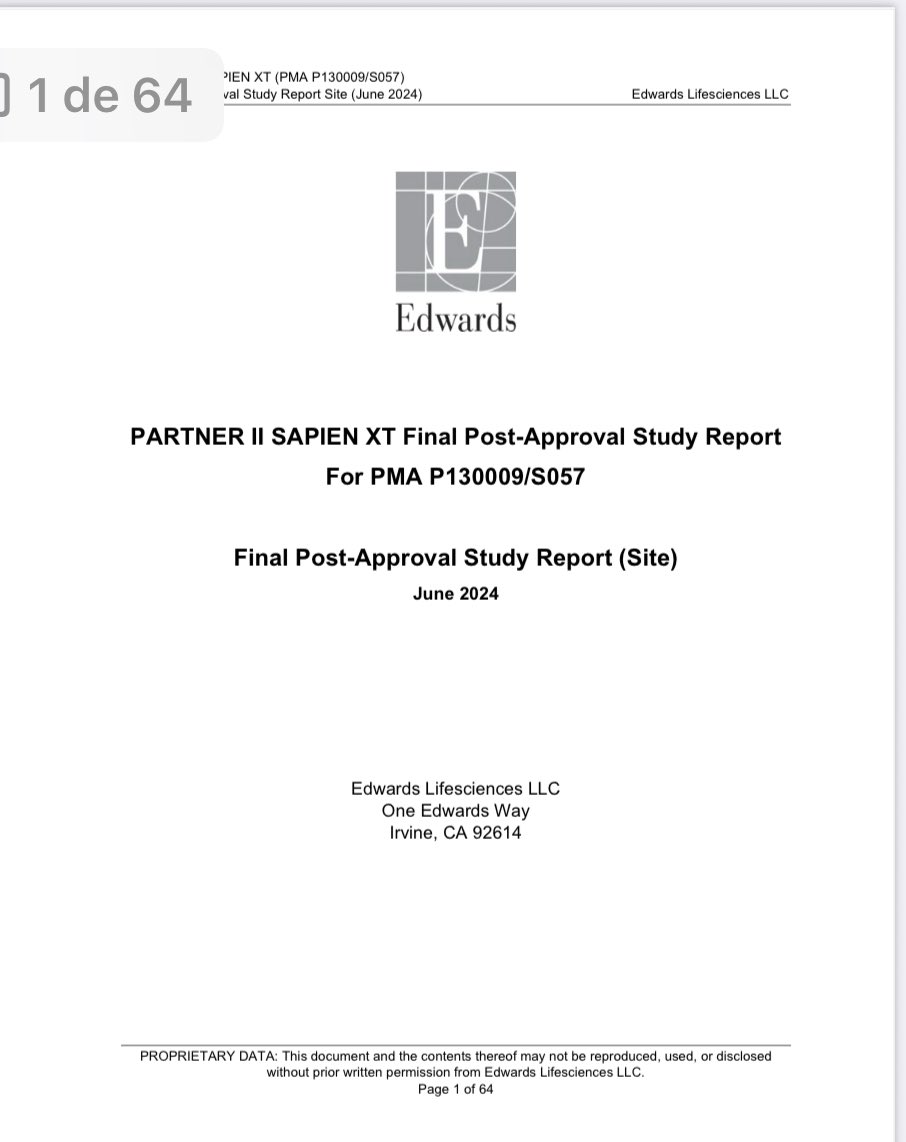
🚑BREAKING NEWS. This is massive. 10 year PARTNER 2 data has been released by the company. No statistical analyses were performed. But I performed them and these is what happened at 10 years. @pomyers@rafasadaba@STS_CTsurgery@EACTS