@SenecaSpeaks21 They don’t just encourage it, they love it…when people are doing well and thriving, their platform isn’t relevant. Squalor and blight are their currency.
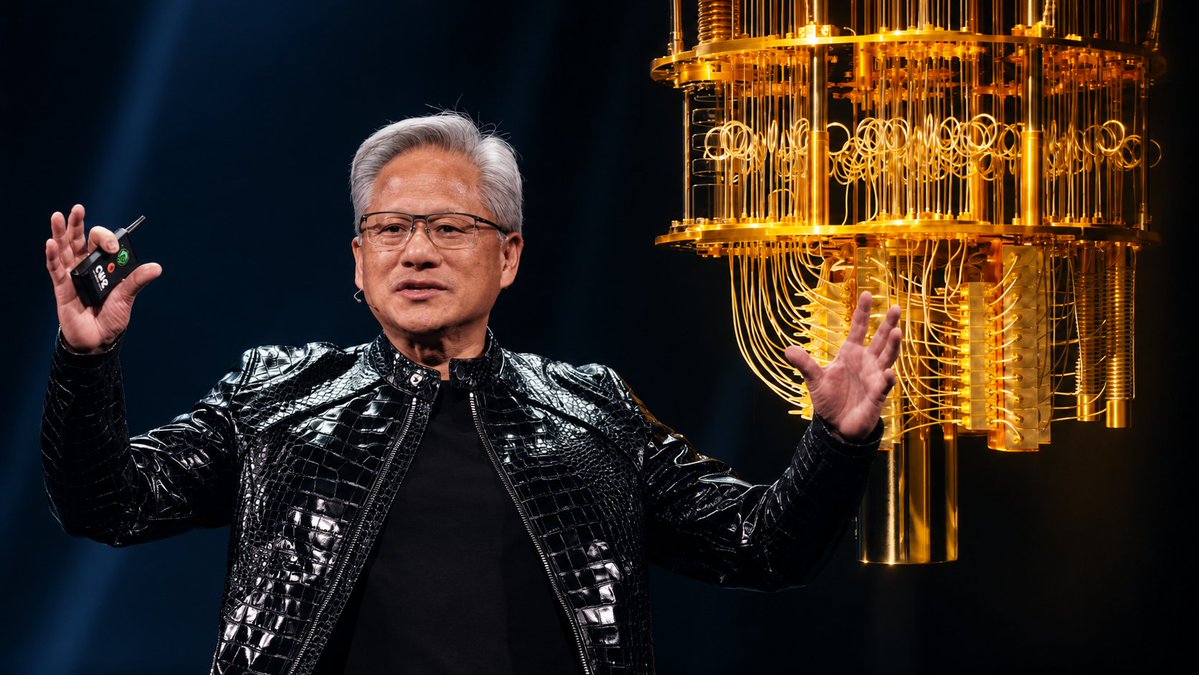
NVIDIA JUST TOLD YOU WHERE TO INVEST NEXT.
QUANTUM IS THEIR FOCUS.
This morning Nvidia committed $1 billion to US science. Three priorities including, Quantum Computing, healthcare and energy.
Nvidia doesn’t build quantum computers, it built NVQLink, the plug that connects a quantum processor to Nvidia GPUs. Every quantum computer that wants to run error correction at speed goes through it.
Here's who to watch:
$IONQ: Trapped ions, named a DARPA finalist this week.
$INFQ: Neutral atoms, sqale processor runs on NVQLink.
$QNT. Quantinuum, runs its error correction decoder on Nvidia chips.
Last January Jensen said quantum was 15 to 30 years out and the whole sector crashed. Today he’s funding it with the White House.
Follow the money.
$INFQ $IONQ $QNT
For manufacturers, a production schedule that works is not always a schedule that makes the best use of time, equipment, and capacity. As product variants and operating constraints multiply, getting a high-quality answer quickly becomes harder.
D-Wave’s new article in @ManufacturingDive explores how quantum optimization can help teams revisit those trade-offs without replacing their existing planning systems. It looks at @fordotosan's production deployment and a @BASF proof of concept to show what faster scheduling can mean in practice.
Read the article to see why yesterday’s “good enough” plan may deserve another look: https://t.co/MhO8IUAI4B
#QuantumOptimization #QuantumComputing #ProductionPlanning
Quantum computing is emerging as an important national security capability. With commercial-grade annealing solutions available today, D-Wave is working with customers on a variety of applications that can improve mission objectives across logistics, emergency response, and national defense. Our work with @anduriltech and Davidson Technologies on U.S. air and missile defense produced solutions at least 10 times faster than classical-only methods while improving threat mitigation by 9% to 12%. The opportunity is clear: faster, better decisions when the stakes are highest. $QBTS #quantumcomputing
.@FloridaAtlantic is one of the nation’s fastest-rising public research universities, and its ambition in quantum shows why. Today FAU announced a $200,000 @NIST award to establish a regional quantum cybersecurity workforce ecosystem with D-Wave and a coalition of education, industry and government partners. The initiative builds on FAU’s move to become the first university in Florida to publicly host a D-Wave Advantage2™ quantum system. We’re proud to partner with FAU as it builds Florida’s quantum future. $QBTS #quantumcomputing
https://t.co/itZdlhUGIa
Arrest records are deliberately and purposefully manipulated in sanctuary jurisdictions to misrepresent crime statistics. The left wants to be able to say that “caucasians” and US citizens commit the most crimes. It's all sleight of hand. We need more data analysis like this.
Recent industry reports have highlighted the need for real-time decoding to achieve fault-tolerant quantum computing. It is essential, but the real differentiator is architecture. D-Wave’s dual-rail qubits detect dominant photon-loss errors in hardware and identify where they occurred, reducing the resources required to correct them. Our peer-reviewed @Nature paper demonstrated a fast, ~99.9%-fidelity two-qubit gate that preserves this error hierarchy, validating our architecture as a scalable foundation for commercial fault tolerance. Correct first, then scale. $QBTS #quantumcomputing
https://t.co/TNRsZcl1iz
.@Google’s Project Suncatcher proposes moving AI compute into orbit to address growing energy demands. But the answer isn’t only where compute runs. It’s how efficiently it runs. Quantum can complement AI by taking on optimization and emerging machine-learning workloads that classical systems may handle inefficiently. The potential is significant. In a materials simulation, D-Wave’s Advantage2 system solved in minutes a problem that would have taken the Frontier classical supercomputer nearly one million years and consumed more electricity than the world uses in a year. The future of AI infrastructure is hybrid: CPUs, GPUs and QPUs working together. #quantumcomputing #AI $QBTS #ProjectSuncatcher
https://t.co/6JeITw8G5t
A physicist loads film into a camera with no lens, and the developed sheet comes out completely blank. Cut it into pieces, and every fragment still holds the entire image.
That's a hologram. It has almost nothing in common with a photograph, except that both use film.
To understand it, you have to start with water.
Drop 2 sources of waves into a tank. Where crest meets crest, the water heaves higher. Where crest meets trough, the motion cancels to nothing. If the 2 sources have the same frequency and amplitude, these zones of motion and calm lock into a fixed pattern. Do the same with 2 speakers playing an identical pure tone, and a microphone moving through the room finds the same thing in sound: bands of loud and bands of silence, hanging in the air.
Light is a wave too. So when 2 beams of light cross, they should paint bands of light and dark.
They don't.
An ordinary bulb throws out many wavelengths at once, none of them in step. Even passed through a red filter, the light is too messy to interfere visibly.
Then came the laser: light so pure and so monochromatic that it finally behaves like the water in the tank.
Split a laser beam in 2. Where the beams cross, place a film in a holder with no lens. Develop it, and it looks blank. Now remove 1 of the beams and shine the other through the film. The missing beam comes back. The film has rebuilt it from nothing but a recorded pattern.
Under a microscope, that pattern is a forest of microscopic layers inside the emulsion, acting like a stack of tiny, partially silvered mirrors.
Now replace the second beam with a car. Every point on its surface reflects laser light, and each reflection interferes with a clean reference beam aimed straight at the film. The table must be absolutely still. The exposure lasts about 10 seconds, and the slightest vibration smears the pattern and ruins everything.
Under magnification, the developed film shows swirls that look nothing like a car.
But shine the reference beam through it, and the car is there again. Fully 3-dimensional. Each tiny pattern reconstructs its own point of light, and together they rebuild the whole object.
Some holograms can be seen in ordinary white light. Inside them, the mirror layers are spaced to reinforce only 1 wavelength. Red laser light made the image, yet it glows green, because the film shrinks during processing and squeezes the layers closer together.
The strangeness keeps going. 1 film can store 2 separate scenes, and you switch channels by tilting it. A lens recorded inside a hologram still focuses light. Laid over the real object, a hologram reveals what no eye can see: a single tap of a finger visibly bending solid steel, and the invisible shimmer of heat rising from a surface.
When this film was made, holography stood roughly where photography stood 100 years earlier.
A photograph remembers how light fell on a thing.
A hologram remembers the light itself.
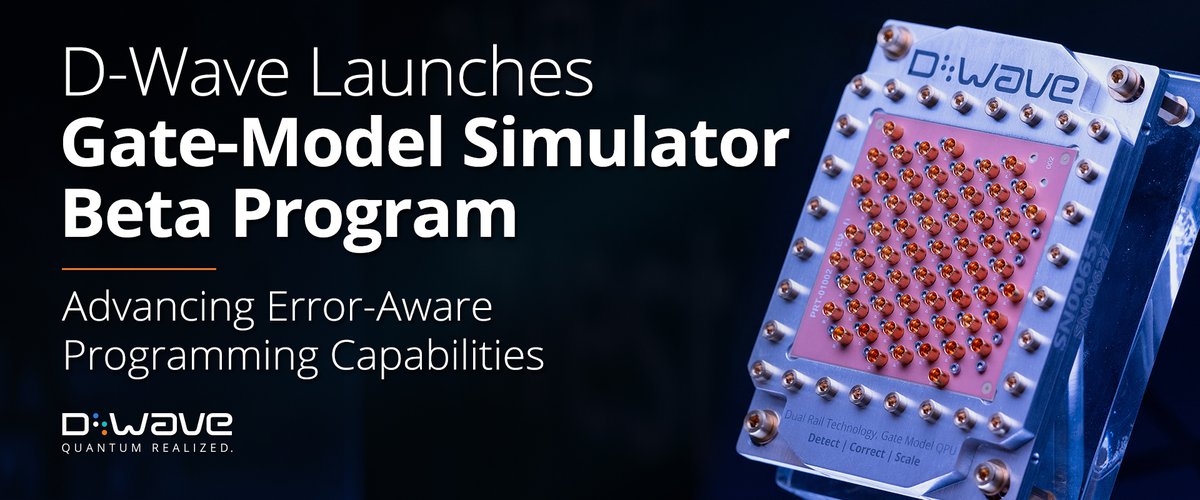
Today, D-Wave announced the launch of its gate-model quantum computing simulator beta program, marking an important milestone in our gate-model development roadmap.
The beta program offers select customers early access to the simulator in advance of its general availability to experiment with error-aware programming and develop quantum applications in preparation for D-Wave’s forthcoming gate-model systems.
Beta participants include the following commercial and research organizations: @BBVA, FirstQFM, @FloridaAtlantic, and @fzj_jsc.
Learn more: https://t.co/Q9sfpjwRqZ
#QuantumComputing #QuantumErrorCorrection
Two people were injured Tuesday night when a Regional Transportation District bus collided with a car on East Colfax Avenue, two days after the street’s center bus rapid-transit lanes opened. It is the first crash involving a bus using those lanes. https://t.co/W5vy7HsxHq
In a new QuantumJane interview with @LeeJane71, @Intel CEO Lip-Bu Tan said quantum computing could become 10 times bigger than AI and called it a race to see who leads. I agree on the magnitude of the opportunity. Where I disagree is Intel’s focus on spin qubits. Superconducting technology has a more mature engineering foundation, enabling fast, high-fidelity operations and sophisticated control. Our dual-rail qubits combine superconducting speed with the high fidelity typically associated with neutral-atom and trapped-ion systems. I believe that combination puts D-Wave in the driver’s seat. $QBTS #quantumcomputing