@Bozenka_2023 My daughter is thinking about going to @StPaulsLondon on her 21st. She’s never been & thought it would be a cool & memorable thing to do.
She’s a student with only min loan (topped up with my overtime) working part time and paying tax - £24
If she did nothing it would be £1🤷🏼♀️
There's just not going to be anything in this Budget for Hospitality is there? Yet again. You cannot have growth if businesses are closing at the rate of 4 a day. And the Treasury makes zero VAT on a closed restaurant/hotel with a list of redundant staff. #VATsTheProblem.
why do grandmas always insist on being called something cutesy like “gigi” or “bunny” when they could instead instill fear with a name like “blade” or “night fury” or “The Reaper”
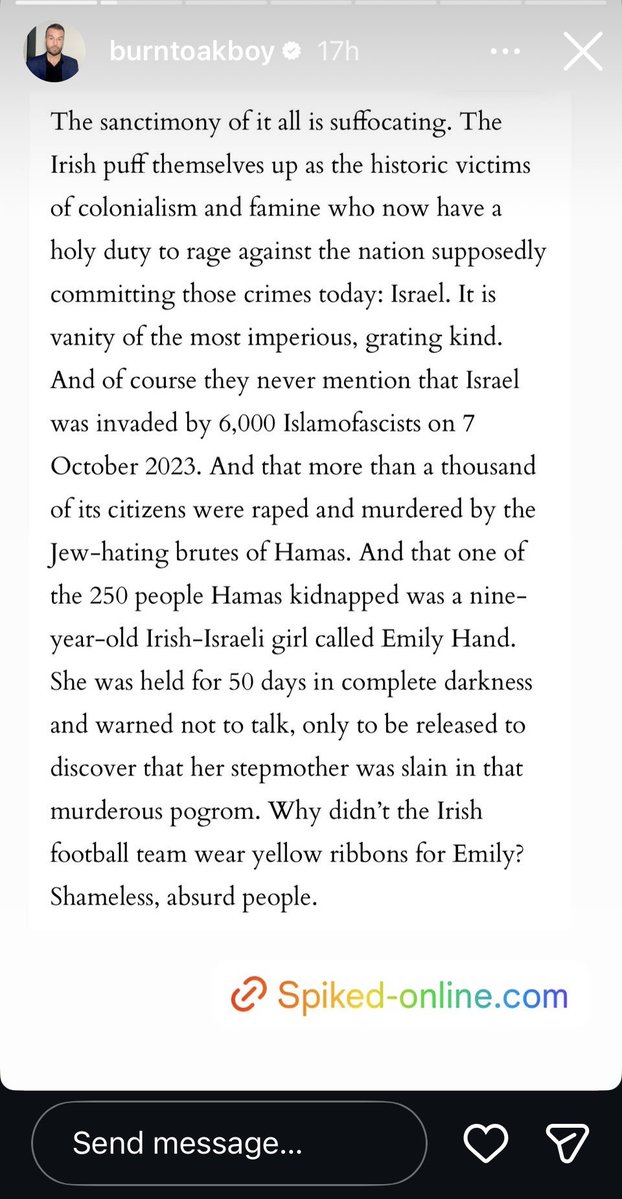
The regime that slaughtered tens of thousands of innocent Iranians and which persecutes ethnic and religious minorities is now supporting the Irish football team ... for reasons
I remember Russell Lloyd-Moyle, former Brighton MP, telling the House of Commons that we should teach children how to strangle themselves safely for sexual pleasure. His cousin had sadly killed himself accidentally by auto-asphyxia, aged 15.
Just because men enjoy a sexual practice doesn’t mean that we should all get behind it and teach it to children. We can talk about the risks, and then say no. No is a full sentence and is what children need to hear. As with injecting heroin, or speeding the wrong way along a motorway without a seat belt, there is no safe way to do it. It kills you or damages your brain, causes anoxia or stroke, and clots from torn carotid arteries, and the answer is no. No. Reassuring children that you can get away with it by getting good at it is setting them up for an adrenaline-chasing compulsion, and to ever-riskier execution of it.
Young women, girls, even, are getting dragged into unbelievably risky acts for the pleasure of boys and men. There is no pleasure for women in anal sex or strangulation, except in extreme BDSM, and they cause life-changing disability. Women’s skin is more likely to tear or give way under trauma, and men now fetishise anal prolapse, which they call “rose budding.” What is that like to live with permanently? And permanent faecal incontinence in your twenties? Strangulation is now the second leading cause of stroke in young women - this means permanent brain damage, and a higher risk of future strokes and seizures over time. This is a wicked burden for young women to bear in the service of male sexuality.
If these practices were pleasurable to women, lesbians would be already doing them. They aren’t.
Meanwhile, Gen X couples are celebrating 30+ years together because he once drunkenly said 'You've got great tits - fancy a snog?' and she said, 'let me finish me fag first' at some shit nightclub in Doncaster in 1992.
Imagine for a minute a father so weak and pathetic that he would sacrifice his own daughters privacy and fairness im sport and allow strange men in her changing room just so he can virtue signal to strangers on the internet.
The ruminant family, and the one job each member does that nothing else can:
Cattle: turn a wet hillside into milk and beef, and build the soil while they stand on it
Sheep: grow a fireproof, compostable fibre every year on grass and rain
Goats: eat the scrub, bramble and invasive weed that chokes everything else out
Water buffalo: make the milk that becomes real mozzarella, on marshland a cow would sink in
Yak: live and give milk at altitudes that would kill any lowland animal
Reindeer: feed and clothe whole peoples above the Arctic Circle, on lichen and moss
Bison: engineer an entire prairie ecosystem simply by grazing across it
Seven animals, one gift each, none of them replaceable by a machine or a crop.
Every one of them classed, this decade, as a liability.
The fact that some parents mistreat their children in creatively horrible ways - perhaps because they truly think it's the right thing to do, given the ridiculous social narratives they've fallen for - is not a reason to run a medical trial of chemical castration of minors
The BBC did this too: wrote a headline to suggest a sensitive prude over-reacted to an admirer. "Asked for a kiss" sounds like an optimistic romantic. In fact he grabbed her hair, virtually sat on her and frightened her. Why are the media so ok with crimes against women? 🤔
Foucault, Derrida, Deleuze. Trois intellectuels qui, dans les années 60, pondent des livres illisibles au fond d'amphis parisiens. Aucun n'a jamais tenu une arme. Aucun n'a jamais entendu parler de Southampton.
Et pourtant, soixante ans plus tard, c'est leur idée qui tient la main qui menotte Henry Nowak, 18 ans, pendant qu'il se vide de son sang.
Comment passe-t-on de l'un à l'autre? Il n'y a pas de hasard. Il y a une ligne droite. Je vais vous la dérouler, maillon par maillon.
Premier maillon. Ces philosophes lâchent une idée d'apparence inoffensive: la vérité ne serait jamais neutre, ce serait toujours une construction du pouvoir. Donc on pourrait, et on devrait, se méfier des faits eux-mêmes. Ils n'ont pas voulu ce qui allait suivre. Mais ils ont armé un mécanisme: le soupçon généralisé envers le réel.
Deuxième maillon. Cette idée traverse l'Atlantique et mute dans les universités américaines. Elle rencontre une impulsion noble, la repentance, reconnaître des injustices historiques réelles. Et elle la transforme en tout autre chose: une hiérarchie morale permanente. Des groupes classés selon leur degré supposé de victimité. Oppresseurs d'un côté, opprimés de l'autre. Pour toujours.
Troisième maillon, et c'est là que tout bascule. Une fois qu'on classe les gens par groupe, on cesse de les juger par leurs actes. On les juge par leur catégorie. La crédibilité n'est plus méritée, elle est assignée d'avance.
Quatrième maillon. Black Lives Matter en fut l'apogée liturgique. « I can't breathe » devient une formule sacrée. La règle implicite: croire d'office la victime désignée, soupçonner d'office l'oppresseur désigné. Avant les faits. À la place des faits.
Comprenez bien ce qu'on installe là. Pas une opinion. Un réflexe. Un automatisme cognitif gravé dans des institutions entières: l'accusation venue de la « bonne » catégorie l'emporte sur ce que vous voyez de vos propres yeux.
Et un réflexe, on sait ce que ça fait à des hommes ordinaires.
Je me suis longtemps passionné pour la psychologie, et une période m'obsède: l'après-guerre. Le moment où des chercheurs se sont posé la question la plus dérangeante du siècle. Comment l'Allemagne nazie avait-elle transformé des pères de famille ordinaires en bourreaux de camp?
La réponse, ils ne l'ont pas trouvée chez des monstres. Ils l'ont trouvée chez des hommes parfaitement banals.
Hannah Arendt a appelé ça la banalité du mal. L'historien Christopher Browning, en étudiant le bataillon de réserve 101 (des policiers d'âge mûr, des pères, des commerçants), a montré que ce ne sont pas des fanatiques qui ont fusillé des civils, mais des hommes normaux incapables de désobéir au cadre dominant.
Puis vint Milgram. À Yale, environ deux tiers de gens ordinaires ont infligé ce qu'ils croyaient être des décharges mortelles, simplement parce qu'une autorité le leur ordonnait. L'expérience de la prison de Stanford a montré la même chose sous un autre angle: donnez à quelqu'un un rôle et un cadre, et il s'y conformera jusqu'à l'inhumain.
La leçon n'est pas allemande. Elle est humaine. Le mécanisme s'active dès qu'un cadre moral dominant fait craindre la sanction sociale plus que ne compte le témoignage de ses propres yeux. L'individu cesse de voir ce qu'il voit. Il voit ce que le cadre l'autorise à voir.
Maintenant, rejouez la scène de Southampton au ralenti.
Henry Nowak, 18 ans, poignardé, allongé au sol, répète aux policiers « j'ai été poignardé », « je ne peux plus respirer ».
Réponse de l'officier: « I don't think you have, mate. »
Pendant ce temps, son meurtrier retourne la situation d'une phrase: il aurait été victime d'une agression raciste, on lui aurait arraché son turban. L'officier n'a pas vu Henry. Il a vu deux catégories. D'un côté, un homme qui dégaine le script de l'agression raciste, crédible par défaut. De l'autre, un jeune homme blanc à terre, sans grief à brandir, sans formule sacrée à réciter, suspect par défaut.
Le cadre a choisi à sa place. Il n'a même pas eu à réfléchir. C'est ça, le conditionnement: la pensée a déjà eu lieu, avant lui. Exactement le mécanisme de Milgram, de Browning. Un homme normal qui cesse de croire ses propres yeux parce qu'un cadre moral lui a appris ce qu'il devait craindre.
René Girard avait tout décrit. Le coupable détourne sa faute en désignant un bouc émissaire, et le système l'accepte d'autant plus volontiers qu'il colle au rôle attendu. Henry n'a pas été cru parce qu'il ne pouvait pas jouer la victime. Sa catégorie le lui interdisait.
Souvenez-vous. Le monde entier s'est agenouillé pour quatre mots, « I can't breathe ». Des entreprises, des gouvernements, des stades entiers. Henry a prononcé exactement les mêmes mots, en train de mourir. Il n'y aura ni genou à terre, ni hashtag, ni minute de silence. Parce que sa mort ne sert pas le cadre. Elle le contredit.
Voilà l'inversion finale, et la plus monstrueuse. Une idéologie née en promettant de protéger les vulnérables a fini par apprendre à des hommes à ignorer la personne la plus vulnérable de la pièce, celle qui agonise, parce que sa catégorie n'était pas la bonne.
Et le vrai piège, c'est de croire que l'erreur aurait été de choisir le mauvais camp. Non. L'erreur, c'est de choisir des camps. De voir des catégories là où il y a un être humain qui saigne devant soi.
De Foucault à Southampton, voilà la ligne droite. Soixante ans pour qu'une idée abstraite apprenne à un homme à ne plus voir un enfant mourir sous ses yeux.
Henry Nowak n'avait rien demandé. Il demandait juste qu'on le voie.
Personne ne l'a vu.
Pride Month might be of use in a place like Iran or Palestine, where gay people are actually discriminated against and persecuted (in serious danger, in fact), but in North America, it's just an opportunity for boring progressives to pretend like they stand for something.
Progressives would never take a stand against or in defense of something that might put them at risk— socially, financially, physically, or otherwise. They are the biggest cowards on the planet, but constantly larp as people fighting the power.
In fact, you are doing exactly what "the power" wants you to do. You are regurgitating propaganda fed to you by corporations, the mainstream media, and well-funded political organizations.
You support whatever you are told to support. You say whatever is the easiest, most popular, most acceptable thing to say. Every position you have is the most celebrated one.
It isn't brave to shout "Free Palestine," or "Transwomen are women," or "Fuck ICE," or "Globalize the Intifada," or "No Kings." You aren't "resisting" anything. You are the cogs in the machine. You are working for the man. You are the fools.
Woke message fiction may be slowly dying, but stories won't magically get better when it's dead.
Because there's a deeper problem.
I found it in a book I'll call "MillenialQuest". That wasn't its real name, of course. I'm not trying to dunk on some poor soul just for writing a bad book. If I did that, I'd never be stopping.
It was some medieval fantasy thing with a rather likely premise involving a fallen paladin and an army of steampunk centaurs.
But when I opened it up, I quickly realized that every single character, despite living in a world where "horse" was the peak of transportation technology, was a Joss Whedon character wearing a Tolkien skinsuit.
Complete with sarcasm, cutesy little quips, and no emotional self-control whatsoever. Didn't matter if the character was a professional assassin or a cloistered scholar, he talked, acted, and thought as if he were auditioning for a episode of Buffy the Vampire Slayer.
My first impulse was to be annoyed with the author for disappointing me. But I quickly realized that the problem ran deeper, and the author, annoying as her habits were, was both symptom and victim of a deeper malaise.
The primary skill of an author is empathy.
Now, I don't mean the "empathy" that socialist twats are constantly talking up, in lectures about how we must all immediately dismantle Western civilization to create infinity third world biomass.
I mean the actual skill of figuring out what other people are thinking and feeling.
To excel at his craft, an author must empathize in two directions at once. Not alternately, but simultaneously. He must empathize with the audience to understand how they will experience what he writes, and he must empathize with characters, to understand how they see the world, and what they would do and say.
Empathy must be learned. And it can be learned in two ways, either by having lots of conversations with people who are as different from you as possible, or by reading books with characters who are also totally unlike you.
Well, we've now raised several entire generations who cannot withstand the stress of a real conversation with someone from their own nation who happened to vote for the other idiot on a two-option menu.
And what have those people been watching, listening to, and reading?
Well, Whedonized stories wherein every character is a reskinned version of a white, middle class, left-leaning liberal arts student in a small East Coast private college.
The author of MillenialQuest didn't set out to write The Message™. Nobody was a purple-haired mixed-race fat wheelchair lesbian, and there weren't any thinly veiled rants about capitalism or diversity.
Sure, the word "misogynist" was used a bunch, without any apparent awareness of the confused look of incomprehension that your standard medieval knight would respond with.
But so was the word "allergies". And "expense account". And "psychology". And "self-medication".
No, the core pathology here wasn't the irrepressible urge to preach the author's values at all.
It was a complete lack of ability to put her head into someone else's world view.
To the new breed of author, the 21st century liberal zeitgeist isn't just the only moral viewpoint, it's the only imaginable viewpoint.
This is why they think you are evil and crazy if you voted for the other guy. Because they literally have no idea what might have motivated you to do that.
The author of MillenialQuest couldn't imagine a world where differing responsibilities for men and women are a necessity for survival, rather than a cause for complaint.
She couldn't imagine how the concept of an expense account would be expressed in a world where peak financial technology is pounding your shiny metal into discs with faces on them.
Emily Wilson can't understand a woman who would be ashamed of cheating on her husband, or men who would start a war over an insult.
Yes, often it's deliberate. Often it's preaching, or venting their own desire to debate with someone whose response they cannot hear.
But the point is, even if and when they are forced, by threat of major film studio bankruptcy, to stop deliberately trying to preach and propagandize, they won't magically gain the ability to write characters different from themselves.
Empathy is a skill. It has to be learned and then practiced. And most people in the writing game today simply haven't had the opportunity.
We may be exiting the age of DEI slop, but we are entering the age of just plain slop.
"Look back in courage" the judge tells the girls - including one who had told the court she wanted to die.
No. When these girls look back, they’ll remember the pain. The violence. The terror. The humiliation. The sound of their rapists laughing while their lives were destroyed.
And playing behind it all like a sickening backing track: a judge delivering sympathy and praise to their vile attackers - before watching them walk free out of court.
If there was one thing that could have offered the smallest fraction of "comfort" to these girls - it was justice. And there was none here.