@Mpolymer lol. The first time I went to volunteer with a peacekeeping group in North Florida, my wife had to explain to her activist friends that I wasn’t a fed or a cop. Changed my attire the next time.
@Robertwaldeck@AnalyticaCamil1 Bingo. I’ve spent most of my career in government service, both as a civil servant and industry. Anything that isn’t on contract is done at risk. Intermingling personal ethical lapses with billions of financial risk is insane and defending that is beyond me.
The last couple weeks have been useful for determining which of our business and tech elites see the world in dollar signs and which possess a moral compass and a sense of duty to something greater than themselves
I’ve spent most of my career working on space exploration, but I had crucial formative years working on national security. That experience taught me the hazards of thinking that what you do is more important than anything else. If this is at all true, tech world needs perspective
I've never known the tech world to be more unanimous about anything than they are about Jensen Huang. Everyone in tech thinks the board made a huge mistake. Except the board. But they are not in tech.
And yet Putin is absolutely, categorically no “evil genius,” no great historical figure of the sinister kind, no creator of any ideas or ideologies.
He is the most ordinary, nondescript bureaucrat, first from the KGB, then from the St. Petersburg mayor’s office, who spent most of his life as a nobody, obediently carrying briefcases for the right people in suits.
He is a typical Soviet bureaucrat of the Brezhnev-era “stagnation”: poorly educated, with an extremely narrow worldview, appalling taste (just look at the hideous kitsch of his monstrous palaces), thieving, envious, prone to competing with others just like himself in displays of ostentatious luxury, vindictive, petty, resentful, greedy, and susceptible to conspiracy theories.
He never had any political career to speak of, not even the slightest one. He came to power almost by accident, as a protégé, an appointee, and simply a compromise candidate.
He is no loving family man. He created no economic miracle, but came to power on the achievements of the market reforms of the 1990s and amid the colossal torrent of petrodollars that poured into Russia in the 2000s.
With enormous oil wealth at his disposal, over his 27 years in power he has created nothing truly great. Instead, he and his entourage have indulged in absolutely staggering excesses in their dozens of palaces with their aqua discos -- and squandered mind-boggling sums on vanity projects such as the most expensive Olympics in history, accompanied by the biggest doping scandal in history. The entire economic foundation of his rule was the sale of oil and gas.
And that’s without even mentioning the seas and oceans of blood he has spilled over these years, beginning with the “Ryazan sugar” affair and the systematic murders of prominent journalists, activists, and politicians, and culminating, of course, in the most insane, senseless, stupid, and absurd war in human history -- the invasion of Ukraine, in which he has already sacrificed half a million of his own people, literally for the lifeless and unviable ruins of a relatively small stretch of territory in Ukraine’s Donbas, and is prepared to burn all of Russia to the ground just to keep reveling in blood and entertaining himself with the thrill of drawing arrows on maps.
He has built his entire rule on propaganda of hatred on an enormous scale, stupidity, revanchism, chauvinism, monstrously brazen and shameless lies, a cult of death, territorial conquest, an imaginary past, and war against the entire civilized world.
He himself has become completely obsessed with pseudo-historical fantasies and is terrified of the relentless passage of time, desperately trying to hold it back with his cold, dead hand, to make it stand still forever.
And so, being who he is, in his later years he has turned into a perpetually throat-clearing buffoon, spouting semi-incoherent nonsense from podiums, complete with his stupid, sleazy jokes, sadistic little smirks, and ridiculous mannerisms.
One would have to be an extraordinarily narrow-minded person of exceptionally small stature, with a moral compass twisted beyond recognition, to genuinely “admire” a “personality” like Vladimir Putin and his “achievements.”
Ukraine hit the Kerch Bridge with mostly homegrown weapons, and I think it's important to highlight about one important thing Ukraine did for America since 2022, but which has been completely erased by the Trump admin.
Since 2022, Ukraine has used American weapons with such ingenuity, and to such great effect, that it led to an enormous spike in the global sales of American weapons.
That surge was worth literally hundreds of billions of dollars to the American economy.
Then Trump and MAGA came to power.
And instead of leaning into that, fuelling more growth in the US weapons industry, they abandoned Ukraine in favour of forming an alliance with Putin and Russia.
They slowed down or outright shut off weapons deliveries to Ukraine.
They ignored Ukraine's offers of support with drone interceptor systems.
They turned off Starlink for Ukraine.
Ukraine was forced to dramatically escalate its own homegrown weapons industry, building a highly advanced drone interceptor program, a sophisticated cruise missile program, and a long range strike capability to target Russian oil refineries.
America's age old partners looked at the Trump admin's treatment of Ukraine during its most vulnerable moment, and started to reconsider whether it makes sense to buy American weapons.
What's the point of buying weapons systems from a country who holds the power to turn them off?
Countries started to reconsider major programs like the F-35, drones and satellite communications, all the way down to small programs like load carrying systems.
Now there is an evergrowing push across Western countries to build their own homegrown capabilities.
So it's an interesting question.
What will Trump's abandonment of Ukraine actually cost the US weapons industry, and the US economy long term if all these partners decide to focus on building their own programs?
And furthermore, what have the Russians been offering the Trump admin that is so lucrative that they determined this was worth it?
@manpower1955@Mpolymer It is, but we could be helping them win faster and reducing their suffering in the process so they can re-emerge as a free allied democracy sooner. We could do for them what the French did for us and it is to our shame that we have not.
And he’s right. The US criticism is stupid. Also, the US is wildly dysfunctional. The Cheese criticizes the strikes, as he and the Pentagon do essentially nothing for Ukraine….which is an enormous moral stain on the US, considering the previous DoD effort under the former US administration….meanwhile, Ratcliffe and my old crew on Rt 123 actually enable the strikes and is still in the fight (which is awesome, even if the contribution-intel/targeting support- is small). This is not btw some fancy 4D chess. It’s a totally broken foreign policy apparatus. With idiots and Trumpian sycophants in charge. Hegseth is a clown doing pushups and firing anyone not his skin color, and Rubio wearing his many hats is absent dreaming of mojitos in Havana and likely the worst SecState and NSA in our nation’s history…..So I’m glad my old outfit is still helping Ukraine in a small but significant manner, I just wish the enormous power of the DoD could also be put to work. Can Ukraine win, if the US actually provided requisite material? Absolutely. And that is the awful part of the entire equation.
This piece by @benthompson is going viral and for good reason. It's a very well-written historical narrative of why Nvidia is a creature of U.S. strategy, and how the fall of Jensen Huang represents a fundamental break from it. It's wrong, but an important statement on just how most business leaders understand our current context.
The thesis is that "Nvidia was, by the powers that be, considered a defense contractor, and Huang never adjusted." The chip industry, Thompson argues, had from its inception focused on global sales, and not being subject to government control. It was organized by venture capitalists to do so, consistent with a tradition going back hundreds of years. The sharp break to a new model model of competing with China, "pursuing the route of bans and forced compliance, instead of innovation and openness," ends American exceptionalism. That's the argument.
It's wrong, and obviously so. Let me point out that the U.S. didn't set up chip fabs or any infrastructure or transfer technology to the USSR or the Eastern bloc. Why not? Well there was this thing called the Cold War. To argue that bans and forced compliance are new requires overlooking the entire history of the chip industry until 1989!
The chip industry was not created by venture capitalists, it was created, nurtured, and organized at virtually every stage by the U.S. government. It was AT&T that discovered the foundational technology, and military contracts and antitrust cases mandated AT&T share those technologies with U.S. small firms for a small fee. The government then bought from those firms - Motorola and Texas Instruments are the now-famous ones. And the government was the biggest customer for all of the early years, and actively sought to have the customer base widen. The commercialization was not a result of Robert Noyce, but of U.S. policy.
There were also always restrictions, and obvious ones. I mentioned the Cold War. But the transfers of technology were also government choices. You can read Alfred Chandler's The Electronic Century, but there's a reason that most of the keychip supply chain went to countries like Japan, South Korea, the Netherlands, West Germany and Taiwan, who were all under U.S. military protection. There's a reason that the U.S. government created Sematech in the 1980s and threatened import quotas on Japan, and had IBM source memory from Korea. Semiconductors were *always* a strategic industry and were *always* treated as such.
The other point is that the U.S. government has always treated our industries as strategic, and has always used bans and forced compliance as one set of tools to organize our industrial capacity. Alexander Hamilton laid it out his Report on Manufacturers, he did not want the U.S. to be at the mercy of the industrial powerhouse of English, and explicitly sought protection for manufacturing. Thomas Jefferson literally banned U.S. exports. High tariffs were a bulwark of 19th century industrial policy, and that's not even getting into the creation of the 20th century administrative state and very deliberate control over radio technology.
The reasons for all of these controls were exposed during the pandemic, when limited sourcing over everything from chips to personal protective equipment to certain kinds of plastic to baby formula subjected all of us to meaningful risk.
Are "innovation and openness" also part of that toolkit? Of course. But even those words are too flabby to even parse. Take innovation. Our laws until the 1960s made it clear that innovation in immoral devices, like gambling, was not protected by patents. We sought to channel capital into "useful arts and sciences," not *any* arts and sciences. Similarly, "openness" was useful when we needed what other countries provided, but not when it fostered risks. We were open to sending information to the USSR, we were not open to letting them build our space program because they knew how to get a man into space first.
If any American policymaker or business leader prior to the 1980s had looked at Nvidia circa 2026, they would have been horrified and shocked. Ben Thompson just kind of hand waves away how we have put our entire country at risk via the Taiwan strait, or how the whole goal of the company was to coordinate a supply chain outside the control of the U.S. on something that is absolutely vital to the American way of life. We *never* would have allowed anything remotely close to that in previous eras.
Thompson does argue that it was not a good idea to risk the country over Taiwan or send all those factories to China.' But that was the point of Nvidia and the entire chip strategy from the 1990s onward. You can't disentangle the two. Nvidia is the manifestation of the post-Cold War view among U.S. elites suggesting that America would always be the preeminent hyper-power and we could all just focus on getting rich with capital light cream-skimming and then go on our wellness routines.
The only way anyone could see Jensen Huang and Nvidia as a great American and a great American company is if they have an ideologically driven view of U.S. history that airbrushes out how we've always dealt with domestic risk, prosperity, and production. Thompson's argument is important and well-written, because it does reflect the basic lack of understanding pervasive among so many of the talented and insightful people who have learned their trade in modern business.
You can see that in the tension where Thompson does wrestle with the Taiwan problem, or the mass offshoring of factories. But ultimately he doesn't have a compelling way to understand those problems. After all, how are you going to deal with them without "bans and forced compliance"? How would anyone have stopped that mass offshoring without "bans and forced compliance"? If basic tools of statecraft to protect the U.S. people are rendered un-American, the necessary consequence is the risk built up in the Taiwan strait and the offshoring Thompson decries. It is a series of short-term sales of U.S. capacity to foreign entities, something that profits CEOs, consultants and financiers but fosters immense risk. It's not that there's a pecuniary interest among that class, it's just that it's very hard to break with the ideological system that built the success they now have.
I do hope this obituary for Jensen Huang's way of doing business is an actual end of that way of doing business and a return to traditional American statecraft. Or perhaps we are too far coddled by the brief era of American hyperpower to even understand our own traditions that built it. I don't know. Anyway, the piece is worth reading.
@AnalyticaCamil1 How is this not just a cult of personality, no different than the oligarchs in Russia and China that are beyond the law so long as they have the favor of the state?
My love of the James Bond books and films is no secret. I have also made it no secret that I wanted someone like Tom Hiddleston or Idris Elba or Henry Cavill in the role but I recognized that all three were likely too old to start the role.
I was ready to accept a relative newcomer for the role and really wanted Jack Lowden to get the job because his performance in Slow Horses is incredible and I think he'd bring some younger energy to the role while still being subtle spy man.
Then the rumors of Robert Pattinson being the Mystery Actor came along. I didn't really understand that considering he is 40. Hiddleston is 45 and Cavill is 43. That said, the more I thought about it the more I loved it and I moved him to the top of my wish list.
He may be 40 but he has barely aged a day in 15 years. If you told me Robert Pattinson was 30 I'd believe you. Most importantly, he has the physical features of literary Bond and the subtle demeanor that the best Bond performances of the last 64 years had.
I do worry that Amazon is going to squander this the same way Eon squandered Pierce Brosnan and Daniel Craig. Brosnan should have gotten 8 movies and Craig's movies were spaced out so much that by the time he got to his final two films, he looked physically sick of the role. It could have been the god awful writing that made me want to stab my eyes out with a spring loaded shoe blade.
Staying in the role too long has been the top failure mode of the character. When Connery was brought back for Diamonds Are Forever it was just sad. Same for the end of Moore's time, and I'm an unapologetic Roger Moore Bond fan.
My hope is that Amazon will plan to give Pattinson 4-5 films in a 10 year span, then move on. My hope is also that Amazon will dispense with the idea that we need to see James Bond become James Bond. We know who James Bond is. It made sense for Daniel Craig's Bond to soft reboot the franchise. We don't need that now. Throw Pattinson straight into the fire. Give him a From Russia with Love movie right off the bat.
Amazon's production of The Night Manager gives me some hope that they won't hilariously botch this. The Night Manager is stylish and cool and makes beautiful use of locations. If Amazon does that with Bond, we're in good shape.
Robert Pattinson will be the best true actor to ever play the character. They need to lean into that ability and give him some heavy spy stuff, not slide whistles and snake charmers playing the James Bond theme.
Go with god, Robert Pattinson!
I worked at NASA Marshall (Building 4487) when the electrical actuators that would have replaced the hydraulic system were being tested in 1988.
The OMS replacement engines that were LOX/Methane were built and tested, but never integrated. That system would have also replaced the attitude control thrusters on the orbiter.
The goal was to eliminate toxic fuels for the orbiter, which would have slashed the turnaround time by 70% and would have eliminated the troublesome APU's.
Other work to replace large stretches of tiles with thermal blankets were also in play. Some of that work was implemented on Atlantis, the last Shuttle built.
Much of that work was done to the TRL-4-5 level but never carried forward to flight.
The Long Duration Orbiter (LDO) work was also taken pretty far which would have augmented the existing fuel cell system with a LOX/H2 pallet in the cargo bay, along with a solar array. The orbiter could have easily stayed on orbit 30 days with these changes.
Other things that were originally approved for the Shuttle program were cancelled. The Orbital Maneuvering Vehicle (OMV) was 90% completed when congress cancelled it. The OMV would have given the Orbiter the capability to service higher orbits (not to GEO) and given the orbiter tremendous flexibility for in space assembly and operations.
The Orbital Transfer Vehicle (OTV) which would have carried payloads to GEO or lunar trajectories was cancelled. The flight tele robotic servicer was the only survivor, eventually flying as the SPDM on the ISS.
The Orbiter was also supposed to be a platform for the in space assembly of very large spacecraft, a capability that was killed with Challenger.
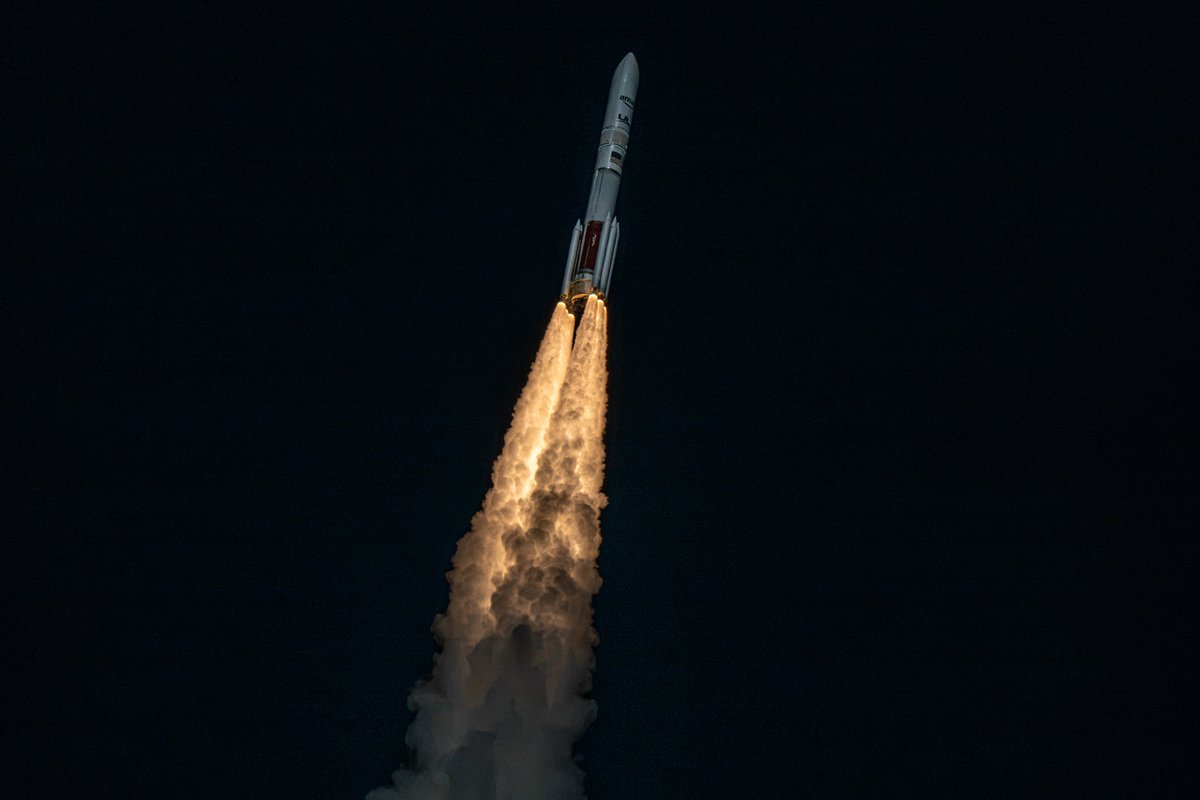
A few thoughts on today's Vulcan anomaly--
My notes below are that of a dispassionate observer, but obviously this sucks. The world is much, much worse off without Vulcan as a launch option.
And the impacts could be much bigger than just "one less rocket", including directly impacting NASA's plan to return astronauts to the Moon.
• It's unclear which stage is the problem - Interestingly it is currently unclear if the problem lies with the LOX/Methane booster and its BE-4 engines, or the LOX/Hydrogen Centaur V upper stage. ULA says the anomaly happened 10 minutes into the flight, after stage separation, but it seems from the broadcast that the booster burn past its planned cutoff, which could mean it was underperforming and had to burn longer to compensate. Which stage is the problem matters for other missions on the books, including NASA's.
• Impacts on Artemis - The Centaur V Upper Stage is what NASA selected for Artemis IV, the mission to return NASA Astronauts to the Moon in 2028. If the Centaur V had serious problems, its unclear what the impacts could be. The good news is NASA has one (and only one!) extra of the old SLS ICPS upper stage built and sitting in storage. NASA is in the rare position of having multiple options for Artemis IV, which is good planning on their part.
• This was first flight of a new Centaur V version - I didn't realize this until I tuned in, but this was the maiden flight of a new "LEO optimized" Centaur V. The changes included trimming the propellant tanks down to a small/shorter size to hold less fuel and, essentially, allow more mass to be used for LEO satellites. Pretty minimal changes all things considered. If the failure occurred as a knock-on effect of these changes, that's good news as it means the Vulcan could return to flight with the standard Centaur V upper stage pretty quickly. If the problem is with something common to all Centaur V upper stages that would be quite bad.
• Hopefully the BE-4 engines are exonerated quickly - Vulcan uses the same engines as Blue Origin's New Glenn. The Blue Origin BE-4 is an extremely impressive piece of engineering-- running an Ox rich staged combustion cycle, same as the legendary RD-180 rocket engine built by the Russians, and has a 100% successful flight track record. I'm very much hoping that continues to be the case here, as an issue would impact not just Vulcan but New Glenn as well.
• The strap on boosters appeared to work flawlessly - good news here. The GEM solid rocket motor was the source of Vulcan's last anomaly. Hopefully that issue is behind us for good.
• The impact to the rest of the industry - Vulcan out of action for another 6 month+ stand down would be bad. The United States needs another launch option and ULA's rockets have historically been the first option for our most important national security space missions, but recently ULA became in high demand by commercial industry as well, at least until Amazon snapped up most of their launch capacity. Disclosure: my company Astranis is not a current customer of ULA, but certainly we are hoping to be one in the future when their launch cadence increases.
• Falcon 9 is needed more than ever - A lot of people in the space industry are hoping SpaceX will ease back on plans to wind down the Falcon 9 and this will turbocharge those pleas. It's no secret that SpaceX has slowed down sales to commercial customers. The Falcon 9 the best rocket ever made (so far), with the best overall track record, highest launch cadence ever achieved and the lowest cost.
Who knows, maybe SpaceX can be convinced to keep flying Falcon 9 a little longer. In the meantime we need Blue Origin, Rocketlab, Relativity Space, Stoke Space, and others to step up and for investors to make sure they have the capital they need to succeed.
Wishing the ULA team a rapid recovery. A lot of great engineers there and I'm sure they are up to the challenge. Ad astra per aspera.
Rubio is supposed to be one of the clever ones. I wonder if he knows that Pompey was not the good guy in this story. He was helping the dictator Sulla crush his Roman opponents and was contemptuous of his victims appeals to law. Sulla was the guy who showed a Roman general could march on the capital and seize power. He published lists of political enemies who could be murdered for a reward. I think I'll keep quoting laws to men with swords.
On Friday, November 13, Starship lifted off from Starbase, Texas on its 15th flight.
On Saturday, November 14, Starship returned to Starbase, Texas, and changed everything → https://t.co/K5XRci6bnw