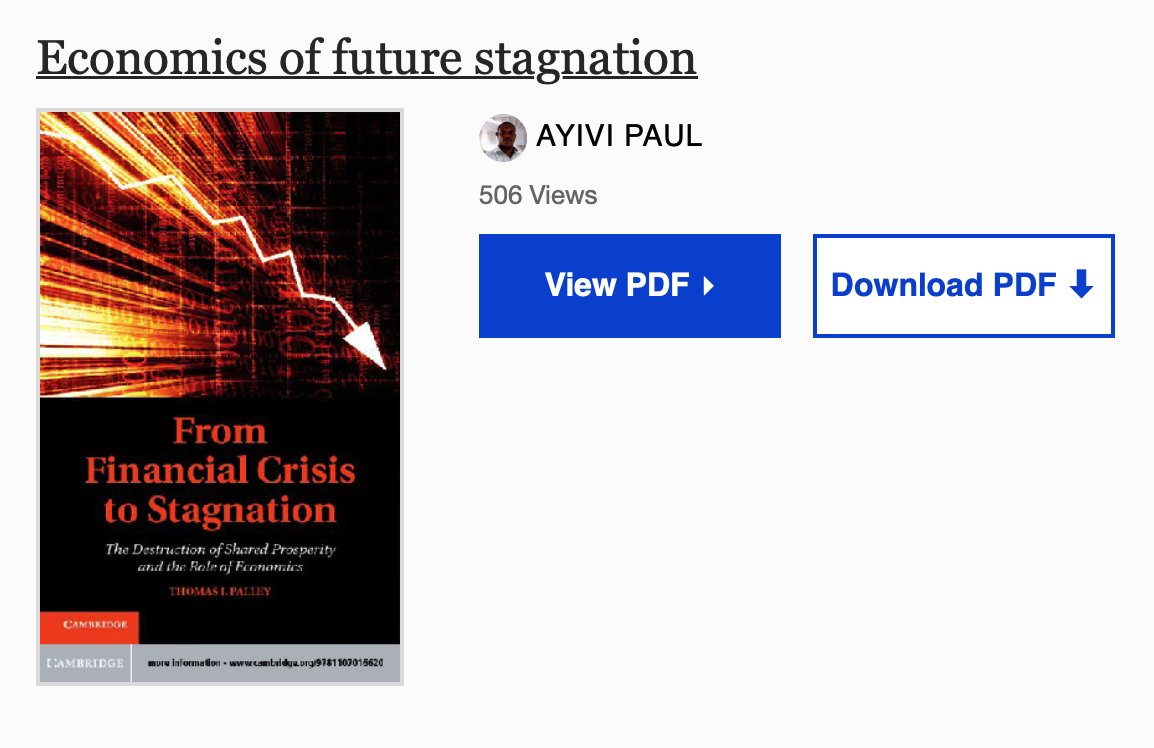
50 years ago high minded people said, forget space, fix the earth. That didn't work. Now its our turn, let us develop the space economy to fix the Earth.
There is a choice before us, this future, or one of prosperity through the economic development of the Moon, Mars, and the asteroid belt.
Choose wisely.
Dystopianism has been baked into the majority of the Intelligentsia since the "Limits to Growth", "Silent Spring", "China syndrome", and the "Population Bomb" came out.
It killed Apollo...
It has stifled all exploration efforts (until now hopefully)
Killed nuclear power.
It is pox-humana..
@PezeshkiCharles All terrestrial Iridium comes from asteroids.
The massive utilization of asteroidal material will create a very large surplus of all PGM's.
A good yet incomplete analysis. Aluminum in 1860 was a currency metal, yet the demand for it increased dramatically with the lower cost.
Here is one area that is overlooked. Using Iridium as sleeves in internal combustion engines. The thermodynamic efficiency of an internal combustion engine is limited by operating temperature. Steel, and especially aluminum require lower operating temperatures. Using iridium sleeves for pistons (and iridium in pistons themselves), allows for a considerably higher operating temperature, thus increasing thermodynamic efficiency and thus gas milage.
Also, for fuel cells. Today we just use Platinum. However, there is solid experimental evidence that a cocktail of multiple PGM's (Platinum, Ruthenium, Rhodium) creates a much higher efficiency for fuel cells, which again translates directly into resources saved.
Stationary steam engines would benefit from cheap iridium as would nuclear reactor steam systems.
Lower catalyst costs for the petroleum
https://t.co/VaLZKMSDGt
@Sabr_Halal Nope
In the Dead Sea scrolls it was found the book of Isaiah. It is the book that most powerfully speaks of Jesus. It was compared to the current version and found to be identical. That is two examples, 2250 years apart.
Sit down.
@Purushottam9983 Slavery has been around for the entirety of human history. It was white, European, Christian men that put an end to it. The only place it thrives today is post colonial Africa.
Just FYI.
Next week, for the first time in human history, a human-made object will reach a distance of one light-day from Earth.
We're inviting the world to celebrate Voyager 1's major milestone with us. https://t.co/0uAIREiUwZ
@AerospaceRom The terrible thing is that these people think that they are "saving the world".
They simply do not understand, nor do they really care to, what the economic development of the solar system does to render their fears moot.
Under the banner of 'saving the planet', a far-reaching political transformation is taking place — and it's happening out of sight.
Behind unelected figureheads like António Guterres (Secretary-General of the United Nations) stands a vast, featureless apparatus: thousands of embedded bureaucrats shaping policy far from public oversight.
The UN has already morphed into one of the largest unelected institutions in world history, absorbing $68 to $74 billion annually. This includes billions for opaque peacekeeping forays and billions more to maintain a global workforce of up to 190,000 personnel — not one of whom pays income tax.
Beyond them lies a vast money-hungry corporate queue waiting to cash in on this forced transition away from dense, dependable power toward intermittent wind and solar. This transition is projected to absorb $275 trillion. The bureaucracy builds the machinery; the market gets the payout.
This is much more than 'overreach' — it's a calculated PR strategy. By exploiting extreme, worst-case climate scenarios, they have created a permanent state of hyper-emergency.
As policy analysts at free-market institutes like Cato have long pointed out, IPCC computer models consistently overestimate actual warming, elevating fringe worst-case projections into accepted policy inevitabilities.
Beneath the cover of this overheated crisis, national sovereignty is being dismantled and local democracy replaced by an unaccountable regime. It's an unprecedented transfer of wealth and political control designed to concentrate power in the hands of a few.
While near-term carbon credit transactions are projected to remain under $10 billion through 2030, the framework is set up to yield a multi-hundred-billion-dollar annual payout by the 2040s.
Guterres and the UN apparatus say these measures are dictated by physical reality. Yet, their remedies all point toward expanded administrative authority and direct global control over world finances.