anthropic just open sourced the tool they use to read what claude is thinking before it says anything 🤯
it's called the jacobian lens (j-lens). they used it to find something they're calling j-space, a small set of internal directions that hold the exact concepts a model is about to talk about, before it writes a single word.
why it works: most interpretability tools make you choose. sparse autoencoders are accurate but expensive to train. the old logit lens is free but turns to noise in early layers. j-lens is one matrix multiply per layer, cheap, and stays readable everywhere.
what you get for $0:
→ a lens that decodes any layer's activity into ranked vocabulary tokens
→ works on any open weights huggingface decoder, examples use qwen
→ a full walkthrough notebook, load model, load or fit lens, render the layer view
→ a live no-setup demo on neuronpedia
what it replaces:
→ training your own sparse autoencoder for every model you want to study
→ guessing what a model "meant" from output alone
how to set it up (2 minutes):
1. pip install -e .
2. load your model and tokenizer with transformers
3. wrap it with jlens.from_hf(hf, tok)
4. apply a pretrained lens or fit your own on ~100 prompts
the honest part: no claude weights or corpora are bundled, this reads open models on your own gpu, not claude directly.
899 stars, apache-2.0, free and open source.
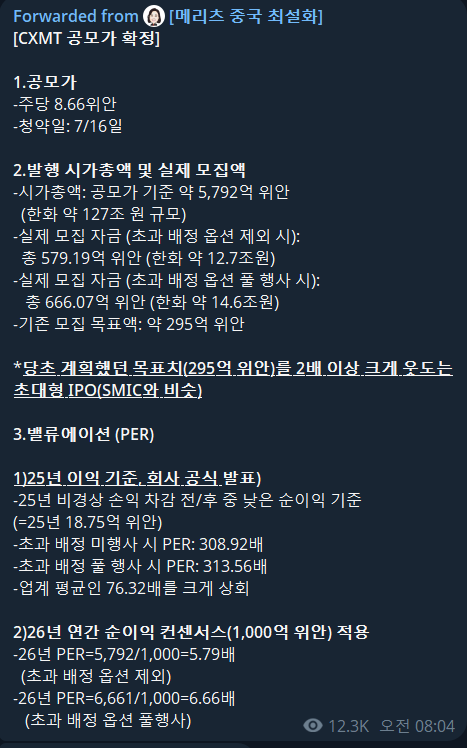
CXMT 공모가 확정
공모가 기준 시총 127조원.
목표 모집액을 2배이상 넘긴 상황
CXMT '26Fwd PER 6.66배
SK하이닉스 '26Fwd PER 6.61배
CXMT가 SK하이닉스보다 비싸네 ㅋㅋ
CXMT는 중국 유일 DRAM 상장사,
마이크론도 미국 유일 DRAM 상장사
한국은 전교 1, 2등이 한 반에 있는 형국.
Extremely excited to announce our first air-to-air kill of a flying moth by an autonomous micro-drone. This is a big step towards completely eradicating mosquitoes.
1-bit Hy3 running locally is 2.2x faster than its API at the same quality!
We gave both models the same task and compared one-shot outputs. 1-bit Hy3 295B GGUF (92GB) ran locally on 4x RTX 5090 with 128GB VRAM against the same Hy3 over cloud API
Tasks:
- Flappy Bird
- Arkanoid
- Snake
Outputs:
Hy3 1-bit local: 76.9K tokens, 15.5 min
Hy3 cloud API: 75.1K tokens, 34.3 min
The 1-bit games look the same as the API ones. Birds fly through the pipes, bricks break, the snake eats and grows. Nothing froze or crashed. Both models even made the same slip: the snake can cross itself and the game does not end. Getting this quality from 1 bit running locally is wild!
Run Hy3 GGUF yourself in Atomic Chat in 2 clicks
OpenAI Build Week 가 진행됩니다.
참가 신청만 해도 $100 상당의 Codex 크레딧이 지급되니 신청해 보세요.
1. https://t.co/sWNVWCkGWu 에 참가 신청
2. Resources 에서 request $100 in Codex credits 신청
3. 7월 17일 오후 12:00 태평양 표준시 까지 신청
(재고 소진 시 종료됨)
@devpost
I switched to GPT-5.6 Sol because it handles the kind of work I actually do: reviewing large technical designs, finding contradictions across documents, and turning vague ideas into practical architectures and implementation plans.
Or… what if we gave you $100 in Codex credits if you tell us what you love about GPT-5.6 Sol or why you switched?
Tweet it, claim your gift, enjoy more usage. First 10k get the free tokens!
https://t.co/8mU93eA13i
Today, we’re announcing Bonsai 27B: the first 27B-class model to run on a phone.
Bonsai 27B is the new multimodal flagship of the Bonsai family. Based on Qwen3.6 27B, it brings a new capability tier to local AI: multi-step reasoning, structured tool use, long-context workflows, and coherent agentic loops.
Until now, models in this class have been impractical to deploy locally. A 27B model occupies roughly 54 GB in 16-bit precision, and even a strong 4-bit build is around 18GB - too large for a phone and for most laptops.
Bonsai 27B changes that.
It comes in two variants:
• Ternary Bonsai 27B: 5.9 GB, 1.71 effective bits per weight, optimized for laptop-class quality.
• 1-bit Bonsai 27B: 3.9 GB, 1.125 effective bits per weight, optimized for phone-class footprint.
Everything is open-sourced today under the Apache 2.0 license.
청소년들은 배재고 야구부의 ‘부적절한 응원’ 에 대해 “논란인 이유 자체를 이해하지 못한다”고 입을 모았습니다. 지적하는 순간 “‘좌X이야? 1찍이야?’ 질문부터 나올 정도”로 혐오 표현은 교실에서 이미 ‘합의에 이른 장난’입니다.
https://t.co/Ifp1rHniEN
Morning. The last 48 hours of Codex and ChatGPT Work have been intense! Three important updates:
- Temporarily removing the 5 hour usage limit restriction for all Plus, Business and Pro plans
- Rolling out changes that will make GPT 5.6 Sol more efficient across the board and that will be reflected in less usage being used so that it can take you further. Exact impact to be quantified and shared
- We hit 6M active users, and are landing a usage reset in the next hour
Go do things
오늘 자 SK 최태원 회장의 블룸버그 인터뷰 내용을 정독했는데,
AI나 반도체 투자하시는 분들은 꼭 보셔야 할 역대급 인사이트가 많네요.
단순히 "HBM 잘 판다" 수준이 아니라 시장의 구조적 변화를 정확히 짚고 있습니다.
중요한 포인트들만 자연스럽게 풀어서 정리해드림.
먼저 SK하이닉스의 미국 ADR 상장 추진 소식.
이게 단순한 주식 거래 확대를 넘어 글로벌 자본을 당기고 미국 현지 탑티어 인재를 영입하기 위한(스톡옵션 활용) 전략적 교두보더라고요.
인터뷰에 나온 265억 달러(약 36조 원)가 거액 같지만,
최 회장은 SK의 전체 투자 스케일에 비하면 "지나치게 큰 수준은 아니다"라며 상당한 자신감을 보였습니다.
기술적으로 가장 소름 돋는 부분은 'KV 캐시(Key-Value Cache)' 수요 폭발을 예측한 점입니다.
과거엔 스마트폰 판매량 같은 '사람 수'에 따라 메모리가 늘어났다면,
이제는 인간이 안 써도 AI 에이전트들이 24시간 작동하며 데이터를 소모하죠.
특히 LLM 추론할 때 이전 문맥을 기억해두는 'KV 캐시' 때문에 메모리 대역폭과 용량 수요가 기하급수적으로 늘어납니다.
우리가 말하는 메모리 병목의 실체를 정확히 짚은 거죠.
지금 공급 부족이 어느 정도냐면,
하이닉스가 향후 5년간 생산 능력을 2배 늘릴 계획인데도 엔비디아나 빅테크 고객사들은 "그걸로 턱없이 부족하니 지금보다 5~6배는 더 달라"고 난리인 상황이랍니다.
HBM은 공정 난이도가 높아서 단기에 늘리기도 어렵고요.
최 회장은 이 쇼티지가 일시적 사이클이 아니라,
AGI(범용 인공지능)가 우리 사회에 완전히 정착할 때까지 장기 지속될 거라 내다봤습니다.
결국 SK의 종착지는 단순 HBM 제조사가 아닙니다.
이 강력한 하드웨어 주도권을 쥐고 AI 데이터센터(AIDC) 인프라, 자체 LLM 개발, 로봇·피지컬 AI, 헬스케어까지 AI 생태계 전반을 다 먹겠다는 'AI 풀스택' 로드맵을 대놓고 드러냈습니다.
판을 정말 크게 짜고 있네요.
마지막으로 요즘 핫한 'AI 거품론'에 대해서는, 일부 주가 과열은 있을지언정 "AI 기술 자체는 현실"이라고 선을 그었습니다.
기술이 발전하면서 토큰 비용(추론 비용)이 계속 낮아질 거고,
결국 전기나 인터넷처럼 누구나 일상적으로 쓰는 대중화 시대가 필연적으로 온다는 논리입니다.
단기 노이즈보다 이 거대한 공급 부족과 생태계 확장 흐름에 집중해야 할 때 같습니다.
-오선의 SAVE-
Upon request, here's an updated version with Grok 4.5 and Meta's Muse Spark 1.1.
Grok 4.5 seems to sit at the Pareto frontier. Good bang for the buck.
(Also added harness info).