Just had one of those "wait… what?" moments in on-chain data.
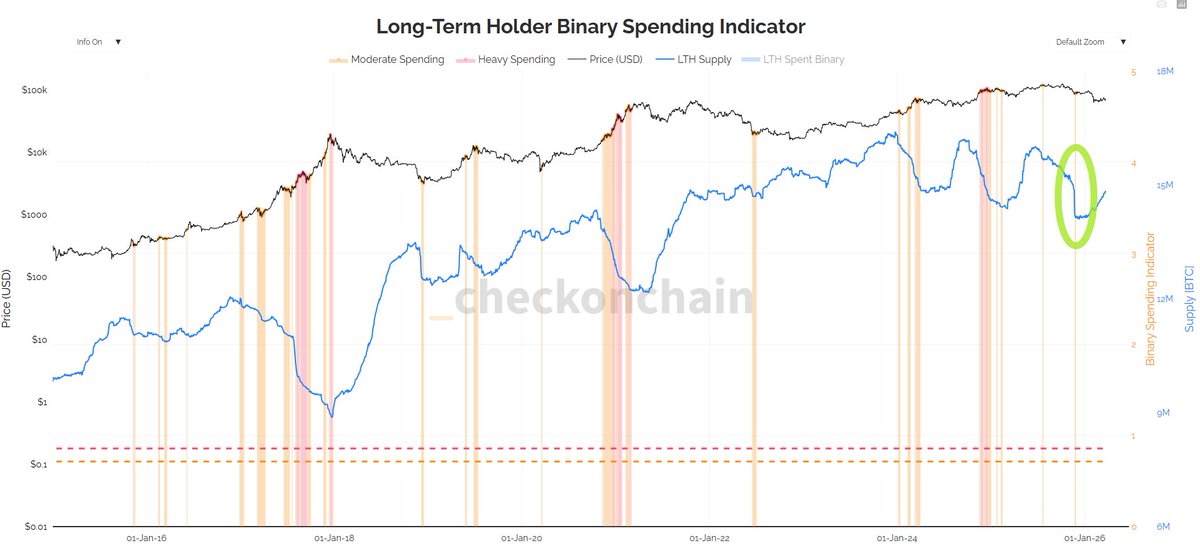
I spotted a massive spike in the 4-5 month HODL wave. Actually one of the biggest in Bitcoin’s history. That sent me straight to the long-term holder supply charts, where it looked like old hands had dumped hard around November 21, 2025. The drop looked brutal.
Then the plot twist hit.
A huge internal wallet migration at Coinbase on November 22 reset the age of those coins on-chain. Multiple sources report it involved nearly 800,000 BTC. It created a completely fake plunge in raw LTH supply. Coinbase’s own announcement is here: https://t.co/FE3tAMOcPL
Public free charts are still showing that distortion months later.
The real story, visible only in proper entity-adjusted data like Glassnode, is very different: true long-term holder supply never actually crashed. It is sitting right underneath an all-time high.
Here’s why this matters.
Because of that internal reshuffle, long-term holder supply is significantly higher than almost all free public data suggests. That means real conviction is much stronger than it appears.
Right now there is really no heat in the market. Even at $71k, holders as a group have far less unrealized profit than they did at similar stages in past cycles. Most coins were bought at higher prices, so there is simply less incentive to sell into strength.
If buying interest picks up again, we actually have a much healthier setup than many would have expected just by looking at the raw long-term holder supply charts.
Charts: https://t.co/uSovY3Va6t
@_Checkmatey_ / @glassnode can you confirm?
Crypto’s "Lost Years" is a Dot-Com Delusion
If you look at the surface of the markets, crypto feels painful. Tech stocks are ripping to all-time highs, while most tokens have spent years trending down only.
To the casual observer, crypto looks dead. But look closer: the value capture is simply shifting away from speculative ghost tokens and pooling into the equities and tokens proving true product-market fit.
We’ve seen this exact movie before. Even the iconic, ultra-successful companies that built the core infrastructure of the internet took a decade or more to recover their dot-com bubble highs. The internet didn't fail. It won. It simply took time for those successful giants to transition from pure hype to fundamental business models.
So, how far out is the breakout this time?
In a world driven by exponential innovation, timelines are heavily compressed. The accumulated energy is building much faster because the infrastructure is already live.
If you want to spot the winners before the vertical breakout happens, stop looking at price charts and start looking for three specific signals:
- Intermediary Elimination: Businesses achieving exceptional profit margins by using blockchain ledgers to completely replace rent-seeking middlemen in financial settlement.
- Performance Parity: Platforms whose speed, liquidity, and execution capability match or exceed traditional finance giants.
- Massive Operational Leverage: Internet-native capital protocols processing unprecedented transactional volume with a fraction of the overhead of incumbent institutions.
The next macro breakout will not be a rising tide that lifts all speculative boats. It will be an aggressive, vertical convergence of capital into the few places creating undeniable utility.
People have forgotten what vertical, exponential energy looks like because they are staring at the disappointing downtrend of the overall market. Do not mistake a brutal structural consolidation for a lack of progress.
The tech is winning. The timeline is compressed. And the value is finally flowing to the teams who actually deserve it.
I have my specific picks for who crosses these three thresholds. Which equities or tokens do you see displaying these signals today?
Stocks are hitting all-time highs while Bitcoin has chopped downward for 9 months. It’s a phase that tests anyone's core thesis.
But while equities rely on opaque earnings reports, Bitcoin's public ledger tells a clear story. 3 independent signals show BTC is structurally primed to follow equities:
🟢 1. Supply Absorption: Supply held by long-term HODLers is at historic highs, while the share held by <1-month hands just hit lifetime lows. The transition from weak hands to conviction buyers is nearly complete.
🟢 2. Seller Exhaustion: Net realized profit/loss across the network has collapsed to late-2023 levels. The market has finished processing its positions. This kind of PnL compression historically marks the late stages of a downturn, not the start.
🟢 3. Capital Floor: Bitcoin’s Realized Cap (the total amount of money put into Bitcoin, valued at what each holder actually paid rather than today's price. Think of it as the total real investment in the asset) is stabilizing and turning up. 75% of this capital is resting with addresses holding 5+ months. This isn't hot money moving on headlines; it’s structural liquidity.
Bitcoin doesn’t need better fundamentals; they’re already baked in. It just needs a macro trigger or institutional announcement to convert this structural readiness into price velocity.
The stock market rewarded patience. The on-chain data suggests Bitcoin is preparing to do the same.
Are you trusting the data here, or questioning the thesis?
@HHorsley@Blockworks@HHorsley@Blockworks any reason Canton is not included yet when we're talking about revenue chains? As per https://t.co/dDGRyEK1PG annualized revenue should be in the $ 700,000,000 ballpark. @CantonNetwork can you confirm?
Iran is testing Bitcoin, in a way it hasn't been tested before.
This week, Iran reportedly began demanding Bitcoin payments from oil tankers seeking safe passage through the Strait of Hormuz. Combined with its existing state-subsidized mining and growing Bitcoin-denominated trade settlement, this represents something new. A sanctioned state is no longer just tolerating Bitcoin. It is conducting state-level economic activity on it.
Most Western coverage is framing this as a problem to be solved. It might be. But it is also the most explicit demonstration to date of a property Bitcoin's design always claimed but rarely had to deliver on at scale: the ability to opt out of a financial system that holds power over you.
That property has been used quietly for years. Argentinians escaping triple-digit inflation. Lebanese savers after their banks froze deposits. Russians and Ukrainians moving capital across a war zone. In each case, ordinary people used Bitcoin for the same reason: their monetary system had failed them and they had no other recourse.
What changes now is that the same property is being used by states themselves. The political question becomes impossible to ignore.
Until recently, most Western governments have been moving toward integrating Bitcoin into the financial system rather than fighting it. The CLARITY Act, the first comprehensive American legal framework for digital assets, is currently progressing through the Senate. Iran's move now forces a harder decision.
One direction is adversarial: deciding that Bitcoin's neutrality is itself the problem and trying to force the network into political alignment. This would put the recent constructive legislative momentum at risk and impose real costs on holders, exchanges, and custodians, because forcing political alignment on a neutral monetary network tends to fracture more than it controls.
The alternative is accepting Bitcoin as a genuinely neutral asset, in roughly the same way gold is. Gold sits in central bank vaults around the world, including in sanctioned countries, and nobody argues that gold's neutrality is the problem. Bitcoin sits in the same conceptual position, but at a level of political acceptance not yet tested.
There is also an outcome almost no one is articulating: Western governments may not be able to force political alignment even if they try. Iran, China, Russia, and others now have their own interests in keeping Bitcoin functional as a neutral network, and enough weight in the system to resist. The very confrontation that looks dangerous becomes the mechanism that preserves the network's foundational property.
This is not comfortable. The same property that protects an Argentinian saver also protects a sanctioned state. Both are real. But the premise of Bitcoin as a neutral monetary network was always going to be tested by exactly this kind of moment.
What governments decide will shape Bitcoin’s future in some form. The answer is no longer theoretical.
How do you think governments should respond, and which response is most likely?
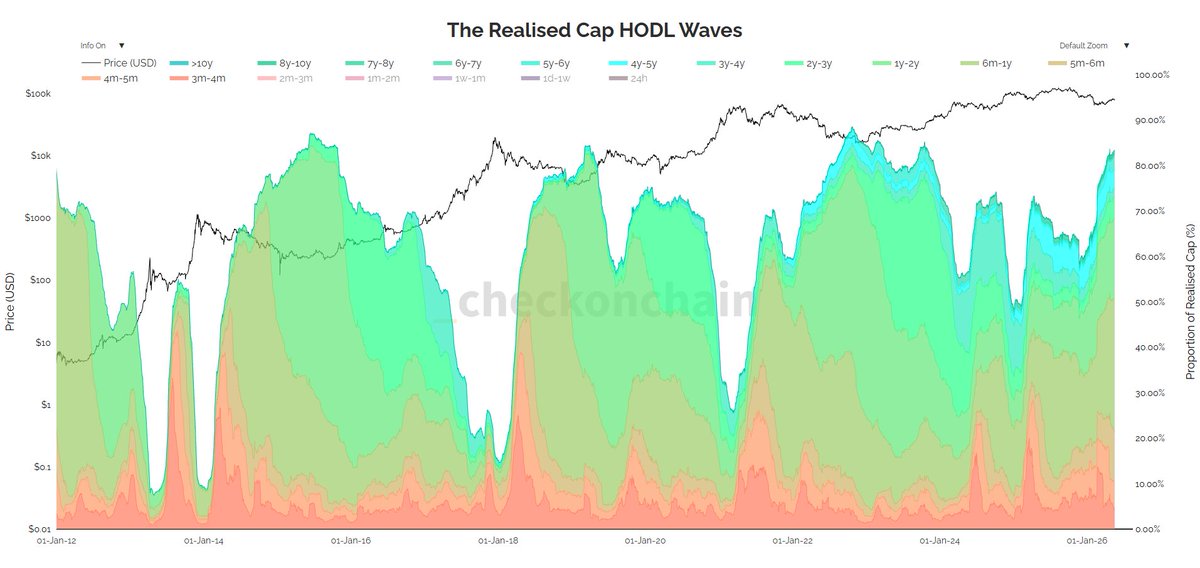
Standard HODL Waves are useful, but Realised Cap HODL Waves are the cleaner signal here, don't you think?
They show the actual dollars invested by each age cohort. Short-term bands have already collapsed (classic capitulation signature), while the realised value is now overwhelmingly concentrated in coins held for 3m+. That pattern marked prior cycle bottoms.
The dollar-weighted picture says the weak hands are mostly gone already.
Chart: @_checkonchain
The Hyperliquid HIP-4 vs Polymarket framing is lazy.
Polymarket is a consumer app. HIP-4 is the binary derivatives primitive that on-chain insurance, synthetic credit, and conditional structured products will get built on. Prediction markets is the smallest use case, not the main one.
@cryptoquant_com@MorenoDV_ could you explain the mechanics underneath it? What on-chain data is tracked as input for the indicator and how is it weighted?
Key events to watch this week:
May 12 — U.S. CPI for April due at 7:30am ET. Est. 3.3% YoY vs prior 3.3%.
May 13 — U.S. PPI for April due. Core PPI est. vs prior 3.8% YoY.
May 14 — Senate Banking Committee markup of the CLARITY Act scheduled.
May 15 — Jerome Powell's term as Fed Chair officially ends.
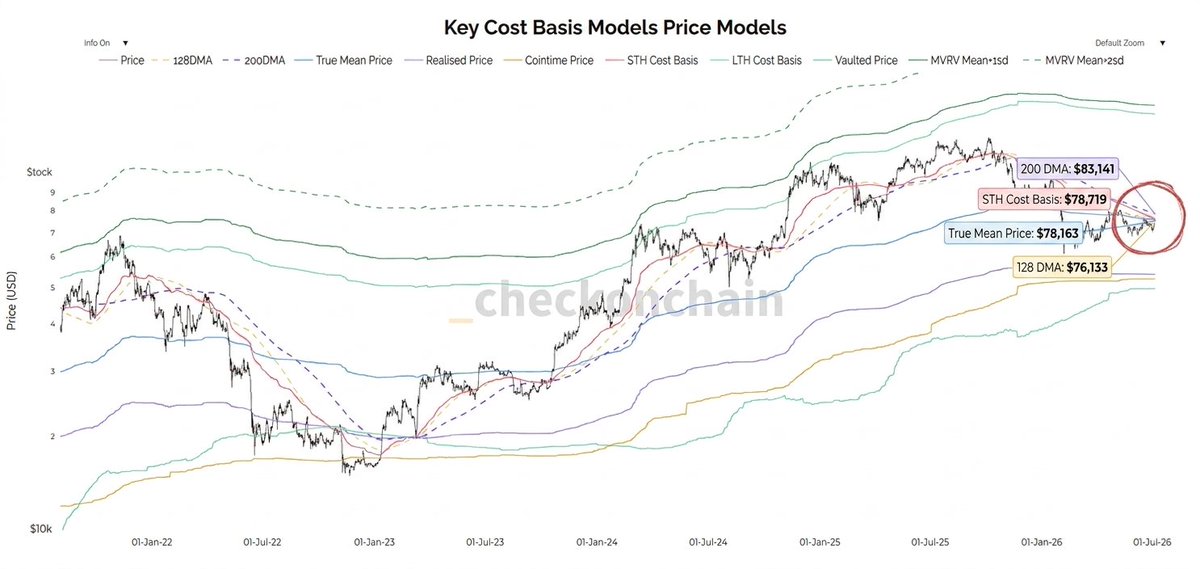
While BTC price has been sideways the last days, the 200 DMA is declining towards current levels. Now at $82,568. Down from $83,141 last Thursday. We almost got to that level in the overnight pump. Still holding the other key cost basis comfortably for now. Big week ahead with Warsh confirmation, CPI and PPI data, Trump visiting China, Clarity markup vote and more. Strap in
What I find so interesting is that the supply cluster between 83k - 85k that you mention is almost entirely Long-Term Holder Supply. Barely any STH Supply between here and 86k.
So the question is: How many LTH are willing to part ways with their Bitcoin at breakeven after holding for 155 days+ ... or are they demanding higher prices for holding through lower prices?
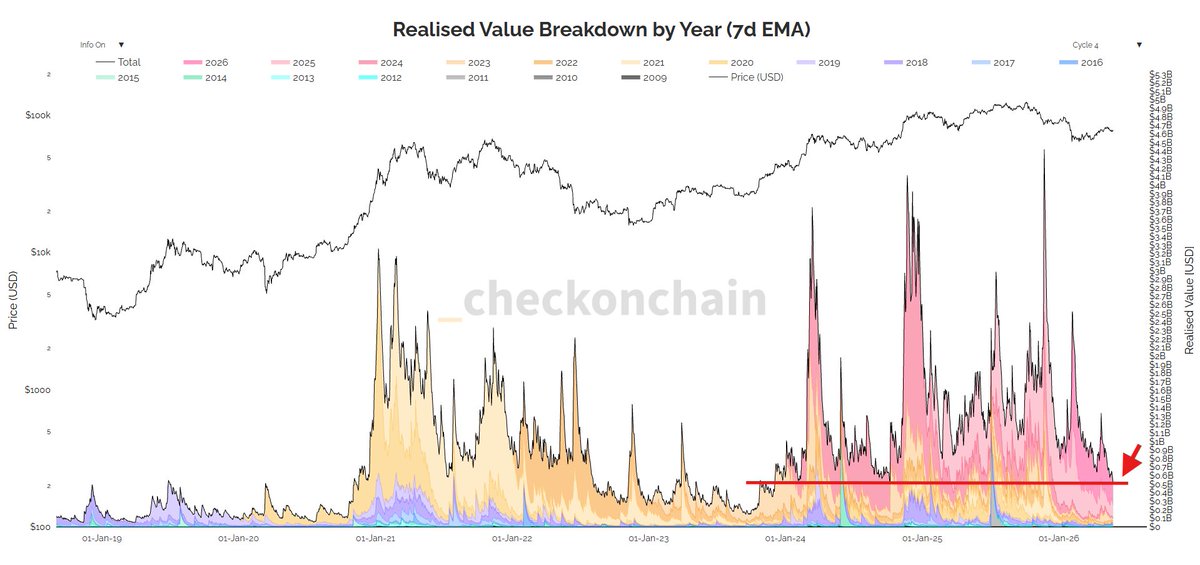
Good to watch the Realised Value for this and whether we see it spiking or continue to be muted.
But before we worry about this, let's make sure we hold the following as support for now:
- the 128 DMA at $76,133
- the True Mean Price at $78,163
- the Short Term Holder Cost Basis at $78,719
Charts: https://t.co/uSovY3Va6t
The business can grow while the token captures none of it.
Derive is built differently. They just dropped their B1. 93% disclosed.
This is what real token to protocol alignment looks like.
@btc_board you're right. There was a spike in realised value in late April when we touched $80k for the first time again. Since then realised value has declined again. Would be encouraging to see this metric stay subdued while prices grind higher
And we're back above par for STRC. Next ex-dividend date is May 15th. Let's see how much ATM activity we can see until then.
Source: @STRC_live / https://t.co/UNHCIF6L27
First time since April 15th we're seeing STRC trading back up to par and having some first volume above par. All eyes on US market hours whether Strategy is back to buying post their earnings release
Source: @STRC_live
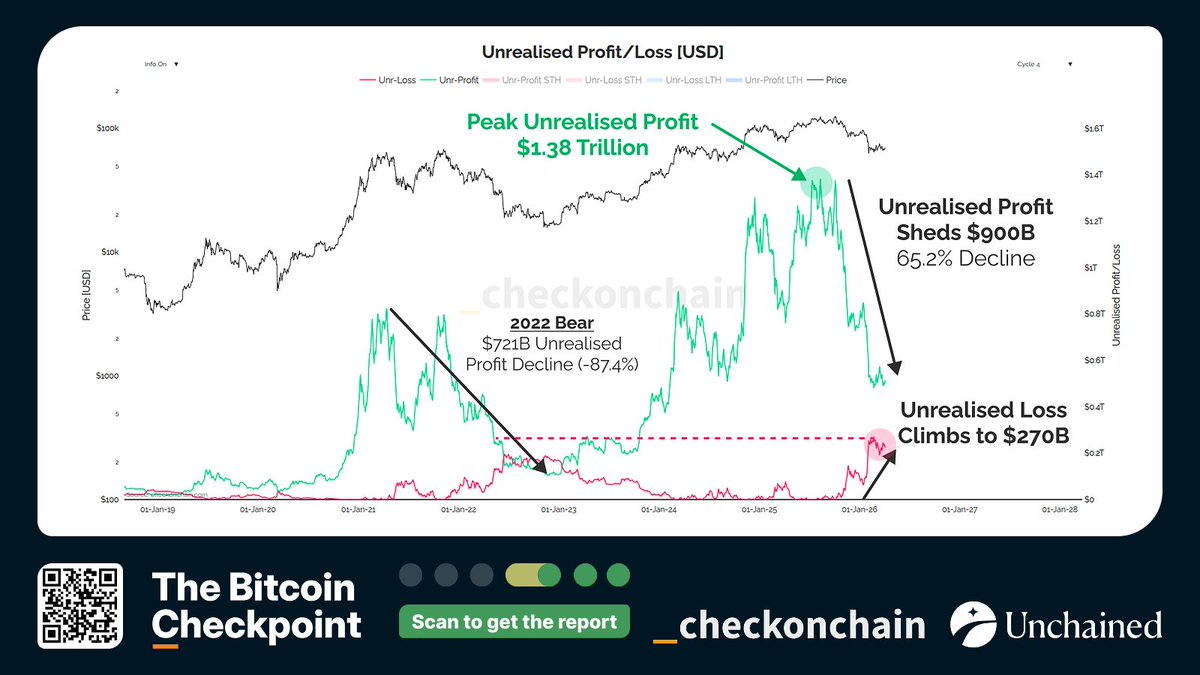
The deepest pain in Bitcoin bears often isn’t realised losses.
It’s watching enormous unrealised profits evaporate.
At the 2025 peak, Bitcoin investors collectively held $1.38T in unrealised profit.
By the Feb-2026 low:
• Unrealised losses hit a record $270B
• Unrealised profit had collapsed by ~$900B
That destruction of paper wealth is what drives fear, panic, and eventual capitulation.
The chart below tracks this shift in investor psychology in real time.
If you want to understand how this Bitcoin bear market actually unfolded beneath the surface, download The Bitcoin Checkpoint → https://t.co/Oa3FlKZrYa
I continue to believe that the impact of the Market Structure Bill potentially passing continues to be underpriced by the broader market.
While we have grown accustomed to a steady drumbeat of headlines from titans like Charles Schwab, Morgan Stanley, and BlackRock, there is a fundamental difference between the existence of institutional rails and actual inflows.
We now have the spot ETFs, the derivatives, and the wealth management access necessary for a massive shift, yet many investors are left wondering why these milestones haven't already propelled the market to new highs. To me, the answer lies in the psychological and fiduciary hurdles facing the world’s largest allocators.
From the perspective of a "Big Money" investor, administrative shifts from the SEC or CFTC are welcome but ultimately ephemeral. Most institution will not allocate in size if there is a lingering risk that a change in administration could rewrite the rules and jeopardize their capital.
This is why the Clarity Act is the ultimate catalyst. It transforms a favorable regulatory mood into a permanent legal reality, providing the safety net required for the next leg higher. Once this bill becomes law, the sidelined capital that has been waiting for a stable foundation will finally enter.
With the markup scheduled for the coming days, I highly recommend following @EleanorTerrett for the most reliable updates as this legislation hopefully moves toward the finish line.