@paulg So your argument is that since the US already has many subpar natives, there is no real need to be selective on who is allowed to come in?
I am honestly trying to understand the reasoning here.
@G_S_Bhogal@earthgzr@waitbutwhy Basic math or not, millions (billions?) would choose blue no matter what. By choosing red you say -It’s OK for them to die, as long as I survive; it was their choice after all.
One could imagine a misanthropic ASI imposing such twisted dilemmas on humanity to cull the population
@G_S_Bhogal@waitbutwhy Red: You survive, but a significant percentage of the population that thinks differently than you doesn’t, and you’re OK with contributing to that.
Blue: You survive in a world with everyone else in it.
Which of the two worlds would be better? That’s the personal test question.
Grievance is an efficient solvent for restraint, because it lets you act badly while feeling righteous doing it. A dangerous combo. Another issue is that it's easy for us to fool ourselves, as Feynman said. You stop measuring your behaviour against your own standards and start measuring it against the worst thing the people you resent did recently, which means the lower limit of your ethical downfall is now being set by the people you claim to be better than.
Practically, the only rigorously proven things you can do for life extension right now are:
- Don't be fat
- Be fit
- Control your blood sugar
- Control your blood pressure
- Have low cholesterol
- Don't poison yourself
Almost everything else is speculative and dubious.
People tend to optimize for feeling productive instead of actually moving the needle. The real flex is knowing which 3 things actually matter this week and having the spine to ignore everything else.
Fun fact:
Sugar consumption only became associated with bad outcomes after healthy people started taking the government's advice to avoid sugar.
The harm signal is a result of selection based on differential uptake of the belief that sugar is bad!
And delusions like this are common
People want to trick themselves, by whatever means, into thinking that things they dislike are harmful, and they will confabulate contrived mechanistic stories to support their beliefs
And they won't let the trial-observed reality check them
Project Hail Mary writer Andy Weir on social commentary in books:
"I dislike social commentary. Like… I really hate it. When I’m reading a book, I just want to be entertained, not preached at by the author. Plus, it ruins the wonder of the story if I know the author has a political or social axe to grind. I no longer speculate about all possible outcomes of the story because I know for a fact that the universe of that book will conspire to ensure that the author’s political agenda is validated. I hate that."
"I put no politics or social commentary into my stories at all. Anyone who thinks they see something like that is reading it in on their own. I have no point to make, and I’m not trying to affect the reader’s opinion on anything. My sole job is to entertain, and I stick to that."
"To that end, I also don’t talk about my personal political opinions publicly. I don’t want readers to even know, honestly. I don’t want that in the back of their minds as they read my stuff."
Is this why he has the #1 sci-fi movie in decades?
The Brass Law: The more social programs are designed to change individuals, the more likely the net impact will be zero.
The Stainless Steel Law: The better designed the impact assessment of a social program, the more likely is the net impact to be zero.
https://t.co/f4qh1J1Kio
Arguing that Elon Musk’s success is due to “narrative control”, luck, or riding others coattails is such an implausible claim that it functions as a useful litmus test for a persons analytical judgment.
This isnt about whether you like Elon Musk. I don’t know him, and I am largely agnostic about him as a person. But I do know his record as a CEO, and studying management and business strategy has been a major part of my job for the past 20yrs. From that perspective I can tell you that Musk isn’t just a good CEO. He is one of the most effective CEOs of our generation.
When I hear people write off Elon’s achievements bc someone else started these companies, it is a clear tell that they don’t understand business. Ideas are a dime a dozen. They are not what makes a great CEO. Execution is. And part of execution is recognizing a good idea when you see one and understanding how to build something around it that actually works.
Tesla was months from bankruptcy when Musk took control. It’s now the company that forced every major automaker on earth to retool their entire product strategy. SpaceX was a startup that serious people in the aerospace industry dismissed as a fantasy. It now conducts more orbital launches than the rest of the world combined and has driven launch costs down by an order of magnitude. Starlink is on track to become one of the most consequential communications infrastructure projects in history. These aren’t narrative achievements. Theyre tangible businesses that work, at scale, in industries where failure is the default condition.
And there’s a consistent pattern where Elon has repeatedly looked crazy, and then been right. The people who called reusable rockets a dream watched a booster fly back and land itself. The people who said a mainstream consumer EV company was impossible watched Tesla restructure the global auto industry. This is a person who has repeatedly seen something others cant see yet, absorbs the ridicule, and then builds toward it anyway.
The PayPal criticism this author pushes is another perfect ex. Do you know how he became CEO? Elon identified the importance of network effects in the late 90s and realized he could take advantage of cheap capital during the internet bubble to pay users to join his network. He was labeled a lunatic. Losing money upfront to lock customers into your network is well understood now but it wasn’t back then. Confinity was forced to merge bc they couldn’t compete with it…and that’s based on Peter Thiel’s own account in Zero to One.
Elon was considered reckless at the time. But he was right.
And now we have people criticizing Musk’s Mars goal. But as Ben Thompson explained, Mars is the strategic North Star that forces you to radically confront the cost structure required to achieve it. Which leads you down the only path that actually scales, without settling for easier short-term solutions. If you’re serious about putting a city on Mars, full reusability is non-negotiable. And that engineering logic turns out to be what dramatically lowers launch costs. Which unlocks Starlink at scale. And Starlink creates the revenue flywheel that funds everything else. An Arianespace executive called reusability a dream in 2013 and said it was impossible. But the dream isnt the destination. It’s the constraint that forces you down the only engineering path that actually works. And it’s why SpaceX is a trillion company today.
You can write off one company as luck. You can write off two as fortunate timing. But at some point the sheer weight of success across different industries and challenges stops looking like coincidence and starts looking like a big flashing signal.
When someone executes repeatedly in industries where lack of execution destroys almost everyone else, the correct analytical move is to update your model. If you can’t see that Elon is a great CEO, then you’re just revealing the limits of your own analytical process.
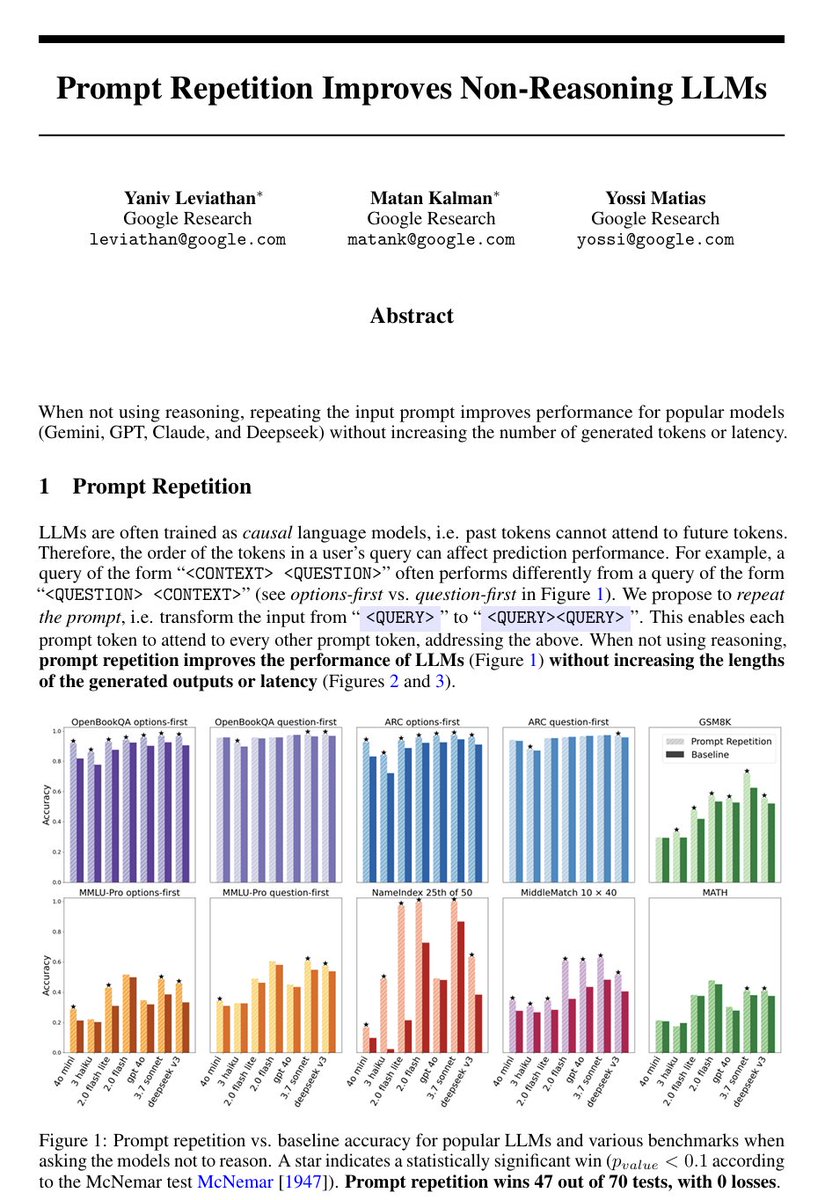
LLMs process text from left to right — each token can only look back at what came before it, never forward. This means that when you write a long prompt with context at the beginning and a question at the end, the model answers the question having "seen" the context, but the context tokens were generated without any awareness of what question was coming. This asymmetry is a basic structural property of how these models work.
The paper asks what happens if you just send the prompt twice in a row, so that every part of the input gets a second pass where it can attend to every other part. The answer is that accuracy goes up across seven different benchmarks and seven different models (from the Gemini, ChatGPT, Claude, and DeepSeek series of LLMs), with no increase in the length of the model's output and no meaningful increase in response time — because processing the input is done in parallel by the hardware anyway.
There are no new losses to compute, no finetuning, no clever prompt engineering beyond the repetition itself.
The gap between this technique and doing nothing is sometimes small, sometimes large (one model went from 21% to 97% on a task involving finding a name in a list). If you are thinking about how to get better results from these models without paying for longer outputs or slower responses, that's a fairly concrete and low-effort finding.
Read with AI tutor: https://t.co/MipHHO6rjX
Get the PDF: https://t.co/XQrqiaGwIO
When you talk about culture there is thin (fashion, food, music, etc.) and thick (what is the Good? What constitutes a fulfilling life? What is the highest human achievement?), and for the U.S., our thick culture is largely inherited from Western Europe, mostly England, and is best summarized as Careerist Protestant Christianity—a prosperity theology manifest as the American Dream, which synthesizes a moral order built on the Ten Commandments, overlaid with a heavy dose of Lockean individualism and Enlightenment rationalism.
Thin culture gets all the attention, but it is the thick culture that makes a nation and determines its long-term path.
"If AIs are all they’re cracked up to be … humans might end up not just subsisting, but thriving, on byproducts produced and discarded in microscopic quantities as part of the routine operations of infinitely smarter and more powerful AIs."
https://t.co/p3RnoJCj4U
Interesting thing about the lead-up to the '79 Iranian revolution was how stunning Iranian economic growth had been. Growth was around 11% per year for over a decade, right up until '77—per capita incomes grew almost 10-fold in 20 years, from $200 to $2,000.
The Shah did all the things liberal economists claim need to be done—modernization, land reform, educational reform, etc.—and the result?
Massive social disruption that emptied the villages and swelled cities with conservative peasants confused by new social structures, drawn by better opportunities, then absorbed into urban neighborhoods (including some slums) where traditional life had dissolved.
Confused, many found meaning and the order they wanted in a more rigorous faith that promised both authenticity and social justice. Faith, once again, as a conduit for nostalgia.
The Shah and his team (with strong ties to the U.S. consensus) couldn't believe any of this was happening.
He'd given his country wealth, wealth, wealth, and modernization, so there was no way they could be unhappy. And yet...