How do Syrians assess their living conditions, government performance, and recent political developments? @philoteo is contributing to the
@SyriaTransition poll.
Read more: https://t.co/9NpYDZoHls
New poll conducted by @SyriaTransition shows economic hardship is widespread in Syria & the population is increasingly dissatisfied with government performance in providing public services, security and fighting rising prices
https://t.co/TLCNCxBrcZ
Back to No War, No Peace?
🔹The extension of the ceasefire for an undefined period – while a naval blockade remains in place against Iran – is widely viewed within Iranian debates as a highly unfavorable scenario.
🔹Some commentators even describe it as a worst-case outcome, as it effectively reverses Iran’s earlier strategy of attritional pressure and redirects it back onto Iran itself. In this situation, Iran is placed in a state of suspension – neither war nor peace – which Iranian leaders have explicitly sought to avoid since the outset of the conflict, preferring instead a decisive conclusion.
🔹From Tehran’s perspective, statements by Donald Trump and the current trajectory suggest that the shadow of war continues to loom over the country and its already strained economy.
🔹At the same time, the United States retains freedom of action, preserving the option to re-escalate militarily at a time of its choosing. This dynamic is further compounded by the ability of Israel to continue operating in a gray-zone environment.
🔹Taken together – economic pressure through blockade, strategic uncertainty, and continued low-intensity confrontation – this scenario is seen as gradually eroding Iran’s remaining strategic capacity. Over time, it could also intensify internal divisions among political factions, making crisis management more difficult for the leadership.
🔹In this reading, Trump’s extension of the ceasefire is not interpreted as a face-saving exit from the conflict, but rather as a recalibration of the war’s form and shape, which lowers costs for the United States while increasing them for Iran.
🔹This helps explain why Tehran may be reluctant to accept such an arrangement and could instead consider more assertive responses.
🔹Much will depend on whether the naval blockade is enforced in a substantive way or remains largely symbolic.
🔹A key potential trigger for renewed escalation would be any further interdiction or seizure of Iranian vessels. Such an incident could be framed by Iran as a violation of the ceasefire, potentially prompting a military response against U.S. naval forces and leading to a return to active conflict.
🔹From the perspective of some Iranian decision-makers, this may be seen as less costly than either yielding under pressure or remaining in a prolonged state of strategic limbo.
Jihadism in the Middle East: From hierarchical territorial control to dispersed local insurgency:
The main threat is now decentralised jihadi insurgencies in fragile settings;
| Matteo Colombo https://t.co/hvulCOre6V Dschihadismus,Mittlerer Osten
What is the current state of jihadism? and how has it evolved in recent years? In my latest publication for @Clingendaelorg , I explore how this global phenomenon is changing:
https://t.co/mztENPR4CT
#Iran War Update No. 34 (focus on Iranian strategic narrative):
🔹Iran’s messaging is shifting more clearly toward infrastructure-centric warfare. In both official and semi-official narratives, the emphasis is no longer limited to retaliation against military targets, but increasingly on demonstrating that attacks on Iran’s bridges, industry, and civilian infrastructure will be met with comparable pressure on the broader U.S.-aligned regional system.
🔹In this sense, Tehran is increasingly framing the war as a contest over regional connectivity rather than battlefield attrition alone. The strategic logic is to signal that the cost of sustained pressure on Iran will not only trigger responses against Israel or U.S. assets and interests in the region, but also against Gulf logistics, data infrastructure, and broader commercial/economic confidence. In other words, the underlying logic is that either all sides endure together, or all face collective ruin.
🔹The Strait of Hormuz remains the central lever, but Iran’s tone suggests ambitions beyond a temporary blockade. Iranian officials are increasingly raising the idea of closure with discussions of postwar protocols and long-term exclusion rules, including potential arrangements with Oman to establish a new legal regime governing the strait.
🔹This is strategically significant because it raises the political cost of de-escalation for Tehran. The more Iran frames Hormuz as a space where wartime sacrifice can be translated into lasting leverage, the more difficult it becomes to reopen the waterway without visible concessions from the opposing side.
🔹Trump’s recent speech was intended to project control over escalation and an endgame trajectory, but Iran has interpreted it in the opposite way. The combination of maximalist threats, the absence of a clear political endpoint, and the lack of a practical plan for reopening Hormuz allows Tehran to portray Washington not as dominant, but as strategically incoherent.
🔹This interpretation helps Iran justify continued escalation without appearing cornered. In Tehran’s framing, U.S. threats are no longer seen as evidence that deterrence has failed, but rather as an indication that Washington is relying on brute pressure due to the absence of a viable exit strategy. Within this framework, attacks on purely civilian infrastructure – such as bridges and pharmaceutical companies – are portrayed as signs of strategic desperation on Trump’s part.
🔹At the same time, Iran has, for the first time, threatened that it may target Israel’s nuclear facilities in response to U.S. and Israeli attacks. Iran’s deputy foreign minister on legal and international affairs stated that if strikes against Iranian infrastructure continue, “the most important option of the Islamic Republic of Iran” would be to target Israel’s nuclear facilities.
🔹This signals a lowering of Iran’s tolerance threshold in response to the attritional infrastructure warfare it has faced in recent days, particularly as Trump’s recent threats suggest the possibility of further escalation. In effect, Iran’s message is that the continuation of such a trajectory is functionally indistinguishable from a nuclear attack and could therefore provoke a response against Israel’s nuclear infrastructure.
🔹On Lebanon, recent developments point to a more entrenched conflict rather than a limited escalation. While Beirut warns that there is no end in sight and Israeli operations appear increasingly oriented toward establishing a longer-term security zone, Hezbollah’s continued strike tempo serves Tehran’s interests by tying Israel down in a costly, open-ended confrontation.
🔹The strategic value of Lebanon for Iran now lies less in decisive escalation and more in its attritional function, particularly if Israel’s northern campaign continues to shift from punitive strikes toward prolonged territorial control.
🔹In Iraq, airstrikes on PMF positions in Nineveh and warnings of potential militia attacks in Baghdad show that Iraq remains a more unpredictable front, where pressure on U.S. interests can increase without Tehran needing to foreground it publicly.
🔹This ambiguity serves Iran’s interests by preserving deniability while keeping the Iraq-Jordan-Syria corridor unstable. The message is that even if the primary theater remains Iran, Washington cannot assume that its regional military footprint is insulated from dispersed retaliation.
🔹Yemen has also become more politically salient. While Houthi attacks themselves are not new, increasingly explicit claims of coordination with Iran and Hezbollah suggest a shift from symbolic solidarity toward a more openly articulated multi-front alignment.
🔹Even where actual command-and-control remains uneven, the signaling effect is significant. Tehran benefits from Yemen being perceived not as an isolated auxiliary front, but as part of a broader escalation architecture that stretches Israeli defenses and underscores that maritime insecurity is not confined to the Strait of Hormuz.
🔹At a different level, international reactions highlight the limits of support for Washington’s preferred response. European reluctance to reopen Hormuz by force or to even allow the U.S. to use their territory for supporting its Iran operations reinforces Iran’s belief that leveraging global economic pressure can generate coalition-management challenges for the United States more rapidly than Washington can generate sufficient pressure to compel Iranian capitulation.
🔹The spike in oil prices underscores this dynamic. With Brent rising above $109 and WTI above $111 following Trump’s remarks, Tehran can credibly argue that the economic burden of the war is increasingly being externalized, reinforcing its view that time and market disruption remain among its most effective strategic tools.
🔹Overall, Day 34 was less about a singular dramatic military shift than about the articulation of a clearer Iranian theory of victory. Tehran used the moment to argue that it can withstand direct strikes, expand the target set to the region’s economic and infrastructural backbone, and shape the conflict around connectivity, cost imposition, and coalition strain, rather than purely tactical destruction.
#Egypt is set to import at least 1 million barrels a month of Libyan oil to compensate for a halt in Kuwaiti crude supplies caused by the effective closure of the Strait of Hormuz.
The agreement follows a request by the state-run Egyptian General Petroleum Corp. to Libya’s National Oil Corp., according to people with knowledge of the situation.
OPEC member Libya will now send two cargoes totaling 1.2 million barrels each month to its eastern neighbor,. #oott https://t.co/KW7b5WcaTe
The Iranian theory of the war boils down to "everyone else has a lot more to lose than we do".
A question that should follow: what if that's true, but it doesn't end up mattering on a timetable that's helpful to the regime?
There's a scenario in which the world staggers out of this with a prolonged energy crisis that does enormous damage to the global economy *and* things end very, very badly for the regime and Iran as a whole.
Is Khamenei dead? What will come next?
🔹Donald Trump has announced on social media that #Khamenei is dead, while simultaneously stating that US attacks against #Iran will continue for the time being.
🔹Iranian state media has dismissed the announcement as deception, arguing that it may be part of a broader psychological or intelligence operation. One interpretation circulating is that the claim was meant to flush out Khamenei’s real location and complete an assassination attempt.
🔹Another interpretation sees this as psychological warfare, encouraging Iranians to believe the regime’s leadership has collapsed, potentially pushing people into the streets while undermining morale within the armed forces.
🔹Reports also indicate that several senior officials, including figures such as Shamkhani and other high-ranking decision-makers, may have been eliminated. The status of multiple senior figures remains unclear, adding to the atmosphere of ambiguity.
🔹If Khamenei has indeed been killed, one striking development is that Iranian missile operations have continued in sustained and increasingly intense waves. This suggests that decentralized command-and-control mechanisms are functioning, at least for now.
🔹The continuation of military responses indicates that the Islamic Republic’s institutional structure remains operational even amid leadership uncertainty. Decision-making authority may already be distributed among surviving elites.
🔹Reports suggest that Ali Larijani, secretary of the Supreme National Security Council, remains alive and could be coordinating elements of Iran’s response if a leadership vacuum has emerged.
🔹The key question now is succession and regime stability. Outcomes will depend heavily on which senior figures remain alive and capable of consolidating authority inside the regime.
🔹Speculation is growing around potential power centers. Political figures such as Rouhani, alongside security establishment actors like Ghalibaf, who may attempt to shape a post-Khamenei order – if they remain alive, of course.
🔹A regime transformation scenario would likely emerge from elite bargaining within the system.
🔹Regime change, however, would require large-scale public mobilization on the ground – something unlikely unless people are convinced that Khamenei is definitively dead and that the regime is too weakened to suppress protests as it did during the January 8-9 crackdowns.
🔹The regime appears aware of this risk. Basij forces have reportedly been deployed across districts in Tehran and other cities to deter and suppress potential unrest before it can materialize.
🔹The situation remains highly fluid. Even if Khamenei is confirmed dead, Iran’s trajectory could still range from controlled succession, to internal power struggle, to gradual state erosion. For now, uncertainty defines the moment.
The first hours of the current strikes against #Iran already show important differences from the 12-Day War; in timing, objectives, coordination, and the scale of escalation.
What we know so far:
🔹The attacks began with explosions reported across Tehran. Early reports indicated ~30 targets in the first wave, including leadership residences, intelligence facilities, and reportedly even the Supreme Leader’s office.
🔹Unlike the 12-Day War, which began with nighttime strikes, this operation started early in the morning, on the first day of Iran’s calendar week. The timing suggests an attempt to maximize operational disruption and leadership exposure from the outset.
🔹Target selection points to a decapitation strategy. Initial strikes appear aimed at leadership nodes and Iran’s security apparatus rather than purely military infrastructure.
🔹U.S. involvement marks a major shift. This time, Washington appears directly engaged from the beginning, with American officials reportedly describing the campaign as extensive and closely coordinated with Israel.
🔹Donald Trump framed the operation as defending Americans and removing immediate threats, but his remarks supporting the Iranian people against the regime strongly suggest regime change is an underlying objective.
🔹The operational concept appears phased: early missile strikes targeting leadership and air defenses, including sites in southern Iran such as Chabahar, likely intended to clear the way for later air force operations against missile bases and strategic assets.
🔹Iran’s response has been unusually rapid. Missile launches reportedly began within a couple of hours, with reported strikes in Tel Aviv and Haifa. The Iranian statements signaled that no “red lines” remain and that full-force retaliation is underway.
🔹This suggests predelegated response authority: rather than waiting for centralized coordination, Iranian forces appear instructed to maintain continuous firepower against Israel from the outset.
🔹Another key difference: Iran has already expanded the confrontation beyond Israel. Reports of explosions in GCC states indicate strikes targeting U.S. bases, signaling direct confrontation with Washington from the start.
🔹This contrasts sharply with June 2025, when Iran’s strike on Al Udeid in Qatar was largely symbolic and designed to facilitate de-escalation before a ceasefire.
🔹Meanwhile, Yemen’s Houthis have announced renewed attacks in the Red Sea, meaning the conflict has already begun evolving into a multi-front regional confrontation.
🔹Overall, the early pattern suggests a far more coordinated, expansive, and escalatory conflict than the 12-Day War, with regime decapitation, direct U.S. participation, rapid Iranian retaliation, and immediate regional spillover.
🔹The key question now: whether escalation stabilizes into controlled exchanges or whether the removal of previous “red lines” pushes the conflict into a prolonged regional war.
I am happy to have contributed to Syria In Transition poll. While the polling is currently geographically limited to Homs, Damascus and its surrondings, it offers some valuable insights:
https://t.co/qcsuCCweXK
Nuova stretta di #Israele sulla #Cisgiordania. ONG e osservatori denunciano “un'annessione di fatto” che svuota gli accordi di Oslo e rende impossibile l’ipotesi stessa di uno #StatoPalestinese.
#ISPIDailyFocus: https://t.co/11FhCKEjlf
Major #Saudi investment deals for #Syria announced in #Damascus today:
- Water desalination plant
- #Aleppo Airport expansion (+ new airport)
- Silk Link fiber optic telecoms
- New regional airlines
- 45 development projects
#Saudi has committed $10.5bn of investment in #Syria.
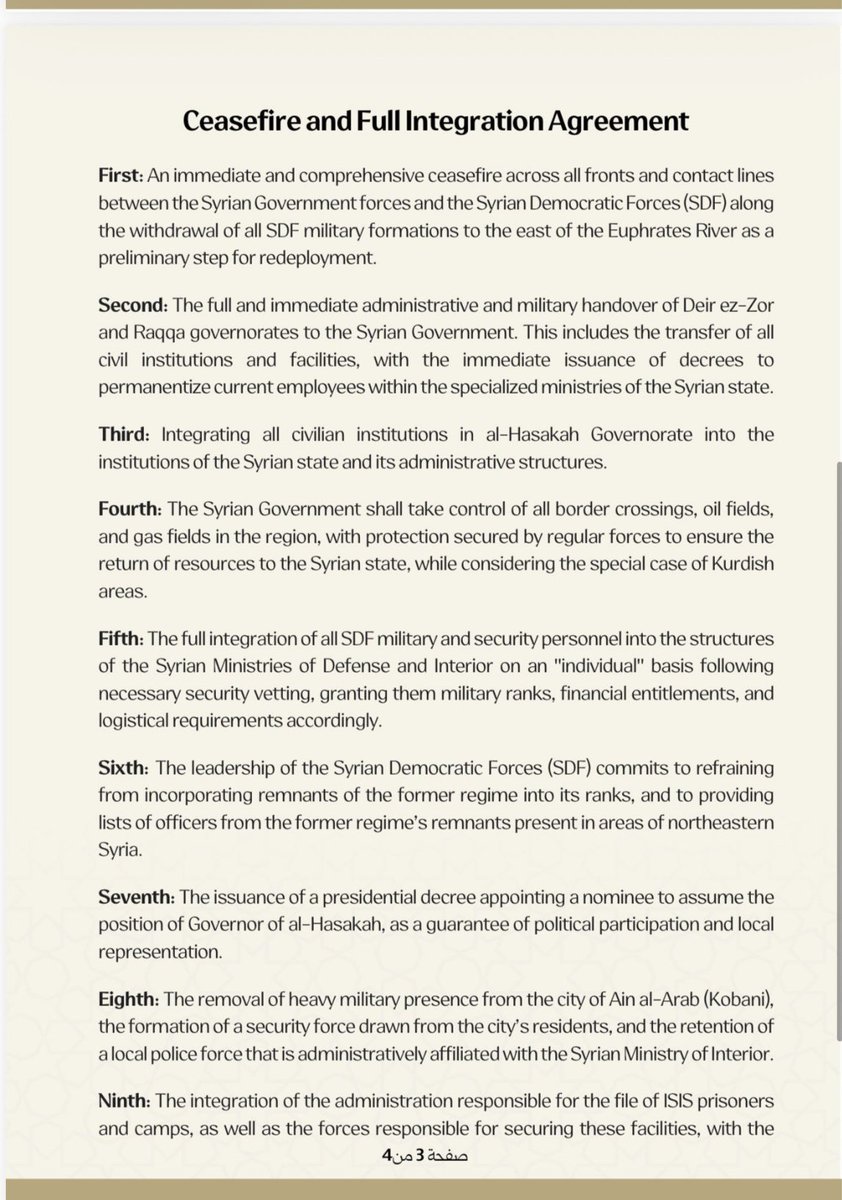
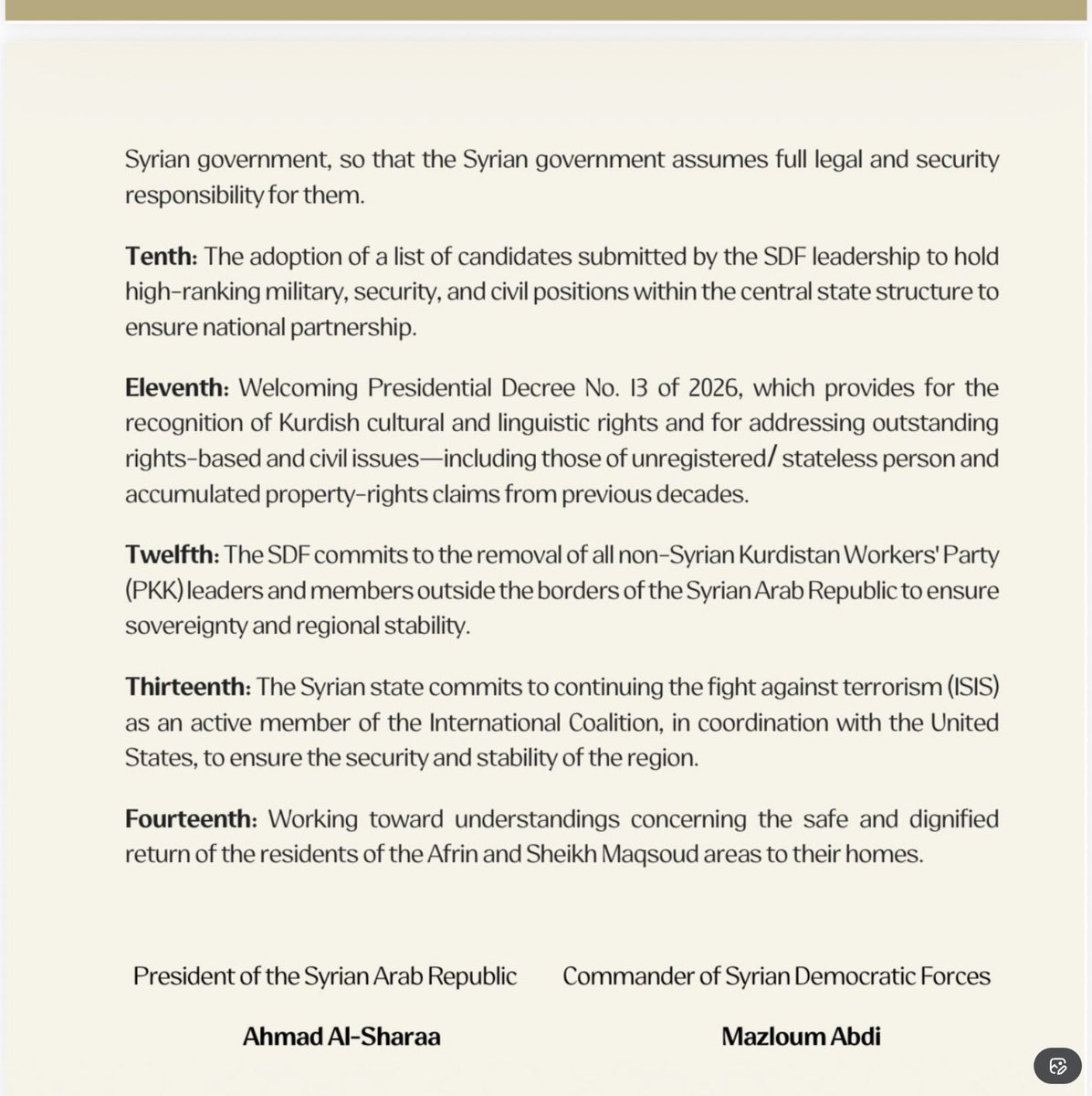
NEW -- Here's the comprehensive integration deal now in place in #Syria -- in Arabic & English.
#SDF fighters are to be integrated as individuals, not entire Divisions; a major change since the deal agreed in-person in October 2025.
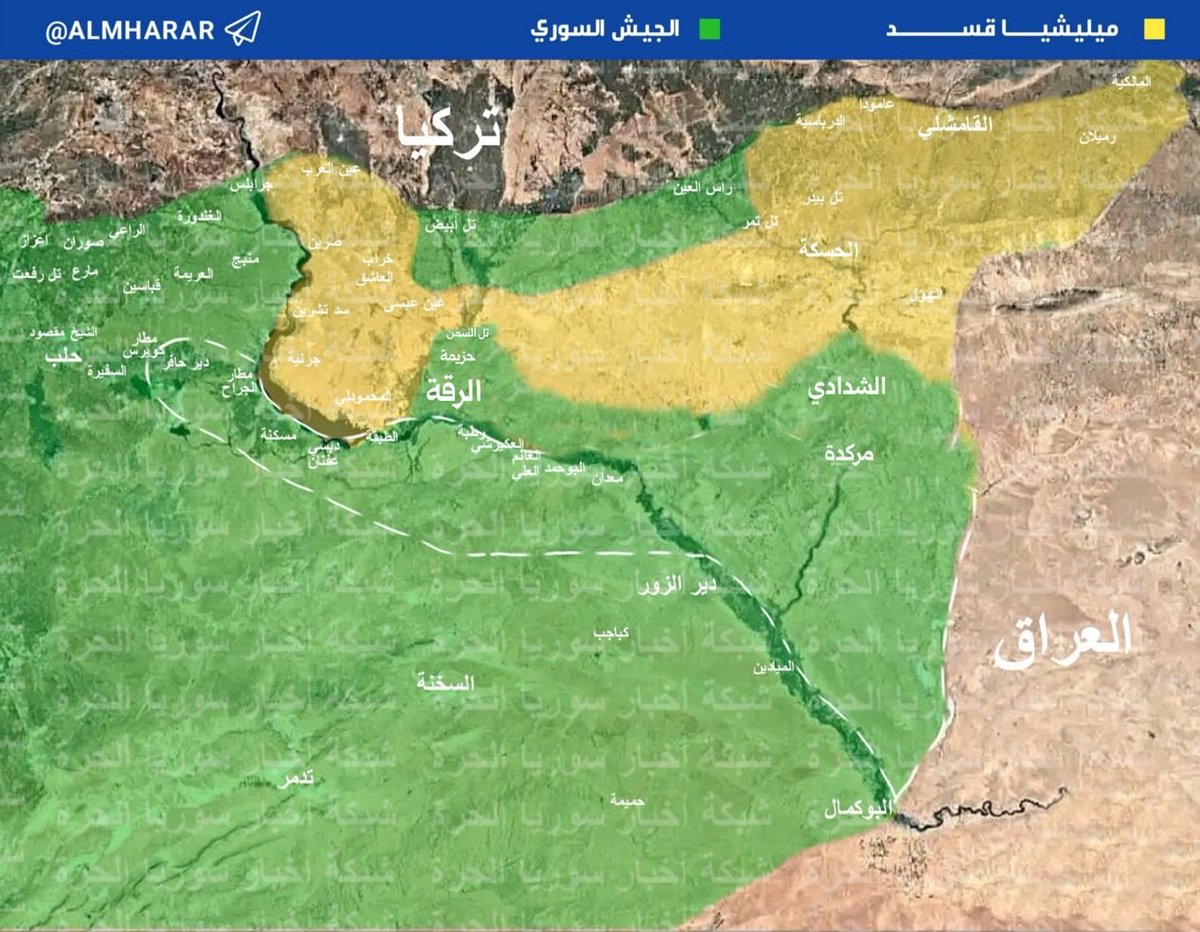
More rapid, consequential developments in NE #Syria overnight, as the #SDF appears to have lost #Raqqa city & all of Deir ez Zour to local tribal revolts.
The map change over 48hrs says a lot. #SDF is melting away from Arab majority areas, fast.
With mass protests erupting amid a backdrop of Israeli threats and US intervention in Venezuela, the Iranian regime views the crisis as an existential threat
From @The_NewArab’s Analysis Desk, featuring comments from @HamidRezaAz ⬇️
https://t.co/pW2OF9dAsl
Nelle ultime settimane ho avuto l’opportunità di condividere alcune riflessioni sulla Siria in diversi contesti di analisi e approfondimento.
🎙️ Su Globally, il podcast di @ispionline;
https://t.co/uo5ohbYbvj